Zigbee Smart Plugs vs WiFi: Which Fits Better?
Choosing between Zigbee smart plugs and WiFi models can directly affect device stability, energy efficiency, scalability, and long-term operating cost. For buyers, engineers, and channel partners comparing smart electronics solutions alongside categories like usb c docking stations, this guide explains the real-world differences in connectivity, security, automation performance, and deployment fit—helping you identify which option better supports your technical and commercial goals.
For most buyers, the short answer is this: WiFi smart plugs are usually better for simple, low-volume deployments and consumer-friendly setup, while Zigbee smart plugs are often the stronger choice for larger, automation-heavy, and more stable smart environments. If you only need a few plugs in a home office, showroom, or light commercial space, WiFi may be enough. If you need reliable device-to-device communication, lower network congestion, and better scalability across many endpoints, Zigbee often fits better.
The most important decision is not which technology sounds more advanced. It is which one matches your installation size, control requirements, security expectations, and maintenance model.
What matters most when comparing Zigbee smart plugs vs WiFi?
People searching for zigbee smart plugs vs WiFi are usually not looking for a basic definition. They want to know which option performs better in real use, which is easier to deploy, and which creates fewer problems over time.
For enterprise buyers, technical evaluators, distributors, and project managers, the key questions are typically:
- Will the connection stay stable when device counts grow?
- What hardware is required for setup and operation?
- How do the two options affect power consumption and network load?
- Which one is more suitable for automation routines and low-latency response?
- What are the security and failure risks?
- Which choice makes more sense commercially over the full lifecycle?
That is why the most useful comparison is not feature-for-feature marketing language. It is an operational comparison based on deployment reality.
How Zigbee and WiFi smart plugs work in practice
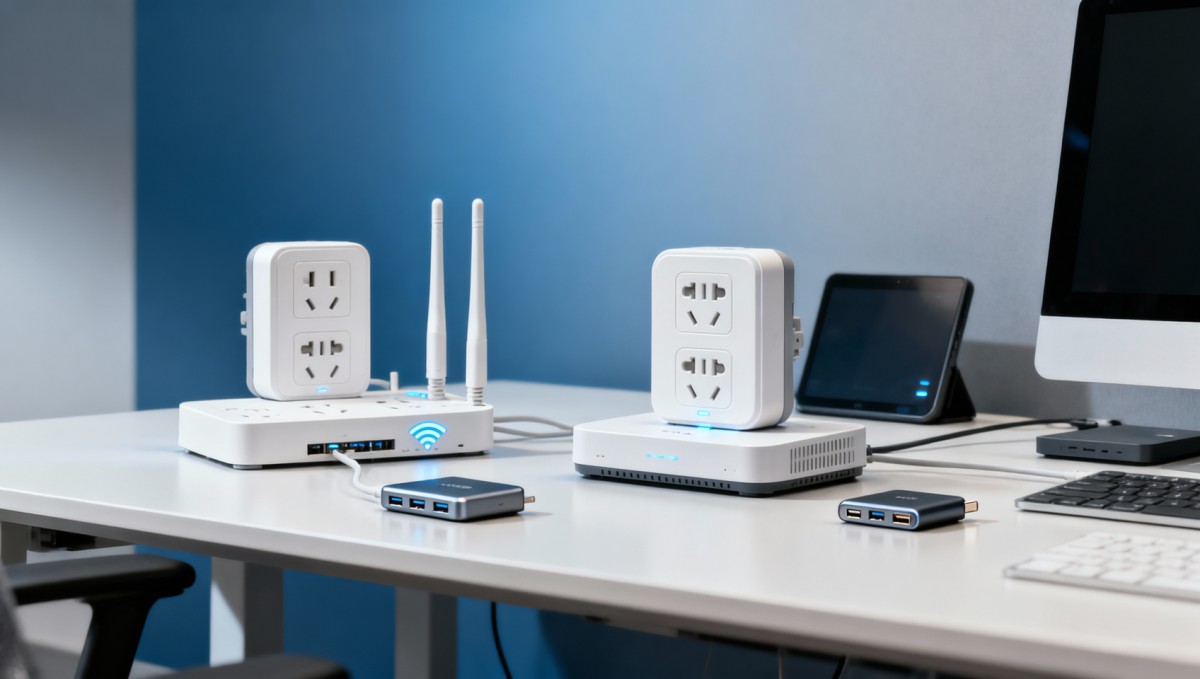
A WiFi smart plug connects directly to your local wireless router. In many cases, it also connects to a vendor app or cloud platform. This makes setup straightforward because there is no separate hub in many product ecosystems.
A Zigbee smart plug communicates over a low-power mesh network and typically requires a Zigbee hub, gateway, or compatible controller. Instead of every plug competing for router bandwidth, Zigbee devices can relay signals through the mesh, improving coverage and resilience in broader deployments.
In practical terms:
- WiFi smart plugs are often easier for small installations.
- Zigbee smart plugs are often more efficient and manageable in multi-device environments.
This difference becomes much more important when moving from a few devices to dozens of endpoints across offices, labs, retail spaces, hospitality sites, or pilot smart-building projects.
Which is better for stability and automation reliability?
If stability is a top priority, Zigbee often has the advantage in structured smart environments.
Why? Because Zigbee was designed for device coordination and automation. It supports low-power communication and mesh networking, which helps maintain consistent responsiveness when many compatible devices work together. In scenes such as occupancy-based automation, scheduled energy control, or synchronized device routines, Zigbee commonly delivers more predictable performance.
WiFi smart plugs can still work very well, especially with strong router coverage and limited device counts. But WiFi networks often carry traffic from laptops, phones, cameras, printers, tablets, usb c docking stations, and other connected hardware. As network activity increases, smart plug response can become less consistent, particularly in lower-cost deployments with basic networking infrastructure.
Best fit by reliability need:
- Zigbee: better for automation-heavy, multi-device, always-on ecosystems
- WiFi: suitable for straightforward remote on/off control with fewer devices
For engineering and operations teams, this means Zigbee can reduce troubleshooting risk in larger smart electronics rollouts.
What about setup complexity and deployment cost?
This is where WiFi often wins early, while Zigbee can win later.
WiFi smart plugs usually have lower entry friction. Users can often install them with an app, connect to an existing router, and start using them quickly. For small-scale deployments, this can reduce initial cost and training effort.
Zigbee smart plugs usually require a hub or compatible gateway. That adds an extra hardware layer and may increase initial procurement cost. For a very small project, this can make Zigbee look less attractive.
However, total deployment economics can shift when scale increases. In larger installations, Zigbee may help reduce:
- router congestion
- power draw across connected endpoints
- connectivity instability caused by overloaded WiFi environments
- maintenance effort linked to fragmented device behavior
So the real cost question is not only “Which is cheaper to buy?” but “Which is cheaper to operate and support over time?”
For finance approvers and commercial decision-makers, that distinction matters. A slightly higher upfront ecosystem cost can be justified if it lowers service calls, downtime, and replacement risk.
How do Zigbee and WiFi compare on energy efficiency?
Zigbee is generally more energy efficient than WiFi. That is one of its core strengths.
Because Zigbee uses low-power communication protocols, it is well suited for smart home and smart building devices that need to remain connected continuously without placing a larger energy burden on the network. This matters even more in broader IoT environments where many devices operate together.
For smart plugs themselves, the energy consumption difference per unit may not always be dramatic enough to drive the entire business case. But across many devices, low-power networking can contribute to better system efficiency and less communications overhead.
WiFi smart plugs, by contrast, rely on a more power-intensive communication standard. For individual, low-volume use, this may be acceptable. But for organizations evaluating scale, Zigbee’s efficiency profile is often more attractive.
Which option is more secure?
Security depends on product quality, configuration discipline, firmware support, and the broader network architecture. Still, there are some meaningful differences.
WiFi smart plugs are often exposed to more common networking risks because they connect directly to the local network and frequently rely on vendor cloud services. If passwords, firmware updates, or router segmentation are poorly managed, risk can increase.
Zigbee smart plugs operate within a dedicated protocol environment and usually sit behind a hub or controller layer. That can reduce direct exposure, although it does not eliminate security concerns. Poorly configured hubs, unsupported firmware, or weak integration practices can still create vulnerabilities.
For technical assessment teams, the better question is not simply “Is Zigbee or WiFi more secure?” but:
- Does the vendor provide regular firmware updates?
- Is device identity and pairing handled securely?
- Can the environment be segmented and centrally managed?
- What happens if cloud access is interrupted?
- Is there a clear support lifecycle?
In higher-value deployments, governance and vendor reliability often matter more than the wireless label alone.
When should you choose WiFi smart plugs?
WiFi smart plugs are often the better fit if your priority is speed, simplicity, and low initial complexity.
Choose WiFi when:
- you only need a small number of smart plugs
- you already have a strong, stable wireless network
- you want direct setup without an additional hub
- the main use case is basic remote switching or scheduling
- the environment is residential, small office, demo space, or light commercial
They are also easier for some resellers and channel partners to position in entry-level projects because buyers often understand WiFi immediately and prefer fewer components.
For low-scale use, WiFi can offer acceptable performance with lower onboarding friction.
When should you choose Zigbee smart plugs?
Zigbee smart plugs are usually the better choice when your project depends on scalability, automation quality, and network efficiency.
Choose Zigbee when:
- you expect device counts to grow over time
- you need dependable automation response across multiple endpoints
- you want to reduce WiFi congestion in a device-dense environment
- you are building a broader smart electronics or IoT ecosystem
- you value low-power communications and mesh resilience
- you can support a hub-based architecture
For commercial integrators, facilities teams, and technical buyers, Zigbee often aligns better with structured deployments than ad hoc plug-by-plug expansion.
A practical decision framework for buyers, engineers, and distributors
If you are evaluating Zigbee smart plugs vs WiFi for procurement or project planning, use this simple framework:
- Count current and future devices.
If the number is small and likely to stay small, WiFi may be enough. If growth is expected, Zigbee deserves serious consideration. - Map the automation requirement.
If you only need app-based switching, WiFi works. If you need coordinated automation and more consistent low-latency control, Zigbee is usually stronger. - Check network conditions.
If the site already has heavy WiFi traffic from office hardware and smart electronics, adding many WiFi plugs may create avoidable strain. - Evaluate support capability.
If users want minimal setup and no hub management, WiFi may be operationally easier. If your team can manage a gateway ecosystem, Zigbee offers more long-term advantages. - Assess total cost, not just unit price.
Include maintenance, downtime risk, scalability, and replacement cycle in the comparison.
This helps move the decision from product preference to business-fit analysis.
Final verdict: Zigbee smart plugs vs WiFi
There is no single winner for every use case, but there is a clear pattern.
WiFi smart plugs fit better for small, simple, low-barrier deployments where direct connectivity and easy setup matter most.
Zigbee smart plugs fit better for larger, smarter, and more scalable environments where automation reliability, lower network strain, and long-term efficiency are more important.
For individual users or light commercial buyers, WiFi may be the practical choice. For enterprise evaluators, integrators, and channel partners planning repeatable smart electronics deployments, Zigbee often delivers the stronger long-term architecture.
In other words, the best choice depends less on the plug itself and more on the system you are trying to build.
Get weekly intelligence in your inbox.
No noise. No sponsored content. Pure intelligence.
 Apr 22, 2026China Leads Global Offshore Wind Installations for 5th YearChina Leads Global Offshore Wind Installations for 5th Year
 Apr 22, 2026China Launches National Mine Safety IoT Monitoring NetworkChina Launches National Mine Safety IoT Monitoring Network
 Apr 22, 2026Yinchuan Boiler Pure Water Solution Certified for Middle East ProjectsYinchuan Boiler Pure Water Solution Certified for Middle East Projects
 Apr 22, 2026China to Enforce Mandatory EV Battery Recycling Standards by 2026China to Enforce Mandatory EV Battery Recycling Standards by 2026
 Apr 22, 2026Vietnam Launches Anti-Circumvention Probe on Electronic ComponentsVietnam Launches Anti-Circumvention Probe on Electronic Components
 Apr 22, 20262026 Shanghai Fastener Show: Robotic Fasteners Drive Overseas Procurement2026 Shanghai Fastener Show: Robotic Fasteners Drive Overseas Procurement
 Apr 22, 2026US BIS Adds EV On-Board Charger Crypto Modules to EAR Appendix 7US BIS Adds EV On-Board Charger Crypto Modules to EAR Appendix 7
 Apr 22, 2026TÜV Rheinland Updates BESS Certification: Propagation Blocking Now MandatoryTÜV Rheinland Updates BESS Certification: Propagation Blocking Now Mandatory
 Apr 22, 2026Red Sea Crisis Escalates: Suez AI Speed Limits & Slot Review from Apr 19Red Sea Crisis Escalates: Suez AI Speed Limits & Slot Review from Apr 19
 Apr 22, 2026EU CBAM Carbon Tariff Takes Effect April 1, 2026EU CBAM Carbon Tariff Takes Effect April 1, 2026
 Apr 21, 2026When to Replace CT Scanner Parts Before Downtime StartsWhen to Replace CT Scanner Parts Before Downtime Starts
 Apr 21, 2026How to Cut Costs in Lathe Turning Without ReworkHow to Cut Costs in Lathe Turning Without Rework
 Apr 21, 2026Lathe Turning Tolerances: What Can You Expect?Lathe Turning Tolerances: What Can You Expect?
 Apr 21, 2026How to Avoid Risks in Solar Panels WholesaleHow to Avoid Risks in Solar Panels Wholesale
 Apr 21, 2026Solar Panels Wholesale: How to Compare SuppliersSolar Panels Wholesale: How to Compare Suppliers
 Apr 21, 2026Solar Mounting Cost Factors You Should KnowSolar Mounting Cost Factors You Should Know
 Apr 21, 2026Solar Mounting Options: Which One Fits Your Project?Solar Mounting Options: Which One Fits Your Project?
 Apr 21, 2026How to Pick USB C Docking Stations for Dual DisplaysHow to Pick USB C Docking Stations for Dual Displays
 Apr 21, 2026USB C Docking Stations: What Ports Do You Need?USB C Docking Stations: What Ports Do You Need?
 Apr 21, 2026What Affects Dental Milling Machine ROI in 2026?What Affects Dental Milling Machine ROI in 2026?
 Apr 21, 2026Dental Milling Machines: Wet or Dry for Your Lab?Dental Milling Machines: Wet or Dry for Your Lab?
 Apr 21, 2026How to Avoid Common Medical Refrigerator MistakesHow to Avoid Common Medical Refrigerator Mistakes
 Apr 21, 2026Medical Refrigerators: What Specs Matter Most?Medical Refrigerators: What Specs Matter Most?
 Apr 21, 2026Portable or Cart Vet Ultrasound: Which to Buy?Portable or Cart Vet Ultrasound: Which to Buy?
 Apr 21, 2026Vet Ultrasound Buying Guide for Small ClinicsVet Ultrasound Buying Guide for Small Clinics
 Apr 21, 2026Yard Management Systems: Key Features to CompareYard Management Systems: Key Features to Compare
 Apr 21, 2026How Yard Management Systems Improve Dock FlowHow Yard Management Systems Improve Dock Flow