Portable Power Station Costs: What Drives the Price Up?
Why do portable power stations vary so widely in price, even when specifications seem similar? From lithium ion batteries and solar battery compatibility to inverter quality, safety systems, and supply chain factors tied to sectors like wind turbine and smart electronics, real cost drivers run deeper than watt-hours alone. This guide helps buyers and evaluators understand what truly affects value, performance, and long-term ROI.
For B2B buyers, the price gap between two portable power stations can look irrational at first glance. A 1,000Wh unit may sell for under $500 in one channel and exceed $1,200 in another. Yet for procurement teams, project managers, safety officers, distributors, and technical evaluators, headline capacity is only one layer of the cost structure. Battery chemistry, cycle life, surge capability, thermal controls, certification scope, and supplier maturity all influence the final price.
That matters across multiple sectors. Construction sites need reliable field power. Healthcare technology teams may need silent backup for portable devices. Smart electronics distributors compare portability against inverter cleanliness. Green energy integrators examine solar input and battery expandability. In every case, the lowest purchase price does not always produce the lowest 3-year ownership cost.
The sections below break down the main cost drivers, the trade-offs behind common specifications, and the checkpoints that help enterprise buyers avoid underperforming systems or paying a premium for features they do not need.
Core Hardware: Why Battery, Inverter, and BMS Design Change the Price
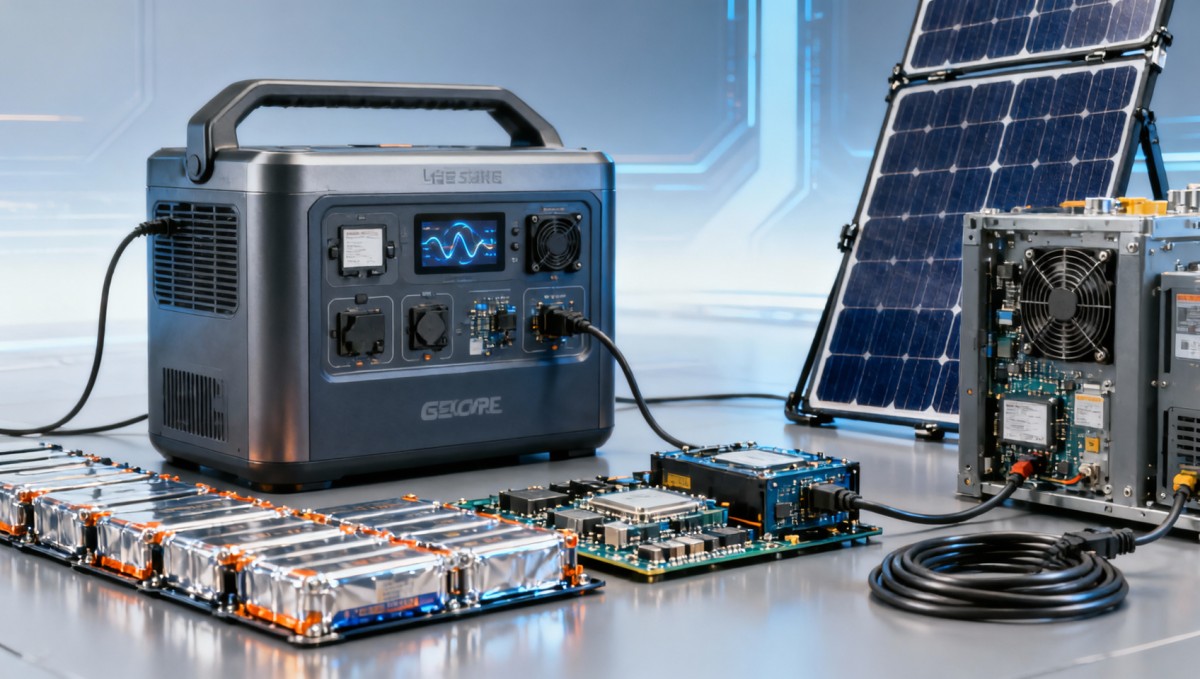
The biggest share of portable power station cost usually comes from the battery pack, often representing 35% to 55% of the total bill of materials. Two products with similar advertised watt-hours can differ sharply in price because their internal cell quality, pack design, and control electronics are not equivalent. A low-cost pack may deliver 500 to 800 cycles before significant degradation, while a premium lithium iron phosphate design may target 2,000 to 3,500 cycles under standard operating conditions.
Lithium ion chemistry also matters. NMC or similar chemistries may offer higher energy density and lighter weight, which is useful for mobile field use, but they can raise thermal management requirements. LFP packs are heavier at the same energy rating, yet they are often chosen for longer cycle life, lower thermal risk, and stronger suitability for frequent charge-discharge operation. For commercial users running 4 to 7 cycles per week, that chemistry decision directly affects replacement timing and lifecycle cost.
The inverter is another major price separator. A pure sine wave inverter with stable voltage regulation, lower total harmonic distortion, and higher surge capacity costs more than a basic implementation. This is critical when powering sensitive test instruments, telecom devices, healthcare peripherals, or smart electronics that react poorly to unstable output. A unit rated at 1,500W continuous with 3,000W surge is built very differently from one that can only tolerate brief overload at 1.2x capacity.
Battery management systems, or BMS, often receive too little attention in buyer discussions. A higher-grade BMS typically adds protections for over-voltage, under-voltage, short circuit, cell balancing, over-current, and thermal monitoring. More advanced designs may monitor multiple temperature points and trigger staged derating rather than abrupt shutdown. That increases component count and validation cost, but it also reduces field failure risk.
What buyers should compare beyond watt-hours
- Battery cycle life at 80% remaining capacity, such as 800, 2,000, or 3,000 cycles.
- Inverter waveform quality and continuous versus surge output, for example 1,000W continuous and 2,000W surge.
- BMS protection scope, including cell balancing, thermal cutoff, and short-circuit response.
- Operating temperature window, often around 0°C to 40°C for charging and -10°C to 45°C for discharge.
- Pack modularity and repairability, which influence post-warranty service cost.
The table below shows how internal architecture changes practical value, even when the published storage capacity appears close.
For technical and commercial evaluators, the takeaway is clear: portable power station costs rise not just because a seller adds margin, but because longer service life, cleaner power output, and more stable protection systems require better materials, testing, and engineering.
Charging Speed, Solar Compatibility, and Expandability as Price Multipliers
A second major driver is charging architecture. Fast AC charging, MPPT solar input, vehicle charging support, and dual charging modes all add hardware complexity. A system that recharges 80% in 1.5 to 2 hours generally needs more robust power electronics and thermal management than one that requires 6 to 8 hours. For field operations, that faster turnaround can improve asset utilization, but it rarely comes at entry-level pricing.
Solar battery compatibility is especially important for buyers in green energy, remote maintenance, temporary installations, and disaster readiness programs. Portable power stations that accept 12V to 60V or higher PV input ranges, integrate MPPT controllers, and support 200W to 1,000W of solar input typically cost more than units with simple DC charging. However, they also reduce dependence on grid charging and support decentralized power strategies.
Expandability changes the economics again. Some portable systems operate as closed units with fixed battery capacity, while others accept one, two, or more external battery modules. This is attractive for enterprise users with changing load profiles, such as project teams moving from 1-day site work to 3-day field deployments. The extra connectors, communication controls, firmware logic, and battery synchronization requirements all raise design and validation cost.
Port variety also matters. USB-C PD ports, regulated DC outputs, multiple AC sockets, RV connectors, or telecom-style outputs add convenience and integration flexibility. For distributors and resellers, those features broaden market appeal. For finance approvers, the key question is whether those ports improve actual operational fit or simply add consumer-facing features with limited return.
Typical charging and expansion considerations
- Define the recharge window required between shifts, such as under 2 hours, 4 hours, or overnight.
- Estimate renewable input needs, including whether 200W, 400W, or 800W solar charging is realistic in the operating environment.
- Confirm whether external battery packs are necessary within the next 12 to 24 months.
- Check connector durability if the unit will be transported daily or used in dusty outdoor settings.
The following comparison helps procurement teams map charging features to cost impact and deployment value.
In practical terms, buyers should pay more for fast charging and solar integration only when the operating model justifies it. A warehouse backup unit used twice a quarter does not need the same charging profile as a mobile service fleet cycling every day.
Safety, Certification, and Quality Control Costs That Buyers Should Welcome
Many price differences reflect invisible but necessary investments in safety. Portable power stations store substantial energy in compact enclosures, often between 300Wh and 3,000Wh in common mobile formats. When these products are shipped globally, deployed indoors, or operated near personnel, design shortcuts can create serious hazards. Better thermal isolation, flame-retardant materials, stronger busbars, and higher-grade connectors all increase cost but reduce operational risk.
Certification readiness is another cost layer. Depending on target markets and use cases, buyers may need products aligned with transport, electrical safety, electromagnetic compatibility, or battery shipping requirements. Even when sellers do not advertise every compliance detail, manufacturers that design for broader market acceptance usually invest more in testing, documentation, and process control. That cost is built into the final unit price.
Quality control also affects pricing in ways distributors and procurement teams can measure. Incoming cell matching, pack assembly verification, burn-in testing, and output validation each add labor and equipment expense. A factory performing 100% function tests and sampling-based thermal checks will normally have a higher factory gate price than one focused only on basic power-on inspection. Yet that difference can save weeks of claims handling and field replacement cost.
For safety managers and quality teams, the hidden cost of a cheap unit is downtime, not just replacement. A failed power station on a service route, temporary clinic setup, or remote instrumentation project can trigger schedule slippage, equipment exposure, and repeated logistics costs. In many B2B settings, one field failure can erase the savings from choosing the lowest bidder.
Four quality checkpoints before approval
1. Thermal and overload behavior
Confirm whether the unit derates safely under high ambient conditions, such as 35°C to 40°C, instead of shutting down unpredictably under moderate overload.
2. Battery traceability
Ask whether the pack uses matched cells with traceable batch records and whether cell balancing is validated during assembly.
3. Output stability for sensitive loads
Check AC output behavior for electronics, sensors, portable medical peripherals, and communications devices that cannot tolerate unstable power.
4. Service and claims handling
A 12- to 24-month warranty is only meaningful if the supplier has a documented response path, spare parts access, and realistic replacement timelines.
When portable power station costs look high relative to capacity alone, safety engineering and QA discipline are often the reason. For enterprise use, that premium is frequently justified.
Supply Chain, Materials, and Market Conditions Behind Price Volatility
Portable power station pricing is also shaped by external market forces. Battery cells, inverter components, semiconductors, aluminum housings, cooling fans, and display modules all move with global supply conditions. Buyers in adjacent sectors such as wind turbine systems, smart electronics, and advanced manufacturing compete for some of the same upstream materials and power components. When demand rises in those industries, portable energy storage products can see cost pressure even if end-user demand remains stable.
Freight and compliance costs matter too. Lithium battery shipping rules can increase documentation requirements, packaging standards, and route limitations. Depending on destination and transport mode, logistics can account for 5% to 15% of landed cost. For distributors managing multiple SKUs, the difference between shipping a 10kg unit and a 25kg unit is not trivial, especially when returns handling is included.
Manufacturing scale is another variable. A factory producing 50,000 units per quarter can spread tooling, testing fixtures, and firmware development across a larger base than a supplier building in smaller runs of 2,000 to 5,000 units. High-volume producers may offer better pricing on standard models, while niche or ruggedized models can remain expensive because demand is specialized and validation cost is spread over fewer shipments.
Procurement timing influences cost as well. Spot buying during peak seasonal demand often increases price and lengthens lead times. In contrast, forecast-based sourcing with a 60- to 90-day planning window may improve component allocation and reduce expedite premiums. For enterprise buyers, price is not only a technical issue but also a planning discipline.
Common supply-side cost drivers
- Cell material price swings affecting lithium-based battery packs.
- Power semiconductor availability for inverters, chargers, and MPPT controllers.
- Freight surcharges, dangerous goods packaging, and destination compliance handling.
- Exchange-rate movement for globally sourced components.
- Order volume and forecast accuracy, especially for OEM and distribution contracts.
The table below summarizes how supply-chain factors often change quoted pricing and delivery expectations.
This is why price benchmarking should never ignore sourcing context. Two similar products can carry different quotes simply because one supplier has stronger component contracts, better logistics planning, or more production scale.
How to Evaluate Real Value: A Practical Buying Framework for B2B Teams
The most effective way to assess portable power station costs is to shift from sticker price to use-case value. A purchasing team should start by defining runtime needs, load type, recharge frequency, and service environment. A 500Wh unit for occasional emergency lighting is a different procurement decision from a 2,000Wh unit supporting laptops, sensors, routers, tools, and battery chargers during daily field work.
A simple evaluation framework can reduce overbuying and underbuying. First, identify continuous load in watts and surge load where applicable. Second, estimate the required operating hours per shift. Third, determine recharge availability: grid only, vehicle charging, solar, or hybrid. Fourth, score risk factors such as indoor use, transport frequency, temperature exposure, and sensitivity of connected devices. These four steps are often enough to narrow the field.
Finance teams should then convert price into annualized value. If one unit costs 40% more but lasts 3 times longer in cycle terms, reduces downtime, and lowers replacement frequency, it may be the more economical choice over 24 to 36 months. This is especially relevant for fleet buyers, distributors building warranty reserves, and project owners managing total deployment cost rather than single-unit expenditure.
For channel partners, the right price point also depends on after-sales burden. Selling a very cheap unit into demanding applications can create returns, reputational risk, and support cost that exceed gross margin gains. In many B2B cases, a mid-tier or premium model is easier to support because it better matches end-user expectations.
Portable power station buying checklist
- Match capacity to real runtime, not marketing claims. A 1,000Wh unit will not always deliver 1,000Wh of usable AC output after conversion losses.
- Check inverter quality for sensitive devices and tool startup loads.
- Review cycle life if usage will exceed 100 to 150 cycles per year.
- Verify charging inputs and recharge time against actual operational windows.
- Assess safety controls, warranty support, and supplier responsiveness before approving volume orders.
FAQ for technical and commercial evaluators
How much capacity should a business buyer reserve above expected load?
A practical buffer is often 15% to 30%, depending on inverter losses, startup surge, and environmental conditions. If the load profile is uncertain or includes motors and compressors, a larger buffer may be prudent.
Is faster charging always worth paying for?
No. It is most valuable when the system cycles daily, supports back-to-back shifts, or must recover during short downtime windows. For occasional backup use, slower charging may be sufficient and more cost-efficient.
Are higher-priced units mainly branding?
Branding can influence retail price, but in B2B evaluation the larger cost differences usually come from battery quality, inverter design, protection systems, testing depth, and support capability.
What lead time should buyers expect?
For standard stock models, lead time may be 7 to 21 days. For private-label, higher-volume, or customized configurations, 4 to 10 weeks is a more realistic planning range depending on battery and electronics availability.
Portable power station costs rise for understandable reasons: better batteries, cleaner inverter output, stronger safety systems, faster charging, wider solar compatibility, more rigorous quality control, and more resilient supply chains. For B2B buyers, the right question is not “Which unit is cheapest?” but “Which unit delivers the best fit, reliability, and total return over its service life?”
If you are comparing suppliers, validating technical specifications, or building a sourcing strategy across green energy, smart electronics, advanced manufacturing, healthcare technology, or distribution channels, a structured evaluation can prevent costly mismatches. To explore more decision-ready insights, sourcing guidance, and market intelligence, connect with TradeNexus Pro and get a tailored view of the solutions that fit your operational and commercial priorities.
Get weekly intelligence in your inbox.
No noise. No sponsored content. Pure intelligence.
 Apr 25, 2026Vietnam Enforces CN-EN Bilingual Safety Labels on Electronic Components from Apr 22, 2026Vietnam Enforces CN-EN Bilingual Safety Labels on Electronic Components from Apr 22, 2026
 Apr 25, 2026ANATEL Mandates Portuguese Offline Voice Assistants for Smart Home Devices in BrazilANATEL Mandates Portuguese Offline Voice Assistants for Smart Home Devices in Brazil
 Apr 25, 2026India BIS Mandates IS 13252:2025 for PLCs & HMIs by Oct 2026India BIS Mandates IS 13252:2025 for PLCs & HMIs by Oct 2026
 Apr 25, 2026SASO EV Charger Rules: Grid Compatibility & Sand Resistance RequiredSASO EV Charger Rules: Grid Compatibility & Sand Resistance Required
 Apr 25, 2026JIS T 0011:2026 Enforces IEC 62366-1:2024 for Rehab Devices in JapanJIS T 0011:2026 Enforces IEC 62366-1:2024 for Rehab Devices in Japan
 Apr 25, 2026THE Alliance Cuts Ningbo–Rotterdam Transit to 18 Days, +35% Spot RateTHE Alliance Cuts Ningbo–Rotterdam Transit to 18 Days, +35% Spot Rate
 Apr 25, 2026TÜV Rheinland Updates IoT EMC Standard: AI Edge Module Immunity Now MandatoryTÜV Rheinland Updates IoT EMC Standard: AI Edge Module Immunity Now Mandatory
 Apr 25, 2026USTR Launches Five-Year China Solar PV AD/CVD ReviewUSTR Launches Five-Year China Solar PV AD/CVD Review
 Apr 25, 2026EU New Battery Regulation Enters Force Apr 24, 2026EU New Battery Regulation Enters Force Apr 24, 2026
 Apr 25, 2026China Customs Launches RCEP Origin Smart Pre-Review for ASEAN机电 ExportsChina Customs Launches RCEP Origin Smart Pre-Review for ASEAN机电 Exports
 Apr 24, 2026India BIS Mandates IS 13252:2025 for PLCs & HMIs by Oct 2026India BIS Mandates IS 13252:2025 for PLCs & HMIs by Oct 2026
 Apr 24, 2026SASO EV Charger Regulation: Sand-Resistant Grid Compatibility Testing RequiredSASO EV Charger Regulation: Sand-Resistant Grid Compatibility Testing Required
 Apr 24, 2026Japan Updates JIS for Rehab Devices: IEC 62366-1:2024 Usability Compliance RequiredJapan Updates JIS for Rehab Devices: IEC 62366-1:2024 Usability Compliance Required
 Apr 24, 2026China Customs Launches RCEP Origin Smart Pre-Review SystemChina Customs Launches RCEP Origin Smart Pre-Review System
 Apr 24, 2026ANATEL Mandates Localized Voice Assistants for Smart Home Devices in BrazilANATEL Mandates Localized Voice Assistants for Smart Home Devices in Brazil
 Apr 24, 2026TÜV Rheinland Updates IoT EMC Standard with AI Edge抗扰度 RequirementTÜV Rheinland Updates IoT EMC Standard with AI Edge抗扰度 Requirement
 Apr 24, 20262M Alliance Shortens Ningbo–Rotterdam Route to 18 Days Amid 35% Slot Premium2M Alliance Shortens Ningbo–Rotterdam Route to 18 Days Amid 35% Slot Premium
 Apr 24, 2026Vietnam Enforces Bilingual Safety Labels for Imported Electronic Components from Apr 22, 2026Vietnam Enforces Bilingual Safety Labels for Imported Electronic Components from Apr 22, 2026
 Apr 24, 2026USTR Launches Sunset Review on China Solar PV AD/CVD DutiesUSTR Launches Sunset Review on China Solar PV AD/CVD Duties
 Apr 24, 2026EU New Battery Regulation Fully Effective Apr 24, 2026EU New Battery Regulation Fully Effective Apr 24, 2026
 Apr 23, 2026Taobao Factory Spark 3.0 Launches AI Workbench for SME Export FactoriesTaobao Factory Spark 3.0 Launches AI Workbench for SME Export Factories
 Apr 23, 2026TENENG Group Inspects IoT Safety Compliance at Jiangnan ChemicalTENENG Group Inspects IoT Safety Compliance at Jiangnan Chemical
 Apr 23, 2026China Launches First Embodied AI Open Data CommunityChina Launches First Embodied AI Open Data Community
 Apr 23, 2026PV Glass Prices Flat for 9 Weeks Amid Rising Integrated ProcurementPV Glass Prices Flat for 9 Weeks Amid Rising Integrated Procurement
 Apr 23, 20262984 NQI One-Stop Platforms Launched Nationwide2984 NQI One-Stop Platforms Launched Nationwide
 Apr 23, 2026China’s Green Smart Ship Tech Norms Accelerate BMS & Shore Power ExportChina’s Green Smart Ship Tech Norms Accelerate BMS & Shore Power Export
 Apr 23, 2026China Builds World's Largest Agri-Meteorological IoT NetworkChina Builds World's Largest Agri-Meteorological IoT Network