Mobility Scooters: Which Type Is Best for Everyday Travel?
Choosing the best mobility scooter for everyday travel comes down to one practical answer: the right type depends on where it will be used most, how far it needs to go per charge, how often it must be transported, and how much stability the rider requires. For most daily users, a mid-size 4-wheel mobility scooter offers the best balance of comfort, safety, and battery range. However, portable travel scooters are often better for frequent car transport, while heavy-duty models are the stronger choice for long outdoor routes, uneven ground, or higher weight capacity needs. For technical evaluators and business buyers, the better decision is not “Which scooter is best in general?” but “Which scooter performs best in our actual use case, total cost, and safety requirements?”
The mobility scooter market also overlaps with wider power and battery decisions. Battery chemistry, charging convenience, lifecycle cost, and uptime expectations all matter more than many first-time buyers expect. This is especially relevant when comparing newer lithium ion batteries with older sealed lead-acid systems, or when considering charging support in facilities, care environments, hospitality operations, and fleet-style deployments. This guide breaks down the main scooter types and the factors that matter most for everyday travel.
What type of mobility scooter is best for everyday travel?
If the goal is reliable everyday travel rather than occasional leisure use, the best option is usually determined by four core variables: daily distance, terrain, transport needs, and rider comfort. In real-world use, these patterns tend to hold true:
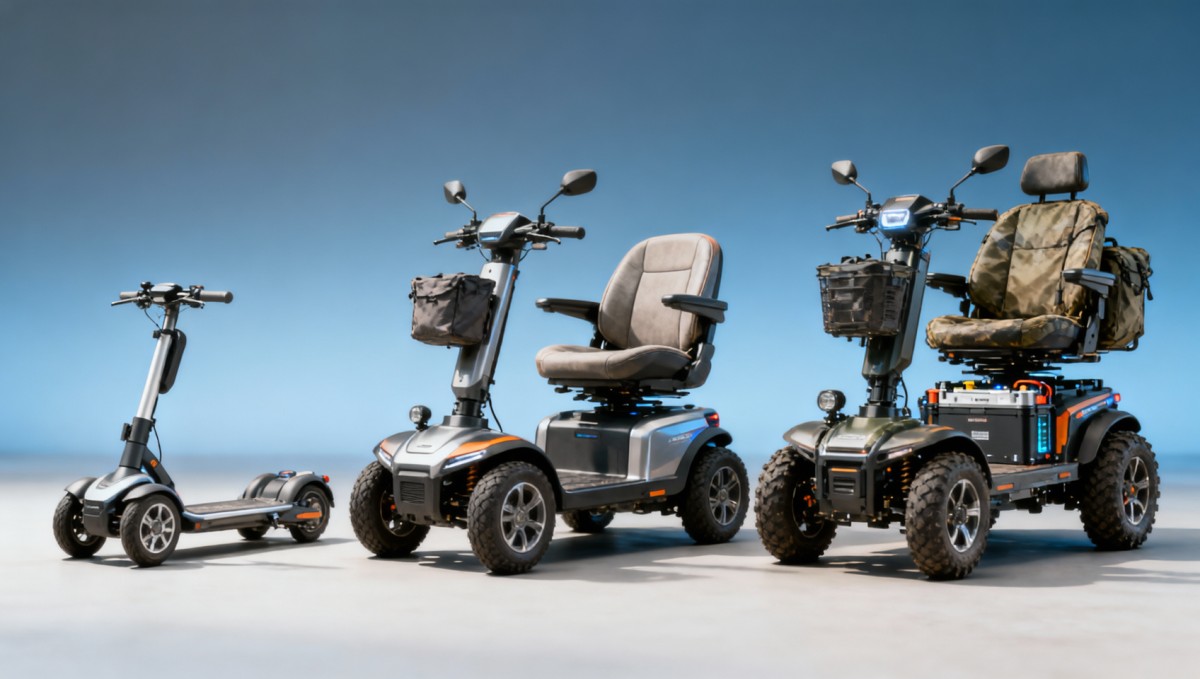
- Travel scooters are best for short trips, indoor use, and users who need a lightweight unit that can be disassembled and placed in a car trunk.
- Mid-size scooters are best for mixed indoor and outdoor use, regular errands, and users who want a stable all-around solution.
- Heavy-duty scooters are best for longer distances, rougher surfaces, higher user weight, and maximum comfort.
- 3-wheel scooters are often best where tight turning radius matters, such as indoors or in compact retail spaces.
- 4-wheel scooters are typically best where outdoor stability and confidence are the priority.
For everyday travel, there is no advantage in choosing a scooter that is too small for the route or too large for the environment. A portable model may save space, but it can create problems if the rider faces long commutes, cracked sidewalks, ramps, or frequent outdoor use. On the other hand, a heavy-duty unit may offer excellent ride quality but become impractical if it must be loaded into a vehicle every day.
How the main mobility scooter types compare in real daily use
Travel mobility scooters are designed for convenience and transportability. They are usually lighter, easier to break down into smaller pieces, and suitable for shopping centers, clinics, airports, and short neighborhood trips. Their trade-off is that they often have smaller batteries, lower top speed, less seat cushioning, and reduced comfort over longer periods. If everyday travel means a few short trips and frequent car transport, this type can be ideal.
Mid-size mobility scooters are the most versatile category for everyday use. They usually provide better suspension, stronger motors, more comfortable seating, and more battery capacity than travel scooters, while still being manageable in common urban and suburban settings. For many buyers, this is the “best overall” class because it supports daily errands, local commuting, and repeated use without the bulk of a full heavy-duty platform.
Heavy-duty mobility scooters are built for maximum performance and support. They are better suited for users who travel farther each day, spend more time outdoors, or need wider seats and higher weight capacity. Their stronger frames and larger batteries improve range and ride comfort, but they also require more storage space, are harder to transport, and usually come with a higher upfront cost.
3-wheel scooters provide sharper maneuverability. They work well in corridors, apartments, and indoor commercial spaces where turning space is limited. However, they are generally less stable than 4-wheel designs on uneven outdoor terrain.
4-wheel scooters offer better balance and a more secure feel outdoors. For many daily users, especially those prioritizing confidence on sidewalks, ramps, and outdoor crossings, a 4-wheel configuration is the safer everyday choice.
What buyers and evaluators should check before choosing a scooter
Whether the reader is an end user, a technical reviewer, a healthcare procurement team, or a business decision-maker, the same screening factors matter:
- Range per charge: Can the scooter complete a full day’s routine without recharge anxiety?
- Battery type: Is it using lithium ion batteries or sealed lead-acid, and what does that mean for lifecycle and maintenance?
- User weight capacity: Is there enough margin for safe and comfortable operation?
- Seat comfort and ergonomics: Is the scooter suitable for daily use rather than occasional short rides?
- Ground clearance and tire type: Can it handle the actual surface conditions?
- Turning radius: Will it work in elevators, hallways, shops, and home spaces?
- Charging logistics: How easy is it to charge at home, in a care setting, or in a commercial environment?
- Serviceability and spare parts: Is there support infrastructure for maintenance and repairs?
- Safety features: Are there anti-tip mechanisms, lights, braking responsiveness, and speed controls?
Many buyers focus too heavily on advertised top speed or appearance. In daily travel, usability metrics matter far more. A scooter with modest speed but better ride stability and dependable charging performance often delivers better long-term value than a faster model with poor comfort or battery reliability.
Battery choice matters more than many users expect
One of the most important but underestimated differences between mobility scooters is the battery system. In many models, buyers will compare traditional sealed lead-acid batteries with lithium ion batteries.
Sealed lead-acid batteries are usually cheaper upfront and widely available. They have served the mobility market for years, but they tend to be heavier, slower to charge, and shorter-lived than lithium alternatives. For low-frequency use, they may still be acceptable. For everyday travel, the operational drawbacks become more noticeable.
Lithium ion batteries are lighter, typically charge faster, and often offer better lifecycle performance. They can improve portability and user convenience, especially in travel scooters where total weight matters. For organizations evaluating long-term operating cost, uptime, and user satisfaction, lithium systems can present a stronger value proposition despite the higher purchase price.
Charging infrastructure is also relevant. In some environments, especially facilities with extended daily usage, managers may consider dedicated charging points or backup power planning. In adjacent energy discussions, portable power stations can support emergency charging strategies or temporary power resilience, but they are not a substitute for a scooter’s properly matched onboard battery and charger. The key point is simple: battery technology affects not only range, but also maintenance burden, transportability, and user confidence.
How to match scooter type to everyday travel scenarios
The easiest way to decide is to map the scooter to the actual travel pattern.
Choose a travel scooter if:
- Trips are short and mostly smooth-surface
- The scooter must fit in a car regularly
- Indoor maneuverability is more important than extended outdoor comfort
- The user values compactness over maximum range
Choose a mid-size scooter if:
- The scooter will be used nearly every day
- Routes include both indoor and outdoor environments
- The buyer wants the best balance of comfort, range, and control
- There is no need for frequent lifting into a vehicle
Choose a heavy-duty scooter if:
- Daily travel distances are longer
- Outdoor performance is critical
- The user needs a higher weight rating or larger seat
- Ride comfort and stability are top priorities
Choose 3-wheel over 4-wheel only if:
- Tight indoor turning is the main challenge
- Outdoor terrain is limited and relatively smooth
Choose 4-wheel over 3-wheel if:
- Outdoor use is frequent
- The rider wants more planted handling and confidence
- Safety and balance are more important than the smallest turning radius
What enterprise buyers and financial approvers should evaluate beyond the product spec sheet
For business and institutional buyers, selecting mobility scooters for staff support, patient mobility, hospitality operations, campus transport, or specialized service environments requires more than comparing model brochures. The better approach is to assess total operational fit.
Key evaluation areas include:
- Total cost of ownership: acquisition price, battery replacement cycle, maintenance, downtime, and expected service life
- User suitability: fit across different operators, physical needs, and training requirements
- Safety compliance: braking reliability, lighting, controls, load limits, and operational risk in shared environments
- Vendor support: warranties, parts access, technical support, and repair response time
- Fleet consistency: whether standardized models simplify training, charging, and spare part management
From a finance perspective, a lower-cost scooter is not automatically the better choice. If poor battery durability, frequent service calls, or low rider acceptance reduce utilization, the actual return on investment weakens quickly. From a project or engineering standpoint, standardized charging, clear maintenance routines, and reliable battery performance often matter more than marginal purchase savings.
Common buying mistakes that lead to poor everyday performance
Several recurring mistakes reduce satisfaction with mobility scooters in daily use:
- Buying for occasional use when the real need is daily commuting
- Choosing the lightest model without checking comfort or range
- Ignoring the importance of battery type and recharge routine
- Selecting 3-wheel units for outdoor environments that require more stability
- Underestimating the value of suspension, seat support, and ground clearance
- Failing to confirm service access and replacement parts availability
These mistakes usually come from evaluating the scooter in a showroom mindset rather than a daily operations mindset. The best-performing scooter is the one that remains dependable after repeated charging cycles, regular route demands, and continuous user handling.
Final answer: which mobility scooter is best?
For most people asking which mobility scooter is best for everyday travel, the strongest general answer is a mid-size 4-wheel mobility scooter. It usually provides the best mix of comfort, stability, battery range, and practical usability for daily life. A travel scooter is better if portability and car transport are the top priorities. A heavy-duty scooter is better if daily routes are longer, outdoor use is heavier, or the user needs more capacity and comfort.
The right decision becomes clearer when buyers focus on real use conditions rather than generic specifications. Daily distance, terrain, charging habits, battery technology, service support, and rider comfort will determine long-term satisfaction far more than marketing claims. For individual users and enterprise evaluators alike, the best mobility scooter is the one that fits everyday travel reliably, safely, and cost-effectively.
Get weekly intelligence in your inbox.
No noise. No sponsored content. Pure intelligence.
 Apr 20, 2026China Academy of IMT Releases Digital Passport White Paper for Industrial MaterialsChina Academy of IMT Releases Digital Passport White Paper for Industrial Materials
 Apr 20, 2026Suez Canal AI Speed & Load Limits Effective Apr 19, 2026Suez Canal AI Speed & Load Limits Effective Apr 19, 2026
 Apr 20, 2026IEC 63275:2026 Published for Warehouse Robotics EMC TestingIEC 63275:2026 Published for Warehouse Robotics EMC Testing
 Apr 20, 20262026 Shanghai Fastener Show: 1427 Exhibitors, Robot-Specific Fasteners in Focus2026 Shanghai Fastener Show: 1427 Exhibitors, Robot-Specific Fasteners in Focus
 Apr 20, 2026US BIS Expands EV Infrastructure Export ControlsUS BIS Expands EV Infrastructure Export Controls
 Apr 20, 2026TÜV Rheinland Updates ESS Certification with Propagation Blocking RequirementTÜV Rheinland Updates ESS Certification with Propagation Blocking Requirement
 Apr 20, 2026Shanghai Port Launches Green Clearance Channel for PV InvertersShanghai Port Launches Green Clearance Channel for PV Inverters
 Apr 20, 2026Vietnam Launches Anti-Circumvention Probe on Chinese Electronic ComponentsVietnam Launches Anti-Circumvention Probe on Chinese Electronic Components
 Apr 20, 2026CPSC Urges Recall of China-Made Smart Plugs Over Firmware VulnerabilitiesCPSC Urges Recall of China-Made Smart Plugs Over Firmware Vulnerabilities
 Apr 20, 2026EU AI Act CE Compliance for IoT Devices Takes Effect Apr 18, 2026EU AI Act CE Compliance for IoT Devices Takes Effect Apr 18, 2026
 Apr 19, 20262026 Dongguan Whole-House Customization List Released2026 Dongguan Whole-House Customization List Released
 Apr 19, 2026Global Shipping Alliances Launch Green Slot Priority for Asia-Europe RoutesGlobal Shipping Alliances Launch Green Slot Priority for Asia-Europe Routes
 Apr 19, 2026Vietnam Imposes AD Duties on Chinese Electronic ComponentsVietnam Imposes AD Duties on Chinese Electronic Components
 Apr 19, 2026Dongguan Victor Tops Local Full-Home Customization ListDongguan Victor Tops Local Full-Home Customization List
 Apr 19, 2026Guosheng Zhike Launches High-Precision Mold Machine Project in TaizhouGuosheng Zhike Launches High-Precision Mold Machine Project in Taizhou
 Apr 19, 2026CRRC Changchun Wins Jiaxing Urban Rail EMU ProjectCRRC Changchun Wins Jiaxing Urban Rail EMU Project
 Apr 19, 2026China Releases Green Design Guidelines 2026 for Industrial ProductsChina Releases Green Design Guidelines 2026 for Industrial Products
 Apr 19, 2026CATL Establishes $3B Era Resources Group for Global Mineral ControlCATL Establishes $3B Era Resources Group for Global Mineral Control
 Apr 19, 2026Shanghai Electric Gas Turbine Backlog Extends to 2028Shanghai Electric Gas Turbine Backlog Extends to 2028
 Apr 19, 2026Hormuz Strait Reopens, China Fertilizer Export Quota Easing ExpectedHormuz Strait Reopens, China Fertilizer Export Quota Easing Expected
 Apr 18, 2026TradeNexus Pro Launches Global Compliance RadarTradeNexus Pro Launches Global Compliance Radar
 Apr 18, 2026JIS T 2304:2026 Takes Effect June 1, 2026 for IVD SoftwareJIS T 2304:2026 Takes Effect June 1, 2026 for IVD Software
 Pathway for Rehab Devices with AI Modules") Apr 18, 2026FDA Updates 510(k) Pathway for Rehab Devices with AI ModulesFDA Updates 510(k) Pathway for Rehab Devices with AI Modules
Apr 18, 2026FDA Updates 510(k) Pathway for Rehab Devices with AI ModulesFDA Updates 510(k) Pathway for Rehab Devices with AI Modules Apr 18, 2026India BIS Approves 3 Chinese IoT Labs for IS 16444:2026 CertificationIndia BIS Approves 3 Chinese IoT Labs for IS 16444:2026 Certification
 Apr 18, 2026THE Alliance Launches Green Slot Priority for China PortsTHE Alliance Launches Green Slot Priority for China Ports
 Apr 18, 2026TÜV Rheinland Releases Dual-Standard ESS Certification Guide for ChinaTÜV Rheinland Releases Dual-Standard ESS Certification Guide for China
 Apr 18, 2026Vietnam Imposes AD Duties on Chinese Electronic ComponentsVietnam Imposes AD Duties on Chinese Electronic Components