Micro machining or EDM for tiny features that must hold
When tiny features must hold tight tolerances and survive real-world loads, choosing between micro machining and EDM can shape cost, quality, and delivery. For teams comparing micro machining with laser cutting services, custom sheet metal fabrication, cnc turning centers, and additive manufacturing services, this guide outlines where each process performs best and how to reduce risk in precision production.
In B2B manufacturing, the wrong process choice often shows up late: burrs that affect fit, heat damage that weakens a thin section, lead times that slip a launch window, or inspection failures that raise total landed cost. That is why procurement teams, production engineers, quality managers, and project leads need a selection framework that goes beyond headline precision claims.
Micro machining and EDM both serve high-value parts with very small features, but they behave differently when a part must not only be made accurately, but also hold tolerance after assembly, coating, sterilization, vibration, or repeated load cycles. The most practical decision comes from feature geometry, material type, required surface condition, lot size, and downstream process risk.
Where Micro Machining and EDM Differ in Real Production
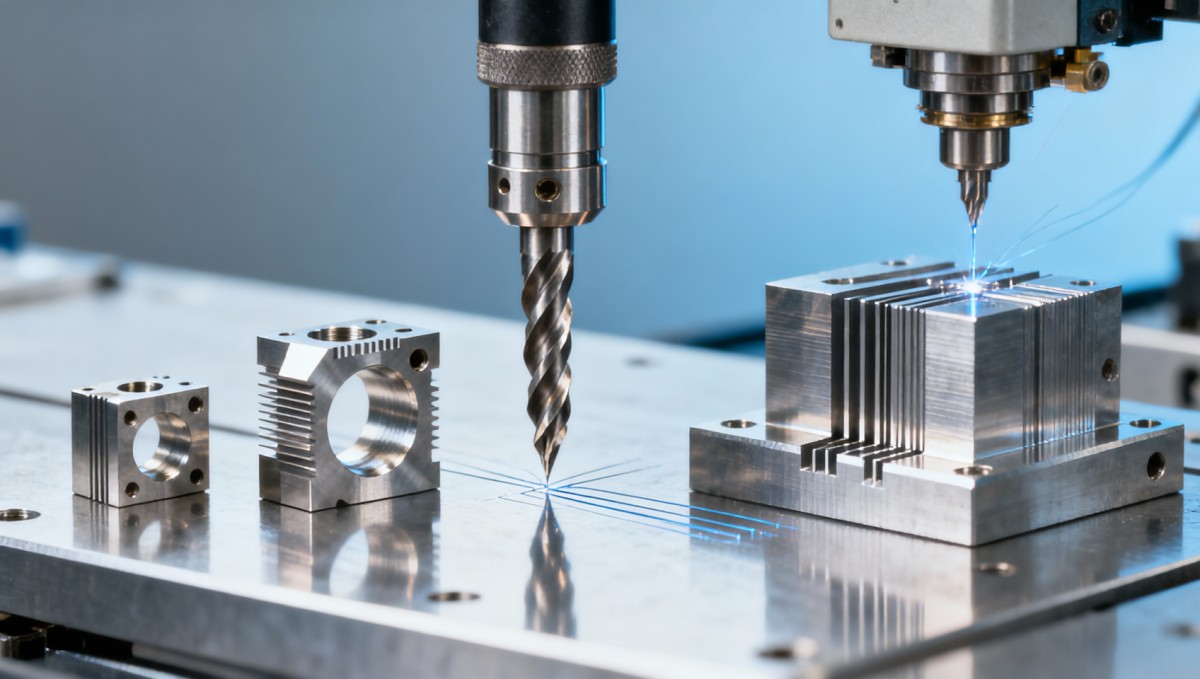
At a basic level, micro machining removes material with rotating tools, while EDM removes material through controlled electrical discharges. Both can produce tiny slots, holes, radii, and profiles, but their strengths diverge once features drop below 1.0 mm, wall sections fall below 0.2 mm, or materials move into hardened alloys, tungsten carbide, titanium, or conductive superalloys.
Micro machining is often the faster option for prismatic features, shallow pockets, and precision faces where cycle time and repeatability matter across 100 to 10,000 parts. It also fits production environments already using cnc turning centers, multi-axis milling, or hybrid inspection cells. For many buyers, that means easier supplier integration and lower handling complexity.
EDM, including wire EDM and sinker EDM, becomes highly attractive when tool pressure would distort the part, when the material is too hard for stable micro tooling, or when an internal corner must remain extremely sharp. Because EDM is a non-contact process, it can reduce mechanical stress on fragile geometries that would otherwise deflect during cutting.
The trade-off is that EDM usually needs electrically conductive materials and may leave a recast layer or heat-affected surface that must be evaluated for fatigue, sealing, or medical-grade cleanliness. Micro machining can introduce burrs, tool marks, and tool wear variation, but it often delivers better throughput and easier secondary finishing for many precision components.
Key process behavior at small scale
For feature widths around 0.05-0.50 mm, process stability matters more than catalog tolerance claims. A supplier may quote ±0.005 mm, but if the feature sits on a thin rib, next to a threaded section, or inside a long unsupported arm, actual functional yield can drop sharply. Process capability must be assessed at the full part level, not at the isolated feature level.
- Micro machining usually favors accessible geometries, shorter tool overhang, and materials that cut predictably under high spindle speed.
- Wire EDM usually favors through-features, narrow slots, and profiles where no cutting force should touch the wall.
- Sinker EDM usually favors blind features, fine internal forms, and sharp corners in hardened conductive materials.
The following comparison helps technical evaluators and sourcing teams match process behavior to production requirements instead of relying on a single precision number.
The table shows why there is no universal winner. Micro machining tends to align with broader production ecosystems and faster scaling, while EDM is often the safer answer when feature integrity matters more than pure cycle time.
How to Choose Based on Feature Type, Material, and Functional Load
The first question is not which process is “more precise,” but what the tiny feature must do in service. A 0.15 mm slot in a sensor housing, a fluid metering channel in healthcare technology, or a retention notch in a smart electronics connector all have different failure modes. Some fail from burrs, some from microcracks, some from dimensional drift after heat treatment, and some from weak edge condition.
If the feature must carry load, lock a mating part, resist vibration, or maintain sealing under pressure, edge quality and subsurface condition become critical. In these cases, buyers should ask for process-specific evidence: sectioned samples, roughness range, burr control method, recast layer management, and measurement data taken after any secondary process such as passivation, coating, or cleaning.
Material selection can shift the answer quickly. Stainless steel, aluminum, copper alloys, titanium, Inconel, and hardened tool steels behave differently under micro tooling and under EDM spark erosion. For example, micro machining aluminum can be efficient, but burr control on thin edges may require deburring under magnification. EDM handles hard conductive alloys well, but surface integrity must be checked where fatigue life matters.
A useful rule for sourcing teams is to define three separate targets: geometric tolerance, surface condition, and structural function. When these are bundled into one vague requirement, supplier quotes may look comparable while real production risk differs by 20% to 40% in rework, scrap, or inspection delay.
Functional selection checklist
- Map the feature to its real job: alignment, flow control, retention, conductivity, wear interface, or cosmetic edge.
- Define the critical dimension range, such as ±0.003 mm, ±0.01 mm, or a flatness limit under 0.02 mm.
- Review the material state: annealed, hardened, plated, coated, or heat-treated after machining.
- Confirm whether the part sees cyclic load, impact, sterilization, or corrosive media.
- Ask whether the feature is inspected at 100%, by sampling, or only at first article.
Typical process fit by application pattern
In advanced manufacturing, EDM is often selected for hard die inserts, precision conductive wear parts, and narrow slots that would overload a micro end mill. In healthcare technology, micro machining is common for miniaturized metal and polymer components where surface cleanliness, rounded transitions, and controlled burr removal are part of the validation path. In smart electronics, either method may work depending on thickness, conductivity needs, and connector geometry.
The next table gives a practical screening view that project managers and technical buyers can use during RFQ review.
This matrix is not a substitute for trials, but it helps narrow process choice early. In many programs, one short prototype round of 10 to 30 parts can prevent months of avoidable qualification drift.
Cost, Lead Time, and Quality Risks Buyers Should Model Early
Many sourcing decisions fail because teams compare only piece price. For tiny features that must hold, total cost includes setup, fixturing, tool life, electrode preparation, inspection time, scrap rate, secondary finishing, and the cost of late engineering changes. A part that is 8% cheaper to quote can become 25% more expensive once rework and delayed acceptance are included.
Micro machining cost sensitivity is often driven by tool breakage, cycle time at high spindle speed, and in-process verification. Tool diameters below 0.3 mm can raise risk quickly if the part requires deep reach or poor chip evacuation. EDM cost sensitivity often comes from burn time, electrode wear, wire consumption, and slower removal rates on thicker sections or complex contours.
Lead time is not only machine time. It also includes CAM programming, process proving, sample inspection, and quality documentation. For prototype lots, a practical market range might be 5-10 working days for straightforward micro-machined parts and 7-15 working days for EDM-heavy parts, although geometry, backlog, and inspection depth can extend both. Production lead times often move to 2-6 weeks depending on volume and approval gates.
Quality risk should be modeled at three levels: process risk, measurement risk, and use-case risk. A supplier may successfully machine the feature, but if the metrology method cannot repeat within the tolerance band, the project still faces acceptance disputes. This is common where vision systems, contact probes, and section analysis each report slightly different values on features below 100 microns.
Common hidden cost drivers
- Extra deburring or polishing steps needed to remove micro burrs from load-bearing edges.
- Additional cleaning or surface conditioning after EDM to address recast concerns.
- First article delays caused by unclear GD&T or missing inspection access points.
- Tooling or fixture redesign when initial clamping deforms thin sections.
- Supplier hand-offs between machining, finishing, and inspection that add 2-5 days.
Early-stage sourcing questions
Before approving a supplier, ask how they control burr height, how they verify form on fragile features, what lot-level sampling plan they use, and whether they can provide pilot-run data. For regulated or safety-sensitive programs, it is also wise to clarify whether the supplier can support traceability by batch, material certificate, and inspection revision level.
Teams comparing micro machining to additive manufacturing services or laser cutting services should remember that process substitution is not always direct. Additive methods may speed complex prototypes but often need post-machining for final tolerance. Laser cutting can be efficient for thin sheet profiles, yet it may not meet the dimensional stability or edge condition needed for tiny loaded features.
Implementation Strategy: RFQ, Validation, and Production Control
The safest path from concept to stable production is to treat micro machining and EDM as engineering choices, not commodity line items. A strong RFQ package should state feature criticality, reference datums, acceptable edge condition, post-process sequence, and inspection method. Without this, suppliers may optimize for the fastest manufacturable interpretation rather than the most reliable functional result.
Validation should begin with a pilot lot rather than immediate scale-up. For many industrial programs, a 10-piece feasibility run followed by a 30-50 piece pilot is enough to expose drift in tool wear, fixture repeatability, or measurement consistency. This is particularly important when a tiny feature interacts with assembly preload, snap-fit force, fluid flow, or electrical contact resistance.
During launch, quality teams should separate cosmetic nonconformities from functional nonconformities. A minor visible mark may be acceptable on a hidden internal feature, while a nearly invisible burr at a sealing edge may cause failure. Clear acceptance criteria reduce supplier dispute cycles and improve approval speed by 1 to 2 review rounds in many projects.
For long-term production, process control plans should include machine capability review, wear monitoring, fixture verification, and periodic correlation between shop-floor measurements and lab inspection. On tiny features, even a 0.005 mm drift can be meaningful if the mating condition is sensitive or the feature carries repeated load.
Recommended launch workflow
- Define the function of each critical feature and rank them by failure impact.
- Request DFM feedback from suppliers using both micro machining and EDM where feasible.
- Run a small feasibility batch and compare measured data against assembly behavior.
- Lock finishing, cleaning, and inspection sequence before pilot approval.
- Use a control plan with review checkpoints at first article, pilot lot, and first production month.
What a robust RFQ should include
A practical RFQ for tiny precision features should include nominal dimensions, tolerance bands, target roughness if relevant, material state, annual volume estimate, prototype quantity, critical-to-function notes, and whether the feature is load-bearing. If the part will be coated or assembled under force, that should be stated up front. These details help prevent low-value quoting rounds and improve comparability across suppliers and regions.
For distributors and sourcing intermediaries, this discipline also improves customer confidence. Buyers are more likely to approve a premium quote when the process rationale, risk controls, and inspection plan are visible instead of assumed.
Frequently Asked Questions for Technical Buyers and Project Teams
The questions below reflect common search and sourcing issues raised by engineering teams, procurement managers, and quality reviewers evaluating precision production options for tiny, high-risk features.
How small can micro machining and EDM realistically go?
Actual limits depend on geometry, material, and inspection method. In practical production, micro machining may handle features well below 0.5 mm, but stability becomes harder with deep reach and fragile tooling. EDM can also produce extremely small conductive features, especially narrow slots and sharp internal forms, but speed and surface condition must be assessed. The manufacturable limit is usually a system limit, not a machine limit alone.
Which process is better for parts that must survive cyclic load?
There is no single answer. If micro machining leaves burrs or tool-induced stress at a critical edge, fatigue performance may suffer. If EDM leaves an unacceptable recast layer or thermal effect in the loaded zone, that can also be a problem. For cyclic-load features, request cross-section review, finishing details, and if needed, a small validation run under simulated use conditions before full release.
How should buyers compare quotes fairly?
Compare at least 6 points: quoted tolerance, inspection method, feature-specific risk notes, lead time, secondary processes, and batch traceability. A lower quote is not equivalent if it excludes deburring, cleaning, or first article reporting. For strategic sourcing, ask suppliers to separate prototype pricing, pilot pricing, and steady-state production pricing.
Can these processes replace laser cutting, sheet metal fabrication, or additive manufacturing?
Sometimes, but not always. Laser cutting services are efficient for many thin-sheet geometries, while custom sheet metal fabrication suits formed parts and broader structural needs. Additive manufacturing services support complex shapes and fast design iteration. Micro machining and EDM are typically chosen when tiny features, tighter tolerances, or functional edge conditions exceed what those processes can hold without extensive post-processing.
For organizations navigating supplier selection across advanced manufacturing and precision sourcing, the best decision is the one that protects function, not just nominal geometry. Micro machining often delivers stronger throughput, easier integration with CNC workflows, and broad material flexibility. EDM often protects delicate conductive features where cutting force, hardness, or corner sharpness would otherwise create failure risk.
If your team is evaluating tiny precision features for new product development, cost reduction, or supplier qualification, a structured comparison can shorten validation time and improve first-pass yield. TradeNexus Pro helps global buyers and technical decision-makers assess process fit, supplier capability, and procurement risk with deeper industry context. Contact us to discuss your application, request a tailored sourcing framework, or explore more precision manufacturing solutions.
Get weekly intelligence in your inbox.
No noise. No sponsored content. Pure intelligence.
 Apr 20, 2026China Academy of IMT Releases Digital Passport White Paper for Industrial MaterialsChina Academy of IMT Releases Digital Passport White Paper for Industrial Materials
 Apr 20, 2026Suez Canal AI Speed & Load Limits Effective Apr 19, 2026Suez Canal AI Speed & Load Limits Effective Apr 19, 2026
 Apr 20, 2026IEC 63275:2026 Published for Warehouse Robotics EMC TestingIEC 63275:2026 Published for Warehouse Robotics EMC Testing
 Apr 20, 20262026 Shanghai Fastener Show: 1427 Exhibitors, Robot-Specific Fasteners in Focus2026 Shanghai Fastener Show: 1427 Exhibitors, Robot-Specific Fasteners in Focus
 Apr 20, 2026US BIS Expands EV Infrastructure Export ControlsUS BIS Expands EV Infrastructure Export Controls
 Apr 20, 2026TÜV Rheinland Updates ESS Certification with Propagation Blocking RequirementTÜV Rheinland Updates ESS Certification with Propagation Blocking Requirement
 Apr 20, 2026Shanghai Port Launches Green Clearance Channel for PV InvertersShanghai Port Launches Green Clearance Channel for PV Inverters
 Apr 20, 2026Vietnam Launches Anti-Circumvention Probe on Chinese Electronic ComponentsVietnam Launches Anti-Circumvention Probe on Chinese Electronic Components
 Apr 20, 2026CPSC Urges Recall of China-Made Smart Plugs Over Firmware VulnerabilitiesCPSC Urges Recall of China-Made Smart Plugs Over Firmware Vulnerabilities
 Apr 20, 2026EU AI Act CE Compliance for IoT Devices Takes Effect Apr 18, 2026EU AI Act CE Compliance for IoT Devices Takes Effect Apr 18, 2026
 Apr 19, 20262026 Dongguan Whole-House Customization List Released2026 Dongguan Whole-House Customization List Released
 Apr 19, 2026Global Shipping Alliances Launch Green Slot Priority for Asia-Europe RoutesGlobal Shipping Alliances Launch Green Slot Priority for Asia-Europe Routes
 Apr 19, 2026Vietnam Imposes AD Duties on Chinese Electronic ComponentsVietnam Imposes AD Duties on Chinese Electronic Components
 Apr 19, 2026Dongguan Victor Tops Local Full-Home Customization ListDongguan Victor Tops Local Full-Home Customization List
 Apr 19, 2026Guosheng Zhike Launches High-Precision Mold Machine Project in TaizhouGuosheng Zhike Launches High-Precision Mold Machine Project in Taizhou
 Apr 19, 2026CRRC Changchun Wins Jiaxing Urban Rail EMU ProjectCRRC Changchun Wins Jiaxing Urban Rail EMU Project
 Apr 19, 2026China Releases Green Design Guidelines 2026 for Industrial ProductsChina Releases Green Design Guidelines 2026 for Industrial Products
 Apr 19, 2026CATL Establishes $3B Era Resources Group for Global Mineral ControlCATL Establishes $3B Era Resources Group for Global Mineral Control
 Apr 19, 2026Shanghai Electric Gas Turbine Backlog Extends to 2028Shanghai Electric Gas Turbine Backlog Extends to 2028
 Apr 19, 2026Hormuz Strait Reopens, China Fertilizer Export Quota Easing ExpectedHormuz Strait Reopens, China Fertilizer Export Quota Easing Expected
 Apr 18, 2026TradeNexus Pro Launches Global Compliance RadarTradeNexus Pro Launches Global Compliance Radar
 Apr 18, 2026JIS T 2304:2026 Takes Effect June 1, 2026 for IVD SoftwareJIS T 2304:2026 Takes Effect June 1, 2026 for IVD Software
 Pathway for Rehab Devices with AI Modules") Apr 18, 2026FDA Updates 510(k) Pathway for Rehab Devices with AI ModulesFDA Updates 510(k) Pathway for Rehab Devices with AI Modules
Apr 18, 2026FDA Updates 510(k) Pathway for Rehab Devices with AI ModulesFDA Updates 510(k) Pathway for Rehab Devices with AI Modules Apr 18, 2026India BIS Approves 3 Chinese IoT Labs for IS 16444:2026 CertificationIndia BIS Approves 3 Chinese IoT Labs for IS 16444:2026 Certification
 Apr 18, 2026THE Alliance Launches Green Slot Priority for China PortsTHE Alliance Launches Green Slot Priority for China Ports
 Apr 18, 2026TÜV Rheinland Releases Dual-Standard ESS Certification Guide for ChinaTÜV Rheinland Releases Dual-Standard ESS Certification Guide for China
 Apr 18, 2026Vietnam Imposes AD Duties on Chinese Electronic ComponentsVietnam Imposes AD Duties on Chinese Electronic Components