Hydrogen Energy Safety Gaps That Delay Industrial Adoption
Hydrogen energy promises cleaner industry, but unresolved safety gaps continue to slow real-world adoption. For procurement leaders, operators, and safety managers, the challenge goes beyond compliance to integrated energy management, energy monitoring, and risk control across modern facilities. As hydrogen projects increasingly intersect with warehouse automation, AGV robots, ASRS systems, automated storage and retrieval, electronic shelf labels, smart warehousing, and TMS software, understanding these safety barriers is critical to making confident investment and operational decisions.
For most industrial buyers and project teams, the real question is not whether hydrogen has long-term potential. It is whether hydrogen systems can be deployed safely, insured affordably, operated reliably, and scaled without introducing unacceptable operational risk. The short answer is this: industrial adoption is delayed less by a lack of interest and more by unresolved gaps in standards, workforce readiness, infrastructure compatibility, monitoring capability, and incident-response planning. Companies that evaluate these gaps early can avoid costly redesigns, delayed approvals, and underperforming assets.
Why hydrogen safety remains the main barrier to industrial adoption
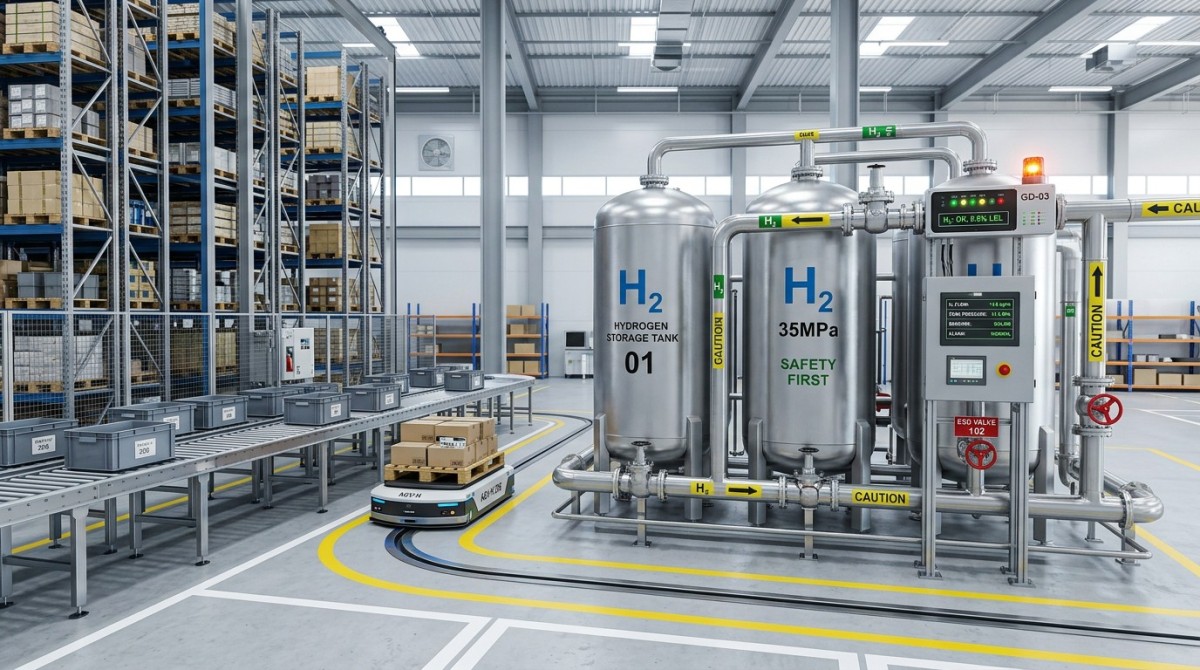
Hydrogen is attractive because it can support decarbonization across manufacturing, logistics, mobility, and power applications. But compared with more familiar fuels and energy systems, hydrogen introduces a different safety profile that many facilities are not fully prepared to manage.
Its small molecular size makes leakage harder to contain. Its wide flammability range increases ignition risk under certain conditions. Its nearly invisible flame complicates detection during an incident. In addition, hydrogen storage, compression, transport, and end-use systems often require specialized materials, ventilation, sensors, controls, and maintenance practices. These are not minor engineering details. They directly affect site approval, operating procedures, insurance assessments, and total project cost.
For enterprise decision-makers, this means adoption delays often come from practical deployment friction rather than strategic hesitation. A hydrogen pilot may look attractive on paper, yet stall when the site team realizes that existing layouts, safety protocols, and monitoring systems are not ready for continuous operation.
What safety gaps matter most to operators, procurement teams, and plant leaders
The most important hydrogen energy safety gaps are usually not isolated technical failures. They are system-level weaknesses that appear between design, procurement, installation, operation, and emergency response.
1. Detection and monitoring gaps
Many industrial facilities still lack hydrogen-specific gas detection coverage, especially in enclosed, high-ceiling, or airflow-variable spaces. This becomes more serious in smart warehousing and automated environments where AGV robots, ASRS systems, conveyor networks, charging points, and traffic paths create complex airflow and equipment density patterns. Without reliable energy monitoring and gas detection integration, leaks may not be identified quickly enough to prevent escalation.
2. Ventilation and facility design mismatch
Hydrogen projects are sometimes introduced into buildings originally designed for conventional electrical, battery, or fossil-fuel systems. That creates a design mismatch. Ventilation rates, enclosure design, ignition source control, ceiling geometry, and hazardous area zoning may all require revision. In mixed-use industrial sites, especially those combining production and automated storage and retrieval operations, retrofitting can be more difficult than expected.
3. Materials and equipment compatibility
Hydrogen can affect material performance through embrittlement and long-term stress effects in certain components. Procurement teams focused only on upfront price may underestimate the importance of verified compatibility in valves, seals, piping, storage vessels, connectors, and compressors. A lower-cost component that fails early can create downtime, reputational risk, and safety exposure far beyond the original purchase value.
4. Workforce readiness and procedural discipline
Even well-designed systems can become unsafe if operating teams are not trained for hydrogen-specific handling, isolation, inspection, and emergency response. Operators, maintenance staff, warehouse supervisors, and safety managers need clear procedures that reflect actual site conditions. This is especially important when hydrogen equipment is deployed in facilities also running warehouse automation, TMS software, electronic shelf labels, and tightly coordinated logistics flows where human response time is already compressed.
5. Fragmented standards and compliance interpretation
One of the biggest reasons projects slow down is uncertainty over which codes, standards, and certification pathways apply. Requirements can vary by geography, application type, storage method, and local authority interpretation. For project managers and financial approvers, unclear compliance paths increase timeline risk and make capital decisions harder to justify.
Where hydrogen projects most often get delayed in the real world
Industrial hydrogen adoption is rarely delayed by a single dramatic issue. More often, projects slow down at predictable decision points.
- Site assessment stage: early feasibility reviews fail to capture ventilation, separation distance, or hazardous zone constraints.
- Procurement stage: buyers discover too late that certified components, monitoring systems, or compatible storage solutions have longer lead times and higher costs.
- Integration stage: hydrogen systems do not fit smoothly with existing plant controls, building management systems, energy management platforms, or operational workflows.
- Approval stage: insurers, regulators, or internal governance committees require additional documentation, testing, or design changes.
- Operations stage: maintenance procedures, sensor calibration routines, and emergency drills are not mature enough for reliable scale-up.
For distributors, integrators, and project owners, these delays can damage confidence in the technology even when the root problem is implementation readiness rather than hydrogen itself.
How to evaluate hydrogen safety before making a major investment
For procurement leaders and enterprise decision-makers, the best approach is to move from technology enthusiasm to structured readiness assessment. Before approving a hydrogen project, ask five practical questions.
Is the facility physically suitable?
Review ventilation design, ignition source mapping, traffic flow, storage location, ceiling conditions, emergency access, and separation from sensitive operations. In smart warehousing environments, include AGV routes, automated storage and retrieval density, charging zones, and maintenance areas.
Is monitoring integrated, not isolated?
Hydrogen safety depends on continuous visibility. Gas detection, pressure monitoring, shutdown logic, alarm escalation, and energy monitoring should connect to broader operational systems where possible. If hydrogen safety data sits in a separate silo, response time and accountability often suffer.
Are components verified for long-term duty?
Insist on traceable specifications, certification records, material compatibility evidence, and maintenance guidance. Price should be evaluated alongside lifecycle reliability, replacement frequency, and failure consequence.
Is the workforce trained for normal and abnormal conditions?
Training must cover startup, shutdown, inspection, leak response, lockout procedures, maintenance isolation, and escalation protocols. Tabletop planning is not enough. Teams should run practical drills aligned with the actual site layout.
Is there a full risk ownership model?
Someone must clearly own hydrogen safety performance across engineering, operations, procurement, EHS, and executive governance. Many projects struggle because responsibilities are distributed but not integrated.
Why safety gaps become more complex in automated and connected facilities
Hydrogen is increasingly discussed alongside digitalized operations, not as a stand-alone energy topic. That changes the risk picture. In facilities using warehouse automation, AGV robots, ASRS systems, smart warehousing platforms, and TMS software, hydrogen infrastructure must coexist with dense equipment networks, continuous movement, and software-driven operations.
This creates new planning demands. For example, a hydrogen fueling or storage area cannot be evaluated only as a static engineering zone. It must be understood in relation to vehicle movement, maintenance windows, sensor interoperability, emergency stop architecture, and the operational priority rules embedded in digital systems. If these layers are not coordinated, a technically compliant system may still perform poorly in daily operations.
For safety managers and quality teams, this means hydrogen adoption should be reviewed as part of integrated facility risk control. For executives, it means the investment case should include system orchestration costs, not just core equipment costs.
What a strong hydrogen adoption strategy looks like
Companies that move forward successfully with hydrogen usually take a phased and disciplined approach. They do not treat compliance as a final checkbox. They build safety into project selection, design review, vendor qualification, commissioning, and operations management from the beginning.
A strong strategy typically includes:
- early cross-functional feasibility analysis involving engineering, procurement, EHS, operations, and finance
- site-specific hazard identification instead of generic technology assumptions
- vendor selection based on certification, service support, and monitoring capability
- integration of hydrogen alarms and performance data into broader energy management and facility oversight systems
- clear emergency response planning with local authority and insurer alignment
- pilot deployment with measurable safety and operational KPIs before scale expansion
This approach does more than reduce incident risk. It also improves budget predictability, speeds internal approvals, and strengthens the business case for future deployment.
How buyers and decision-makers should think about ROI when safety is uncertain
Hydrogen projects should never be evaluated on emissions potential alone. The real return on investment depends on whether the system can operate consistently, meet throughput needs, satisfy insurers, and avoid repeated retrofits. When safety gaps are ignored, hidden costs appear quickly in redesign fees, downtime, training gaps, delayed commissioning, and compliance disputes.
For financial approvers, the right question is not “What is the cheapest hydrogen option?” but “What is the lowest-risk path to stable performance and scalable adoption?” In many cases, spending more on qualified components, monitoring systems, design validation, and workforce preparation produces a better long-term outcome than pushing for a low-cost initial deployment.
Conclusion: hydrogen adoption will accelerate when safety readiness becomes operationally practical
Hydrogen energy is not being held back by lack of market relevance. It is being slowed by unresolved safety gaps that affect procurement confidence, operational readiness, and investment timing. For operators, safety managers, project leaders, and enterprise decision-makers, the priority is clear: treat hydrogen safety as a full-system business issue, not just a technical compliance task.
The organizations most likely to benefit from hydrogen are those that evaluate detection, facility design, component quality, workforce training, compliance pathways, and digital integration before committing major capital. When these factors are addressed early, hydrogen becomes easier to approve, safer to operate, and more credible as a scalable industrial energy solution.
Get weekly intelligence in your inbox.
No noise. No sponsored content. Pure intelligence.
 Apr 22, 2026China Leads Global Offshore Wind Installations for 5th YearChina Leads Global Offshore Wind Installations for 5th Year
 Apr 22, 2026China Launches National Mine Safety IoT Monitoring NetworkChina Launches National Mine Safety IoT Monitoring Network
 Apr 22, 2026Yinchuan Boiler Pure Water Solution Certified for Middle East ProjectsYinchuan Boiler Pure Water Solution Certified for Middle East Projects
 Apr 22, 2026China to Enforce Mandatory EV Battery Recycling Standards by 2026China to Enforce Mandatory EV Battery Recycling Standards by 2026
 Apr 22, 2026Vietnam Launches Anti-Circumvention Probe on Electronic ComponentsVietnam Launches Anti-Circumvention Probe on Electronic Components
 Apr 22, 20262026 Shanghai Fastener Show: Robotic Fasteners Drive Overseas Procurement2026 Shanghai Fastener Show: Robotic Fasteners Drive Overseas Procurement
 Apr 22, 2026US BIS Adds EV On-Board Charger Crypto Modules to EAR Appendix 7US BIS Adds EV On-Board Charger Crypto Modules to EAR Appendix 7
 Apr 22, 2026TÜV Rheinland Updates BESS Certification: Propagation Blocking Now MandatoryTÜV Rheinland Updates BESS Certification: Propagation Blocking Now Mandatory
 Apr 22, 2026Red Sea Crisis Escalates: Suez AI Speed Limits & Slot Review from Apr 19Red Sea Crisis Escalates: Suez AI Speed Limits & Slot Review from Apr 19
 Apr 22, 2026EU CBAM Carbon Tariff Takes Effect April 1, 2026EU CBAM Carbon Tariff Takes Effect April 1, 2026
 Apr 21, 2026When to Replace CT Scanner Parts Before Downtime StartsWhen to Replace CT Scanner Parts Before Downtime Starts
 Apr 21, 2026How to Cut Costs in Lathe Turning Without ReworkHow to Cut Costs in Lathe Turning Without Rework
 Apr 21, 2026Lathe Turning Tolerances: What Can You Expect?Lathe Turning Tolerances: What Can You Expect?
 Apr 21, 2026How to Avoid Risks in Solar Panels WholesaleHow to Avoid Risks in Solar Panels Wholesale
 Apr 21, 2026Solar Panels Wholesale: How to Compare SuppliersSolar Panels Wholesale: How to Compare Suppliers
 Apr 21, 2026Solar Mounting Cost Factors You Should KnowSolar Mounting Cost Factors You Should Know
 Apr 21, 2026Solar Mounting Options: Which One Fits Your Project?Solar Mounting Options: Which One Fits Your Project?
 Apr 21, 2026How to Pick USB C Docking Stations for Dual DisplaysHow to Pick USB C Docking Stations for Dual Displays
 Apr 21, 2026USB C Docking Stations: What Ports Do You Need?USB C Docking Stations: What Ports Do You Need?
 Apr 21, 2026What Affects Dental Milling Machine ROI in 2026?What Affects Dental Milling Machine ROI in 2026?
 Apr 21, 2026Dental Milling Machines: Wet or Dry for Your Lab?Dental Milling Machines: Wet or Dry for Your Lab?
 Apr 21, 2026How to Avoid Common Medical Refrigerator MistakesHow to Avoid Common Medical Refrigerator Mistakes
 Apr 21, 2026Medical Refrigerators: What Specs Matter Most?Medical Refrigerators: What Specs Matter Most?
 Apr 21, 2026Portable or Cart Vet Ultrasound: Which to Buy?Portable or Cart Vet Ultrasound: Which to Buy?
 Apr 21, 2026Vet Ultrasound Buying Guide for Small ClinicsVet Ultrasound Buying Guide for Small Clinics
 Apr 21, 2026Yard Management Systems: Key Features to CompareYard Management Systems: Key Features to Compare
 Apr 21, 2026How Yard Management Systems Improve Dock FlowHow Yard Management Systems Improve Dock Flow


