GaN chargers: why compact size does not guarantee cool operation
GaN chargers are widely praised for their compact form, fast charging, and efficiency, but smaller size does not always mean cooler performance. As power density rises, heat management becomes a critical factor affecting safety, lifespan, and real-world reliability. This article explores why thermal design matters, what buyers should examine beyond dimensions, and how informed sourcing decisions can reduce risk.
Why the market conversation around GaN chargers is shifting
For several years, the strongest selling point of GaN chargers was obvious: more power in a smaller brick. That value proposition still matters, especially for mobile professionals, travelers, and device ecosystems built around USB-C Power Delivery. Yet the market signal is changing. Buyers are no longer asking only whether a charger is compact or fast. They are increasingly asking whether it stays stable under sustained load, whether the enclosure becomes uncomfortably hot, and whether multi-port performance matches the label in real use.
This shift is not cosmetic. As power density rises, thermal behavior becomes a practical decision factor for distributors, enterprise procurement teams, and brand owners. In the smart electronics landscape, compact GaN chargers are moving from novelty to standard accessory. That transition naturally raises expectations. Once a product category matures, the market pays less attention to headline wattage and more attention to consistency, durability, and post-sale risk.
For information researchers and sourcing professionals, this means the evaluation lens for gan chargers is becoming more technical. Size still influences buying decisions, but thermal design, component quality, certification credibility, and long-duration performance now shape trust more strongly than product photos or shell dimensions alone.
The core trend: higher power density is creating new thermal trade-offs
The current trend in gan chargers is defined by one tension: consumers and OEM buyers want smaller, lighter chargers, while devices keep demanding more power. Laptops, tablets, gaming handhelds, and multi-device charging stations all push chargers toward higher output ranges. In response, suppliers compress more functionality into tighter enclosures. That creates efficiency gains, but it also reduces the margin for thermal error.
GaN semiconductors do offer advantages over traditional silicon, including faster switching and lower losses in many designs. However, those benefits do not eliminate heat. They simply change where heat is generated, how quickly it accumulates, and how important system-level thermal planning becomes. A charger can use GaN components and still run hot if the transformer design, PCB layout, port distribution logic, casing material, ventilation strategy, or control firmware is weak.
That is why compact size does not guarantee cool operation. In fact, in some market segments the opposite is true: the more aggressively a charger is miniaturized, the more difficult it becomes to dissipate heat across long charging sessions or under dual-port output. This is not a contradiction to GaN technology. It is a reminder that charger performance is the result of total design integration, not one material choice.
What is driving this change in buyer priorities
Several forces are pushing thermal performance higher on the decision agenda for gan chargers. First, USB-C ecosystems are consolidating. One charger is now expected to handle phones, ultrabooks, earbuds, tablets, and portable monitors. Second, more brands are launching high-wattage compact models, which increases direct comparison and exposes differences in temperature behavior. Third, users are relying on chargers for longer continuous sessions, not just short phone top-ups. Laptop charging for hours is a different thermal event than a 20-minute smartphone fast charge.
Another driver is market maturity. Early adopters often tolerate compromises in exchange for innovation. Mainstream buyers do not. Once gan chargers became more common in retail, e-commerce, and B2B sourcing catalogs, tolerance for hot surfaces, output throttling, or premature failure started to decline. Return rates, customer reviews, and compliance scrutiny now have stronger commercial consequences.
In parallel, procurement teams are under pressure to reduce hidden lifecycle costs. A charger that looks premium because it is tiny may still create problems if it ages quickly in warm environments, performs poorly in bundled deployments, or triggers customer complaints after repeated high-load use.
Why some gan chargers run hot despite advanced materials
The most common misunderstanding is that GaN automatically means low temperature. In reality, gan chargers can still become hot for several practical reasons. High switching efficiency reduces some losses, but heat is still generated in magnetic components, control circuits, rectification stages, and even cable or connector interfaces. If engineers pursue extreme miniaturization, these heat sources are packed closer together.
Another issue is thermal spreading. A charger may be electrically efficient yet still feel hot because the enclosure transfers concentrated heat to the outer surface. Surface warmth does not always mean danger, but it can indicate that the internal thermal path is working near its limit. Under repeated full-load use, that matters for capacitor aging, solder fatigue, and long-term output stability.
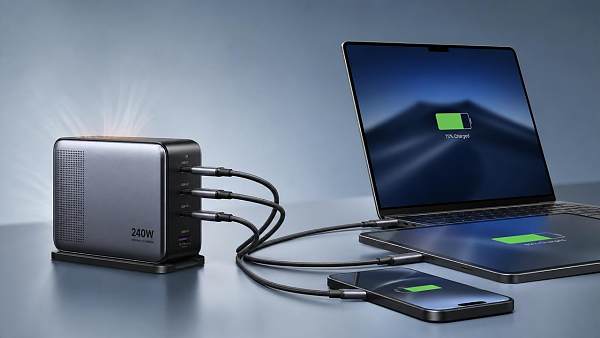
Port-sharing design also plays a role. Many compact gan chargers advertise multiple ports, but thermal behavior changes when two or three outputs are active simultaneously. Some products redistribute power intelligently; others may cycle, throttle, or run significantly warmer. Buyers who compare only peak wattage can miss this difference.
The supply side is separating into two quality tiers
A notable market development is the widening gap between mature charger manufacturers and opportunistic entrants. As gan chargers gain volume, more suppliers are entering the category. Some bring real power electronics experience and strong validation processes. Others rely heavily on the marketing appeal of the GaN label while underinvesting in thermal simulation, component derating, and reliability testing.
This creates a two-tier market. In the upper tier, suppliers compete on thermal architecture, certified safety performance, and stable behavior under continuous load. In the lower tier, products compete on wattage claims, shell size, and price compression. For B2B buyers, this divide is important because visual inspection alone cannot reveal internal design margin. Two gan chargers may look nearly identical in size and output label but perform very differently over time.
That quality separation is likely to deepen as brands seek lower return rates and stronger channel confidence. In other words, the next phase of competition in gan chargers will not be driven only by who makes the smallest adapter, but by who can prove dependable thermal behavior in realistic usage conditions.
Who is most affected by poor thermal judgment
The impact of thermal performance is uneven across the market. Different stakeholders feel the consequences in different ways, and that shapes sourcing priorities.
What buyers should examine beyond dimensions and wattage
For information researchers evaluating gan chargers, the practical question is not whether heat exists, but whether heat is controlled. A better sourcing framework starts with performance under realistic conditions. Ask how the charger behaves at sustained near-full load, in warmer rooms, and with multiple ports engaged. A compact shell that performs well for ten minutes may not behave the same after two hours.
It is also useful to check whether the manufacturer discusses thermal protection strategy with specificity. General phrases such as “safe charging” are weak indicators. More credible signals include transparent certification, test protocols, component selection discipline, overload response, and data on surface or internal thermal management under defined conditions.
Another important factor is derating philosophy. A supplier that designs for some thermal headroom usually delivers better long-term reliability than one that pushes every component close to its limit for the sake of extreme miniaturization. In a mature market, conservative engineering often outperforms aggressive spec marketing.
Useful evaluation questions for gan chargers
- What is the temperature behavior at continuous full or near-full output?
- How does multi-port use affect output stability and heat?
- Which safety certifications and test standards are documented?
- What is the expected performance in high-ambient environments?
- Does the supplier provide failure analysis, aging data, or quality traceability?
A forward-looking view: regulation, user behavior, and design expectations
Looking ahead, several developments are likely to reinforce this trend. First, charger standardization around USB-C reduces interface confusion but increases direct comparability. When products become easier to compare, weak thermal design stands out faster. Second, sustainability expectations may indirectly elevate thermal scrutiny. A charger that fails early or degrades quickly is not only a quality issue but also a waste issue.
Third, more professional buyers are building approval lists for accessories rather than treating chargers as generic add-ons. In that environment, gan chargers with documented reliability are more likely to gain recurring enterprise demand. Finally, user behavior continues to evolve toward all-day charging ecosystems. As notebooks, docks, phones, and accessories operate in parallel, the importance of stable thermal performance will grow rather than fade.
This suggests a broader market direction: compactness will remain important, but “compact and controlled” will become the real benchmark. The winning products will be those that balance power density, safety margin, user comfort, and long-term consistency.
How businesses should respond to the next phase of the GaN charger market
For businesses involved in sourcing, branding, or distributing gan chargers, the most effective response is to upgrade evaluation criteria now. Do not treat thermal performance as a secondary engineering detail. Treat it as a commercial risk and product positioning issue. That means requesting more than a specification sheet, comparing real-use test conditions, and aligning charger selection with end-user scenarios rather than marketing language.
It also means segmenting decisions by use case. A compact charger for travel retail may tolerate different trade-offs than a charger bundled with productivity laptops for enterprise deployment. The right choice depends on duty cycle, ambient conditions, device mix, and support expectations. Procurement teams that define those conditions early will make better decisions than those that compare only wattage, cost, and dimensions.
For suppliers, the message is equally clear: claims around gan chargers need stronger evidence. Thermal validation, transparent communication, and consistent quality control are becoming stronger competitive assets than minimalist industrial design alone.
Final judgment signals to monitor
If your organization wants to judge how the gaN chargers trend may affect its business, focus on a few practical signals: whether customer complaints mention heat or unstable output, whether supplier test data reflects sustained real-world use, whether high-wattage compact models show clear quality separation, and whether your target users are charging more devices for longer sessions. These signals reveal where thermal performance is moving from engineering detail to purchasing priority.
In short, the market is moving beyond the idea that smaller is automatically better. For gan chargers, compact form can be a strength, but only when paired with disciplined thermal design. Businesses that understand this shift early will be better positioned to reduce risk, improve product trust, and choose suppliers whose performance holds up after the marketing claims end.
Get weekly intelligence in your inbox.
No noise. No sponsored content. Pure intelligence.
 Sep 21, 2026What to Look for in a Grid Integration Company for Utility-Scale Solar ProjectsWhat to Look for in a Grid Integration Company for Utility-Scale Solar Projects
 Sep 20, 2026Microgrid Controller Pricing: What Drives Cost in Commercial Energy Projects?Microgrid Controller Pricing: What Drives Cost in Commercial Energy Projects?
 Sep 19, 2026How to Choose a GaN Charger for Laptops Without Compromising Power or PortabilityHow to Choose a GaN Charger for Laptops Without Compromising Power or Portability
 Sep 18, 2026Floating Solar Farm Costs: CAPEX, OPEX, and the Site Factors That Shape ROIFloating Solar Farm Costs: CAPEX, OPEX, and the Site Factors That Shape ROI
 Sep 17, 2026Drone Delivery Solutions for Last-Mile Routes: Site, Payload, and Range PlanningDrone Delivery Solutions for Last-Mile Routes: Site, Payload, and Range Planning
 Sep 16, 2026When Low-Volume Electronics Manufacturing Makes More Sense Than Mass ProductionWhen Low-Volume Electronics Manufacturing Makes More Sense Than Mass Production
 Sep 15, 2026Wholesale WiFi Smart Switches: What Buyers Should Verify Before OrderingWholesale WiFi Smart Switches: What Buyers Should Verify Before Ordering
 Sep 14, 2026How to Select IoT Sensors for Reliable Monitoring in Harsh Industrial EnvironmentsHow to Select IoT Sensors for Reliable Monitoring in Harsh Industrial Environments
 Sep 13, 2026How Procurement Teams Can Improve Supplier Reliability With Supply Chain VisibilityHow Procurement Teams Can Improve Supplier Reliability With Supply Chain Visibility
 Sep 12, 2026Smart Manufacturing Trends 2026: What Leaders Should Prioritize for ROISmart Manufacturing Trends 2026: What Leaders Should Prioritize for ROI
 Sep 11, 2026B2B Market Analysis: How Buyers Evaluate Suppliers, Pricing, and Delivery RiskB2B Market Analysis: How Buyers Evaluate Suppliers, Pricing, and Delivery Risk
 Sep 10, 2026Residential Solar Kits in Canada: How to Size a System for Your Home and ClimateResidential Solar Kits in Canada: How to Size a System for Your Home and Climate
 Sep 09, 2026How to Specify a Syringe Assembly Line for High-Volume Sterile ProductionHow to Specify a Syringe Assembly Line for High-Volume Sterile Production
 Sep 08, 2026How to Evaluate Warehouse Robotics System Suppliers for Reliable Multi-Site DeploymentHow to Evaluate Warehouse Robotics System Suppliers for Reliable Multi-Site Deployment
 Sep 07, 2026Renewable Geothermal Energy Explained: How It Works for Heating and PowerRenewable Geothermal Energy Explained: How It Works for Heating and Power
 Sep 07, 2026How to Choose an Industrial Packaging Robot Manufacturer for Your Production LineHow to Choose an Industrial Packaging Robot Manufacturer for Your Production Line
 Sep 05, 2026How to Evaluate a Turnkey Hydro Turbine Generator Supplier for Remote Power ProjectsHow to Evaluate a Turnkey Hydro Turbine Generator Supplier for Remote Power Projects
 Sep 04, 2026Automated Ultrasonic Welding for Thermoplastic Assemblies: Process Controls That MatterAutomated Ultrasonic Welding for Thermoplastic Assemblies: Process Controls That Matter
 Sep 03, 2026Energy Forecasting for Grid Planning: Sizing Solar and Storage CapacityEnergy Forecasting for Grid Planning: Sizing Solar and Storage Capacity
 Sep 02, 2026Which Metrics Should an Energy Analytics Dashboard Track for Factory Energy Management?Which Metrics Should an Energy Analytics Dashboard Track for Factory Energy Management?
 Sep 01, 2026How Warehouse Voice Picking Improves Accuracy and Throughput in Order FulfillmentHow Warehouse Voice Picking Improves Accuracy and Throughput in Order Fulfillment
 Aug 31, 2026How to Automate Dropshipping Order Processing Without Overselling StockHow to Automate Dropshipping Order Processing Without Overselling Stock
 Aug 30, 2026How to Evaluate a Smart Lighting Supplier for Multi-Site Commercial ProjectsHow to Evaluate a Smart Lighting Supplier for Multi-Site Commercial Projects
 Aug 29, 2026Recent Advances in Smart Manufacturing and Materials Reshaping Factory InvestmentRecent Advances in Smart Manufacturing and Materials Reshaping Factory Investment
 Aug 29, 2026Selecting Lightweight Aluminum Extrusions for Strength-Critical Industrial DesignsSelecting Lightweight Aluminum Extrusions for Strength-Critical Industrial Designs
 Aug 29, 2026Vertical Powder Anodizing Explained: Process Controls for Uniform Coating QualityVertical Powder Anodizing Explained: Process Controls for Uniform Coating Quality
 Aug 29, 2026PV Module Product Due Diligence: What Buyers Should Verify Before ContractingPV Module Product Due Diligence: What Buyers Should Verify Before Contracting