Why smart sleep trackers often disagree on sleep quality
Why do smart sleep trackers often report different sleep scores for the same night? For information-focused readers, the answer lies in how devices interpret movement, heart rate, breathing patterns, and proprietary algorithms. This article explores why smart sleep trackers can disagree on sleep quality, what those differences really mean, and how to evaluate the data more critically before drawing conclusions.
Why do smart sleep trackers disagree in the first place?
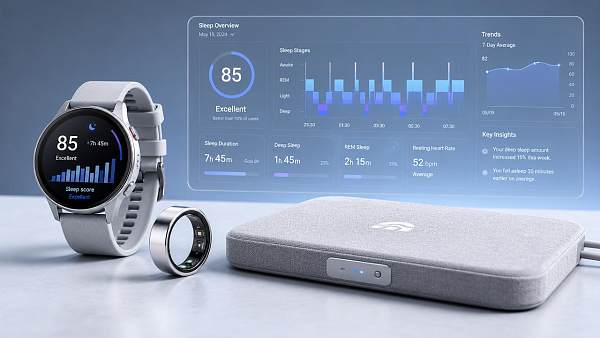
At a surface level, most smart sleep trackers appear to measure the same thing: how long you slept and how well you slept. In practice, they do not observe sleep directly. Most consumer devices infer sleep from indirect signals such as wrist motion, optical heart rate, heart rate variability, skin temperature trends, and estimated respiration. That means two devices can watch the same night and still produce different interpretations.
This matters to information researchers, procurement teams, product strategists, and health-tech observers because smart sleep trackers sit at the intersection of smart electronics, healthcare technology, sensor engineering, and data platforms. The disagreement is not always a product defect. It often reflects differences in sensor quality, body placement, firmware tuning, data filtering, and scoring logic.
For B2B market intelligence readers, the bigger lesson is that sleep quality is not a universal metric. It is a constructed metric. Each vendor defines it differently, weights factors differently, and updates formulas over time. A score of 82 from one wearable may not be equivalent to an 82 from another.
- Some smart sleep trackers prioritize movement and bed time consistency.
- Others place more emphasis on resting heart rate, overnight recovery, or estimated time in deep sleep.
- A few devices blend sleep analytics with daytime strain or readiness models, making the score partly about recovery rather than sleep alone.
That is why comparing smart sleep trackers requires a method closer to technical benchmarking than casual app browsing. TradeNexus Pro follows this approach across healthcare technology and smart electronics coverage: separate the sensing layer, the analytics layer, and the decision layer before evaluating product claims.
What exactly are smart sleep trackers measuring?
A useful way to understand disagreement is to break smart sleep trackers into functional components. Most devices do not detect brain activity directly, unlike polysomnography used in clinical sleep labs. Instead, they estimate sleep states through surrogate signals. Those signals are valid for consumer wellness use, but they are not identical to medical-grade sleep staging.
Core signals behind consumer sleep tracking
The table below summarizes common data inputs used by smart sleep trackers and how each input can influence reported sleep quality.
The main takeaway is that smart sleep trackers measure proxies, not sleep itself. That is enough for pattern tracking, but not enough to expect perfect agreement across brands, form factors, or software versions.
Why placement matters more than many users assume
A wrist-worn tracker and a ring do not experience the night in the same way. A mattress sensor captures pressure shifts and broad respiratory patterns, while a ring captures pulse and temperature close to the finger. Body location changes the raw data stream. It also changes susceptibility to movement noise, loose fit, circulation changes, and missed signals.
For anyone evaluating smart sleep trackers as a category, this is a procurement-level issue. The device form factor is not just industrial design. It is part of the measurement system.
How proprietary algorithms create different sleep scores
The strongest reason smart sleep trackers disagree is that each vendor uses proprietary scoring models. These models are trained on selected datasets, tuned for particular user populations, and optimized for specific product goals. One company may focus on consumer wellness clarity. Another may emphasize athlete recovery. A third may reduce false awakenings to improve user satisfaction.
The result is similar to having multiple weather apps built on different data models. They are not all wrong. They are processing uncertainty in different ways.
Common algorithm differences
- Sleep onset detection: some systems mark sleep when movement drops; others wait for supporting heart rate changes.
- Wake detection: brief awakenings may be counted by one device and ignored by another.
- Sleep stage estimation: deep, light, and REM assignments rely on pattern recognition rather than direct neural signals.
- Score weighting: total sleep time, efficiency, latency, regularity, HRV, and respiration may all receive different weightings.
- Baseline personalization: some smart sleep trackers compare you against your own historical pattern rather than a population average.
These differences are especially relevant in the smart electronics and healthcare technology sectors, where algorithm updates can materially change product behavior without changing the hardware. A user may think the device has become more accurate or less accurate, when the real change is a revised software model.
Which factors make the same person get different results on different nights?
Even if two smart sleep trackers use high-quality sensors, the same user can trigger unstable readings because sleep environments are highly variable. Data quality depends not only on the device but also on biological and environmental conditions.
Night-to-night variables that distort comparison
When information researchers compare smart sleep trackers, they should control for these variables before assuming one device is unreliable.
This is why a one-night comparison rarely tells the full story. Smart sleep trackers become more meaningful when assessed over two to four weeks under relatively stable routines. Trend reliability is often more valuable than nightly precision.
How should information-focused readers compare smart sleep trackers more critically?
If your goal is research rather than impulse buying, compare systems as measurement frameworks, not lifestyle gadgets. That means asking what the device measures, how often it samples, how the score is calculated, how transparent the vendor is, and whether the product is aligned with your intended use.
A practical evaluation checklist
- Define the use case first. Are you tracking general wellness, athletic recovery, sleep consistency, or symptom monitoring support?
- Check the sensing stack. Look for motion sensing, optical heart rate, respiration estimation, and temperature trend capability where relevant.
- Review score transparency. A useful system explains whether the score is driven by duration, efficiency, stages, recovery metrics, or deviations from baseline.
- Examine update history. Regular firmware and app revisions can improve performance, but they can also disrupt continuity in long-term comparisons.
- Assess data export and interoperability. For enterprise research, raw or semi-structured exports are more valuable than app-only dashboards.
- Separate wellness claims from clinical utility. Smart sleep trackers can support awareness, but they are not interchangeable with sleep lab diagnostics.
This analytical approach is increasingly important for buyers in healthcare technology, smart electronics distribution, digital health partnerships, and cross-border sourcing. TradeNexus Pro regularly frames technology choices this way because the wrong comparison criteria can distort both procurement decisions and market forecasts.
What should buyers and product researchers look for before choosing a device category?
Not all smart sleep trackers serve the same commercial or operational purpose. A ring, a smartwatch, a band, and a mattress sensor may all claim sleep quality insights, but their strengths differ by user compliance, battery profile, data depth, and integration potential.
Category comparison for decision support
The table below helps information-focused readers compare smart sleep trackers by use-case fit rather than marketing language.
For procurement and market analysis, this category-level comparison is often more useful than comparing headline sleep scores. It reveals which type of smart sleep trackers align with the end-user environment, data objectives, and total product experience.
What are the most common misconceptions about sleep quality scores?
Many users assume that a single number captures sleep truth. That is the biggest misconception. Sleep quality scores are summaries of estimated signals, not direct biological verdicts. They can be helpful, but only when interpreted in context.
FAQ and misconceptions
Are smart sleep trackers accurate enough to trust?
They are generally useful for trend monitoring, behavior awareness, and relative changes over time. They are less reliable as stand-alone tools for diagnosing sleep disorders or validating precise sleep stages. Trust them more for patterns than for exact nightly stage counts.
If two smart sleep trackers disagree, is one of them wrong?
Not necessarily. Different models may be emphasizing different biological or behavioral features. One may score your total sleep duration favorably while another penalizes elevated overnight heart rate or irregular respiration. The disagreement often reflects design intent rather than outright failure.
Should users compare scores across brands?
Only with caution. Cross-brand score comparison is rarely apples to apples. A better approach is to compare trend stability, event detection, comfort, data transparency, and consistency under the same conditions across multiple nights.
Do higher-priced smart sleep trackers always deliver better sleep insights?
Not always. Price may reflect ecosystem features, premium materials, subscription services, or broader health analytics. Better sleep insights depend on fit, sensor quality, algorithm maturity, and the match between device category and use case.
What does this mean for market intelligence, sourcing, and future product strategy?
The smart sleep trackers market illustrates a broader shift in connected healthcare technology: competitive advantage increasingly comes from data interpretation, not just hardware components. Sensors are becoming more accessible, but strong signal processing, personalization, and ecosystem integration remain key differentiators.
For exporters, OEM partners, procurement leaders, and technology scouts, that creates several decision pressures. First, hardware comparison alone is no longer enough. Second, firmware governance and app lifecycle management matter more than before. Third, regulatory boundaries between wellness tracking and health-related functionality require careful messaging and product positioning.
- Smart electronics teams should evaluate sensor sourcing, battery trade-offs, and wearability effects on signal fidelity.
- Healthcare technology stakeholders should examine how sleep data is contextualized, whether outputs support meaningful behavior change, and how claims are framed.
- Supply chain teams should monitor software dependency risk, component substitution impact, and vendor roadmap stability.
This is exactly where a focused intelligence platform adds value. TradeNexus Pro tracks the intersection of device architecture, market signals, sourcing realities, and category-level technology shifts so decision-makers can evaluate smart sleep trackers with clearer commercial context, not just consumer-facing claims.
Why choose us for deeper analysis or contact us for decision support?
If you are researching smart sleep trackers for sourcing, market mapping, product benchmarking, or partnership evaluation, TradeNexus Pro can help you move beyond surface-level reviews. Our coverage is built for professionals who need structured comparisons, technical context, and practical decision signals across smart electronics and healthcare technology.
You can contact us for specific support on parameter confirmation, device category selection, supplier landscape scanning, software-versus-hardware evaluation, delivery cycle considerations, certification-related questions, pilot comparison frameworks, and quote-stage intelligence preparation. For teams exploring smart sleep trackers as part of a broader digital health or connected device strategy, we also help clarify which metrics matter, which claims need validation, and which product assumptions deserve closer scrutiny.
When sleep data becomes a business input rather than a lifestyle curiosity, better questions lead to better decisions. That is the perspective TradeNexus Pro brings to the market.
Get weekly intelligence in your inbox.
No noise. No sponsored content. Pure intelligence.
 Sep 21, 2026What to Look for in a Grid Integration Company for Utility-Scale Solar ProjectsWhat to Look for in a Grid Integration Company for Utility-Scale Solar Projects
 Sep 20, 2026Microgrid Controller Pricing: What Drives Cost in Commercial Energy Projects?Microgrid Controller Pricing: What Drives Cost in Commercial Energy Projects?
 Sep 19, 2026How to Choose a GaN Charger for Laptops Without Compromising Power or PortabilityHow to Choose a GaN Charger for Laptops Without Compromising Power or Portability
 Sep 18, 2026Floating Solar Farm Costs: CAPEX, OPEX, and the Site Factors That Shape ROIFloating Solar Farm Costs: CAPEX, OPEX, and the Site Factors That Shape ROI
 Sep 17, 2026Drone Delivery Solutions for Last-Mile Routes: Site, Payload, and Range PlanningDrone Delivery Solutions for Last-Mile Routes: Site, Payload, and Range Planning
 Sep 16, 2026When Low-Volume Electronics Manufacturing Makes More Sense Than Mass ProductionWhen Low-Volume Electronics Manufacturing Makes More Sense Than Mass Production
 Sep 15, 2026Wholesale WiFi Smart Switches: What Buyers Should Verify Before OrderingWholesale WiFi Smart Switches: What Buyers Should Verify Before Ordering
 Sep 14, 2026How to Select IoT Sensors for Reliable Monitoring in Harsh Industrial EnvironmentsHow to Select IoT Sensors for Reliable Monitoring in Harsh Industrial Environments
 Sep 13, 2026How Procurement Teams Can Improve Supplier Reliability With Supply Chain VisibilityHow Procurement Teams Can Improve Supplier Reliability With Supply Chain Visibility
 Sep 12, 2026Smart Manufacturing Trends 2026: What Leaders Should Prioritize for ROISmart Manufacturing Trends 2026: What Leaders Should Prioritize for ROI
 Sep 11, 2026B2B Market Analysis: How Buyers Evaluate Suppliers, Pricing, and Delivery RiskB2B Market Analysis: How Buyers Evaluate Suppliers, Pricing, and Delivery Risk
 Sep 10, 2026Residential Solar Kits in Canada: How to Size a System for Your Home and ClimateResidential Solar Kits in Canada: How to Size a System for Your Home and Climate
 Sep 09, 2026How to Specify a Syringe Assembly Line for High-Volume Sterile ProductionHow to Specify a Syringe Assembly Line for High-Volume Sterile Production
 Sep 08, 2026How to Evaluate Warehouse Robotics System Suppliers for Reliable Multi-Site DeploymentHow to Evaluate Warehouse Robotics System Suppliers for Reliable Multi-Site Deployment
 Sep 07, 2026Renewable Geothermal Energy Explained: How It Works for Heating and PowerRenewable Geothermal Energy Explained: How It Works for Heating and Power
 Sep 07, 2026How to Choose an Industrial Packaging Robot Manufacturer for Your Production LineHow to Choose an Industrial Packaging Robot Manufacturer for Your Production Line
 Sep 05, 2026How to Evaluate a Turnkey Hydro Turbine Generator Supplier for Remote Power ProjectsHow to Evaluate a Turnkey Hydro Turbine Generator Supplier for Remote Power Projects
 Sep 04, 2026Automated Ultrasonic Welding for Thermoplastic Assemblies: Process Controls That MatterAutomated Ultrasonic Welding for Thermoplastic Assemblies: Process Controls That Matter
 Sep 03, 2026Energy Forecasting for Grid Planning: Sizing Solar and Storage CapacityEnergy Forecasting for Grid Planning: Sizing Solar and Storage Capacity
 Sep 02, 2026Which Metrics Should an Energy Analytics Dashboard Track for Factory Energy Management?Which Metrics Should an Energy Analytics Dashboard Track for Factory Energy Management?
 Sep 01, 2026How Warehouse Voice Picking Improves Accuracy and Throughput in Order FulfillmentHow Warehouse Voice Picking Improves Accuracy and Throughput in Order Fulfillment
 Aug 31, 2026How to Automate Dropshipping Order Processing Without Overselling StockHow to Automate Dropshipping Order Processing Without Overselling Stock
 Aug 30, 2026How to Evaluate a Smart Lighting Supplier for Multi-Site Commercial ProjectsHow to Evaluate a Smart Lighting Supplier for Multi-Site Commercial Projects
 Aug 29, 2026Recent Advances in Smart Manufacturing and Materials Reshaping Factory InvestmentRecent Advances in Smart Manufacturing and Materials Reshaping Factory Investment
 Aug 29, 2026Selecting Lightweight Aluminum Extrusions for Strength-Critical Industrial DesignsSelecting Lightweight Aluminum Extrusions for Strength-Critical Industrial Designs
 Aug 29, 2026Vertical Powder Anodizing Explained: Process Controls for Uniform Coating QualityVertical Powder Anodizing Explained: Process Controls for Uniform Coating Quality
 Aug 29, 2026PV Module Product Due Diligence: What Buyers Should Verify Before ContractingPV Module Product Due Diligence: What Buyers Should Verify Before Contracting