Smart Pet Feeders Explained: Key Features, Feeding Modes, and App Control Options
Why Smart Pet Feeders Matter More Now
Smart pet feeders have moved from niche gadgets to practical home tools.
They help keep feeding routines steady when work, travel, and irregular schedules make manual feeding less reliable.
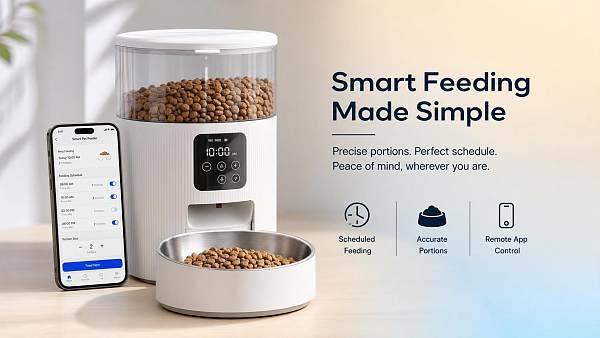
What makes them more relevant today is not only convenience.
Connected devices, app ecosystems, and better sensor design now allow smart pet feeders to support consistency, portion control, and remote oversight.
That places them within a broader smart electronics trend.
Platforms such as TradeNexus Pro often track these shifts because connected home hardware is shaped by supply chains, embedded systems, and app-driven product design.
For households, the result is simple.
Feeding becomes easier to manage, but choosing the right device becomes more technical than it first appears.
The difference between a useful feeder and a frustrating one often comes down to small details.
What Smart Pet Feeders Actually Do
At the most basic level, smart pet feeders dispense food automatically based on settings chosen by the owner.
That can include meal timing, portion size, feeding frequency, and in some models, remote release of an extra meal.
The smarter models add digital layers.
They connect through Wi-Fi or Bluetooth, sync with mobile apps, send alerts, and sometimes track feeding history.
Some also include cameras, microphones, voice recording, or blockage detection.
In other words, smart pet feeders combine mechanical dispensing with software control.
That combination is exactly why product quality varies so much across the market.
A feeder may look similar on the outside, yet differ significantly in motor accuracy, app stability, food compatibility, and long-term reliability.
Key Features That Deserve Closer Attention
When comparing smart pet feeders, feature lists can be misleading.
The more useful approach is to focus on how each function affects daily use.
Portion accuracy and meal scheduling
Accurate portion control matters for weight management and routine.
A good device should allow small adjustments rather than only broad serving sizes.
Scheduling should also be flexible enough for multiple meals per day.
Food capacity and kibble compatibility
Storage volume affects refill frequency, but hopper design matters just as much.
Some smart pet feeders work well only with specific kibble shapes and sizes.
If food pieces are too large, oily, or uneven, jams become more likely.
Power backup and offline function
Power loss is easy to overlook until it happens.
Battery backup helps protect the feeding schedule during outages.
Some devices can continue scheduled dispensing even when the internet drops.
Cleaning and material quality
Removable trays, sealed storage, and food-safe materials reduce maintenance headaches.
A feeder that is hard to clean often becomes less hygienic over time.
- Look for consistent dispensing, not just large feature counts.
- Check whether the feeder supports your preferred kibble size.
- Treat power backup as a practical requirement, not a bonus.
- Choose a design that can be disassembled and cleaned quickly.
Understanding Common Feeding Modes
Feeding modes shape how flexible smart pet feeders feel in real life.
The best mode is not always the one with the most automation.
It is the one that matches eating behavior and household routine.
Scheduled feeding remains the core mode for most smart pet feeders.
Still, mixed mode has become more valuable as app control improves.
That flexibility helps when routines shift, visitors intervene, or meal timing needs a quick adjustment.
Why App Control Can Be the Real Deciding Factor
A weak app can undermine a well-built feeder.
That is why app control should be judged as seriously as the hardware itself.
This is also where smart electronics and software design meet in a very visible way.
TradeNexus Pro regularly highlights this kind of cross-sector convergence.
Connected products no longer compete only on components.
They compete on user interface, update support, data reliability, and platform continuity.
Useful app features
- Real-time alerts for missed meals, low food levels, or blockages.
- Remote meal release for schedule disruptions.
- Feeding logs that show when and how much food was dispensed.
- Multi-user access for shared household control.
- Firmware updates that improve performance after purchase.
App control also raises a few practical questions.
Does the feeder depend entirely on cloud access.
Does the app remain stable after updates.
Are notifications timely enough to matter.
These details often separate dependable smart pet feeders from flashy but short-lived products.
Where Smart Pet Feeders Create the Most Value
The clearest value appears in ordinary situations rather than extreme ones.
Busy weekdays, early meetings, delayed commutes, and short trips are where smart pet feeders often prove their worth.
They also help reduce accidental overfeeding when multiple people share feeding responsibility.
For pets that benefit from regular portions, automation can support a more stable routine.
Some households value the monitoring aspect even more than the feeding itself.
A quick app check can confirm whether a meal was delivered, which removes uncertainty during a long day away from home.
That said, smart pet feeders are not a full substitute for human care.
They manage routine feeding well, but they do not replace observation, interaction, or health-related attention.
How to Compare Options Without Getting Lost
A practical comparison starts with daily needs, not marketing claims.
Before choosing among smart pet feeders, it helps to narrow the decision around a few questions.
- How many meals need to be scheduled each day.
- How precise should the portion settings be.
- Will the feeder be used mainly at home, during workdays, or during travel.
- Is remote control essential or only occasionally useful.
- Can the device keep operating during power or network interruptions.
- How easy is it to clean the bowl, hopper, and dispensing path.
Reading the product page alone rarely answers all of this.
It is worth checking app screenshots, update history, and real use feedback.
That habit reflects a wider digital buying trend.
People increasingly judge connected products through the quality of information around them, not just the device image.
This is one reason editorial platforms with stronger technology and supply chain context remain relevant.
A Smarter Next Step
Choosing smart pet feeders becomes easier once the decision is reduced to routine, reliability, and control.
The best option is rarely the one with the longest feature list.
It is the one that fits feeding habits, works consistently, and stays manageable over time.
A sensible next step is to map your feeding schedule, food type, and app expectations before comparing models.
From there, smart pet feeders can be assessed less like impulse gadgets and more like connected household tools worth choosing carefully.
Get weekly intelligence in your inbox.
No noise. No sponsored content. Pure intelligence.
 Sep 15, 2026Wholesale WiFi Smart Switches: What Buyers Should Verify Before OrderingWholesale WiFi Smart Switches: What Buyers Should Verify Before Ordering
 Sep 14, 2026How to Select IoT Sensors for Reliable Monitoring in Harsh Industrial EnvironmentsHow to Select IoT Sensors for Reliable Monitoring in Harsh Industrial Environments
 Sep 13, 2026How Procurement Teams Can Improve Supplier Reliability With Supply Chain VisibilityHow Procurement Teams Can Improve Supplier Reliability With Supply Chain Visibility
 Sep 12, 2026Smart Manufacturing Trends 2026: What Leaders Should Prioritize for ROISmart Manufacturing Trends 2026: What Leaders Should Prioritize for ROI
 Sep 11, 2026B2B Market Analysis: How Buyers Evaluate Suppliers, Pricing, and Delivery RiskB2B Market Analysis: How Buyers Evaluate Suppliers, Pricing, and Delivery Risk
 Sep 10, 2026Residential Solar Kits in Canada: How to Size a System for Your Home and ClimateResidential Solar Kits in Canada: How to Size a System for Your Home and Climate
 Sep 09, 2026How to Specify a Syringe Assembly Line for High-Volume Sterile ProductionHow to Specify a Syringe Assembly Line for High-Volume Sterile Production
 Sep 08, 2026How to Evaluate Warehouse Robotics System Suppliers for Reliable Multi-Site DeploymentHow to Evaluate Warehouse Robotics System Suppliers for Reliable Multi-Site Deployment
 Sep 07, 2026Renewable Geothermal Energy Explained: How It Works for Heating and PowerRenewable Geothermal Energy Explained: How It Works for Heating and Power
 Sep 07, 2026How to Choose an Industrial Packaging Robot Manufacturer for Your Production LineHow to Choose an Industrial Packaging Robot Manufacturer for Your Production Line
 Sep 05, 2026How to Evaluate a Turnkey Hydro Turbine Generator Supplier for Remote Power ProjectsHow to Evaluate a Turnkey Hydro Turbine Generator Supplier for Remote Power Projects
 Sep 04, 2026Automated Ultrasonic Welding for Thermoplastic Assemblies: Process Controls That MatterAutomated Ultrasonic Welding for Thermoplastic Assemblies: Process Controls That Matter
 Sep 03, 2026Energy Forecasting for Grid Planning: Sizing Solar and Storage CapacityEnergy Forecasting for Grid Planning: Sizing Solar and Storage Capacity
 Sep 02, 2026Which Metrics Should an Energy Analytics Dashboard Track for Factory Energy Management?Which Metrics Should an Energy Analytics Dashboard Track for Factory Energy Management?
 Sep 01, 2026How Warehouse Voice Picking Improves Accuracy and Throughput in Order FulfillmentHow Warehouse Voice Picking Improves Accuracy and Throughput in Order Fulfillment
 Aug 31, 2026How to Automate Dropshipping Order Processing Without Overselling StockHow to Automate Dropshipping Order Processing Without Overselling Stock
 Aug 30, 2026How to Evaluate a Smart Lighting Supplier for Multi-Site Commercial ProjectsHow to Evaluate a Smart Lighting Supplier for Multi-Site Commercial Projects
 Aug 29, 2026Recent Advances in Smart Manufacturing and Materials Reshaping Factory InvestmentRecent Advances in Smart Manufacturing and Materials Reshaping Factory Investment
 Aug 29, 2026Selecting Lightweight Aluminum Extrusions for Strength-Critical Industrial DesignsSelecting Lightweight Aluminum Extrusions for Strength-Critical Industrial Designs
 Aug 29, 2026Vertical Powder Anodizing Explained: Process Controls for Uniform Coating QualityVertical Powder Anodizing Explained: Process Controls for Uniform Coating Quality
 Aug 29, 2026PV Module Product Due Diligence: What Buyers Should Verify Before ContractingPV Module Product Due Diligence: What Buyers Should Verify Before Contracting
 Aug 29, 2026Solar Design for Challenging Terrain: Managing Slope, Soil, and Shading RisksSolar Design for Challenging Terrain: Managing Slope, Soil, and Shading Risks
 Aug 29, 2026IS 16444 Smart Meter Requirements: Key Functions, Tests, and ComplianceIS 16444 Smart Meter Requirements: Key Functions, Tests, and Compliance
 Aug 29, 2026Rehabilitation Equipment Market Outlook: Demand Drivers and Growth SegmentsRehabilitation Equipment Market Outlook: Demand Drivers and Growth Segments
 Aug 29, 2026When Does Container Handling Automation Deliver ROI in Port Yard Operations?When Does Container Handling Automation Deliver ROI in Port Yard Operations?
 Aug 29, 2026Customs API Integration: A Practical Checklist for Automated Trade ComplianceCustoms API Integration: A Practical Checklist for Automated Trade Compliance
 Aug 29, 2026Returnable Packaging for Automotive: How to Cut Damage and Reverse Logistics CostsReturnable Packaging for Automotive: How to Cut Damage and Reverse Logistics Costs