
Hydrogen Fuel Cell Efficiency Explained: Stack Design, Operating Conditions, and System Losses
Hydrogen fuel cells are often introduced through a simple promise: clean electricity with water as the main byproduct. That framing is useful, but incomplete. In real projects, efficiency is shaped by electrochemistry, stack architecture, operating conditions, auxiliary power demand, and system integration choices.
That is why efficiency claims for hydrogen fuel cells deserve closer reading. A lab result at ideal temperature and load may say little about field performance in mobility, distributed power, backup systems, or industrial energy applications.
For cross-border technology evaluation, the question is rarely whether hydrogen fuel cells work. The more relevant question is how efficiently they perform in the specific duty cycle, climate, maintenance environment, and balance-of-plant configuration that the project actually requires.
Why efficiency matters beyond the headline number
Efficiency determines more than energy conversion quality. It affects hydrogen consumption, thermal management burden, equipment footprint, operating cost, and the economics of storage and transport across the supply chain.
In green energy markets, that matters because hydrogen itself is still costly to produce, compress, liquefy, move, and dispense. A few percentage points of system efficiency can change the commercial viability of a project.
This also explains why platforms such as TradeNexus Pro focus on decision-grade industry analysis. For technologies that sit between advanced manufacturing, clean energy, and industrial supply chains, performance must be read in commercial context, not in isolation.
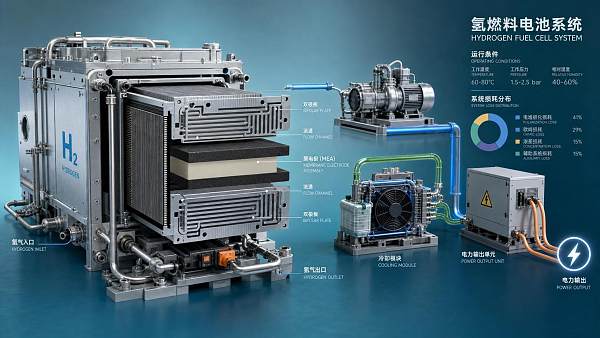
A stack with excellent peak efficiency may still underperform if startup losses are high, air compression is inefficient, or the unit operates far from its design point during daily use.
What efficiency means in hydrogen fuel cells
At the cell level, hydrogen fuel cells convert chemical energy into electrical energy through an electrochemical reaction. They avoid combustion, which is one reason their theoretical efficiency can exceed many conventional thermal systems.
But theoretical efficiency is not the same as usable efficiency. In practice, evaluators usually distinguish among cell efficiency, stack efficiency, and full system efficiency.
This distinction matters when comparing suppliers. Some published values describe gross stack efficiency, while procurement and deployment decisions usually depend on net system efficiency.
How stack design shapes performance
Stack design sits at the center of hydrogen fuel cells performance. Materials, geometry, sealing quality, bipolar plate design, catalyst loading, membrane properties, and flow-field engineering all influence losses and durability.
Active area and current density
Higher current density can reduce system size and cost per kilowatt. It can also lower voltage efficiency, increase heat generation, and accelerate degradation if the design margin is narrow.
A compact stack may look commercially attractive, yet its efficiency curve could be weaker at sustained high load. That tradeoff is common in mobile and space-constrained applications.
Flow-field and reactant distribution
Hydrogen and air must reach reaction sites evenly. Poor distribution creates local starvation, water accumulation, and uneven temperature zones. These effects reduce output and increase long-term reliability risk.
Membrane and catalyst choices
The membrane electrode assembly strongly affects proton transport, water balance, and tolerance to operating variation. Catalyst formulation influences activation losses, precious metal content, and sensitivity to contaminants.
For technical comparison, efficiency should always be reviewed alongside expected service life. A design tuned aggressively for short-term output is not automatically stronger in lifecycle economics.
Operating conditions can change the result quickly
Even well-designed hydrogen fuel cells can perform very differently under changing operating conditions. Temperature, pressure, humidity, fuel purity, altitude, transient load, and startup frequency all influence efficiency.
Temperature and humidity balance
Low membrane hydration raises resistance. Too much water causes flooding and blocks gas transport. Efficient operation depends on maintaining the narrow zone where conductivity and gas access remain balanced.
Pressure and air supply
Pressurization can improve reaction kinetics and power density. However, compressors consume electricity. If auxiliary demand is high, net efficiency may fall even when stack performance appears stronger.
Load profile and transients
Steady operation usually supports better efficiency. Frequent ramps, idling, stop-start cycling, and partial-load operation create additional losses. This is especially relevant in transport fleets and hybrid microgrids.
When reading supplier data, the test protocol deserves as much attention as the efficiency number itself. Without that context, comparisons between hydrogen fuel cells can be misleading.
Where system losses actually come from
The largest misunderstanding in many evaluations is assuming the stack explains the whole system. In reality, balance-of-plant losses can materially reduce the net value delivered by hydrogen fuel cells.
- Air compression and blower power draw
- Coolant pumps and thermal management equipment
- Hydrogen recirculation and purge losses
- Power conditioning and DC-AC conversion losses
- Controls, sensors, valves, and standby consumption
- Startup heating and cold-weather conditioning
These losses vary by system type. Proton exchange membrane units often face different balance issues than solid oxide systems, especially regarding temperature management, startup behavior, and part-load response.
From an industrial sourcing perspective, this is where specification clarity becomes critical. Suppliers may share stack benchmarks, while project economics depend on net output after every parasitic load is counted.
What to examine in real business scenarios
Hydrogen fuel cells are not evaluated the same way in every market. Stationary power, heavy mobility, backup systems, material handling, and off-grid applications all place different weight on efficiency metrics.
This broader reading aligns with how TradeNexus Pro approaches green energy and industrial technology coverage. The important question is not only technical feasibility, but whether a solution remains efficient within supply, maintenance, and deployment realities.
A practical framework for evaluating supplier claims
A disciplined review process helps separate credible performance from selective presentation. Hydrogen fuel cells should be assessed through operating evidence, not through one isolated benchmark.
- Check whether the figure is cell, stack, gross system, or net system efficiency.
- Request the load point, temperature, pressure, humidity, and fuel purity behind the result.
- Review efficiency across the operating range, not only at the best point.
- Ask for auxiliary power consumption under startup, steady load, and standby conditions.
- Compare efficiency with degradation rate, maintenance interval, and expected stack replacement timing.
- Look for third-party validation, field references, and transparent test standards.
This approach is particularly useful when evaluating international suppliers or new market entrants. In content-driven discovery environments, strong technical storytelling should still be backed by measurable, auditable evidence.
What comes next in hydrogen fuel cells assessment
Efficiency will remain a central metric, but it should be treated as part of a wider decision model. Hydrogen fuel cells compete on durability, manufacturability, safety, fuel pathway economics, and regional infrastructure readiness as well.
The next useful step is to map the intended application against real operating conditions, then compare technologies using net system performance, not headline stack numbers. That creates a clearer basis for shortlisting suppliers, testing assumptions, and identifying where deeper due diligence is needed.
When efficiency is viewed through stack design, operating behavior, and system losses together, hydrogen fuel cells become easier to judge with precision. That is usually where better technical decisions begin.
Get weekly intelligence in your inbox.
No noise. No sponsored content. Pure intelligence.
 Oct 08, 2026How Digital Health Improves Diagnostic Accuracy and Workflow in Clinical LabsHow Digital Health Improves Diagnostic Accuracy and Workflow in Clinical Labs
 Oct 07, 2026Selecting Voice Picking Systems for German Warehouses: Integration, Languages and ROISelecting Voice Picking Systems for German Warehouses: Integration, Languages and ROI
 Oct 06, 2026How to Choose Last Mile Dispatch Software for On-Time Delivery at ScaleHow to Choose Last Mile Dispatch Software for On-Time Delivery at Scale
 Oct 05, 2026Vietnam’s Consumer Electronics Market: Demand Shifts and Sourcing OpportunitiesVietnam’s Consumer Electronics Market: Demand Shifts and Sourcing Opportunities
 Oct 04, 2026Digital Health Investment Priorities for Providers: Improving Access, Outcomes, and EfficiencyDigital Health Investment Priorities for Providers: Improving Access, Outcomes, and Efficiency
 Oct 03, 2026How to Specify an FR4 Custom PCB Board for High-Voltage and High-Heat DesignsHow to Specify an FR4 Custom PCB Board for High-Voltage and High-Heat Designs
 Oct 02, 2026ERP Software Market Intelligence: Adoption, Pricing, and Vendor Signals to WatchERP Software Market Intelligence: Adoption, Pricing, and Vendor Signals to Watch
 Oct 01, 2026How to Select Calibrated Temperature Data Loggers for GMP Cold Storage MonitoringHow to Select Calibrated Temperature Data Loggers for GMP Cold Storage Monitoring
 Sep 30, 2026Custom Molded Rubber Pricing: What Drives Unit Cost and Tooling Fees?Custom Molded Rubber Pricing: What Drives Unit Cost and Tooling Fees?
 Sep 29, 2026How to Evaluate Energy Management Software Vendors for Multi-Site OperationsHow to Evaluate Energy Management Software Vendors for Multi-Site Operations
 Sep 28, 2026How to Select a DIN Rail Smart Meter for Multi-Circuit Energy MonitoringHow to Select a DIN Rail Smart Meter for Multi-Circuit Energy Monitoring
 Sep 27, 2026TWS Earbuds in Vietnam: Demand Drivers, Price Tiers, and Retail Channel OpportunitiesTWS Earbuds in Vietnam: Demand Drivers, Price Tiers, and Retail Channel Opportunities
 Sep 26, 2026How UAE Clinics Can Qualify a Smart Glucometer Supplier for Accuracy and ComplianceHow UAE Clinics Can Qualify a Smart Glucometer Supplier for Accuracy and Compliance
 Sep 25, 2026Buying Aesthetic Lasers in the USA: FDA Status, Wavelengths, and Service SupportBuying Aesthetic Lasers in the USA: FDA Status, Wavelengths, and Service Support
 Sep 24, 2026Laser Cutting Brass Sheet: How to Prevent Burrs and Heat Marks on Thin PartsLaser Cutting Brass Sheet: How to Prevent Burrs and Heat Marks on Thin Parts
 Sep 23, 2026How to Choose Lightweight ANC Headphones for Comfortable All-Day TravelHow to Choose Lightweight ANC Headphones for Comfortable All-Day Travel
 Sep 22, 2026IPX5 TWS Bluetooth Earbuds: What Protection Do They Offer for Workouts?IPX5 TWS Bluetooth Earbuds: What Protection Do They Offer for Workouts?
 Sep 21, 2026What to Look for in a Grid Integration Company for Utility-Scale Solar ProjectsWhat to Look for in a Grid Integration Company for Utility-Scale Solar Projects
 Sep 20, 2026Microgrid Controller Pricing: What Drives Cost in Commercial Energy Projects?Microgrid Controller Pricing: What Drives Cost in Commercial Energy Projects?
 Sep 19, 2026How to Choose a GaN Charger for Laptops Without Compromising Power or PortabilityHow to Choose a GaN Charger for Laptops Without Compromising Power or Portability
 Sep 18, 2026Floating Solar Farm Costs: CAPEX, OPEX, and the Site Factors That Shape ROIFloating Solar Farm Costs: CAPEX, OPEX, and the Site Factors That Shape ROI
 Sep 17, 2026Drone Delivery Solutions for Last-Mile Routes: Site, Payload, and Range PlanningDrone Delivery Solutions for Last-Mile Routes: Site, Payload, and Range Planning
 Sep 16, 2026When Low-Volume Electronics Manufacturing Makes More Sense Than Mass ProductionWhen Low-Volume Electronics Manufacturing Makes More Sense Than Mass Production
 Sep 15, 2026Wholesale WiFi Smart Switches: What Buyers Should Verify Before OrderingWholesale WiFi Smart Switches: What Buyers Should Verify Before Ordering
 Sep 14, 2026How to Select IoT Sensors for Reliable Monitoring in Harsh Industrial EnvironmentsHow to Select IoT Sensors for Reliable Monitoring in Harsh Industrial Environments
 Sep 13, 2026How Procurement Teams Can Improve Supplier Reliability With Supply Chain VisibilityHow Procurement Teams Can Improve Supplier Reliability With Supply Chain Visibility
 Sep 12, 2026Smart Manufacturing Trends 2026: What Leaders Should Prioritize for ROISmart Manufacturing Trends 2026: What Leaders Should Prioritize for ROI



























