How to Choose a Plastic Injection Molding Machine for Medical Devices
Start with the part and the process, not the machine brochure
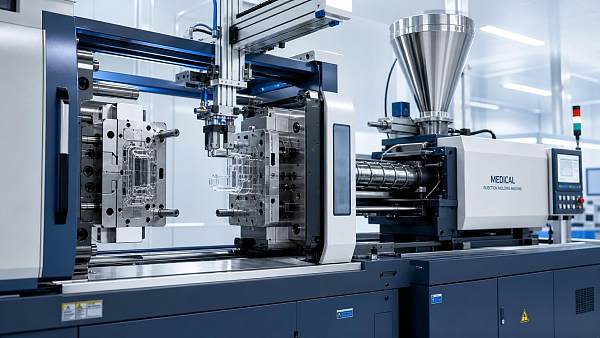
When you are selecting a plastic injection molding machine for medical devices, the usual shortcuts fail fast. Clamp tonnage, shot size, and price matter, but they are not the main story. In medical manufacturing, a machine is only a good fit if it can hold a stable process for the resin you plan to run, support the cleanliness level your product requires, and produce documentation that fits your validation and quality system.
That changes the evaluation sequence. Before comparing brands or negotiating cost, define the part family, resin type, cavity concept, cleanroom expectations, downstream assembly method, and the level of process evidence your quality team will require. A machine that looks oversized and safe on paper can still be the wrong choice if it shears a sensitive resin, creates avoidable particulate, or cannot repeat a narrow process window over long production runs.
For technical evaluators, the practical question is simple: which machine characteristics directly reduce variation and compliance risk for this device program? That is the lens worth using all the way through the checklist below.
Check the resin before you size the machine
Medical parts are often molded from materials that punish a poorly matched machine. PC, PEEK, PPSU, PEI, certain grades of PP, and many filled or transparent materials each bring different sensitivity to heat history, moisture, residence time, and screw design. If your team starts with clamp force alone, you can end up with a machine that can physically mold the part but cannot do it consistently without degrading the polymer.
- Review the resin supplier's processing guidance: melt temperature range, mold temperature range, drying requirement, residence time limits, and any warning about shear sensitivity.
- Ask whether the machine's screw geometry and barrel configuration are suitable for that resin family, not just whether the controller has the right temperature range.
- Look at expected shot utilization. Running a very small shot on a very large barrel often creates avoidable residence time problems, especially with heat-sensitive materials.
A common mistake is buying for future flexibility so aggressively that the first program runs in a poor operating window. Some spare capacity is sensible. Excess barrel volume is not always harmless.
Match clamp force to the mold, but also check platen layout and tie-bar spacing
Clamp tonnage gets attention because it is easy to compare. In practice, the machine must fit the mold base, support the projected area and injection pressure, and leave enough room for utilities, hot runner connections, and maintenance access. Tie-bar spacing and platen dimensions can become the hidden constraint long before nameplate tonnage does.
For medical programs, include future validation realities in this check. If the mold will need cavity pressure sensors, valve gate wiring, quick mold change hardware, or additional monitoring hardware, make sure the machine layout supports those features without awkward workarounds. A technically possible installation that is difficult to service becomes a production risk later.
Do not treat repeatability as a marketing word
Medical device molding usually lives or dies on process consistency. Flash, short shots, gate vestige variation, dimensional drift, bubble formation, and cosmetic shifts can all trace back to unstable shot control. This is where machine architecture matters. Electric machines are often preferred for cleanroom-friendly operation and high repeatability, but the right choice still depends on part geometry, material, cycle profile, and facility standards.
Instead of asking whether a machine is "precise," ask for evidence tied to control points that matter in molding:
- Injection speed control across the filling phase
- Transfer repeatability from velocity to pressure
- Hold pressure stability
- Screw recovery consistency
- Cushion control from shot to shot
If your part has thin walls, micro features, insert overmolding, or tight visual standards, this section deserves extra weight in the machine scorecard. Those applications expose control weakness quickly.
Check whether the machine is genuinely suitable for cleanroom production
Not every medical device is molded in the same environment. Some parts are made outside a cleanroom and cleaned later. Others move directly into packaging or sterile barrier assembly. The machine has to fit the actual contamination-control plan, not a generic "medical" label.
Look at practical details:
- Lubrication points and the risk of oil mist or leaks
- Particle-generating motion components near the mold area
- Surface design that allows effective cleaning
- Cable routing, covers, and debris traps
- Compatibility with laminar flow or enclosed molding cells
This is also where auxiliary equipment starts to matter. Dryers, loaders, chillers, robots, granulators, and conveyor systems can undermine a clean setup even if the molding press itself looks appropriate. Machine selection should be reviewed as part of the full cell, not in isolation.
Validation support is not optional if the process must be documented
Technical teams often focus on whether the machine can make acceptable parts during trials. Quality teams care whether that performance can be documented, locked, monitored, and reproduced. For many medical device programs, especially those feeding regulated manufacturing systems, the machine controller and data functions deserve as much attention as the mechanics.
Check these points early:
If the site plans IQ, OQ, and PQ activities around the molding process, make sure the supplier can clearly explain the machine documentation package, software version control, and service support model. The machine does not need to solve your quality system for you, but it should not create avoidable gaps.
Look closely at screw, barrel, and nozzle configuration
This is where many evaluations stay too shallow. Resin behavior in medical molding is heavily affected by plasticizing design. Screw diameter influences injection pressure and shot control. Compression ratio and check ring behavior influence melt uniformity. Nozzle design affects drool, stringing, freeze-off behavior, and temperature stability at the gate.
Ask the machine supplier to map the proposed injection unit to your expected shot weight range, resin family, and cycle time. If the part is small and the resin is sensitive, a better-matched smaller screw can be more valuable than a machine with broader general-purpose flexibility. That matters even more for transparent medical parts, micro-molded components, and multi-cavity tools where small variations multiply fast.
Think through automation and part handling before approval
Medical parts are often damaged after molding, not during filling. Scratches, deformation, contamination from manual contact, and mixed-lot handling can wipe out the benefit of a stable press. If the device program needs robotic demolding, vision inspection, insert loading, in-line assembly, or protected transfer into packaging, machine selection should reflect those integration needs from the start.
A few questions save time here:
- Is there enough access and mounting provision for the robot or take-out system?
- Can the controller exchange signals cleanly with vision, sealing, marking, or downstream assembly equipment?
- Will the ejection and part drop path protect delicate features?
If the answer to any of these is vague during quotation stage, that usually becomes an integration problem later.
Do not ignore maintenance access and spare parts logic
A machine that is technically capable but difficult to maintain is a bad fit for a validated medical line. The cost is not just downtime. Every unstable repair cycle creates more process requalification work, more scrap exposure, and more operator dependence.
Review wear parts, lead times, local service response, and preventive maintenance access. Pay attention to components that directly affect process stability: heaters, thermocouples, check rings, seals, transducers, servo components, and controller hardware. If replacement parts require long cross-border lead times, the risk belongs in the buying decision, not only in operations planning.
Use trials to stress the process window, not to prove one good run
A useful machine trial does more than produce sample parts that look fine on the table. It should show how the press behaves as you move around the expected process window. That means reviewing startup behavior, recovery after interruption, shot-to-shot consistency, response to controlled parameter changes, and stability over enough cycles to reveal drift.
For technical evaluation, record what actually matters to the product: part weight consistency, critical dimension movement, visual defects, fill balance where relevant, and any relationship between machine data and part quality signals. One attractive demo run proves very little. Trend behavior tells you much more.
A short decision filter for final selection
When two or three machines still look viable, narrow them with a harder filter:
- Which machine best matches the resin and shot size without creating unnecessary residence time risk?
- Which one gives the most stable control over fill, transfer, hold, and recovery?
- Which setup fits your actual cleanliness strategy and automation layout?
- Which controller and data package will support validation and deviation review with the least friction?
- Which supplier can support the machine over the life of the medical program, not just during installation?
That is usually the right order. Medical molding rewards fit and stability far more than headline capacity.
What to lock down before issuing the purchase decision
Before the order is released, confirm the approved machine configuration in writing: injection unit details, screw and barrel specification, controller functions, data interfaces, utility requirements, cleanroom-related features, robot interface scope, documentation package, and service commitments. A lot of avoidable trouble in medical equipment sourcing comes from assuming these items are standard when they are actually optional or region-dependent.
The safest buying habit is to work from the part outward. Define the material and risk profile, fit the machine to the real process window, verify how it will be validated and maintained, then compare commercial terms. That sequence usually leads to a machine that performs well after commissioning, not just during the sales demo.
Get weekly intelligence in your inbox.
No noise. No sponsored content. Pure intelligence.
 Sep 20, 2026Microgrid Controller Pricing: What Drives Cost in Commercial Energy Projects?Microgrid Controller Pricing: What Drives Cost in Commercial Energy Projects?
 Sep 19, 2026How to Choose a GaN Charger for Laptops Without Compromising Power or PortabilityHow to Choose a GaN Charger for Laptops Without Compromising Power or Portability
 Sep 18, 2026Floating Solar Farm Costs: CAPEX, OPEX, and the Site Factors That Shape ROIFloating Solar Farm Costs: CAPEX, OPEX, and the Site Factors That Shape ROI
 Sep 17, 2026Drone Delivery Solutions for Last-Mile Routes: Site, Payload, and Range PlanningDrone Delivery Solutions for Last-Mile Routes: Site, Payload, and Range Planning
 Sep 16, 2026When Low-Volume Electronics Manufacturing Makes More Sense Than Mass ProductionWhen Low-Volume Electronics Manufacturing Makes More Sense Than Mass Production
 Sep 15, 2026Wholesale WiFi Smart Switches: What Buyers Should Verify Before OrderingWholesale WiFi Smart Switches: What Buyers Should Verify Before Ordering
 Sep 14, 2026How to Select IoT Sensors for Reliable Monitoring in Harsh Industrial EnvironmentsHow to Select IoT Sensors for Reliable Monitoring in Harsh Industrial Environments
 Sep 13, 2026How Procurement Teams Can Improve Supplier Reliability With Supply Chain VisibilityHow Procurement Teams Can Improve Supplier Reliability With Supply Chain Visibility
 Sep 12, 2026Smart Manufacturing Trends 2026: What Leaders Should Prioritize for ROISmart Manufacturing Trends 2026: What Leaders Should Prioritize for ROI
 Sep 11, 2026B2B Market Analysis: How Buyers Evaluate Suppliers, Pricing, and Delivery RiskB2B Market Analysis: How Buyers Evaluate Suppliers, Pricing, and Delivery Risk
 Sep 10, 2026Residential Solar Kits in Canada: How to Size a System for Your Home and ClimateResidential Solar Kits in Canada: How to Size a System for Your Home and Climate
 Sep 09, 2026How to Specify a Syringe Assembly Line for High-Volume Sterile ProductionHow to Specify a Syringe Assembly Line for High-Volume Sterile Production
 Sep 08, 2026How to Evaluate Warehouse Robotics System Suppliers for Reliable Multi-Site DeploymentHow to Evaluate Warehouse Robotics System Suppliers for Reliable Multi-Site Deployment
 Sep 07, 2026Renewable Geothermal Energy Explained: How It Works for Heating and PowerRenewable Geothermal Energy Explained: How It Works for Heating and Power
 Sep 07, 2026How to Choose an Industrial Packaging Robot Manufacturer for Your Production LineHow to Choose an Industrial Packaging Robot Manufacturer for Your Production Line
 Sep 05, 2026How to Evaluate a Turnkey Hydro Turbine Generator Supplier for Remote Power ProjectsHow to Evaluate a Turnkey Hydro Turbine Generator Supplier for Remote Power Projects
 Sep 04, 2026Automated Ultrasonic Welding for Thermoplastic Assemblies: Process Controls That MatterAutomated Ultrasonic Welding for Thermoplastic Assemblies: Process Controls That Matter
 Sep 03, 2026Energy Forecasting for Grid Planning: Sizing Solar and Storage CapacityEnergy Forecasting for Grid Planning: Sizing Solar and Storage Capacity
 Sep 02, 2026Which Metrics Should an Energy Analytics Dashboard Track for Factory Energy Management?Which Metrics Should an Energy Analytics Dashboard Track for Factory Energy Management?
 Sep 01, 2026How Warehouse Voice Picking Improves Accuracy and Throughput in Order FulfillmentHow Warehouse Voice Picking Improves Accuracy and Throughput in Order Fulfillment
 Aug 31, 2026How to Automate Dropshipping Order Processing Without Overselling StockHow to Automate Dropshipping Order Processing Without Overselling Stock
 Aug 30, 2026How to Evaluate a Smart Lighting Supplier for Multi-Site Commercial ProjectsHow to Evaluate a Smart Lighting Supplier for Multi-Site Commercial Projects
 Aug 29, 2026Recent Advances in Smart Manufacturing and Materials Reshaping Factory InvestmentRecent Advances in Smart Manufacturing and Materials Reshaping Factory Investment
 Aug 29, 2026Selecting Lightweight Aluminum Extrusions for Strength-Critical Industrial DesignsSelecting Lightweight Aluminum Extrusions for Strength-Critical Industrial Designs
 Aug 29, 2026Vertical Powder Anodizing Explained: Process Controls for Uniform Coating QualityVertical Powder Anodizing Explained: Process Controls for Uniform Coating Quality
 Aug 29, 2026PV Module Product Due Diligence: What Buyers Should Verify Before ContractingPV Module Product Due Diligence: What Buyers Should Verify Before Contracting
 Aug 29, 2026Solar Design for Challenging Terrain: Managing Slope, Soil, and Shading RisksSolar Design for Challenging Terrain: Managing Slope, Soil, and Shading Risks