Energy Forecasting for Grid Planning: Sizing Solar and Storage Capacity
Solar-plus-storage capacity cannot be sized reliably from annual electricity consumption alone. A project can appear well matched on a yearly energy basis and still fail during late-afternoon peaks, cloudy operating periods, seasonal demand highs, or grid outages. The central task in energy forecasting for grid planning is to convert uncertain future conditions into a design envelope: how much energy is needed, when it is needed, how much local solar can produce at those times, and what the grid can absorb or supply.
For project delivery, the most useful output is not a single forecast figure. It is a set of design cases that show how solar capacity, battery power, battery duration, interconnection limits, and operational priorities behave under expected, stressed, and expansion conditions. This prevents two costly outcomes: overbuilding equipment that produces limited additional value, or commissioning a system that cannot support the loads and operating commitments it was intended to serve.
Start with the load shape, not the annual total
Annual demand remains important for financial modelling and broad energy-balance calculations, but it is not enough to determine system size. Solar generation and storage dispatch are governed by intervals—typically hourly or sub-hourly—not by annual averages.
A facility using 10 GWh per year may have a relatively flat 1.1 MW base load, or it may reach 4 MW for short production peaks while consuming little power overnight. Those two profiles call for substantially different storage power ratings, inverter configurations, protection settings, and interconnection strategies, even if their yearly electricity use is identical.
The load forecast should distinguish at least the following operating characteristics:
- Baseload: continuous demand from essential production equipment, refrigeration, data systems, safety infrastructure, pumping, or other always-on processes.
- Peak demand: the highest simultaneous demand and the duration for which it persists. A short motor-starting event is different from a three-hour evening production peak.
- Daily timing: whether consumption aligns with solar output or rises after solar production declines.
- Weekly operating pattern: shutdown days, maintenance windows, shift changes, and weekend operations can alter the value of both solar and storage.
- Seasonal behavior: cooling loads, heating loads, irrigation cycles, tourism-related operations, or production seasonality can create material differences between months.
- Critical versus flexible loads: not every load needs backup or battery support. Some can be shifted, curtailed, or sequenced during constrained periods.
Interval data from utility meters, building management systems, production controls, and submeters should be reconciled before modelling begins. Meter data often contains gaps, estimated readings, timestamp changes, or aggregation problems. A battery model built on unverified load intervals may produce a precise-looking result that has little operational meaning.
Where historical load data is limited, the forecast should be constructed from equipment duty cycles and operating schedules rather than from a single monthly bill. This is particularly important for new plants, expansions, logistics hubs, electrified fleets, and facilities replacing fossil-fuel equipment with electric processes.
Forecast future demand as a range tied to real project decisions
Capacity planning becomes unreliable when a forecast silently assumes that today’s operating pattern will continue unchanged. Future demand should be linked to approved and plausible business changes: additional production lines, new warehouse areas, electrified heating, charging infrastructure, revised shift patterns, process automation, or planned tenant occupancy.
It is useful to separate demand changes by confidence level. A committed expansion with signed equipment orders belongs in the base design case. A possible second-phase production line should be treated as a sensitivity or a defined expansion option. Combining both into one unsupported “expected growth” number can lead either to prematurely oversized infrastructure or to an underprepared site.
The distinction between energy growth and peak growth matters. A new process may add modest annual consumption but materially raise the site’s maximum import demand. Conversely, efficiency upgrades may reduce total consumption without reducing the hours that determine grid charges or transformer loading. Grid planning should therefore forecast peak kW and interval kWh separately.
Solar forecasting must represent site conditions, not just irradiance averages
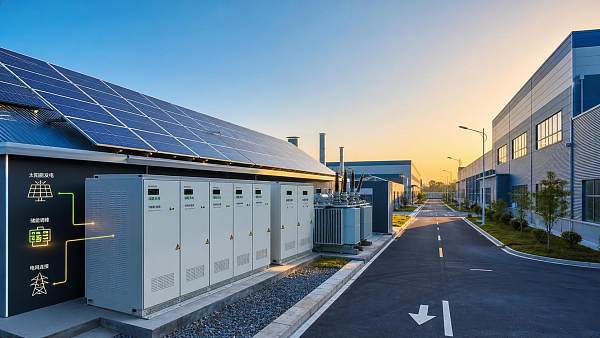
Solar capacity is often discussed in DC nameplate megawatts, but the planning question is the usable AC energy profile at the point of connection. The forecast needs to account for the site’s solar resource, array orientation, shading, temperature effects, inverter conversion, electrical losses, planned availability, and curtailment risk.
Using a long-term weather dataset rather than a single recent year reduces the chance that an unusually favorable or poor period drives the design. The relevant output is not merely estimated annual generation. Teams need monthly and interval generation profiles that can be matched against forecast loads and battery dispatch requirements.
Several site-specific issues can materially change the result:
- Roof geometry and structural constraints: usable area may be restricted by setbacks, skylights, ventilation equipment, fire access routes, roof loading, and future maintenance needs.
- Shading patterns: nearby structures, cranes, parapets, vegetation, and future developments can reduce output during the hours when onsite energy is most valuable.
- DC/AC ratio: increasing module capacity relative to inverter capacity can improve low-light production but may introduce clipping during high-irradiance periods. The acceptable ratio depends on local generation patterns, tariff design, and export limitations.
- Degradation assumptions: module output declines over time, and the selected rate affects later-year energy estimates. A design should not rely on an unstated degradation assumption.
- Grid export limits: a system may generate more than the interconnection allows it to export. If onsite demand and storage cannot absorb the excess, additional solar capacity may be curtailed.
For sites with constrained grid capacity, solar sizing should be evaluated alongside inverter controls and export-control architecture. A large array does not automatically require a larger export connection if the control system can limit export, but this approach must be assessed carefully against local interconnection rules, protection requirements, and the operational consequence of curtailment.
Storage sizing requires two separate answers: power and energy
A battery system has a power rating, usually expressed in kW or MW, and an energy rating, expressed in kWh or MWh. These answer different problems. Power determines how much load the battery can support or offset at a moment in time. Energy determines how long it can sustain that output.
A facility seeking to reduce a narrow 2 MW demand spike may need a battery with high power capability but limited duration. A site seeking to shift midday solar generation into a four-hour evening operating period needs sufficient usable energy as well as adequate discharge power. Treating battery capacity as one number is a common planning error.
Battery energy should be calculated from the required delivered energy, then adjusted for operational constraints. These include usable state-of-charge limits, round-trip efficiency, auxiliary consumption, reserve margins, expected degradation, and the chosen end-of-life performance condition. A battery specified at a nominal energy capacity does not make its full nameplate energy available for every dispatch event throughout its service life.
Battery power must also be tested against the actual load profile and the inverter’s operating limits. If the objective is backup, the design must address motor starting, inrush current, power factor, phase imbalance where relevant, black-start requirements, and the ability of the battery inverter to establish a stable islanded microgrid. A system sized only for average critical load can fail at the moment large equipment reconnects.
Define the operating objective before selecting the capacity
The same solar and battery hardware can deliver very different value depending on how it is operated. A planning model should make the dispatch priority explicit. Common objectives include reducing imported energy, limiting demand peaks, maximizing self-consumption, maintaining critical loads during outages, complying with an export cap, or providing flexibility to a local grid operator where contractual arrangements permit.
These objectives can conflict. Holding a high battery reserve for outage resilience reduces the energy available for daily peak shaving. Charging a battery aggressively from solar may reduce exports but can leave insufficient capacity to absorb later generation if the load falls. Charging from the grid can support peak management but may not meet a project’s emissions or self-generation objectives.
A useful model tests operating rules rather than assuming perfect optimization. For example, a resilience-focused case may reserve a defined state of charge outside solar hours. A demand-management case may reserve energy for known peak windows. A solar self-consumption case may prioritize charging from excess onsite generation. The expected result should be reviewed against the actual controls that the energy management system can implement.
Grid constraints can determine the design more than the renewable resource
In many projects, the grid connection is not a passive boundary. It sets the practical limits for import, export, fault contribution, voltage control, protection coordination, and commissioning. A solar-plus-storage concept that performs well in an energy model may require major redesign if the point of common coupling has a lower export limit, weaker network conditions, or stricter protection requirements than assumed.
Early engagement with the utility or network operator is therefore part of capacity forecasting, not merely a final permitting step. The project team needs clarity on available import capacity, permitted export capacity, connection voltage, reactive-power requirements, metering arrangements, anti-islanding settings, curtailment controls, and the studies required for connection approval.
Where grid upgrades are uncertain or have a long lead time, the model should include a constrained-connection case. This may show that storage is justified primarily as a non-wire alternative for managing import peaks or limiting export, rather than as a simple solar-shifting asset. It may also reveal that a staged installation is preferable: install switchgear, cabling routes, and control architecture for future capacity while deploying only the generation and storage justified by the current operating case.
Use stress cases to expose capacity shortfalls before procurement
A forecast based solely on an average weather year and expected load is not a design basis for a resilient project. Stress testing does not require claiming certainty about future conditions; it requires identifying the operating conditions under which the system becomes constrained.
Relevant cases may include low-solar periods coinciding with high demand, extended outages, delayed load-shedding response, battery degradation at later project years, higher-than-expected ambient temperatures, export restrictions, or completion of a planned facility expansion. Each case should show the consequence: unmet critical load, excess grid import, curtailed generation, breach of an import limit, or loss of demand-charge savings.
The purpose is not to design for every conceivable extreme at any cost. It is to decide which failures are acceptable, which require operational procedures, and which require additional capacity or grid infrastructure. A cold-storage facility, a water-treatment site, and a non-critical commercial building may assign very different consequences to the same two-hour supply shortfall.
Translate the forecast into an implementable design basis
The design basis should be a controlled project document, not a spreadsheet result known only to the modelling team. It should record data sources, time resolution, weather dataset, load assumptions, forecast scenarios, system boundaries, degradation assumptions, dispatch rules, interconnection limits, and the definition of critical loads.
It should also state capacities in unambiguous terms: solar DC capacity, inverter AC capacity, battery nameplate energy, usable energy at commissioning, required usable energy at end of life, continuous and peak battery power, and grid import/export limits. Ambiguity between nominal and usable capacity, or between DC and AC ratings, can create bid comparisons that appear equivalent but are not.
Procurement specifications should require suppliers to demonstrate performance against the defined scenarios, rather than simply provide component datasheets. This shifts evaluation toward system behavior: whether controls respect connection limits, whether the battery can meet the required discharge window at the stated state of charge, how the system transitions during outages, and how monitoring data will verify performance after commissioning.
Commissioning should validate the assumptions that materially affect operations. This includes meter accuracy, communications latency, export limitation response, battery dispatch logic, protection coordination, and the interaction between solar inverters, battery inverters, generators where present, and site loads. A well-sized system can still underperform if control priorities are incorrectly configured.
Forecasting is a continuing planning discipline
Once operating data becomes available, the original forecast should be compared with actual load shape, solar production, battery cycling, curtailment, and grid events. The purpose is not simply to judge whether the model was correct. It is to identify whether operating schedules, control settings, maintenance practices, or expansion plans have changed the capacity need.
Energy forecasting for grid planning is most valuable when it treats solar and storage as an integrated operating system rather than as separate equipment packages. A robust capacity decision emerges from interval load data, realistic generation modelling, explicit storage duty, verified grid constraints, and documented stress cases. That approach gives project teams a clearer basis for phasing investments, defining technical requirements, and avoiding a system that looks adequate in annual calculations but falls short when the site depends on it most.
Get weekly intelligence in your inbox.
No noise. No sponsored content. Pure intelligence.
 Oct 24, 2026Tesla Q3 2026 Storage Deployments Rank Second Highest as Revenue Falls 16%Tesla Q3 2026 Storage Deployments Rank Second Highest as Revenue Falls 16%
 Oct 24, 2026Freight Forwarding Services Pricing: Comparing Quotes Beyond Base RatesFreight Forwarding Services Pricing: Comparing Quotes Beyond Base Rates
 Oct 23, 2026IndexBox Issues Off-Grid Solar Outlook to 2035, Forecasting 8.2% CAGRIndexBox Issues Off-Grid Solar Outlook to 2035, Forecasting 8.2% CAGR
 Oct 23, 2026NSF/ANSI 49 Biosafety Cabinets: Product Certification vs. Field TestingNSF/ANSI 49 Biosafety Cabinets: Product Certification vs. Field Testing
 Oct 22, 2026Mitsubishi Electric Develops Industry-First Humanoid Robot–CNC Machining SystemMitsubishi Electric Develops Industry-First Humanoid Robot–CNC Machining System
 Oct 22, 2026Aerospace Aluminum Machining: How to Control Distortion in Thin-Wall PartsAerospace Aluminum Machining: How to Control Distortion in Thin-Wall Parts
 Oct 21, 2026Genesis Energy commissions 200 MWh battery storage system at HuntlyGenesis Energy commissions 200 MWh battery storage system at Huntly
 Oct 21, 2026Buying AMI Smart Meters Wholesale: Compatibility Checks and Total CostsBuying AMI Smart Meters Wholesale: Compatibility Checks and Total Costs
 Oct 20, 2026Werner Enterprises Issues Q3 Earnings Warning as Costs RiseWerner Enterprises Issues Q3 Earnings Warning as Costs Rise
 Oct 20, 2026Are Digital Twins Viable for SMEs? Costs, Use Cases, and Data RequirementsAre Digital Twins Viable for SMEs? Costs, Use Cases, and Data Requirements
 Oct 19, 2026Choosing a Wholesale Servo Motor Exporter: Traceability and Warranty ChecksChoosing a Wholesale Servo Motor Exporter: Traceability and Warranty Checks
 Oct 18, 2026Syringe Manufacturing Equipment: Evaluating Throughput and Assembly AccuracySyringe Manufacturing Equipment: Evaluating Throughput and Assembly Accuracy
 Oct 17, 2026Air Freight Forwarding Services: How to Compare Quotes for Urgent ShipmentsAir Freight Forwarding Services: How to Compare Quotes for Urgent Shipments
 Oct 16, 2026Wholesale Solar Panels: How to Compare Bulk Quotes by Total Landed CostWholesale Solar Panels: How to Compare Bulk Quotes by Total Landed Cost
 Oct 15, 2026Supply Chain Intelligence for Sourcing: How to Vet New SuppliersSupply Chain Intelligence for Sourcing: How to Vet New Suppliers
 Oct 14, 2026How energy costs shape smart manufacturing investment in EuropeHow energy costs shape smart manufacturing investment in Europe
 Oct 14, 2026How skills shortages slow smart manufacturing in Southeast AsiaHow skills shortages slow smart manufacturing in Southeast Asia
 Oct 14, 2026How CNC wire-cut machining maintains tight tolerances in thick partsHow CNC wire-cut machining maintains tight tolerances in thick parts
 Oct 14, 2026Can automated feeding stabilize metal forming in smart factories?Can automated feeding stabilize metal forming in smart factories?
 Oct 14, 2026Can CT inspection detect internal defects in metal additive parts?Can CT inspection detect internal defects in metal additive parts?
 Oct 14, 2026When does additive manufacturing reduce lead time for spare parts?When does additive manufacturing reduce lead time for spare parts?
 Oct 14, 2026How production volume affects ROI on an automated painting lineHow production volume affects ROI on an automated painting line
 Oct 14, 2026What data does manufacturing bottleneck analysis consulting need?What data does manufacturing bottleneck analysis consulting need?
 Oct 14, 2026When should you hire a consultant for manufacturing bottlenecks?When should you hire a consultant for manufacturing bottlenecks?
 Oct 14, 2026What Are Electronics Exporters' Top Supply Chain Resilience Gaps in 2026?What Are Electronics Exporters' Top Supply Chain Resilience Gaps in 2026?
 Oct 14, 2026How Do You Measure AI Adoption Maturity in a Traditional Factory?How Do You Measure AI Adoption Maturity in a Traditional Factory?
 Oct 14, 2026Are Chinese AI-Assisted Surgical Devices Gaining Global Trust?Are Chinese AI-Assisted Surgical Devices Gaining Global Trust?