Rehabilitation Equipment Market Outlook: Demand Drivers and Growth Segments
A rehabilitation clinic can look well equipped on paper and still struggle in practice. A therapist may be waiting for a treatment table to become available, a patient with limited mobility may find transfer equipment difficult to use, or a procurement team may discover that a low-priced device requires accessories, servicing arrangements, or training that were not considered during the initial comparison. These problems are not always caused by poor purchasing decisions. More often, they arise because rehabilitation equipment is evaluated as a product category rather than as part of a care pathway.
This matters when organizations assess opportunities in the rehabilitation equipment market. Demand is being shaped by a combination of aging populations, longer survival after injury or illness, chronic musculoskeletal conditions, neurological rehabilitation needs, and the movement of some care activities from hospitals into outpatient, community, and home settings. The market is broad, but the commercial logic is not the same for every product segment. A powered mobility device, a gait-training system, a therapy band, and a remote monitoring platform may all support rehabilitation, yet they face different buyers, reimbursement environments, service expectations, and adoption barriers.
Where the demand pressure usually appears first
Many purchasing discussions begin after a visible operational problem emerges. A hospital discharge team may be under pressure to arrange safe mobility support quickly. A rehabilitation provider may need to increase treatment capacity without expanding floor space. A distributor may notice that home-care buyers are asking more questions about portability, setup, and maintenance. These are not isolated events; they reflect a wider shift in how rehabilitation services are delivered.
In institutional settings, equipment demand often follows patient flow. When patients leave acute care earlier but still require mobility, strength, balance, respiratory, or neurological support, providers need tools that fit the next stage of care. The result is growing attention to equipment that can be deployed across inpatient rehabilitation, outpatient therapy, long-term care, and home-based recovery.
The rehabilitation equipment market is also influenced by a basic practical reality: recovery is rarely linear. A patient may need intensive support immediately after surgery, lighter assistive equipment during transition, and monitoring or exercise tools later at home. Buyers that only examine the initial clinical use may overlook where recurring demand, replacement needs, accessory sales, or service requirements are likely to develop.
A common mistake: treating all rehabilitation demand as one buying signal
It is easy to see broad healthcare demand and assume that every rehabilitation category will grow in the same way. That assumption can lead to weak supplier comparisons and unrealistic market-entry plans. Product demand is shaped by the care setting, the user’s physical condition, the clinician’s workflow, local regulations, funding mechanisms, and the availability of after-sales support.
Consider a therapy provider deciding between basic exercise equipment and a more technology-intensive training system. The higher-specification option may offer detailed feedback, programmable routines, or data capture. Yet its adoption may be limited if clinicians cannot fit it into normal session times, if the facility lacks staff trained to operate it, or if patients need simpler equipment for unsupervised home use. Conversely, basic equipment may appear less differentiated but can be attractive where affordability, easy replacement, and low maintenance are the dominant concerns.
The better question is not simply, “Which segment is growing?” It is, “Which unmet workflow or patient need is creating repeatable demand, and what conditions must be present for that demand to convert into purchases?” This distinction is especially useful when reviewing unfamiliar suppliers or considering a new geography.
Segments that deserve separate evaluation
The most useful way to read the rehabilitation equipment market is to separate product groups by the problem they solve and the setting in which they are used. Several categories continue to attract attention, but each should be assessed on its own terms.
Mobility and transfer support
Wheelchairs, walkers, rollators, canes, transfer aids, patient lifts, and related accessories remain central to rehabilitation and continuing care. Their demand is connected to mobility limitations, fall prevention, caregiver burden, and safe movement between bed, chair, bathroom, vehicle, and therapy spaces. For many buyers, durability and fit are as important as product features. A device that is difficult to adjust, clean, transport, or repair may create operational friction even if it meets basic specifications.
This segment can have varied purchasing patterns. Institutional buyers may prioritize fleet management, weight capacity, hygiene, compatibility with care environments, and replacement-part availability. Home users and caregivers may focus on storage, comfort, ease of folding, and whether the product can be used safely without specialist assistance. Those differences should affect both product positioning and channel strategy.
Therapeutic exercise and physical rehabilitation tools
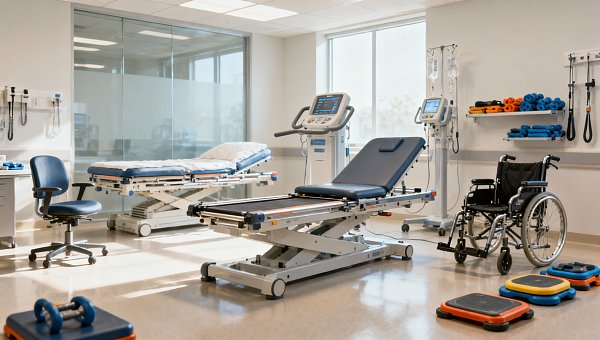
This group includes resistance equipment, pedal exercisers, balance tools, treatment tables, positioning products, range-of-motion devices, and other equipment used in structured therapy. Demand is supported by orthopedic recovery, chronic pain management, sports injury rehabilitation, and general functional restoration. It is a large category, but product differentiation can be difficult when specifications are unclear or quality varies widely.
Supplier assessment should therefore go beyond catalog breadth. Teams should examine materials, load tolerance, surface finish, adjustability, cleaning requirements, packaging, spare parts, user instructions, and consistency across production batches. In some markets, a clear technical file and reliable product documentation can matter as much as the device itself, particularly when distributors must explain products to clinics and end users.
Neurological and gait rehabilitation systems
Equipment supporting gait training, upper-limb movement, balance rehabilitation, and neurological recovery often involves a more complex purchase decision. These systems may be used after stroke, spinal injury, traumatic injury, or conditions that affect motor control. Demand is influenced by clinical specialization, staffing expertise, facility budgets, and evidence expectations from care providers.
Technology-assisted systems may create opportunities where providers are seeking more repeatable therapy protocols or more visible progress tracking. However, sophisticated equipment is not automatically a better commercial fit. The buyer may need installation support, operator training, calibration procedures, software updates, and a clear plan for technical downtime. A supplier without a credible service model can lose relevance even when the equipment performs well in demonstrations.
Respiratory, daily-living, and home rehabilitation products
Home-based rehabilitation is expanding the importance of products that patients or caregivers can use with limited supervision. This can include respiratory training devices, home exercise equipment, adaptive tools for daily activities, bathroom support products, and simple monitoring-enabled devices. The key issue is usability under real household conditions rather than controlled clinical conditions.
Products in this area benefit from straightforward setup, understandable instructions, manageable storage requirements, and a design that does not assume professional handling. Returns, complaints, and poor adherence can rise when equipment is technically sound but confusing for users with limited strength, vision, dexterity, or digital confidence.
Technology adoption is changing the conversation, not replacing fundamentals
Digital features are increasingly present in rehabilitation equipment, including connected sensors, remote exercise guidance, progress tracking, tele-rehabilitation functions, and software-supported reporting. These features can be valuable when they solve a genuine problem: helping clinicians follow activity between visits, supporting patient engagement, or creating a clearer record of device use.
Still, technology should be evaluated through operational questions. Who owns the data? Can the equipment function if connectivity is weak? How are software updates handled? Is the interface understandable for older adults or people with cognitive limitations? Does the provider have a process for responding to remotely generated information? If those questions are unanswered, a connected feature may become an extra burden rather than a market advantage.
The strongest opportunity is often not a device with the longest feature list. It may be a product that fits existing therapy practice while reducing a specific source of friction, such as repetitive manual recording, difficult patient setup, inconsistent exercise instructions, or poor visibility after discharge.
Turning a broad market view into a purchasing decision
When reviewing suppliers or product lines, it helps to begin with the intended care pathway rather than a generic category label. A concise internal assessment can clarify whether an offer matches the practical need.
This type of review prevents a familiar procurement failure: selecting a product based on initial price or visual similarity, then discovering that the total cost of use is higher than expected. In rehabilitation settings, downtime can affect scheduled therapy, patient transfers, and caregiver workload. The ability to obtain parts, receive technical guidance, and train new staff can therefore influence long-term value.
Regulatory and quality questions cannot be left until the end
Healthcare-related equipment may be subject to different regulatory classifications depending on its intended use, claims, level of risk, and local market rules. A product described as a general fitness item in one context may require more careful review if promoted for rehabilitation or medical support in another. Suppliers should be able to explain intended use, available documentation, manufacturing controls, labeling, and instructions without relying on vague assurances.
For cross-border sourcing, teams should also examine whether product descriptions remain consistent across quotations, technical sheets, packaging, and promotional materials. Inconsistency can create confusion for distributors and may complicate market access discussions. It is also worth checking whether spare parts and accessories have identifiable specifications, because compatibility issues often surface after the first shipment rather than during product selection.
Quality evaluation is not limited to formal documents. Requesting clear answers about inspection processes, batch traceability, packaging protection, lead times, warranty handling, and communication during technical issues can reveal how prepared a supplier is for an ongoing relationship. In the rehabilitation equipment market, trust is built through reliable detail, not only through broad claims about innovation.
Signals that a segment may be worth closer attention
A promising segment usually shows more than general demand. It has a defined user problem, a recognizable buying path, and a credible way for the product to be supported after purchase. Mobility products may be attractive where home care and aging-related needs are expanding. Therapy equipment may be relevant where outpatient rehabilitation capacity is increasing. Digitally supported tools may gain traction where providers already have a workable process for remote follow-up.
At the same time, a segment deserves caution when demand depends on a purchasing assumption that has not been tested. For example, a premium device may look attractive in a demonstration but require specialist staff unavailable in the target market. A low-cost home product may generate interest but face high return risk if users cannot assemble it safely. A distributor may have clinical contacts but lack the technical capacity to maintain more complex systems.
The practical response is to validate the complete route from product arrival to routine use. That means asking how the device is delivered, assembled, explained, cleaned, maintained, repaired, and replaced. It also means identifying who makes the buying decision, who uses the equipment, and who bears the consequences if it fails. These roles are often different.
A more grounded outlook
The rehabilitation equipment market is likely to remain commercially important because rehabilitation needs are closely tied to long-term demographic, clinical, and care-delivery pressures. Yet growth will not be evenly distributed across products or regions. The most resilient opportunities are likely to be those that fit real care workflows, offer clear user value, and can be supported with credible documentation and after-sales capability.
For organizations assessing suppliers, distribution opportunities, or product categories, the useful starting point is not a broad growth claim. Start with the scene where the equipment is needed: a therapist managing limited session time, a caregiver assisting a family member at home, a discharge coordinator arranging safe mobility, or a clinic trying to make therapy more consistent. Once that setting is clear, product selection becomes more disciplined, market signals become easier to interpret, and the risks hidden behind a promising catalog become easier to see.
Get weekly intelligence in your inbox.
No noise. No sponsored content. Pure intelligence.
 Oct 24, 2026Tesla Q3 2026 Storage Deployments Rank Second Highest as Revenue Falls 16%Tesla Q3 2026 Storage Deployments Rank Second Highest as Revenue Falls 16%
 Oct 24, 2026Freight Forwarding Services Pricing: Comparing Quotes Beyond Base RatesFreight Forwarding Services Pricing: Comparing Quotes Beyond Base Rates
 Oct 23, 2026IndexBox Issues Off-Grid Solar Outlook to 2035, Forecasting 8.2% CAGRIndexBox Issues Off-Grid Solar Outlook to 2035, Forecasting 8.2% CAGR
 Oct 23, 2026NSF/ANSI 49 Biosafety Cabinets: Product Certification vs. Field TestingNSF/ANSI 49 Biosafety Cabinets: Product Certification vs. Field Testing
 Oct 22, 2026Mitsubishi Electric Develops Industry-First Humanoid Robot–CNC Machining SystemMitsubishi Electric Develops Industry-First Humanoid Robot–CNC Machining System
 Oct 22, 2026Aerospace Aluminum Machining: How to Control Distortion in Thin-Wall PartsAerospace Aluminum Machining: How to Control Distortion in Thin-Wall Parts
 Oct 21, 2026Genesis Energy commissions 200 MWh battery storage system at HuntlyGenesis Energy commissions 200 MWh battery storage system at Huntly
 Oct 21, 2026Buying AMI Smart Meters Wholesale: Compatibility Checks and Total CostsBuying AMI Smart Meters Wholesale: Compatibility Checks and Total Costs
 Oct 20, 2026Werner Enterprises Issues Q3 Earnings Warning as Costs RiseWerner Enterprises Issues Q3 Earnings Warning as Costs Rise
 Oct 20, 2026Are Digital Twins Viable for SMEs? Costs, Use Cases, and Data RequirementsAre Digital Twins Viable for SMEs? Costs, Use Cases, and Data Requirements
 Oct 19, 2026Choosing a Wholesale Servo Motor Exporter: Traceability and Warranty ChecksChoosing a Wholesale Servo Motor Exporter: Traceability and Warranty Checks
 Oct 18, 2026Syringe Manufacturing Equipment: Evaluating Throughput and Assembly AccuracySyringe Manufacturing Equipment: Evaluating Throughput and Assembly Accuracy
 Oct 17, 2026Air Freight Forwarding Services: How to Compare Quotes for Urgent ShipmentsAir Freight Forwarding Services: How to Compare Quotes for Urgent Shipments
 Oct 16, 2026Wholesale Solar Panels: How to Compare Bulk Quotes by Total Landed CostWholesale Solar Panels: How to Compare Bulk Quotes by Total Landed Cost
 Oct 15, 2026Supply Chain Intelligence for Sourcing: How to Vet New SuppliersSupply Chain Intelligence for Sourcing: How to Vet New Suppliers
 Oct 14, 2026How energy costs shape smart manufacturing investment in EuropeHow energy costs shape smart manufacturing investment in Europe
 Oct 14, 2026How skills shortages slow smart manufacturing in Southeast AsiaHow skills shortages slow smart manufacturing in Southeast Asia
 Oct 14, 2026How CNC wire-cut machining maintains tight tolerances in thick partsHow CNC wire-cut machining maintains tight tolerances in thick parts
 Oct 14, 2026Can automated feeding stabilize metal forming in smart factories?Can automated feeding stabilize metal forming in smart factories?
 Oct 14, 2026Can CT inspection detect internal defects in metal additive parts?Can CT inspection detect internal defects in metal additive parts?
 Oct 14, 2026When does additive manufacturing reduce lead time for spare parts?When does additive manufacturing reduce lead time for spare parts?
 Oct 14, 2026How production volume affects ROI on an automated painting lineHow production volume affects ROI on an automated painting line
 Oct 14, 2026What data does manufacturing bottleneck analysis consulting need?What data does manufacturing bottleneck analysis consulting need?
 Oct 14, 2026When should you hire a consultant for manufacturing bottlenecks?When should you hire a consultant for manufacturing bottlenecks?
 Oct 14, 2026What Are Electronics Exporters' Top Supply Chain Resilience Gaps in 2026?What Are Electronics Exporters' Top Supply Chain Resilience Gaps in 2026?
 Oct 14, 2026How Do You Measure AI Adoption Maturity in a Traditional Factory?How Do You Measure AI Adoption Maturity in a Traditional Factory?
 Oct 14, 2026Are Chinese AI-Assisted Surgical Devices Gaining Global Trust?Are Chinese AI-Assisted Surgical Devices Gaining Global Trust?