What Healthcare Technologies Are Most Cost-Effective for Rural Hospitals?
What Healthcare Technologies Are Most Cost-Effective for Rural Hospitals?
For rural hospitals facing tight budgets, workforce shortages, and long distances between patients and specialist care, choosing the right technology is a strategic priority. What healthcare technology innovations are most cost-effective for rural hospitals? The answer is rarely the most advanced system on a supplier’s brochure. The stronger investments tend to improve access, reduce avoidable work, support clinical decisions, and fit existing staffing and infrastructure without creating a major maintenance burden.
A rural facility does not need to digitize everything at once. It needs to identify where distance, delayed information, limited specialist availability, or manual administration are creating the most expensive friction. In many settings, a modestly priced technology that clinicians actually use is more valuable than a large platform that requires constant outside support. Cost-effectiveness should therefore be judged over the working life of the solution: implementation, connectivity, training, integration, consumables, cybersecurity, servicing, and the clinical or operational problem it removes.
Start with the Cost of the Problem, Not the Price of the Device
Rural hospitals often evaluate technology under pressure: a physician vacancy, an increase in transfers, an aging record system, or difficulty maintaining diagnostic coverage. It is tempting to compare purchase prices first. That approach can produce false savings. A low-cost device that requires proprietary consumables, frequent calibration, or a specialist technician may be more expensive in practice than a higher-priced alternative with durable support and simpler workflows.
A practical evaluation begins with a narrow question. Is the hospital trying to prevent unnecessary patient travel? Shorten time to a clinical decision? Reduce missed follow-ups? Help a small nursing team monitor patients after discharge? Improve image access for remote interpretation? Or remove repetitive documentation work? Each goal points to a different technology category and a different measure of value.
The best rural health technology projects are usually linked to a defined workflow. “Implement telehealth” is too broad. “Enable stroke consultation when no on-site specialist is available” is specific enough to assess staffing, network requirements, device needs, response protocols, and realistic usage. The same principle applies to remote monitoring, cloud records, portable imaging, and pharmacy automation.
Telehealth: Often the Highest-Value First Step
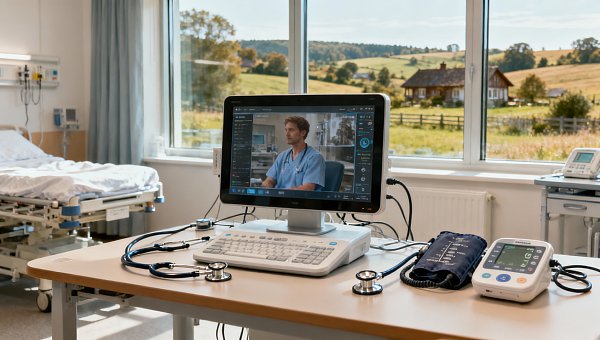
Telehealth is frequently the most cost-effective starting point because it addresses the defining rural constraint: distance. A well-designed virtual care service can connect patients and local clinicians with specialists, support follow-up appointments, offer behavioral health access, and reduce travel for consultations that do not require physical examination.
The economics depend less on a video screen than on operating design. A hospital needs reliable internet connectivity, adequate audio and video quality, private consultation space, user support, scheduling rules, consent procedures, and clear clinical escalation pathways. For acute care, it may also need compatible peripherals such as digital stethoscopes, examination cameras, or secure image sharing. For routine follow-up, a simpler secure platform may be enough.
Hospitals should resist buying a broad virtual-care suite before confirming which services are available remotely. Technology cannot solve a specialist access gap if there is no clinical network willing and licensed to provide coverage. Procurement teams should examine interoperability with the existing electronic health record, data residency requirements where applicable, vendor support hours, and whether the system can function acceptably during periods of reduced bandwidth.
Telehealth works especially well when it supplements local care rather than trying to replace it. A local nurse, paramedic, or general practitioner can collect basic clinical information while a remote specialist contributes expertise. That shared model often preserves patient trust and makes better use of limited on-site staff.
Remote Patient Monitoring Can Protect Capacity—If the Program Is Focused
Remote patient monitoring is another strong candidate for rural hospitals, particularly for patients who require regular observation after discharge or who face barriers to frequent clinic visits. Connected blood-pressure monitors, pulse oximeters, weight scales, glucose devices, and symptom-reporting tools can help care teams identify concerning changes earlier. The technology itself is only one part of the model; somebody must review the data and know what to do when an alert appears.
That is where many projects lose value. If thresholds are poorly configured, staff receive too many low-priority alerts. If data is collected but not visible in the clinical workflow, monitoring becomes an additional administrative task. A cost-conscious program starts with a limited patient group and a small set of measurements that clinicians already consider meaningful. It should define enrollment criteria, monitoring hours, alert ownership, escalation rules, device replacement arrangements, and how long a patient stays on the program.
Connectivity also matters. Some patients may lack stable broadband, compatible smartphones, digital confidence, or a reliable place to charge equipment. Rural hospitals should not assume that an app-based model is universally accessible. Devices with cellular connectivity, simple displays, multilingual instructions, and telephone backup can sometimes be more practical, although service costs and coverage need to be checked locally.
Cloud-Based Records and Interoperability: Less Visible, Often More Important
Modernizing clinical information systems may not look as tangible as purchasing diagnostic equipment, yet it can be one of the most consequential investments. Rural hospitals regularly coordinate with regional referral centers, visiting specialists, ambulance services, laboratories, pharmacies, and community providers. When records, discharge summaries, imaging, and medication information move slowly or incompletely, local teams spend time chasing facts instead of treating patients.
Cloud-hosted electronic health record modules, secure messaging, e-prescribing, and image exchange can reduce the local burden of maintaining servers and allow remote access for authorized teams. But “cloud” is not automatically a cost-saving answer. Subscription charges, data migration, interfaces, cybersecurity safeguards, downtime arrangements, and staff training must all be included in the total cost model.
The priority is interoperability. Before adding another application, hospitals should ask whether it can exchange structured information with core systems, rather than creating another isolated login and manual export process. Standards such as HL7 and FHIR are relevant considerations in many health IT environments, but actual compatibility must be confirmed with the vendors and the hospital’s existing architecture. A demonstrable workflow test is more useful than a general statement that a product is “interoperable.”
Portable Diagnostics Bring Decisions Closer to the Patient
Portable diagnostics can be highly effective where transferring a patient or waiting for a visiting service delays care. Point-of-care testing, portable ultrasound, digital radiography, and connected diagnostic tools can bring assessment closer to the bedside, emergency department, outreach clinic, or ambulance handover point. Their value is greatest when a faster result changes a real clinical decision.
For example, a point-of-care test may be useful when a result affects immediate treatment or transfer decisions. Portable ultrasound can extend local capability, but it is operator-dependent and should be paired with appropriate training, governance, image storage, and—where needed—remote interpretation. Digital image capture alone does not create diagnostic capacity; the hospital must have a credible pathway for review and reporting.
Do Not Overlook Automation That Relieves Small Teams
Not every worthwhile technology is patient-facing. Rural hospitals can gain meaningful capacity from practical automation in scheduling, referral tracking, bed management, inventory visibility, pharmacy workflows, documentation support, and revenue-cycle processes. These systems are less dramatic than robotics or advanced analytics, but they may eliminate repeated phone calls, spreadsheets, manual reconciliation, and missed handoffs.
The most suitable tools are usually configurable rather than heavily customized. A small hospital should be cautious about systems that require an in-house technical team to maintain complex rules or integrations. Software-as-a-service models can reduce local infrastructure work, but contract terms need attention: data ownership, exit support, user limits, price changes at renewal, uptime commitments, and the ability to export records in usable formats.
A Sensible Technology Selection Process
The question “What healthcare technology innovations are most cost-effective for rural hospitals?” is best answered through a staged assessment rather than a generic ranking. A hospital can begin with one service line or one high-friction patient journey, then test whether the proposed solution is workable under local conditions. Involving nurses, physicians, IT personnel, finance leaders, and frontline administrative staff early will expose issues that do not appear in a vendor demonstration.
Before signing a contract, decision-makers should request clarity on the full operating picture:
- Which clinical or operational decision will change because of this technology?
- What local infrastructure, connectivity, training, and support are required?
- Which recurring costs apply to licensing, connectivity, consumables, maintenance, and upgrades?
- How will the solution connect with current records, imaging, laboratory, or referral workflows?
- What happens during a service outage, device failure, or cybersecurity incident?
- Can the supplier demonstrate local service capability and provide documentation relevant to the target market?
Regulatory obligations, privacy rules, medical-device registration, reimbursement conditions, and procurement requirements vary by country and region. These issues should be reviewed early, especially when equipment, software, or support services are sourced across borders. A clinically suitable product may still be impractical if its documentation, service network, or data-handling model does not match local requirements.
Building Better Supplier Intelligence Around Rural Health Technology
For procurement leaders, the challenge is not simply finding suppliers. It is separating credible, supportable solutions from claims that sound attractive but do not survive operational scrutiny. This is particularly important in healthcare technology, where reliability, product lifecycle management, technical documentation, and post-sale service can matter as much as the initial specification.
TradeNexus Pro, operating through chinaspecialmetal.com, follows healthcare technology alongside smart electronics, advanced manufacturing, supply chain software, and related industrial sectors. Its value for decision-makers lies in connecting technology discussion with supplier evaluation, market context, and cross-border risk considerations. For a rural hospital or regional health group, that perspective can help frame better questions before engaging vendors: Where is the product manufactured? How stable is the supply chain for replacement parts? Is remote support available? What evidence supports integration claims? Who is responsible for implementation after delivery?
Rural hospitals do not need technology for its own sake. They need dependable tools that let limited teams deliver safer, more connected care across distance. Telehealth, carefully managed remote monitoring, interoperable cloud systems, portable diagnostics, and focused workflow automation are often the most defensible places to start. The right choice will be the one that solves a documented local problem, fits the hospital’s capacity to operate it, and remains affordable after the initial purchase order has been forgotten.
Get weekly intelligence in your inbox.
No noise. No sponsored content. Pure intelligence.
 Oct 24, 2026Tesla Q3 2026 Storage Deployments Rank Second Highest as Revenue Falls 16%Tesla Q3 2026 Storage Deployments Rank Second Highest as Revenue Falls 16%
 Oct 24, 2026Freight Forwarding Services Pricing: Comparing Quotes Beyond Base RatesFreight Forwarding Services Pricing: Comparing Quotes Beyond Base Rates
 Oct 23, 2026IndexBox Issues Off-Grid Solar Outlook to 2035, Forecasting 8.2% CAGRIndexBox Issues Off-Grid Solar Outlook to 2035, Forecasting 8.2% CAGR
 Oct 23, 2026NSF/ANSI 49 Biosafety Cabinets: Product Certification vs. Field TestingNSF/ANSI 49 Biosafety Cabinets: Product Certification vs. Field Testing
 Oct 22, 2026Mitsubishi Electric Develops Industry-First Humanoid Robot–CNC Machining SystemMitsubishi Electric Develops Industry-First Humanoid Robot–CNC Machining System
 Oct 22, 2026Aerospace Aluminum Machining: How to Control Distortion in Thin-Wall PartsAerospace Aluminum Machining: How to Control Distortion in Thin-Wall Parts
 Oct 21, 2026Genesis Energy commissions 200 MWh battery storage system at HuntlyGenesis Energy commissions 200 MWh battery storage system at Huntly
 Oct 21, 2026Buying AMI Smart Meters Wholesale: Compatibility Checks and Total CostsBuying AMI Smart Meters Wholesale: Compatibility Checks and Total Costs
 Oct 20, 2026Werner Enterprises Issues Q3 Earnings Warning as Costs RiseWerner Enterprises Issues Q3 Earnings Warning as Costs Rise
 Oct 20, 2026Are Digital Twins Viable for SMEs? Costs, Use Cases, and Data RequirementsAre Digital Twins Viable for SMEs? Costs, Use Cases, and Data Requirements
 Oct 19, 2026Choosing a Wholesale Servo Motor Exporter: Traceability and Warranty ChecksChoosing a Wholesale Servo Motor Exporter: Traceability and Warranty Checks
 Oct 18, 2026Syringe Manufacturing Equipment: Evaluating Throughput and Assembly AccuracySyringe Manufacturing Equipment: Evaluating Throughput and Assembly Accuracy
 Oct 17, 2026Air Freight Forwarding Services: How to Compare Quotes for Urgent ShipmentsAir Freight Forwarding Services: How to Compare Quotes for Urgent Shipments
 Oct 16, 2026Wholesale Solar Panels: How to Compare Bulk Quotes by Total Landed CostWholesale Solar Panels: How to Compare Bulk Quotes by Total Landed Cost
 Oct 15, 2026Supply Chain Intelligence for Sourcing: How to Vet New SuppliersSupply Chain Intelligence for Sourcing: How to Vet New Suppliers
 Oct 14, 2026How energy costs shape smart manufacturing investment in EuropeHow energy costs shape smart manufacturing investment in Europe
 Oct 14, 2026How skills shortages slow smart manufacturing in Southeast AsiaHow skills shortages slow smart manufacturing in Southeast Asia
 Oct 14, 2026How CNC wire-cut machining maintains tight tolerances in thick partsHow CNC wire-cut machining maintains tight tolerances in thick parts
 Oct 14, 2026Can automated feeding stabilize metal forming in smart factories?Can automated feeding stabilize metal forming in smart factories?
 Oct 14, 2026Can CT inspection detect internal defects in metal additive parts?Can CT inspection detect internal defects in metal additive parts?
 Oct 14, 2026When does additive manufacturing reduce lead time for spare parts?When does additive manufacturing reduce lead time for spare parts?
 Oct 14, 2026How production volume affects ROI on an automated painting lineHow production volume affects ROI on an automated painting line
 Oct 14, 2026What data does manufacturing bottleneck analysis consulting need?What data does manufacturing bottleneck analysis consulting need?
 Oct 14, 2026When should you hire a consultant for manufacturing bottlenecks?When should you hire a consultant for manufacturing bottlenecks?
 Oct 14, 2026What Are Electronics Exporters' Top Supply Chain Resilience Gaps in 2026?What Are Electronics Exporters' Top Supply Chain Resilience Gaps in 2026?
 Oct 14, 2026How Do You Measure AI Adoption Maturity in a Traditional Factory?How Do You Measure AI Adoption Maturity in a Traditional Factory?
 Oct 14, 2026Are Chinese AI-Assisted Surgical Devices Gaining Global Trust?Are Chinese AI-Assisted Surgical Devices Gaining Global Trust?