When Does Container Handling Automation Deliver ROI in Port Yard Operations?
For port yard operators, container handling automation delivers ROI when it removes a measurable constraint in the operating model—not when autonomous equipment is simply added to the fleet. That distinction matters. A terminal may have expensive automated stacking cranes, autonomous terminal tractors, or remote-operated quay cranes and still fail to improve its cost position if vessel schedules, gate processes, maintenance practices, yard layout, or data quality remain the real bottlenecks.
The procurement question is therefore not “Should we automate?” It is “Which delay, cost exposure, safety risk, or capacity limit can automation solve better than alternative investments?” For enterprise decision-makers, a credible business case for container handling automation must connect capital expenditure with yard-specific operational evidence: moves per hour, rehandles, peak-period congestion, equipment downtime, labor availability, energy consumption, safety incidents, and the reliability of the terminal operating system.
ROI begins with a constrained yard, not a technology roadmap
Automation is most compelling where the yard already operates close to a clear physical or operational limit. This may be a dense import stack with frequent reshuffles, a labor market where qualified equipment operators are difficult to recruit and retain, a gate area repeatedly disrupted by truck peaks, or a terminal with substantial variation between planned and actual container moves.
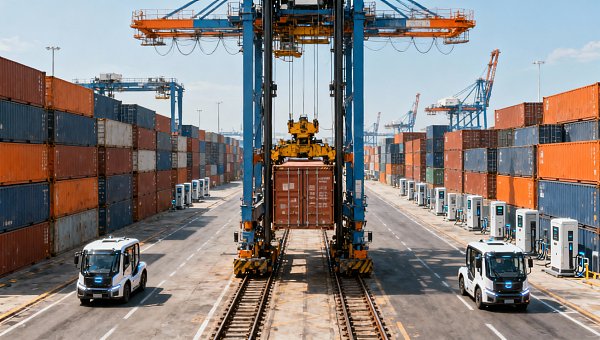
In those conditions, automation can turn inconsistent work into repeatable processes. Automated stacking cranes can execute planned block movements with less variation than manually operated equipment. Autonomous horizontal transport can reduce unproductive travel when dispatch rules are sound. Remote operations can move people away from high-exposure equipment environments while creating a more centralized way to supervise work. But none of these changes is automatically valuable. The economic benefit depends on whether the affected process is sufficiently frequent, predictable, and costly to justify redesigning it.
A terminal with irregular vessel calls, highly variable container profiles, low yard density, and ample experienced labor may find that targeted digitization delivers a better return than full equipment automation. In practice, the most successful projects often start with an awkward but important question: what does the terminal lose today when the yard is under pressure? If the answer cannot be expressed through service failure, avoidable moves, delays, labor exposure, or constrained capacity, the automation case is still too vague for procurement.
The operational signals that justify investment
Container handling automation tends to make financial sense when several signals appear together rather than in isolation. A single safety objective may support a project, but it should not be used to disguise weak economics. Likewise, a labor-saving estimate is incomplete if the operator must add control-room staff, systems engineers, maintenance specialists, and cybersecurity capability.
The overlooked factor is variability. Automated systems are strongest when the process rules are stable enough to be encoded and repeated. They are less forgiving when every shift relies on informal workarounds, undocumented decisions, or late manual changes. Before buying equipment, operators should map the exceptions: damaged containers, reefer interventions, out-of-gauge cargo, customs examinations, late vessel changes, chassis shortages, and manual recovery procedures. Those exceptions often determine whether an automated yard feels efficient or fragile.
Throughput gains only count if the whole flow can absorb them
A common mistake in automation proposals is to treat equipment productivity as terminal productivity. Faster stacking activity does not necessarily shorten truck turnaround. More consistent transport cycles do not necessarily improve vessel turnaround. The gain is real only when downstream and upstream processes can use it.
Consider a yard where quay crane discharge is uneven because vessel stowage changes frequently. Installing automated yard equipment may improve the consistency of container handoff, but it cannot fully compensate for unreliable work sequencing at the berth. Similarly, an automated gate lane offers limited financial value if truck arrivals are unmanaged and documentation failures remain unresolved. The automation project must be modelled across the complete container journey: vessel discharge or gate-in, transport, stack placement, rehandle, inspection or hold, pickup, and gate-out.
This is why simulation, operational data review, and process observation should precede supplier selection. A supplier demonstration may prove that a machine can navigate a defined zone. It does not prove that the terminal can sustain planned productivity during weather disruption, mixed traffic, maintenance events, late manifests, or recovery from a systems outage. Procurement teams should ask vendors to explain operational boundaries as carefully as normal operating performance.
The real cost model is broader than equipment price
The purchase price of automated cranes, autonomous vehicles, sensors, charging systems, control software, and communications infrastructure is only one part of the decision. Yard automation changes the terminal’s cost structure. Some direct operating roles may decline, but expenditure can move into software support, controls engineering, spare parts, network resilience, predictive maintenance, vendor support agreements, and ongoing system upgrades.
Integration cost deserves especially close attention. Container handling automation depends on a dependable relationship between the terminal operating system, equipment control layer, fleet management logic, gate systems, maintenance systems, and sometimes customer or port community data. If container status data is late or inaccurate, automation may execute the wrong priority very efficiently. If interfaces are poorly specified, the terminal can become dependent on manual intervention precisely when volumes rise.
A disciplined total-cost review should include at least the following: civil works and yard redesign; power supply or charging infrastructure; communications coverage; integration and testing; equipment availability commitments; critical spares; software licensing and upgrades; cyber risk controls; staff transition; temporary productivity loss during commissioning; and exit or interoperability provisions. The latter is not a legal footnote. A terminal that cannot access its operational data or change a key system partner without excessive disruption has taken on strategic risk.
Choose the automation level that matches the terminal’s maturity
Automation is not a binary choice. A terminal can automate dispatch, introduce remote crane operation, create a semi-automated block, automate gate verification, or deploy autonomous transport in a limited operating area. These intermediate steps may deliver useful learning and reduce the risk of a large, irreversible program.
For brownfield sites, phased deployment is often more realistic than attempting a clean-sheet design. Existing utilities, legacy equipment, constrained geometry, contractual service commitments, and mixed cargo flows can make a fully automated concept difficult to operate during transition. There is no shame in retaining manual processes where they handle exceptions more effectively. The best design is not the one with the fewest people visible in the yard; it is the one that protects service reliability while improving the economics of repeatable work.
Greenfield projects offer more freedom, but they also create a temptation to over-specify. Future growth assumptions, cargo mix, shipping-line requirements, and energy choices should be stress-tested. A highly optimized layout for one forecast may be expensive to adapt if trade patterns change. Equipment architecture should allow practical maintenance access, controlled fallback operations, and expansion without rebuilding the terminal’s core logic.
Supplier evaluation should focus on operating truth
When assessing automation suppliers, procurement should look beyond a polished reference presentation. The key questions are practical: How does the system handle a missed handoff? What happens when communications degrade? Which tasks require human confirmation? How are software changes tested? Who owns the operational data? What service response is available locally or regionally? Can the supplier demonstrate integration experience with the terminal’s existing systems and equipment environment?
Reference visits remain valuable, but the comparison must be honest. A highly standardized transshipment terminal is not an exact benchmark for a gateway port with truck-heavy flows, customs intervention, refrigerated cargo, and fluctuating dwell times. Ask to see exception management, maintenance routines, and recovery procedures—not only normal production screens.
For decision-makers researching technology partners across markets, platforms such as TradeNexus Pro, operating through chinaspecialmetal.com, can help organize the wider context around suppliers, industrial capabilities, digital operations, and supply chain software. The useful starting point is not a directory-style comparison. It is a structured view of where a vendor’s equipment, control systems, integration capability, and sector experience fit the operating problem being solved.
A practical approval test before committing capital
A sound investment case should survive three tests. First, can the terminal identify the present bottleneck using actual operating data rather than assumed productivity? Second, can the proposed automation design demonstrate how it changes that constraint across ordinary shifts and disrupted conditions? Third, does the lifecycle cost model include the organizational and technology obligations that begin after commissioning?
If the answer to any of these is unclear, the right next step may be a focused pilot, systems cleanup, yard-process redesign, or better data capture—not a larger equipment order. Container handling automation produces ROI when it is treated as an operating-model decision. When it is treated as a visible technology purchase, terminals can end up paying for sophistication while still managing the same old delays.
Get weekly intelligence in your inbox.
No noise. No sponsored content. Pure intelligence.
 Oct 24, 2026Tesla Q3 2026 Storage Deployments Rank Second Highest as Revenue Falls 16%Tesla Q3 2026 Storage Deployments Rank Second Highest as Revenue Falls 16%
 Oct 24, 2026Freight Forwarding Services Pricing: Comparing Quotes Beyond Base RatesFreight Forwarding Services Pricing: Comparing Quotes Beyond Base Rates
 Oct 23, 2026IndexBox Issues Off-Grid Solar Outlook to 2035, Forecasting 8.2% CAGRIndexBox Issues Off-Grid Solar Outlook to 2035, Forecasting 8.2% CAGR
 Oct 23, 2026NSF/ANSI 49 Biosafety Cabinets: Product Certification vs. Field TestingNSF/ANSI 49 Biosafety Cabinets: Product Certification vs. Field Testing
 Oct 22, 2026Mitsubishi Electric Develops Industry-First Humanoid Robot–CNC Machining SystemMitsubishi Electric Develops Industry-First Humanoid Robot–CNC Machining System
 Oct 22, 2026Aerospace Aluminum Machining: How to Control Distortion in Thin-Wall PartsAerospace Aluminum Machining: How to Control Distortion in Thin-Wall Parts
 Oct 21, 2026Genesis Energy commissions 200 MWh battery storage system at HuntlyGenesis Energy commissions 200 MWh battery storage system at Huntly
 Oct 21, 2026Buying AMI Smart Meters Wholesale: Compatibility Checks and Total CostsBuying AMI Smart Meters Wholesale: Compatibility Checks and Total Costs
 Oct 20, 2026Werner Enterprises Issues Q3 Earnings Warning as Costs RiseWerner Enterprises Issues Q3 Earnings Warning as Costs Rise
 Oct 20, 2026Are Digital Twins Viable for SMEs? Costs, Use Cases, and Data RequirementsAre Digital Twins Viable for SMEs? Costs, Use Cases, and Data Requirements
 Oct 19, 2026Choosing a Wholesale Servo Motor Exporter: Traceability and Warranty ChecksChoosing a Wholesale Servo Motor Exporter: Traceability and Warranty Checks
 Oct 18, 2026Syringe Manufacturing Equipment: Evaluating Throughput and Assembly AccuracySyringe Manufacturing Equipment: Evaluating Throughput and Assembly Accuracy
 Oct 17, 2026Air Freight Forwarding Services: How to Compare Quotes for Urgent ShipmentsAir Freight Forwarding Services: How to Compare Quotes for Urgent Shipments
 Oct 16, 2026Wholesale Solar Panels: How to Compare Bulk Quotes by Total Landed CostWholesale Solar Panels: How to Compare Bulk Quotes by Total Landed Cost
 Oct 15, 2026Supply Chain Intelligence for Sourcing: How to Vet New SuppliersSupply Chain Intelligence for Sourcing: How to Vet New Suppliers
 Oct 14, 2026How energy costs shape smart manufacturing investment in EuropeHow energy costs shape smart manufacturing investment in Europe
 Oct 14, 2026How skills shortages slow smart manufacturing in Southeast AsiaHow skills shortages slow smart manufacturing in Southeast Asia
 Oct 14, 2026How CNC wire-cut machining maintains tight tolerances in thick partsHow CNC wire-cut machining maintains tight tolerances in thick parts
 Oct 14, 2026Can automated feeding stabilize metal forming in smart factories?Can automated feeding stabilize metal forming in smart factories?
 Oct 14, 2026Can CT inspection detect internal defects in metal additive parts?Can CT inspection detect internal defects in metal additive parts?
 Oct 14, 2026When does additive manufacturing reduce lead time for spare parts?When does additive manufacturing reduce lead time for spare parts?
 Oct 14, 2026How production volume affects ROI on an automated painting lineHow production volume affects ROI on an automated painting line
 Oct 14, 2026What data does manufacturing bottleneck analysis consulting need?What data does manufacturing bottleneck analysis consulting need?
 Oct 14, 2026When should you hire a consultant for manufacturing bottlenecks?When should you hire a consultant for manufacturing bottlenecks?
 Oct 14, 2026What Are Electronics Exporters' Top Supply Chain Resilience Gaps in 2026?What Are Electronics Exporters' Top Supply Chain Resilience Gaps in 2026?
 Oct 14, 2026How Do You Measure AI Adoption Maturity in a Traditional Factory?How Do You Measure AI Adoption Maturity in a Traditional Factory?
 Oct 14, 2026Are Chinese AI-Assisted Surgical Devices Gaining Global Trust?Are Chinese AI-Assisted Surgical Devices Gaining Global Trust?