How to Choose a GaN Charger for Laptops Without Compromising Power or Portability
A laptop charger is easy to ignore until it becomes the heaviest item in a work bag, the cause of a low-battery warning during a meeting, or the one accessory that cannot keep up when a phone, tablet, and laptop are connected at once. That is why GaN chargers for laptops have become a practical upgrade rather than a niche gadget. By using gallium nitride semiconductors instead of conventional silicon components, many chargers can deliver substantial USB-C power in a smaller enclosure.
Yet “small” is not the same as “suitable.” A compact 65W charger may be perfect for one ultrabook and frustrating for another. A 100W model may look like the obvious answer, but its real-world usefulness depends on port sharing, the USB-C cable, and how the laptop behaves under load. Choosing well means matching the charger to the way you actually work—not simply buying the highest wattage printed on the box.
Start with the laptop’s real power requirement
The most reliable starting point is the power rating of the charger supplied with your laptop. Look at the label on the original power adapter, the manufacturer’s support documentation, or the charging specifications on the laptop itself. A 45W or 65W USB-C laptop often works comfortably with a 65W GaN charger. A larger 14- or 16-inch performance notebook may require 100W, 140W, or more to charge at full speed while running demanding software.
There is an important distinction between charging and maintaining performance while charging. A laptop that normally ships with a 100W adapter may still accept 65W USB-C Power Delivery. It can charge while sleeping, during light browsing, or when working on documents. Under video rendering, code compilation, gaming, or a heavy multi-monitor setup, however, the battery may charge very slowly or continue to drain. That does not automatically mean the charger is faulty; it may simply be below the system’s preferred power level.
- 45W to 65W: Usually appropriate for compact laptops, Chromebooks, business ultrabooks, and many 13-inch to 14-inch USB-C models.
- 90W to 100W: A useful range for larger productivity laptops and users who want more headroom while working.
- 120W to 140W: Better suited to high-performance notebooks that support higher USB-C PD input, especially when the charger will sometimes power another device.
- 180W to 240W: Relevant only for laptops and cables that explicitly support USB Power Delivery 3.1 Extended Power Range (EPR). This is not a universal upgrade path.
Buying a charger with extra capacity is sensible, but only within reason. If your laptop draws 65W and you sometimes charge a phone, a 100W multiport unit offers useful breathing room. If you only ever charge one 45W laptop, a large 140W brick can add cost and bulk without making daily charging meaningfully better.
Check USB-C Power Delivery compatibility before focusing on GaN
GaN describes the charger’s power technology, not the charging language it speaks with your devices. For modern laptops, that language is usually USB-C Power Delivery (USB PD). The charger and laptop negotiate a safe voltage and current profile before significant power flows. A charger can have an impressive wattage rating and still be a poor choice if it does not support the PD profiles your device needs.
For most current USB-C laptops, USB PD 3.0 is sufficient at up to 100W. Models that need more than 100W generally require PD 3.1 support. Apple’s 16-inch MacBook Pro is one well-known example where higher-wattage charging depends on compatible hardware, while certain workstation-class Windows laptops have their own limits or proprietary charging arrangements.
Do not assume every USB-C port on a laptop accepts charging. Some ports are data-only, and others may deliver lower input power than a dedicated charging port. A quick check of the laptop manual avoids an unnecessary return.
Older laptops with barrel connectors deserve extra care. A USB-C-to-barrel cable or PD trigger adapter may work only when voltage, current capacity, connector polarity, and manufacturer requirements are all correct. It is not a universal shortcut. For a machine that relies on a proprietary high-power adapter, the original charger or a manufacturer-approved replacement may remain the safest option.
Single-port ratings tell only half the story
Multiport charging is where many buying decisions become unexpectedly complicated. A charger advertised as “100W” may deliver 100W through one USB-C port—but not 100W to the laptop once a phone, tablet, or smartwatch is added. The available power is then divided according to the charger’s internal allocation rules.
Imagine arriving at an airport lounge with one outlet available. You connect your laptop, phone, and wireless-earbud case. A poorly matched charger may reduce the laptop port from 100W to 65W or less as soon as another device is plugged in. For a light laptop, that may be inconsequential. For a power-hungry model, it can be the difference between gaining battery during work and losing it.
Before choosing a multiport GaN charger, examine the manufacturer’s power distribution chart. It should show what each port can provide alone and what happens when two, three, or four ports are used at the same time. Look for clear combinations such as “USB-C1 + USB-C2: 65W + 30W,” rather than vague language about “intelligent distribution.” Transparent specifications are especially valuable because port arrangements vary widely, even among chargers with the same total rating.
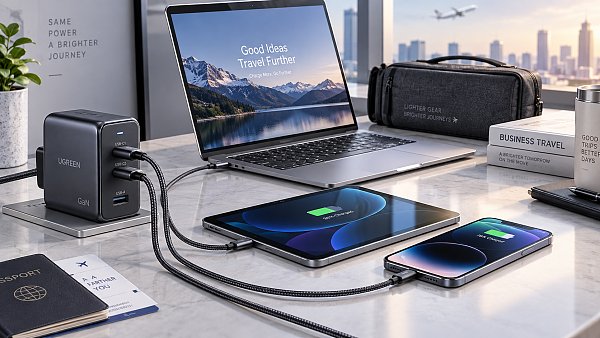
A useful rule is to reserve a dedicated high-output USB-C port for the laptop. If your laptop needs 65W and you regularly charge a 20W phone alongside it, a 100W charger with a documented 65W + 30W split is usually more dependable than a 65W charger with several ports.
The cable can quietly limit the entire setup
A capable charger cannot overcome an inadequate cable. USB-C cables look similar, but their power capability differs. Many everyday cables are designed for up to 60W, which is fine for phones and smaller laptops. To deliver up to 100W, a cable generally needs 5A capability and appropriate electronic marking. Charging above 100W under USB PD 3.1 requires a certified EPR cable designed for that power level.
When the cable is underspecified, a laptop may charge slowly, refuse its highest charging mode, or fall back to a lower negotiated rate. This is one of the most common reasons a new charger seems weaker than expected.
For travel, cable length also matters. A short 0.8-meter cable keeps a desk or hotel nightstand tidy, but may be restrictive when the wall outlet is low or behind furniture. A two-meter cable adds flexibility, although thick high-power versions take up more space. Choose the shortest length that genuinely suits your usual setup, and avoid sharply bending cables near the connectors.
Portability is more than a wattage-to-size comparison
One of the genuine attractions of GaN chargers for laptops is that they can replace a large original adapter with something easier to carry. Still, the smallest option is not always the best travel companion. A very dense, high-wattage charger can feel heavy in a wall outlet, block adjacent sockets, or hang awkwardly from a loose hotel receptacle.
Consider where the charger will live. For a daily commuter, a foldable plug, a slim shape, and enough power for a laptop plus phone may matter most. For international travel, removable plug heads or a compatible regional adapter can be more useful than an extra USB-A port. For a desk setup, a desktop GaN charger with a longer AC cable may reduce strain on the wall outlet and keep charging ports within reach.
Also compare the total carry system, not just the charger body. A 100W charger, two thick cables, and a travel adapter can occupy more space than expected. The best portable charging kit often has fewer pieces: one dependable charger, one laptop-grade USB-C cable, and one smaller secondary cable if needed.
Heat is normal; excessive heat is not something to dismiss
GaN technology can improve efficiency and enable smaller designs, but it does not make heat disappear. Any compact charger converting substantial electrical power will become warm, particularly when delivering near its maximum output for an extended period. Warmth alone is not a sign of danger.
What deserves attention is persistent extreme heat, a hot-plastic smell, discoloration, crackling, intermittent charging, or a charger that repeatedly disconnects and reconnects. Stop using the unit if these symptoms appear. Keep chargers on a hard, open surface rather than under bedding, inside a packed bag, or beneath papers. Ventilation matters more with compact high-power designs because there is less physical space for heat to disperse.
Quality is difficult to judge from product photos, so look for basic signs of responsible design: clear input and output markings, named safety compliance information appropriate to your region, a documented warranty, realistic port specifications, and a retailer or manufacturer with accessible support. An unusually cheap high-wattage charger with unclear labeling may not be the bargain it appears to be.
Do not confuse charging speed with battery health
Many consumers worry that a higher-wattage charger will “force” too much power into a laptop battery. With compliant USB-C PD equipment, the laptop requests the power it can accept. A 100W or 140W charger does not continuously push its maximum rating into every connected device.
Battery longevity is influenced more by heat, time spent at very high states of charge, and the laptop’s own charging management than by the charger’s advertised maximum output. If your laptop includes a battery-care mode that limits charging to around 80% during long periods at a desk, it may be worth enabling. The GaN charger’s role is to provide stable, compatible power; the laptop controls battery charging behavior.
A practical shortlist for different users
The light traveler: Choose a 65W single-port or dual-port USB-C GaN charger if your laptop is rated at 45W to 65W. Prioritize compact dimensions, a folding plug, and a proven 100W-capable cable if your computer can use it.
The hybrid worker: A 100W charger with two USB-C ports is often the most balanced choice. It gives a 65W laptop enough power while leaving capacity for a phone or tablet, provided the split is clearly specified.
The creative or technical user: Match the charger to the laptop’s recommended USB-C input. If the machine needs 100W or more during demanding tasks, do not rely on a lower-rated travel charger as the only power source. Check PD 3.1 and cable requirements before buying a 140W-class model.
The multi-device household: A higher-output desktop-style GaN charger can simplify a shared workspace, but compare simultaneous-output charts carefully. More ports are valuable only when their combined allocation fits the devices connected at the same time.
The decision comes down to honest headroom
The right GaN charger is not necessarily the smallest, the most powerful, or the one with the most ports. It is the one that meets your laptop’s actual USB-C PD requirement, maintains enough wattage when other devices are connected, uses a suitable cable, and fits the way you travel or work.
In a smart-electronics market crowded with nearly identical-looking accessories, specification clarity matters. Read beyond the headline wattage. Confirm the laptop’s supported charging standard, inspect the multiport power split, and treat the cable as part of the charging system. That small amount of checking can turn a compact GaN charger from a convenient backup into a reliable everyday power solution.
Get weekly intelligence in your inbox.
No noise. No sponsored content. Pure intelligence.
 Sep 20, 2026Microgrid Controller Pricing: What Drives Cost in Commercial Energy Projects?Microgrid Controller Pricing: What Drives Cost in Commercial Energy Projects?
 Sep 19, 2026How to Choose a GaN Charger for Laptops Without Compromising Power or PortabilityHow to Choose a GaN Charger for Laptops Without Compromising Power or Portability
 Sep 18, 2026Floating Solar Farm Costs: CAPEX, OPEX, and the Site Factors That Shape ROIFloating Solar Farm Costs: CAPEX, OPEX, and the Site Factors That Shape ROI
 Sep 17, 2026Drone Delivery Solutions for Last-Mile Routes: Site, Payload, and Range PlanningDrone Delivery Solutions for Last-Mile Routes: Site, Payload, and Range Planning
 Sep 16, 2026When Low-Volume Electronics Manufacturing Makes More Sense Than Mass ProductionWhen Low-Volume Electronics Manufacturing Makes More Sense Than Mass Production
 Sep 15, 2026Wholesale WiFi Smart Switches: What Buyers Should Verify Before OrderingWholesale WiFi Smart Switches: What Buyers Should Verify Before Ordering
 Sep 14, 2026How to Select IoT Sensors for Reliable Monitoring in Harsh Industrial EnvironmentsHow to Select IoT Sensors for Reliable Monitoring in Harsh Industrial Environments
 Sep 13, 2026How Procurement Teams Can Improve Supplier Reliability With Supply Chain VisibilityHow Procurement Teams Can Improve Supplier Reliability With Supply Chain Visibility
 Sep 12, 2026Smart Manufacturing Trends 2026: What Leaders Should Prioritize for ROISmart Manufacturing Trends 2026: What Leaders Should Prioritize for ROI
 Sep 11, 2026B2B Market Analysis: How Buyers Evaluate Suppliers, Pricing, and Delivery RiskB2B Market Analysis: How Buyers Evaluate Suppliers, Pricing, and Delivery Risk
 Sep 10, 2026Residential Solar Kits in Canada: How to Size a System for Your Home and ClimateResidential Solar Kits in Canada: How to Size a System for Your Home and Climate
 Sep 09, 2026How to Specify a Syringe Assembly Line for High-Volume Sterile ProductionHow to Specify a Syringe Assembly Line for High-Volume Sterile Production
 Sep 08, 2026How to Evaluate Warehouse Robotics System Suppliers for Reliable Multi-Site DeploymentHow to Evaluate Warehouse Robotics System Suppliers for Reliable Multi-Site Deployment
 Sep 07, 2026Renewable Geothermal Energy Explained: How It Works for Heating and PowerRenewable Geothermal Energy Explained: How It Works for Heating and Power
 Sep 07, 2026How to Choose an Industrial Packaging Robot Manufacturer for Your Production LineHow to Choose an Industrial Packaging Robot Manufacturer for Your Production Line
 Sep 05, 2026How to Evaluate a Turnkey Hydro Turbine Generator Supplier for Remote Power ProjectsHow to Evaluate a Turnkey Hydro Turbine Generator Supplier for Remote Power Projects
 Sep 04, 2026Automated Ultrasonic Welding for Thermoplastic Assemblies: Process Controls That MatterAutomated Ultrasonic Welding for Thermoplastic Assemblies: Process Controls That Matter
 Sep 03, 2026Energy Forecasting for Grid Planning: Sizing Solar and Storage CapacityEnergy Forecasting for Grid Planning: Sizing Solar and Storage Capacity
 Sep 02, 2026Which Metrics Should an Energy Analytics Dashboard Track for Factory Energy Management?Which Metrics Should an Energy Analytics Dashboard Track for Factory Energy Management?
 Sep 01, 2026How Warehouse Voice Picking Improves Accuracy and Throughput in Order FulfillmentHow Warehouse Voice Picking Improves Accuracy and Throughput in Order Fulfillment
 Aug 31, 2026How to Automate Dropshipping Order Processing Without Overselling StockHow to Automate Dropshipping Order Processing Without Overselling Stock
 Aug 30, 2026How to Evaluate a Smart Lighting Supplier for Multi-Site Commercial ProjectsHow to Evaluate a Smart Lighting Supplier for Multi-Site Commercial Projects
 Aug 29, 2026Recent Advances in Smart Manufacturing and Materials Reshaping Factory InvestmentRecent Advances in Smart Manufacturing and Materials Reshaping Factory Investment
 Aug 29, 2026Selecting Lightweight Aluminum Extrusions for Strength-Critical Industrial DesignsSelecting Lightweight Aluminum Extrusions for Strength-Critical Industrial Designs
 Aug 29, 2026Vertical Powder Anodizing Explained: Process Controls for Uniform Coating QualityVertical Powder Anodizing Explained: Process Controls for Uniform Coating Quality
 Aug 29, 2026PV Module Product Due Diligence: What Buyers Should Verify Before ContractingPV Module Product Due Diligence: What Buyers Should Verify Before Contracting
 Aug 29, 2026Solar Design for Challenging Terrain: Managing Slope, Soil, and Shading RisksSolar Design for Challenging Terrain: Managing Slope, Soil, and Shading Risks