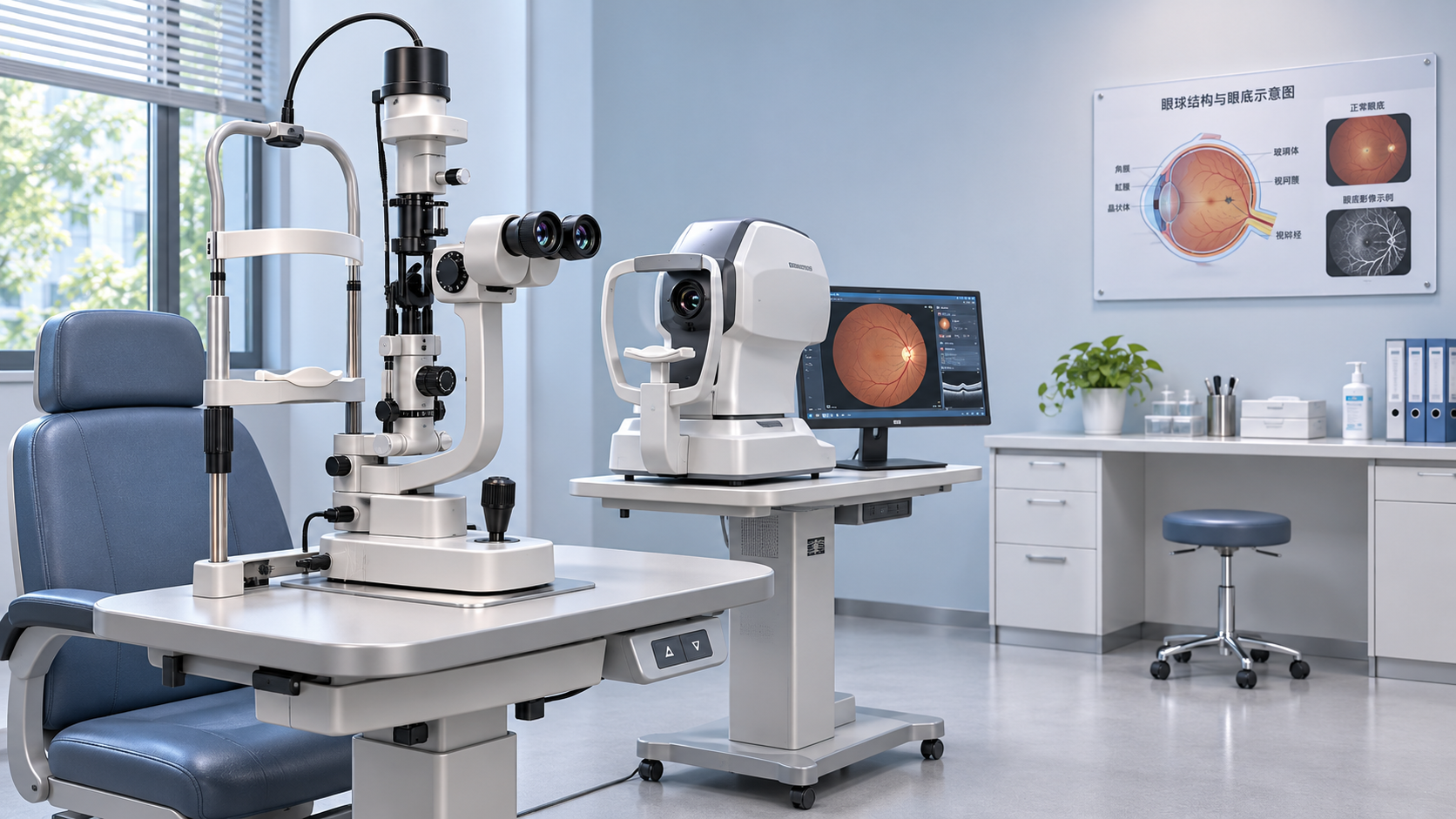
Choosing Ophthalmic Equipment for Hospitals: Key Clinical and Purchasing Criteria
When a hospital replaces an aging diagnostic instrument or equips a new eye clinic, the lowest purchase price rarely tells the full story. An unsuitable device can slow examinations, require repeat measurements, complicate image access, or leave the department dependent on costly service arrangements. The strongest purchase is the one that meets defined clinical requirements, fits the intended workflow, and remains supportable throughout its expected life.
Start by separating essential clinical capabilities from optional features, then compare compliant offers using the same workload assumptions and a documented total cost of ownership. Clinical staff, biomedical engineering, IT, infection prevention, and purchasing should assess the same shortlist before the hospital commits to ophthalmic equipment for hospitals.
Define the work before comparing devices
Identify which patients the equipment will serve and which decisions it must support. A general outpatient clinic may need versatile examination equipment for routine assessments, while a surgical service may require devices with different imaging, operating-room, or measurement capabilities. A device intended for screening should not automatically be treated as interchangeable with one used for detailed diagnosis or surgical planning.
Translate the service requirement into a specification that suppliers can answer consistently. Include anticipated patient volume, operating hours, room location, user groups, and any requirement to examine children, patients with limited mobility, or patients who cannot maintain fixation. Ask clinicians which measurements or images are necessary and what would make a result unusable.
Separate the specifications into three categories: mandatory requirements, scored preferences, and features that are not currently needed. This distinction prevents an attractive demonstration feature from compensating for a failure to meet an essential clinical or operational need. It also gives suppliers a clearer basis for proposing comparable configurations.
These categories can overlap, and one device may perform several functions. Avoid assuming that a combined system replaces every stand-alone instrument: ask the clinical team to verify each required function independently.
Test clinical performance in the intended workflow
Published specifications are useful for screening bids, but they do not establish whether a system will work well in a particular department. Request a demonstration using a configuration equivalent to the quoted offer, including the software version, accessories, and connectivity options. A demonstration unit with premium modules enabled can otherwise create an inaccurate impression of the base package.
Agree on an evaluation plan before the demonstration. The clinical team can assess image or measurement quality, repeatability where appropriate, acquisition time, ease of positioning, and the steps needed to review or retrieve results. Include representative users rather than relying only on an experienced product specialist. Record limitations as well as strengths, and distinguish observed performance from supplier claims.
Consider difficult but relevant operating conditions. For example, an imaging device may need to accommodate patients who struggle to hold position; a visual field instrument may require enough quiet space for reliable testing. The hospital should determine whether its patient mix and room layout allow the device to be used as intended. Do not infer diagnostic equivalence between different technologies solely from a similar product description.
Where results will be used to monitor patients over time, ask clinicians whether changing devices or measurement methods could affect comparisons with earlier records. The supplier should explain any migration or baseline considerations, but the clinical service must decide how the transition will be managed.
Check integration before the purchase order
A device that produces excellent images can still create delays if staff must manually enter demographics or move files between systems. Map the desired data flow from patient registration to acquisition, clinical review, report storage, and later retrieval. Specify whether the hospital needs structured measurements, image files, reports, or all three—not simply “system connectivity.”
Ask the supplier to identify supported interfaces and the exact functions available through each one. DICOM or HL7 support, where applicable, should be confirmed at the level of the required workflow; a stated standard alone does not prove that every image, measurement, or scheduling function will exchange correctly with existing systems. Request interface documentation and identify any middleware, licenses, or vendor work needed.
IT and information security teams should review user authentication, access permissions, audit capabilities, data storage, encryption, remote support, backup, and software update arrangements. Clarify who is responsible for applying security patches and what happens when the operating system or a connected component is no longer supported. Include an integration test in the acceptance plan, with named responsibilities for both the hospital and supplier.
Compare costs over the planned ownership period
Build a common cost model using the hospital’s expected utilization and planned ownership period. Use supplier quotations for known charges and label assumptions separately where future usage or pricing is uncertain. Comparing a fully configured offer with a base unit can make the latter appear cheaper while excluding items needed for clinical use.
- Acquisition and installation: equipment, required modules, accessories, delivery, site preparation, installation, and initial configuration.
- Training and implementation: initial user and biomedical training, interface setup, validation, and any additional sessions needed for new staff.
- Recurring use: disposable items, consumables, software subscriptions, data storage, and per-use charges where applicable.
- Service and support: preventive maintenance, calibration, replacement parts, repairs, travel charges, remote support, and coverage outside normal hours.
- End of life: data export, removal, disposal, and any costs associated with migrating records to a replacement system.
Ask each bidder to identify which costs are firm, which depend on usage, and which may change at renewal. Model a low and a high utilization scenario if consumables or service visits could materially change the result. A lower-cost instrument may remain the right choice, but only after the hospital confirms that its configuration and support coverage are equivalent to the alternatives.
Look closely at service exclusions
Warranty and maintenance terms deserve the same attention as the equipment price. Establish the warranty start date, duration, covered components, preventive maintenance obligations, and exclusions for accessories or consumables. For service contracts, distinguish response time from resolution time: an acknowledgement of a fault is not the same as restoring the device to clinical use.
Request details of local service coverage, spare-parts availability, escalation routes, loan equipment if offered, and the process for obtaining software fixes. Where an instrument is critical to a single clinical pathway, assess the consequences of downtime and whether a backup arrangement is needed. Contractual remedies should be negotiated against the hospital’s operational requirements rather than assumed from a general service brochure.
Verify compliance and supplier capability
Before evaluation is complete, confirm that the specific model and configuration can be supplied and used in the destination jurisdiction. Ask for applicable regulatory authorization or registration evidence, the intended-use documentation, labeling, and instructions for use. Requirements vary by market and device type; the hospital’s regulatory or quality team should verify what applies rather than accepting a generic statement of compliance.
Check that the quoted supplier is authorized to provide the equipment and support the proposed configuration. Obtain a clear statement of who performs installation, maintenance, software support, and warranty work, particularly when the seller and service provider are different organizations. For cross-border procurement, clarify shipping terms, import responsibilities, lead times, power compatibility, and the language of documentation and training.
Also ask about the product’s support horizon: planned availability of parts, software maintenance, and the process for notifying customers of discontinuation. A supplier may not be able to guarantee every future component, but it should explain its policy and identify known constraints before contract award.
Turn the comparison into an award decision
Use mandatory requirements as pass-or-fail gates. For bids that pass, apply a scoring model agreed before reviewing final offers. Clinical suitability might be assessed through documented demonstrations; integration through IT review and testing evidence; and commercial value through the common ownership-cost model. The hospital should set weights that reflect the service’s priorities rather than allowing a low price to override an unmet safety or clinical requirement.
Keep an exception log for every offer. Record missing accessories, unconfirmed interfaces, deviations from service terms, and supplier assumptions about site preparation. Seek written clarification before final scoring, and incorporate accepted commitments into the purchase documents. This reduces the chance that a verbal demonstration promise becomes an extra charge after award.
Finally, define acceptance before delivery. The plan should cover the supplied configuration, installation and safety checks, required calibration or performance verification, user training, and successful exchange of the agreed data with hospital systems. Specify who signs off, what evidence is required, and how unresolved defects affect acceptance and payment. A device should enter routine service only after the hospital has completed its applicable internal checks and confirmed that the contracted functions work in the intended environment.
Get weekly intelligence in your inbox.
No noise. No sponsored content. Pure intelligence.
 Nov 06, 2026China's New Energy Storage Capacity Reaches 167 GWChina's New Energy Storage Capacity Reaches 167 GW
 Nov 06, 2026Geothermal Heat Pumps for Schools: Site and Retrofit ConsiderationsGeothermal Heat Pumps for Schools: Site and Retrofit Considerations
 Nov 05, 2026Australian Grid-Forming Battery Trial Completed as Akaysha Seeks ContractsAustralian Grid-Forming Battery Trial Completed as Akaysha Seeks Contracts
 Nov 05, 2026Smart Kitchen Appliances for Meal Prep: Which Ones Save the Most Time?Smart Kitchen Appliances for Meal Prep: Which Ones Save the Most Time?
 Nov 04, 2026Solar Inverter Makers Raise Prices, Fueling Margin Recovery ExpectationsSolar Inverter Makers Raise Prices, Fueling Margin Recovery Expectations
 Nov 04, 2026Choosing Ophthalmic Equipment for Hospitals: Key Clinical and Purchasing CriteriaChoosing Ophthalmic Equipment for Hospitals: Key Clinical and Purchasing Criteria
 Nov 03, 2026Amazon Raises European FBA Fuel and Logistics Surcharge to 2% From November 2Amazon Raises European FBA Fuel and Logistics Surcharge to 2% From November 2
 Nov 03, 2026How Exporters Can Build an Editorial Framework for Overseas MarketsHow Exporters Can Build an Editorial Framework for Overseas Markets
 Nov 02, 2026China-Peru Free Trade Agreement Upgrade Takes Effect November 1China-Peru Free Trade Agreement Upgrade Takes Effect November 1
 Nov 02, 2026Choosing Digital Blood Pressure Monitors for Accurate Home ReadingsChoosing Digital Blood Pressure Monitors for Accurate Home Readings
 Nov 01, 2026Laboratory Equipment Prices: Budgeting for Purchase and Operating CostsLaboratory Equipment Prices: Budgeting for Purchase and Operating Costs
 Oct 31, 2026Chinese Portable Energy Storage Firms Report Overseas Order Growth in Q3Chinese Portable Energy Storage Firms Report Overseas Order Growth in Q3
 Oct 31, 2026SCARA Robot Cycle Times: How Payload and Travel Distance Affect SpeedSCARA Robot Cycle Times: How Payload and Travel Distance Affect Speed
 Oct 30, 2026Walmart and Symbotic Sign $6 Billion Global Automation AgreementWalmart and Symbotic Sign $6 Billion Global Automation Agreement
 Oct 30, 2026Choosing a Waterproof Folding Solar Charger: IP Ratings and Power OutputChoosing a Waterproof Folding Solar Charger: IP Ratings and Power Output
 Oct 29, 2026Poland to End SENT Registration for Certain Scrap Metal Road Shipments on October 28Poland to End SENT Registration for Certain Scrap Metal Road Shipments on October 28
 Oct 29, 2026Energy Storage System Quotation: How to Compare Scope and Hidden CostsEnergy Storage System Quotation: How to Compare Scope and Hidden Costs
 Oct 28, 2026BNEF Raises US Battery Storage Forecast 30%, Sees 213.9 GW by 2030BNEF Raises US Battery Storage Forecast 30%, Sees 213.9 GW by 2030
 Oct 28, 2026Global Trade Intelligence Pricing: Data Coverage, User Seats, and API CostsGlobal Trade Intelligence Pricing: Data Coverage, User Seats, and API Costs
 Oct 27, 2026Western Australia 1GW Data Centre With 5GWh Battery Enters Federal Review ProcessWestern Australia 1GW Data Centre With 5GWh Battery Enters Federal Review Process
 Oct 27, 2026USB-C Docking Stations in the UK: A Buyer's Guide to Compatibility and ChargingUSB-C Docking Stations in the UK: A Buyer's Guide to Compatibility and Charging
 Oct 26, 2026AgiBot Scales Up Production as 100 Expedition A3 Robots Stage Guinness Record AttemptAgiBot Scales Up Production as 100 Expedition A3 Robots Stage Guinness Record Attempt
 Oct 26, 2026Rehabilitation Equipment for Outpatient Clinics: What to Check Before BuyingRehabilitation Equipment for Outpatient Clinics: What to Check Before Buying
 Oct 25, 2026Teradyne Robotics and Sereact Partner on AI-Powered Returns AutomationTeradyne Robotics and Sereact Partner on AI-Powered Returns Automation
 Oct 25, 2026Smart Warehousing Integration: How to Connect Robots to an Existing WMSSmart Warehousing Integration: How to Connect Robots to an Existing WMS
 Oct 24, 2026Tesla Q3 2026 Storage Deployments Rank Second Highest as Revenue Falls 16%Tesla Q3 2026 Storage Deployments Rank Second Highest as Revenue Falls 16%
 Oct 24, 2026Freight Forwarding Services Pricing: Comparing Quotes Beyond Base RatesFreight Forwarding Services Pricing: Comparing Quotes Beyond Base Rates