Smart Warehousing Integration: How to Connect Robots to an Existing WMS
Connecting warehouse robots to an existing WMS does not necessarily require replacing the WMS. It requires a reliable boundary between inventory decisions and physical execution: the WMS controls what stock should move and why, while an execution layer translates that work into robot missions and returns verified results. The difficult part is keeping those systems consistent when a mission is delayed, partially completed, interrupted, or reported twice.
Successful smart warehousing integration therefore begins with task ownership, not API selection. Before choosing middleware or developing interfaces, define which system releases work, reserves inventory, confirms a physical handoff, handles exceptions, and authorizes recovery. An interface that exchanges messages correctly can still create inventory errors if those responsibilities remain ambiguous.
Define the workflow before defining the interface
“Connect robots to the WMS” is too broad to serve as an implementation requirement. Start with a bounded workflow, such as moving a scanned pallet from an inbound staging lane to a designated storage handoff point. Document its trigger, load identity, source, destination, completion evidence, and exception paths.
The distinction between transport and inventory movement matters. An autonomous mobile robot may carry a tote to a picking station without changing its inventory location in the WMS. In another workflow, delivery to a storage position must trigger a location update. Treating both movements identically can produce unnecessary transactions or leave stock recorded in the wrong place.
A responsibility model should establish clear decision rights:
Software labels are not enough. A vendor’s warehouse control system may include orchestration functions that another vendor places in a warehouse execution system. Assign responsibility by capability rather than product name.
Check whether the existing WMS can support the required behavior
An API catalog establishes connectivity, not operational suitability. The assessment must confirm whether the WMS can release eligible work, reserve the relevant stock, accept partial results, query transaction status, and support controlled cancellation. These capabilities determine whether integration can remain relatively thin or needs a stateful orchestration layer.
Test the actual warehouse transaction model. A WMS may expose order creation through an API but require a separate process for confirming a pallet move. It may also restrict extensions, limit request rates, or process updates asynchronously. Those constraints affect dispatch speed, recovery design, and the number of tasks that can safely remain outstanding.
Inspect master data at the same time. Location identifiers must map to valid robot destinations; load dimensions and weights must match equipment limits; container identifiers must remain unique across participating systems. A destination called “STAGE-04” in the WMS is not useful until its physical position, permitted load types, and availability rules are defined.
For a legacy WMS, supported file exchange or middleware may be workable when transaction volumes and response-time requirements permit it. Direct database writes should not substitute for a supported interface: they can bypass validations and leave application records inconsistent. Any database-level integration needs explicit vendor support and documented transaction semantics.
Choose an architecture that matches the coordination problem
A direct WMS-to-fleet connection is reasonable when one robot platform handles a narrow workflow and the WMS already provides suitable task release and confirmation functions. Its advantage is fewer components. Its limitation is that mappings, retries, and exception logic can become tightly coupled to both systems.
An integration layer is justified when the main challenge is translation and reliable exchange. It can map identifiers, validate payloads, retain messages during outages, and maintain correlation between a WMS task and a robot mission. However, message routing alone does not provide warehouse execution logic. Middleware should not acquire responsibility for work prioritization simply because it sits between systems.
A warehouse execution or orchestration layer becomes relevant when robots must coordinate with conveyors, picking stations, manual work, or multiple fleets. It can manage destination capacity and dependencies across workflows. The added complexity is justified only when those coordination needs exist; otherwise, it introduces another state model and support boundary without solving a necessary problem.
A practical logical flow is WMS work release → integration or execution layer → fleet manager → robot execution, with verified status events returning upstream. Safety functions remain within the equipment’s validated safety architecture, rather than depending on the availability of this business-message chain.
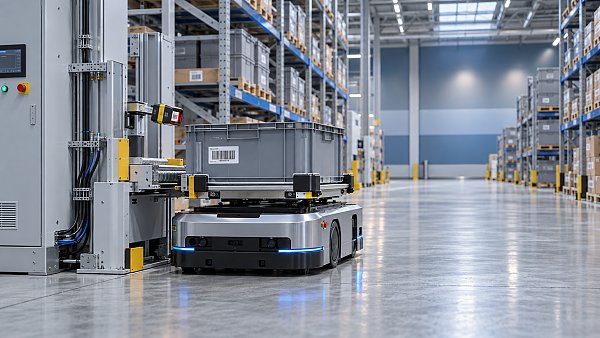
Standards-based interfaces can reduce some customization, but they do not eliminate workflow design. VDA 5050, for example, addresses communication between a master control system and mobile robots; it does not by itself define WMS inventory posting or business exception handling. Confirm supported versions, implemented features, and responsibility boundaries rather than accepting “standard-compatible” as proof of end-to-end interoperability.
Make task state and completion evidence explicit
One business task may generate several robot missions. Moving a pallet through an intermediate buffer, for example, can involve separate transport legs. Maintain a durable relationship between the WMS task, each mission, and the handling unit. Without that relationship, a completed transport leg can be mistaken for completion of the entire warehouse transaction.
The interface contract should include task and mission identifiers, handling-unit identity, source and destination, quantity and unit of measure where relevant, priority, timestamps, and event identifiers. Define permitted state transitions as carefully as field formats. A useful model distinguishes requested, accepted, executing, physically completed, inventory-posted, failed, and canceled states.
These distinctions prevent an acknowledgment from being treated as execution. “Accepted” means the receiving system has taken responsibility for a request; it does not mean a robot has picked up the load. Similarly, “physically completed” and “inventory-posted” may occur separately and require reconciliation if the WMS is temporarily unavailable.
Completion evidence must match the operation. At a conveyor interface, it might require load-presence confirmation and a downstream handshake. At a staffed station, it might require a container scan or operator acknowledgment. Navigation success alone proves neither correct load identity nor successful transfer.
Design for duplicate delivery and uncertain outcomes. Use idempotency keys so retrying the same request cannot create another movement or inventory posting. Preserve stable event identifiers, reject invalid state regressions, and provide status queries. A timeout means the caller does not know the result—not that the action failed. Recovery should check the existing task before issuing a replacement.
Design exceptions around the physical load
Exception handling becomes most important after pickup. Before pickup, cancellation may release a reservation. After pickup, cancellation requires a safe destination and a corresponding inventory decision. A digital “cancel” command cannot make a carried pallet return to its original location.
For each failure, define the load’s possible physical state, the system authorized to decide the next action, and the evidence required to close the exception. A blocked destination might lead to an approved buffer; an unidentified tote might require quarantine and a scan. Neither should automatically become an ordinary successful delivery.
Network interruption needs equally explicit rules. Decide whether already accepted work may continue, whether new work must stop, and what happens when a robot reaches a handoff point without upstream connectivity. Local continuation is appropriate only where equipment behavior, destination availability, and inventory traceability remain controlled.
Provide an exception queue that shows the last confirmed physical event, current task state, reservation status, and permitted recovery actions. Free-form corrections across several applications undermine auditability. Manual moves should use a controlled scan-and-confirm process, with authority to reconcile records clearly assigned.
Operational continuity also depends on site readiness. Validate wireless coverage along routes and at docking points, endpoint access, service-account permissions, certificate renewal, and monitoring. Keep business integration separate from safety control, while ensuring restart procedures cannot resume missions against stale destinations or unresolved loads.
Test uncertainty, not just successful missions
Testing should prove that the systems recover from disagreement, not merely demonstrate that a robot can travel between two points. Interface tests can validate payloads and state transitions before equipment arrives. Simulation can explore queueing and capacity constraints. Physical acceptance testing must then verify scans, docking, load transfer, and recovery under actual site conditions.
Include failure injection in the acceptance plan:
- Resend a task request and verify that only one executable task exists.
- Lose an acknowledgment after acceptance, then recover status without creating replacement work.
- Deliver duplicate or out-of-order events and verify that state cannot regress incorrectly.
- Interrupt connectivity after pickup and confirm controlled load handling.
- Block a destination after dispatch and verify the alternate-destination process.
- Restart an integration service with work in progress and reconcile outstanding tasks.
- Complete a physical move while WMS posting is unavailable, then restore consistency without moving the load again.
Measure the complete workflow: time from work release to verified posting, queue age, exception frequency, reconciliation backlog, and recovery duration. Robot travel time alone can conceal bottlenecks at stations or transaction interfaces. Test expected peak concurrency and destination congestion, not only isolated missions.
Acceptance criteria should specify observable outcomes. “Automatic recovery” is incomplete unless it states which failures are covered, whether operator action is allowed, and what evidence demonstrates consistency. Assign an owner for cross-system defects so issues do not stall between software and equipment suppliers.
Release work gradually, with a workable rollback boundary
Begin production with a bounded zone or workflow whose manual alternative is understood. Limit outstanding work until physical movements, task states, and WMS postings remain aligned under normal load and injected exceptions. Expanding robot count before proving recovery increases the number of loads exposed to the same unresolved defect.
Cutover requires a defined inventory snapshot, verified master-data mappings, controlled work release, and procedures for existing open tasks. Prevent manual and automated processes from allocating the same handling unit. Any parallel operation needs an explicit partition by zone, task type, or another enforceable rule.
Rollback should stop new dispatches, account for accepted missions, identify carried or buffered loads, and reconcile inventory before manual work resumes. Simply disabling the interface can leave robots executing tasks that the WMS still considers open.
The final release gate is operational control: every active load can be located, every outstanding task has an accountable owner, and every completed movement can be reconciled with the WMS. When those conditions are demonstrable, robots can become an extension of the existing warehouse process rather than a separate operation that depends on manual reconciliation.
Get weekly intelligence in your inbox.
No noise. No sponsored content. Pure intelligence.
 Oct 25, 2026Teradyne Robotics and Sereact Partner on AI-Powered Returns AutomationTeradyne Robotics and Sereact Partner on AI-Powered Returns Automation
 Oct 25, 2026Smart Warehousing Integration: How to Connect Robots to an Existing WMSSmart Warehousing Integration: How to Connect Robots to an Existing WMS
 Oct 24, 2026Tesla Q3 2026 Storage Deployments Rank Second Highest as Revenue Falls 16%Tesla Q3 2026 Storage Deployments Rank Second Highest as Revenue Falls 16%
 Oct 24, 2026Freight Forwarding Services Pricing: Comparing Quotes Beyond Base RatesFreight Forwarding Services Pricing: Comparing Quotes Beyond Base Rates
 Oct 23, 2026IndexBox Issues Off-Grid Solar Outlook to 2035, Forecasting 8.2% CAGRIndexBox Issues Off-Grid Solar Outlook to 2035, Forecasting 8.2% CAGR
 Oct 23, 2026NSF/ANSI 49 Biosafety Cabinets: Product Certification vs. Field TestingNSF/ANSI 49 Biosafety Cabinets: Product Certification vs. Field Testing
 Oct 22, 2026Mitsubishi Electric Develops Industry-First Humanoid Robot–CNC Machining SystemMitsubishi Electric Develops Industry-First Humanoid Robot–CNC Machining System
 Oct 22, 2026Aerospace Aluminum Machining: How to Control Distortion in Thin-Wall PartsAerospace Aluminum Machining: How to Control Distortion in Thin-Wall Parts
 Oct 21, 2026Genesis Energy commissions 200 MWh battery storage system at HuntlyGenesis Energy commissions 200 MWh battery storage system at Huntly
 Oct 21, 2026Buying AMI Smart Meters Wholesale: Compatibility Checks and Total CostsBuying AMI Smart Meters Wholesale: Compatibility Checks and Total Costs
 Oct 20, 2026Werner Enterprises Issues Q3 Earnings Warning as Costs RiseWerner Enterprises Issues Q3 Earnings Warning as Costs Rise
 Oct 20, 2026Are Digital Twins Viable for SMEs? Costs, Use Cases, and Data RequirementsAre Digital Twins Viable for SMEs? Costs, Use Cases, and Data Requirements
 Oct 19, 2026Choosing a Wholesale Servo Motor Exporter: Traceability and Warranty ChecksChoosing a Wholesale Servo Motor Exporter: Traceability and Warranty Checks
 Oct 18, 2026Syringe Manufacturing Equipment: Evaluating Throughput and Assembly AccuracySyringe Manufacturing Equipment: Evaluating Throughput and Assembly Accuracy
 Oct 17, 2026Air Freight Forwarding Services: How to Compare Quotes for Urgent ShipmentsAir Freight Forwarding Services: How to Compare Quotes for Urgent Shipments
 Oct 16, 2026Wholesale Solar Panels: How to Compare Bulk Quotes by Total Landed CostWholesale Solar Panels: How to Compare Bulk Quotes by Total Landed Cost
 Oct 15, 2026Supply Chain Intelligence for Sourcing: How to Vet New SuppliersSupply Chain Intelligence for Sourcing: How to Vet New Suppliers
 Oct 14, 2026How to assess a smart manufacturing systems integrator for retrofitsHow to assess a smart manufacturing systems integrator for retrofits
 Oct 14, 2026How energy costs shape smart manufacturing investment in EuropeHow energy costs shape smart manufacturing investment in Europe
 Oct 14, 2026How skills shortages slow smart manufacturing in Southeast AsiaHow skills shortages slow smart manufacturing in Southeast Asia
 Oct 14, 2026How CNC wire-cut machining maintains tight tolerances in thick partsHow CNC wire-cut machining maintains tight tolerances in thick parts
 Oct 14, 2026Can automated feeding stabilize metal forming in smart factories?Can automated feeding stabilize metal forming in smart factories?
 Oct 14, 2026Can CT inspection detect internal defects in metal additive parts?Can CT inspection detect internal defects in metal additive parts?
 Oct 14, 2026When does additive manufacturing reduce lead time for spare parts?When does additive manufacturing reduce lead time for spare parts?
 Oct 14, 2026How production volume affects ROI on an automated painting lineHow production volume affects ROI on an automated painting line
 Oct 14, 2026What data does manufacturing bottleneck analysis consulting need?What data does manufacturing bottleneck analysis consulting need?
 Oct 14, 2026When should you hire a consultant for manufacturing bottlenecks?When should you hire a consultant for manufacturing bottlenecks?