Geothermal Heat Pumps for Schools: Site and Retrofit Considerations
A geothermal heat pump for schools can support long-term energy and decarbonization goals, but project success depends on more than equipment selection. Site conditions, available land, ground-loop design, existing HVAC infrastructure, and construction schedules all influence feasibility and cost. Retrofit planning must also account for classroom disruption, permitting, and coordination across stakeholders. The most useful early question is not simply whether geothermal technology will work, but whether it can be delivered and operated sensibly on this particular campus.
Start With the Campus, Not the Equipment Schedule
A ground-source heat pump system moves heat between a building and the ground through a heat exchanger. In heating mode, it extracts heat from the ground; in cooling mode, it rejects heat back into it. A closed-loop system circulates fluid through buried pipes, while an open-loop system uses groundwater directly and must address water availability, discharge, treatment, and applicable permissions.
That basic description leaves several decisions unresolved. A school may have enough land for a loop field but insufficient access for drilling equipment. Its central plant may be near replacement, while classroom distribution systems still have years of service life. Or the electrical system may need a substantial upgrade before heating loads can be electrified. These conditions can determine the project’s scope more than the choice of heat pump manufacturer.
Begin with a campus-level feasibility study that brings together utility records, building plans, equipment inventories, occupancy schedules, and known site constraints. Where records are incomplete, site investigation should be budgeted as part of design rather than treated as an avoidable extra. A low-confidence estimate based on old drawings can quickly become an expensive construction change.
Ground-Loop Options and the Land They Actually Require
The loop field is a long-lived infrastructure decision. It is also one of the hardest parts of a geothermal retrofit to change later. The appropriate configuration depends on heating and cooling loads, ground properties, available space, installation access, and local requirements.
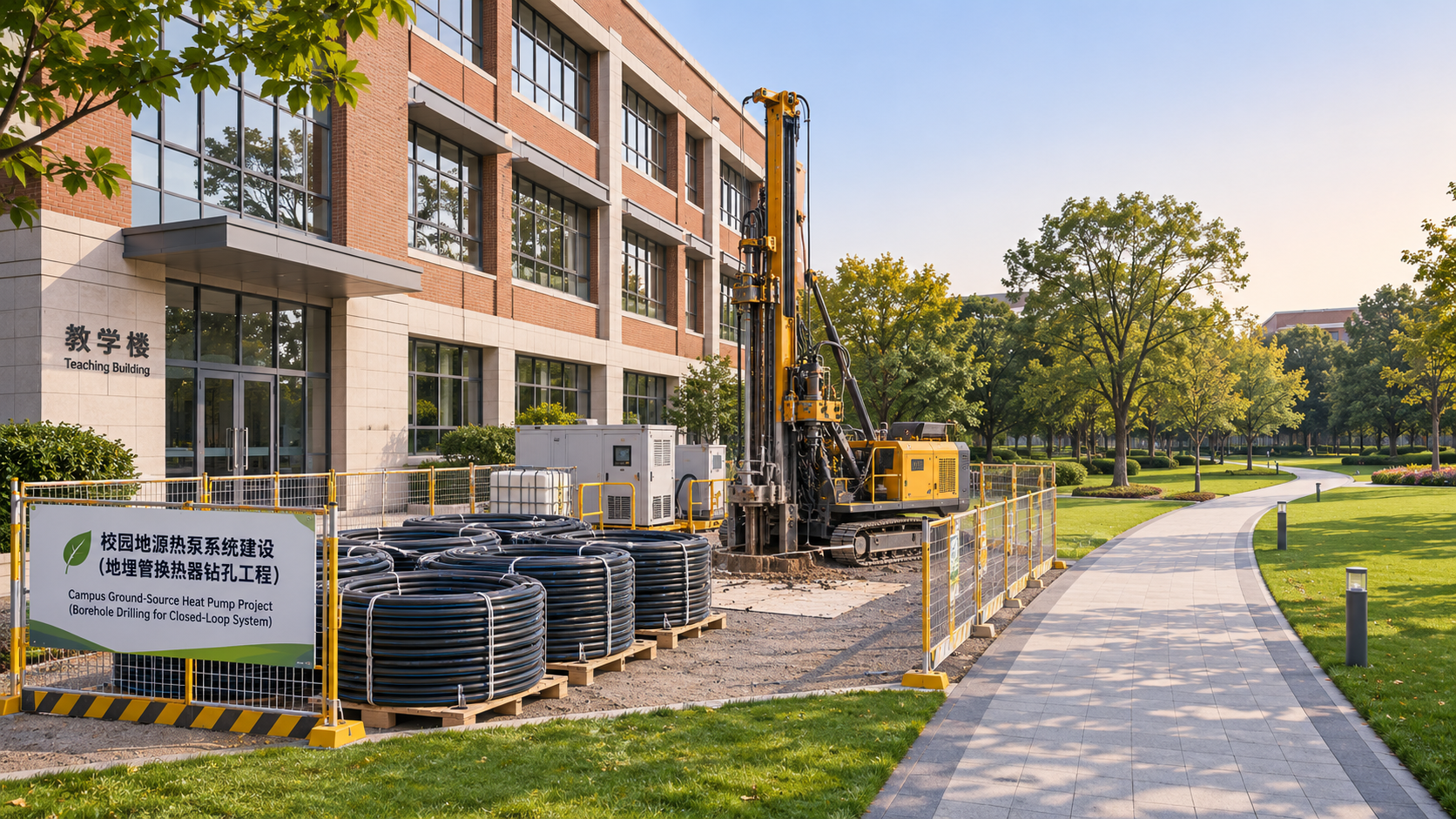
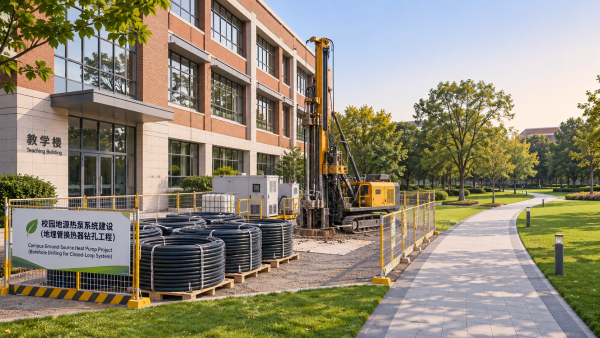
Vertical closed loops use boreholes and can be practical where surface area is limited. They still need room for drilling rigs, pipe handling, borehole spacing, and connections to the building. Drilling conditions and subsurface restrictions can materially affect cost and schedule.
Horizontal closed loops use trenches and may suit campuses with accessible open ground. Playing fields can appear attractive on a site plan, but the project must account for excavation, soil storage, drainage, reinstatement, and the period during which the area will be unavailable.
Open-loop arrangements may be worth investigating where groundwater resources and regulations permit. Their feasibility depends on more than the presence of a well: water quality, sustainable yield, discharge or reinjection arrangements, maintenance, and environmental approvals all require assessment.
A pond or other surface-water heat exchanger may also be possible where a suitable water body is available and its use is permitted. Ownership, seasonal conditions, ecological constraints, and protection of submerged piping must be investigated before it becomes a credible option.
The site drawing should show more than the proposed loop field. Include underground utilities, foundations, access routes, mature trees, protected areas, future building footprints, and the route into the mechanical room. A field that fits geometrically may still conflict with a planned extension or the only safe path for emergency vehicles.
Investigate the Ground Before Fixing the Budget
Ground-loop sizing depends on how the site transfers heat, not just on building floor area. Soil and rock conditions, groundwater movement, borehole construction, and the balance between annual heat extraction and rejection all matter. A design that overlooks a persistent imbalance can lead to unfavorable ground temperatures over time and reduce system performance.
For a larger or uncertain project, the design team may recommend a test borehole and thermal response testing. The results can inform loop design, although they do not remove all subsurface risk across an entire campus. Ask the engineer to explain which assumptions the test will verify, how results will affect the design, and what happens if drilling encounters unexpected conditions.
Ground investigations should also consider contamination, buried structures, groundwater protection, and the disposal of drilling materials. Requirements vary by location. Early discussions with the relevant authorities and a qualified local drilling contractor are more useful than assuming a previous project’s approvals will apply.
A hybrid design can sometimes reduce loop-field demands by combining the ground source with another heating or heat-rejection system. This adds controls and equipment, so the decision should be based on modeled lifecycle costs and site constraints rather than on the smallest possible bore field.
Retrofit Compatibility Is Usually the Harder Question
The ground loop is only one side of the system. Heat pumps must also deliver useful temperatures and airflow through the building’s existing distribution network. A school with aging high-temperature radiators may not be able to replace its boiler with a heat pump without additional work. Lower supply temperatures may require larger emitters, envelope improvements, a different distribution strategy, or retained supplementary heating.
The same scrutiny applies to cooling and ventilation. A heat pump does not automatically provide adequate outdoor air or solve humidity problems. If the retrofit adds cooling to classrooms that previously had none, the team must assess condensate drainage, moisture control, duct capacity, acoustics, and controls. Laboratories, kitchens, gyms, and assembly spaces may have schedules or ventilation needs that differ substantially from standard classrooms.
Inspect the equipment rooms and the routes between them. Can new units be brought through existing doors? Is there space to service filters, pumps, valves, and electrical panels? Can pipework reach classrooms without disturbing fire-rated assemblies or creating inaccessible maintenance points? These practical questions are easier to resolve before procurement than after equipment arrives.
Electrical capacity also deserves early attention. Review existing demand, available service capacity, switchgear condition, and the utility’s process for upgrades. Model winter peak demand as well as annual consumption. A system that reduces fuel use can still create a costly electrical bottleneck if the service strategy is left until detailed design.
Design Around the School Calendar
School retrofits rarely have an uninterrupted construction window. Examinations, summer programs, building rentals, and maintenance activities can limit access even when regular classes are not in session. A schedule based only on the formal school year is therefore incomplete.
Separate the work into activities that can occur outside the building, activities requiring restricted access, and those that need a heating or cooling shutdown. Ground-loop installation may be possible while the school operates, but drilling noise, deliveries, fencing, dust, and pedestrian routes still need management. Interior work can require temporary classroom moves, containment, or work outside occupied hours.
If the existing plant must stay operational during installation, document the temporary operating arrangement and who is responsible for it. For phased work, identify when each zone can be connected and commissioned, how controls will handle mixed old and new equipment, and whether temporary heating or cooling is necessary. A phased approach can protect occupancy, but temporary connections and repeated mobilization should be included in the cost comparison.
Compare Costs on a Consistent Basis
A credible business case compares complete alternatives, not a geothermal equipment quote against the cost of replacing a boiler. At minimum, consider a code-compliant conventional replacement, an air-source heat pump option where suitable, and the proposed ground-source solution. Use the same assumptions for building improvements, operating schedules, energy prices, maintenance, replacement periods, and analysis horizon.
The geothermal estimate should include investigation, drilling or excavation, loop piping, building distribution changes, electrical upgrades, controls, commissioning, reinstatement, and temporary arrangements. Allowances for unknown ground conditions should be explicit. Where incentives or financing affect the comparison, verify eligibility, timing, and application requirements locally rather than treating funding as guaranteed.
Energy and carbon outcomes also depend on the electricity supply, utility tariffs, actual operating hours, and the system’s performance in service. Request a sensitivity analysis showing how the result changes if drilling is more difficult than expected, electricity prices change, or the building load differs from the initial model. This is more useful to a decision-maker than a single payback figure with no visible assumptions.
Procurement and Commissioning: Define the Interfaces
Ground-source projects cross several disciplines: drilling, ground-loop installation, mechanical and electrical construction, controls, and building operations. The contract documents should make responsibility for each interface clear. Otherwise, a problem at the boundary between packages can become a dispute about whose work is incomplete.
Ask bidders to identify the basis for loop sizing, ground-property assumptions, drilling exclusions, warranty boundaries, and contingency provisions. Confirm who will obtain permits, manage drilling waste, restore surfaces, pressure-test the loop, and provide as-built records. For internationally sourced equipment, also check local service availability, spare parts, electrical compatibility, and documentation requirements.
Commissioning should cover the complete system rather than individual heat pumps alone. The plan should address loop flushing and pressure testing, flow verification, controls integration, ventilation performance, alarms, and functional testing across operating modes. Some seasonal conditions may not be available at handover, so schedule return visits where needed. Facilities staff should receive practical training and accessible operating documentation, including what to check when a classroom is uncomfortable.
TradeNexus Pro’s green energy coverage provides a wider context for comparing technologies and suppliers, but project-specific design evidence remains essential. Before committing to a preferred solution, ask the engineering team for a site constraint plan, a load and distribution assessment, an electrical capacity review, a phased construction strategy, and a cost comparison with stated assumptions. Those documents make it much easier to judge whether geothermal is a sound fit for the campus—and where the remaining uncertainties sit.
Get weekly intelligence in your inbox.
No noise. No sponsored content. Pure intelligence.
 Nov 06, 2026China's New Energy Storage Capacity Reaches 167 GWChina's New Energy Storage Capacity Reaches 167 GW
 Nov 06, 2026Geothermal Heat Pumps for Schools: Site and Retrofit ConsiderationsGeothermal Heat Pumps for Schools: Site and Retrofit Considerations
 Nov 05, 2026Australian Grid-Forming Battery Trial Completed as Akaysha Seeks ContractsAustralian Grid-Forming Battery Trial Completed as Akaysha Seeks Contracts
 Nov 05, 2026Smart Kitchen Appliances for Meal Prep: Which Ones Save the Most Time?Smart Kitchen Appliances for Meal Prep: Which Ones Save the Most Time?
 Nov 04, 2026Solar Inverter Makers Raise Prices, Fueling Margin Recovery ExpectationsSolar Inverter Makers Raise Prices, Fueling Margin Recovery Expectations
 Nov 04, 2026Choosing Ophthalmic Equipment for Hospitals: Key Clinical and Purchasing CriteriaChoosing Ophthalmic Equipment for Hospitals: Key Clinical and Purchasing Criteria
 Nov 03, 2026Amazon Raises European FBA Fuel and Logistics Surcharge to 2% From November 2Amazon Raises European FBA Fuel and Logistics Surcharge to 2% From November 2
 Nov 03, 2026How Exporters Can Build an Editorial Framework for Overseas MarketsHow Exporters Can Build an Editorial Framework for Overseas Markets
 Nov 02, 2026China-Peru Free Trade Agreement Upgrade Takes Effect November 1China-Peru Free Trade Agreement Upgrade Takes Effect November 1
 Nov 02, 2026Choosing Digital Blood Pressure Monitors for Accurate Home ReadingsChoosing Digital Blood Pressure Monitors for Accurate Home Readings
 Nov 01, 2026Laboratory Equipment Prices: Budgeting for Purchase and Operating CostsLaboratory Equipment Prices: Budgeting for Purchase and Operating Costs
 Oct 31, 2026Chinese Portable Energy Storage Firms Report Overseas Order Growth in Q3Chinese Portable Energy Storage Firms Report Overseas Order Growth in Q3
 Oct 31, 2026SCARA Robot Cycle Times: How Payload and Travel Distance Affect SpeedSCARA Robot Cycle Times: How Payload and Travel Distance Affect Speed
 Oct 30, 2026Walmart and Symbotic Sign $6 Billion Global Automation AgreementWalmart and Symbotic Sign $6 Billion Global Automation Agreement
 Oct 30, 2026Choosing a Waterproof Folding Solar Charger: IP Ratings and Power OutputChoosing a Waterproof Folding Solar Charger: IP Ratings and Power Output
 Oct 29, 2026Poland to End SENT Registration for Certain Scrap Metal Road Shipments on October 28Poland to End SENT Registration for Certain Scrap Metal Road Shipments on October 28
 Oct 29, 2026Energy Storage System Quotation: How to Compare Scope and Hidden CostsEnergy Storage System Quotation: How to Compare Scope and Hidden Costs
 Oct 28, 2026BNEF Raises US Battery Storage Forecast 30%, Sees 213.9 GW by 2030BNEF Raises US Battery Storage Forecast 30%, Sees 213.9 GW by 2030
 Oct 28, 2026Global Trade Intelligence Pricing: Data Coverage, User Seats, and API CostsGlobal Trade Intelligence Pricing: Data Coverage, User Seats, and API Costs
 Oct 27, 2026Western Australia 1GW Data Centre With 5GWh Battery Enters Federal Review ProcessWestern Australia 1GW Data Centre With 5GWh Battery Enters Federal Review Process
 Oct 27, 2026USB-C Docking Stations in the UK: A Buyer's Guide to Compatibility and ChargingUSB-C Docking Stations in the UK: A Buyer's Guide to Compatibility and Charging
 Oct 26, 2026AgiBot Scales Up Production as 100 Expedition A3 Robots Stage Guinness Record AttemptAgiBot Scales Up Production as 100 Expedition A3 Robots Stage Guinness Record Attempt
 Oct 26, 2026Rehabilitation Equipment for Outpatient Clinics: What to Check Before BuyingRehabilitation Equipment for Outpatient Clinics: What to Check Before Buying
 Oct 25, 2026Teradyne Robotics and Sereact Partner on AI-Powered Returns AutomationTeradyne Robotics and Sereact Partner on AI-Powered Returns Automation
 Oct 25, 2026Smart Warehousing Integration: How to Connect Robots to an Existing WMSSmart Warehousing Integration: How to Connect Robots to an Existing WMS
 Oct 24, 2026Tesla Q3 2026 Storage Deployments Rank Second Highest as Revenue Falls 16%Tesla Q3 2026 Storage Deployments Rank Second Highest as Revenue Falls 16%
 Oct 24, 2026Freight Forwarding Services Pricing: Comparing Quotes Beyond Base RatesFreight Forwarding Services Pricing: Comparing Quotes Beyond Base Rates