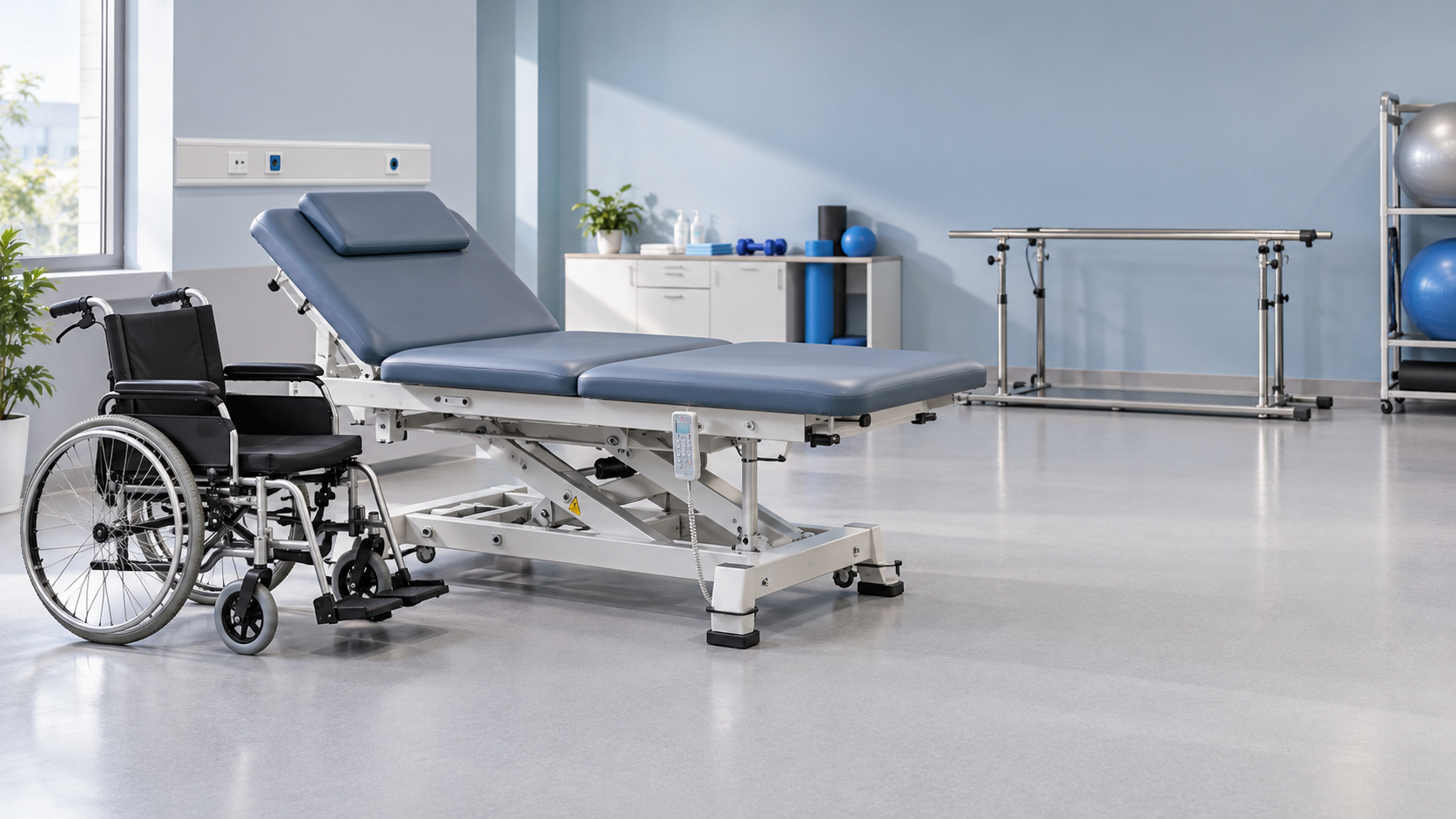
Rehabilitation Equipment for Outpatient Clinics: What to Check Before Buying
Rehabilitation equipment earns its place in an outpatient clinic when it supports the clinic’s treatment workload, fits the available space, and remains practical to operate between appointments. A competitive purchase price matters, but it cannot compensate for difficult patient transfers, slow adjustment, restrictive cleaning requirements, or unreliable repair support.
Before shortlisting models, procurement teams should establish four things: which patients and treatments the equipment must support, how it will function within the clinic’s daily workflow, what evidence supports its safety and suitability, and what ownership will cost over its expected service life. These checks help distinguish a useful investment from equipment that looks capable in a demonstration but sees limited use after installation.
Define the treatment workload before comparing specifications
A purchase request such as “a rehabilitation treadmill” or “an adjustable treatment table” leaves too much room for suppliers to propose products with different capabilities. Start with the treatment tasks the clinic needs to deliver and the patient characteristics that affect equipment selection. Clinical staff should define those requirements before procurement turns them into a specification.
For a clinic focused on musculoskeletal rehabilitation, priorities may include accessible treatment surfaces, progressive resistance, and quick changes between exercises. A service treating patients with neurological conditions may place greater emphasis on assisted transfers, supported movement, and space for a therapist to work alongside the patient. An equipment package built around one workload may serve the other poorly.
Translate these differences into requirements that can be demonstrated. “Suitable for patients with limited mobility” is too broad. Useful questions include whether a patient can approach the equipment with a mobility aid, whether the starting position is accessible, and whether the therapist can assist without reaching across moving components.
- Patient fit: Check the supported body dimensions, applicable weight limits, transfer needs, and positioning options against the population the clinic expects to treat.
- Treatment capability: Identify the required movement patterns, resistance or assistance settings, adjustment range, and any measurements needed for clinical decisions.
- Operating demands: Establish anticipated appointment volume, session duration, and frequency of changes between patients.
- Staff involvement: Specify whether treatments require continuous assistance, occasional adjustment, or supervision across several stations.
Look closely at the limits behind headline specifications. A stated maximum user weight does not explain every loading condition, accessory restriction, or permitted activity. Likewise, a broad resistance range says little about whether its lowest setting is appropriate for a patient beginning rehabilitation. Ask suppliers to explain the relevant operating limits in the instructions for use and demonstrate the settings that matter to your clinicians.
Separate essential capabilities from optional ones. An advanced measurement module may be valuable if clinicians will use its output to adjust treatment or document progress. If that information duplicates an existing assessment process, it may add cost, training, and maintenance without improving the service. Each optional feature should have an identified user and a clear purpose.
Test the equipment as part of a working room
Published dimensions describe the product, but purchasing decisions require the full working footprint. A treatment table needs room for therapist access and patient transfers. Exercise equipment may require clearance around moving parts, an approach route, and space for mobility aids. Accessories, cables, and stored attachments also occupy space that a product photograph can hide.
Mark the proposed layout on the floor before approving the purchase. Include the equipment in its largest operating configuration, any manufacturer-specified clearances, and the positions of staff and patients during use. Check the route from the entrance through to the treatment area, including doorways, turns, lifts, and delivery access. A unit that fits the room can still be difficult or costly to install.
A useful demonstration follows a complete appointment sequence: patient approach, transfer or mounting, adjustment, treatment, exit, cleaning, and preparation for the next patient. Ask the therapist who will use the equipment to perform these steps. Sales demonstrations can emphasize smooth operation while giving less attention to repositioning accessories or resetting the system between users.
Pay particular attention to adjustments made repeatedly throughout the day. Controls should be reachable from the positions in which staff actually work. Seats, supports, and handles should lock securely, with clear confirmation that they are engaged. For powered equipment, assess access to stop controls and the procedure for safely assisting a patient if power is lost or movement stops unexpectedly.
Cleaning deserves its own trial. Obtain the manufacturer’s cleaning and disinfection instructions, then compare them with the clinic’s infection prevention procedures. Check compatible products, required contact times, and any restrictions affecting upholstery, straps, touchscreens, or exposed components. Removable supports may improve access for cleaning but create additional handling, storage, and replacement work.
Consider throughput as a workflow question. Equipment that delivers an appropriate exercise may still create a bottleneck if setup and turnaround occupy too much of the appointment. Conversely, a compact multifunction unit may save floor space while preventing two therapists from treating patients at the same time. Compare those consequences against the clinic’s actual schedule before assuming that consolidation improves efficiency.
For equipment with software, include login, patient selection, report retrieval, and session closure in the trial. Establish whether essential functions remain available during an internet interruption and whether staff can operate the device without sharing accounts. Connected features deserve the same scrutiny as mechanical ones: they should make the treatment process workable under everyday conditions.
Verify the exact product, its documentation, and its support route
Regulatory obligations depend on the jurisdiction, the product’s intended purpose, and the claims made for it. Some equipment used in rehabilitation falls within medical device requirements; other products may follow different rules. Procurement should establish the applicable route for the proposed model and intended use, with input from the clinic’s clinical or compliance lead where appropriate.
Request documentation tied to the exact model, configuration, and legal manufacturer. A brochure referring to a product family does not establish the status of every version or accessory. The supplier should be able to explain what each document covers and how it relates to lawful supply and use in the clinic’s market.
Keep quality management evidence separate from product-specific evidence. A manufacturer’s quality certification can support an assessment of its processes, but it does not, by itself, establish that a particular device is authorized for a particular use. Broad statements such as “internationally certified” need to be translated into identifiable documents with relevant scope.
The instructions for use are also a purchasing document. Review the intended users, operating environment, contraindications or warnings where applicable, inspection requirements, and maintenance schedule before committing. Restrictions discovered after delivery can undermine the clinical case for buying the equipment.
Traceability matters for future service and safety communications. Establish how the clinic will identify its installed unit, record maintenance, receive relevant notices, and contact the responsible organization. For imported equipment, clarify which party handles local service, warranty claims, and regulatory responsibilities. A distributor’s commercial relationship with a manufacturer should be supported by clear responsibilities.
Service claims need similar precision. “Local support available” could mean telephone troubleshooting, a visiting engineer, or referral to another contractor. Ask where technicians are based, which models they are trained to repair, what parts they hold, and how service requests are escalated. Distinguish an initial response commitment from a repair commitment; receiving a reply does not restore treatment capacity.
- Which preventive maintenance, safety inspections, or calibration activities does this model require, and who is qualified to perform them?
- Which components are treated as consumables or wear items, and what are their prices and replacement procedures?
- How are spare parts supplied, and what support period will the supplier commit to in writing?
- What happens when a fault cannot be resolved remotely, including transport, engineer travel, and access to temporary replacement equipment?
- Which warranty exclusions apply to upholstery, batteries, accessories, software, and use intensity?
For connected systems, establish responsibility for updates, security fixes, user access, and patient data handling. Confirm where data is stored, whether exports are usable outside the supplier’s software, and what functionality remains when a subscription or support agreement ends. If integration with the clinic’s records system is important, ask for a demonstration of the required workflow. A general claim of compatibility is insufficient evidence of a working connection.
Compare the cost of usable treatment capacity
A meaningful price comparison begins with a common scope. One quotation may include delivery, installation, accessories, and staff training; another may cover only the base unit. Ask each shortlisted supplier to price the same required configuration and identify exclusions separately. Otherwise, apparent savings may disappear when the clinic prepares the equipment for use.
Build the ownership estimate around an agreed planning period. Include purchase and financing costs where relevant, site preparation, installation, mandatory accessories, training, preventive maintenance, inspections, consumables, software fees, and likely wear-part replacement. For cross-border purchases, identify responsibility for freight, insurance, customs handling, and applicable import charges.
Keep assumptions visible. If future repair costs are uncertain, compare reasonable scenarios rather than assigning a falsely precise figure. The same applies to utilization: a highly specialized unit may be appropriate for a defined treatment service, but its economics depend on how often suitable patients will use it and whether staffing is available.
A useful internal measure is estimated ownership cost per usable treatment session. Divide the projected cost over the planning period by the sessions the clinic realistically expects to deliver. Allow for setup, cleaning, planned maintenance, staffing constraints, and downtime. This is a planning tool; it does not establish clinical value or guarantee reimbursement.
Downtime should also influence the service specification. If a single unit supports a service that cannot easily be moved elsewhere, a lengthy repair can disrupt appointments and consume staff time. A clinic with interchangeable equipment may tolerate the same outage more easily. The value of a service agreement therefore depends on the equipment’s role in the clinic, alongside the supplier’s actual repair capability.
Before award, agree on acceptance criteria and put them in the purchase documents. These should cover the delivered model and accessories, installation, required documentation, staff training, and checks showing that the equipment performs the agreed tasks. Where payment terms allow, connect the final payment milestone to documented acceptance.
A compact evaluation record can then show each essential requirement, the supplier’s evidence, the demonstration result, and the relevant contract commitment. Resolve any gap affecting patient access, intended use, cleaning, or service continuity before placing the order. Optional features can be negotiated; an unresolved limitation in the clinic’s core treatment workflow is a reason to reconsider the selection.
Get weekly intelligence in your inbox.
No noise. No sponsored content. Pure intelligence.
 Oct 30, 2026Walmart and Symbotic Sign $6 Billion Global Automation AgreementWalmart and Symbotic Sign $6 Billion Global Automation Agreement
 Oct 30, 2026Choosing a Waterproof Folding Solar Charger: IP Ratings and Power OutputChoosing a Waterproof Folding Solar Charger: IP Ratings and Power Output
 Oct 29, 2026Poland to End SENT Registration for Certain Scrap Metal Road Shipments on October 28Poland to End SENT Registration for Certain Scrap Metal Road Shipments on October 28
 Oct 29, 2026Energy Storage System Quotation: How to Compare Scope and Hidden CostsEnergy Storage System Quotation: How to Compare Scope and Hidden Costs
 Oct 28, 2026BNEF Raises US Battery Storage Forecast 30%, Sees 213.9 GW by 2030BNEF Raises US Battery Storage Forecast 30%, Sees 213.9 GW by 2030
 Oct 28, 2026Global Trade Intelligence Pricing: Data Coverage, User Seats, and API CostsGlobal Trade Intelligence Pricing: Data Coverage, User Seats, and API Costs
 Oct 27, 2026Western Australia 1GW Data Centre With 5GWh Battery Enters Federal Review ProcessWestern Australia 1GW Data Centre With 5GWh Battery Enters Federal Review Process
 Oct 27, 2026USB-C Docking Stations in the UK: A Buyer's Guide to Compatibility and ChargingUSB-C Docking Stations in the UK: A Buyer's Guide to Compatibility and Charging
 Oct 26, 2026AgiBot Scales Up Production as 100 Expedition A3 Robots Stage Guinness Record AttemptAgiBot Scales Up Production as 100 Expedition A3 Robots Stage Guinness Record Attempt
 Oct 26, 2026Rehabilitation Equipment for Outpatient Clinics: What to Check Before BuyingRehabilitation Equipment for Outpatient Clinics: What to Check Before Buying
 Oct 25, 2026Teradyne Robotics and Sereact Partner on AI-Powered Returns AutomationTeradyne Robotics and Sereact Partner on AI-Powered Returns Automation
 Oct 25, 2026Smart Warehousing Integration: How to Connect Robots to an Existing WMSSmart Warehousing Integration: How to Connect Robots to an Existing WMS
 Oct 24, 2026Tesla Q3 2026 Storage Deployments Rank Second Highest as Revenue Falls 16%Tesla Q3 2026 Storage Deployments Rank Second Highest as Revenue Falls 16%
 Oct 24, 2026Freight Forwarding Services Pricing: Comparing Quotes Beyond Base RatesFreight Forwarding Services Pricing: Comparing Quotes Beyond Base Rates
 Oct 23, 2026IndexBox Issues Off-Grid Solar Outlook to 2035, Forecasting 8.2% CAGRIndexBox Issues Off-Grid Solar Outlook to 2035, Forecasting 8.2% CAGR
 Oct 23, 2026NSF/ANSI 49 Biosafety Cabinets: Product Certification vs. Field TestingNSF/ANSI 49 Biosafety Cabinets: Product Certification vs. Field Testing
 Oct 22, 2026Mitsubishi Electric Develops Industry-First Humanoid Robot–CNC Machining SystemMitsubishi Electric Develops Industry-First Humanoid Robot–CNC Machining System
 Oct 22, 2026Aerospace Aluminum Machining: How to Control Distortion in Thin-Wall PartsAerospace Aluminum Machining: How to Control Distortion in Thin-Wall Parts
 Oct 21, 2026Genesis Energy commissions 200 MWh battery storage system at HuntlyGenesis Energy commissions 200 MWh battery storage system at Huntly
 Oct 21, 2026Buying AMI Smart Meters Wholesale: Compatibility Checks and Total CostsBuying AMI Smart Meters Wholesale: Compatibility Checks and Total Costs
 Oct 20, 2026Werner Enterprises Issues Q3 Earnings Warning as Costs RiseWerner Enterprises Issues Q3 Earnings Warning as Costs Rise
 Oct 20, 2026Are Digital Twins Viable for SMEs? Costs, Use Cases, and Data RequirementsAre Digital Twins Viable for SMEs? Costs, Use Cases, and Data Requirements
 Oct 19, 2026Choosing a Wholesale Servo Motor Exporter: Traceability and Warranty ChecksChoosing a Wholesale Servo Motor Exporter: Traceability and Warranty Checks
 Oct 18, 2026Syringe Manufacturing Equipment: Evaluating Throughput and Assembly AccuracySyringe Manufacturing Equipment: Evaluating Throughput and Assembly Accuracy
 Oct 17, 2026Air Freight Forwarding Services: How to Compare Quotes for Urgent ShipmentsAir Freight Forwarding Services: How to Compare Quotes for Urgent Shipments
 Oct 16, 2026Wholesale Solar Panels: How to Compare Bulk Quotes by Total Landed CostWholesale Solar Panels: How to Compare Bulk Quotes by Total Landed Cost
 Oct 15, 2026Supply Chain Intelligence for Sourcing: How to Vet New SuppliersSupply Chain Intelligence for Sourcing: How to Vet New Suppliers