Smart Kitchen Appliances for Meal Prep: Which Ones Save the Most Time?
Meal prep can save time, but chopping, cooking, and cleaning still add up. The right appliances can simplify these tasks for individuals and families alike.
From programmable multicookers to connected air fryers, each device offers different benefits, and not every smart feature is worth the investment.
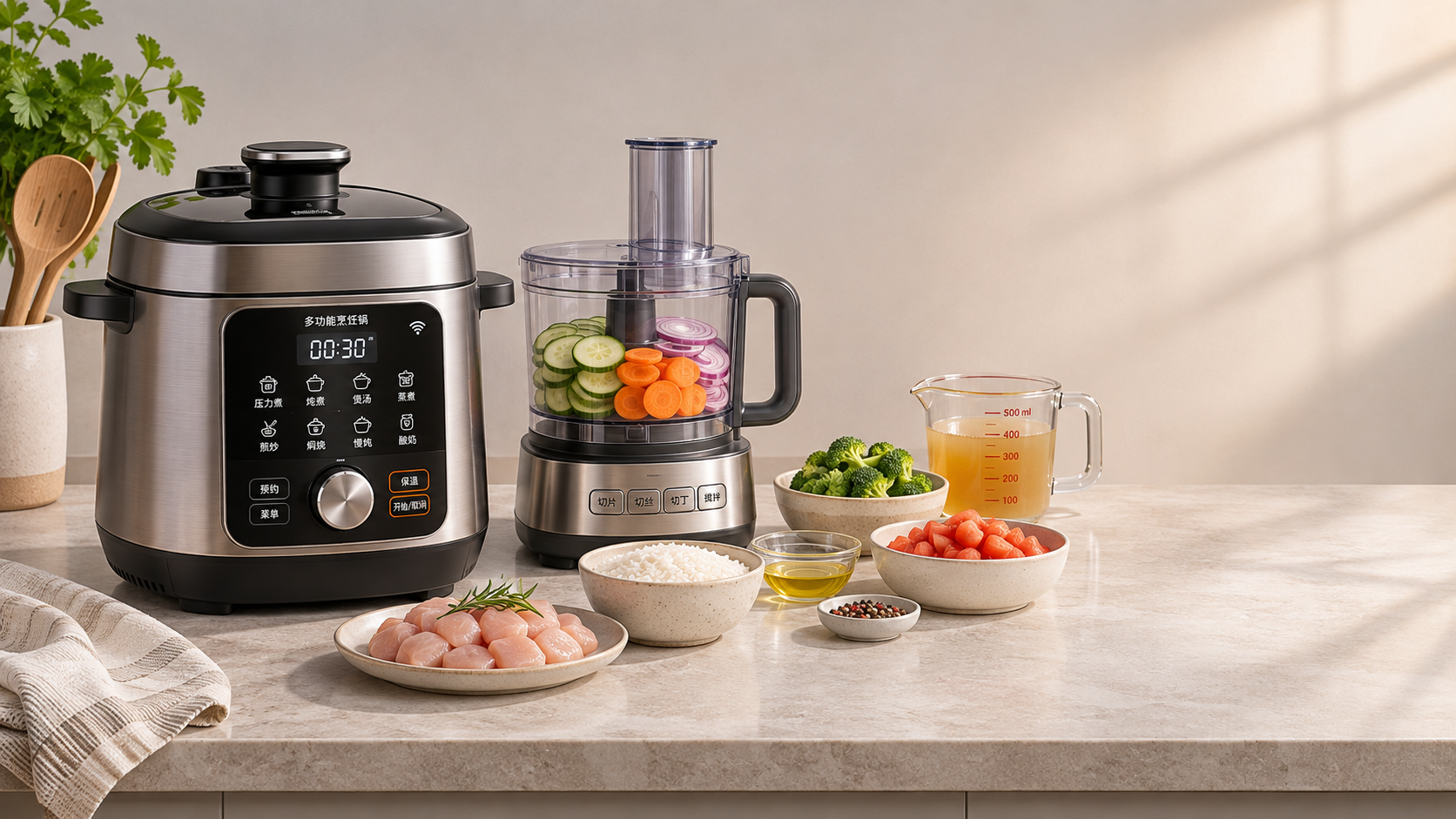
For most households, a programmable multicooker saves the most hands-on time across complete meals. A food processor is often the better choice for vegetable-heavy prep.
The best choice depends on what you cook, how much you prepare, and whether you want faster cooking, less supervision, or fewer repetitive tasks.
Which Appliances Save the Most Meal Prep Time?
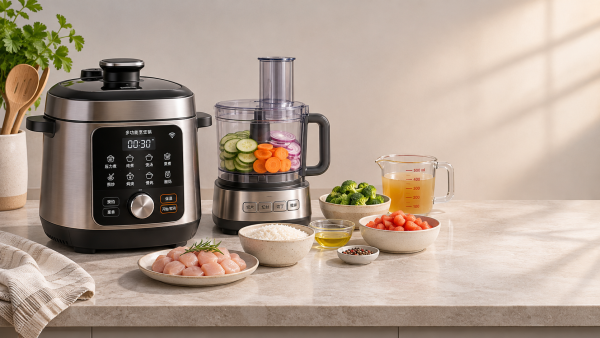
A multicooker is the strongest all-around option because it can cook substantial batches with limited attention. An air fryer excels at smaller, quick-cooking portions.
For chopping and slicing, a food processor can make the biggest difference, even without an app. Its advantage grows when you prepare large quantities.
The estimates below are illustrative, not guarantees. Actual savings depend on ingredients, batch size, appliance capacity, cleaning, and the equipment you already own.
Think in terms of active time as well as elapsed time. An appliance can free you to do other work even when dinner takes just as long.
Is a Programmable Multicooker Worth It for Meal Prep?
A programmable multicooker combines functions such as pressure cooking, slow cooking, sautéing, and steaming in one countertop device, although available modes vary by model.
It is especially useful for batch-cooking foods that normally need regular attention, including dried beans, stews, shredded meats, and some whole grains.
Pressure cooking can substantially shorten cooking for certain ingredients compared with conventional stovetop methods. However, the displayed cooking program is not the entire process.
Allow time for the appliance to build pressure and release it afterward. Depending on the recipe and release method, these stages can noticeably extend the wait.
Its biggest advantage is often reduced supervision. Once ingredients are loaded and the program starts, you can wash produce, prepare sides, or work elsewhere.
For example, cook a batch of chicken or lentils while chopping salad vegetables. Portion the cooked ingredients into several meals after they cool appropriately.
Look for a removable inner pot, straightforward controls, a reliable sealing mechanism, and a capacity that matches your household. Check replacement parts before buying.
App connectivity can be useful for notifications or recipes, but many programmable models work well without it. A useful timer matters more than a crowded feature list.
Skip this purchase if you mostly cook quick individual portions or already use a slow cooker and stovetop efficiently. A large pot still needs cleaning and storage.
Can a Food Processor Make Chopping Faster?
A food processor is often the most valuable appliance for people who spend Sunday afternoon slicing vegetables, shredding cabbage, or making dips in bulk.
It handles repeated cutting motions quickly and can produce consistent slices or shreds with the appropriate disc. Many models also mix sauces and pulse ingredients.
Consider the complete job before judging the savings. You may need to trim ingredients, assemble the bowl and blade, then wash several components afterward.
For one onion, a knife and cutting board may be faster overall. For a week of slaw, sliced peppers, and shredded carrots, the processor becomes more compelling.
Choose a bowl large enough for your usual batch and check whether replacement blades are available. Dishwasher-safe parts can make frequent use more practical.
Most food processors are not connected devices, and that is not a disadvantage. Mechanical capability can save more time than an app-controlled appliance.
Use the pulse function when texture matters, particularly for salsa or chopped vegetables. Continuous processing can quickly turn an intended chop into a puree.
Does an Air Fryer Save Time for Weekly Meals?
An air fryer is a compact convection oven that circulates hot air around food. It can cook or reheat smaller portions without warming a full-size oven.
It works well for vegetables, tofu, fish, chicken pieces, and leftovers. Cooking times vary with thickness, quantity, starting temperature, and the appliance itself.
For one or two servings, it can be convenient on busy evenings. A large family may need several batches, reducing or eliminating the time advantage.
A connected air fryer may send completion alerts or offer preset recipes. Those features help with coordination, but they do not replace checking food for doneness.
Choose capacity based on the amount you actually cook, and leave room for air circulation. Overcrowding can lead to uneven results and longer cooking.
Check the basket and tray design before buying. A dishwasher-safe basket may reduce cleanup, although baked-on residue can still need soaking or hand washing.
For meat and poultry, use a food thermometer rather than relying only on a preset. Cooking recommendations differ by food and should be followed carefully.
Are Smart Rice Cookers, Ovens, and Blenders Worth Buying?
These appliances can be excellent for specific routines, but their value depends on whether they solve a recurring problem in your kitchen.
Rice and Grain Cookers
A rice cooker is useful when you prepare rice several times a week. Load it, start the program, and focus on the rest of the meal.
Many models switch to a keep-warm setting automatically. Follow the manufacturer’s instructions for safe holding, and refrigerate leftovers promptly rather than leaving them out.
Check which grains a model supports before assuming it can handle everything from quinoa to steel-cut oats. Programs and recommended water ratios differ.
Smart Countertop Ovens
A smart countertop oven can roast, bake, toast, or reheat, depending on the model. Some include temperature probes, guided programs, or phone notifications.
It may be useful when you regularly cook sheet-pan meals or want a smaller alternative to a conventional oven. Compare usable interior space, not just exterior dimensions.
Smart presets still require sensible judgment about portion size and food safety. A connected oven also costs more than many conventional toaster ovens.
Connected Blenders
A blender earns its space when smoothies, sauces, or pureed soups are regular menu items. Automatic programs can provide repeatable results with minimal attention.
However, an app rarely removes the need to measure ingredients, load the jar, and clean it. A dependable conventional blender may deliver similar practical value.
For hot liquids, follow the manufacturer’s instructions carefully. Some sealed blending containers are unsuitable for hot ingredients because pressure can build inside.
How Much Time Can You Realistically Save?
There is no universal number: a device that saves time on a large batch may slow down a small meal once setup and washing are included.
Use your current routine as a baseline. Record active preparation, cooking supervision, and cleanup separately, then compare them with the same recipe using the appliance.
For example, suppose a processor saves 15 minutes of chopping but adds five minutes of assembly and washing. Your net active-time saving is 10 minutes.
Likewise, a multicooker may take an hour from start to finish but require only 15 minutes of attention. That is valuable if you use the remaining time productively.
Account for batch size, too. A smaller air fryer might require three rounds of cooking, while a conventional oven can prepare the same quantity at once.
Before buying, estimate how often you will use the device. A modest saving repeated twice weekly can matter more than a large saving once a month.
Which Smart Features Are Actually Useful?
The most useful features reduce a specific inconvenience: notifications prevent forgotten food, timers coordinate meals, and saved settings simplify dishes you make repeatedly.
Remote monitoring can be helpful when you are elsewhere in the home. Check whether the appliance requires a compatible phone, account, subscription, or reliable internet connection.
Remote starting deserves extra caution. Do not leave perishable ingredients at room temperature while waiting for a program to begin; follow food-safety guidance and manufacturer instructions.
Some connected devices limit remote operation for safety or require manual confirmation at the appliance. Check the actual controls before assuming you can start cooking anywhere.
Also consider privacy and longevity. Review what data the app collects, whether software updates are available, and which basic functions work without an account or internet.
A programmable timer is not necessarily a connected feature. If you only need delayed cooking or an audible alert, a nonconnected model may be sufficient.
How to Choose the Right Appliance for Your Routine
Start with the task you repeat most often, not the longest feature list. Match the appliance to that bottleneck and to the amount of food you prepare.
For one or two people: A compact air fryer can be useful for quick portions. A large multicooker may be unnecessary unless you freeze substantial batches.
For family batch cooking: Consider a suitably sized multicooker or food processor. Check the maximum fill lines and usable bowl capacity before comparing models.
For plant-forward meals: A processor helps with vegetables and sauces, while a multicooker is useful for beans, lentils, and soups. Choose based on your biggest chore.
For frequent rice eaters: A dedicated rice cooker can make a recurring task nearly hands-off. Otherwise, a multicooker with a suitable program may be more versatile.
For small kitchens: Measure counter and storage space, including clearance for ventilation and opening lids. A multifunction appliance can reduce clutter if you use its functions.
Compare the total cost, including accessories, replacement seals, filters, and any subscription. A low purchase price is less attractive when essential parts are hard to find.
Finally, read the cleaning instructions. Removable dishwasher-safe parts are helpful, but check whether lids, seals, blades, and heating elements require separate hand cleaning.
How to Build a Faster Meal Prep Routine
Even the best smart kitchen appliances for meal prep work better with a simple plan. Choose recipes that share ingredients and can cook alongside one another.
First, decide how many meals you need and check your refrigerator and freezer space. Select two proteins or legumes, a grain, and vegetables with overlapping uses.
Start the longest hands-off task first, such as a multicooker stew or a pot of rice. Then wash produce and prepare sauces while it cooks.
Use a processor for a large batch of vegetables if you have one. Reserve delicate ingredients for hand chopping when texture or appearance matters.
Cook quick items in an air fryer or oven while the first batch finishes. Avoid stacking too much food in the basket to preserve even airflow.
Finish by dividing meals into shallow containers and refrigerating promptly. Label portions with the preparation date, and freeze any you will not use within recommended storage times.
For specific storage times and safe temperatures, consult current guidance from your local food-safety authority. Reheat leftovers thoroughly using an appropriate thermometer when needed.
Frequently Asked Questions
Do smart appliances actually cook faster?
Sometimes, but connectivity itself does not speed up cooking. Pressure cooking, compact heating, and automated controls can help, depending on the food and batch size.
What should I buy first on a limited budget?
Choose the device that addresses your most frequent bottleneck. For varied batch meals, consider a programmable multicooker; for frequent vegetable preparation, consider a food processor.
Do I need Wi-Fi for meal prep appliances?
No. Many effective multicookers, rice cookers, air fryers, and food processors work without Wi-Fi. Connectivity is optional for most everyday meal prep tasks.
Is a multicooker better than an air fryer?
Neither is universally better. A multicooker suits soups and larger batches; an air fryer is convenient for crisping, reheating, and cooking smaller portions quickly.
Final Verdict
For most people preparing several meals at once, a programmable multicooker offers the best combination of versatility and reduced hands-on cooking.
Choose a food processor when chopping dominates your routine, or an air fryer when small portions and quick reheating are your priority.
The best purchase is the one you will use regularly, clean easily, and fit into your available space. Treat connectivity as a bonus, not the main benefit.
Get weekly intelligence in your inbox.
No noise. No sponsored content. Pure intelligence.
 Nov 06, 2026China's New Energy Storage Capacity Reaches 167 GWChina's New Energy Storage Capacity Reaches 167 GW
 Nov 06, 2026Geothermal Heat Pumps for Schools: Site and Retrofit ConsiderationsGeothermal Heat Pumps for Schools: Site and Retrofit Considerations
 Nov 05, 2026Australian Grid-Forming Battery Trial Completed as Akaysha Seeks ContractsAustralian Grid-Forming Battery Trial Completed as Akaysha Seeks Contracts
 Nov 05, 2026Smart Kitchen Appliances for Meal Prep: Which Ones Save the Most Time?Smart Kitchen Appliances for Meal Prep: Which Ones Save the Most Time?
 Nov 04, 2026Solar Inverter Makers Raise Prices, Fueling Margin Recovery ExpectationsSolar Inverter Makers Raise Prices, Fueling Margin Recovery Expectations
 Nov 04, 2026Choosing Ophthalmic Equipment for Hospitals: Key Clinical and Purchasing CriteriaChoosing Ophthalmic Equipment for Hospitals: Key Clinical and Purchasing Criteria
 Nov 03, 2026Amazon Raises European FBA Fuel and Logistics Surcharge to 2% From November 2Amazon Raises European FBA Fuel and Logistics Surcharge to 2% From November 2
 Nov 03, 2026How Exporters Can Build an Editorial Framework for Overseas MarketsHow Exporters Can Build an Editorial Framework for Overseas Markets
 Nov 02, 2026China-Peru Free Trade Agreement Upgrade Takes Effect November 1China-Peru Free Trade Agreement Upgrade Takes Effect November 1
 Nov 02, 2026Choosing Digital Blood Pressure Monitors for Accurate Home ReadingsChoosing Digital Blood Pressure Monitors for Accurate Home Readings
 Nov 01, 2026Laboratory Equipment Prices: Budgeting for Purchase and Operating CostsLaboratory Equipment Prices: Budgeting for Purchase and Operating Costs
 Oct 31, 2026Chinese Portable Energy Storage Firms Report Overseas Order Growth in Q3Chinese Portable Energy Storage Firms Report Overseas Order Growth in Q3
 Oct 31, 2026SCARA Robot Cycle Times: How Payload and Travel Distance Affect SpeedSCARA Robot Cycle Times: How Payload and Travel Distance Affect Speed
 Oct 30, 2026Walmart and Symbotic Sign $6 Billion Global Automation AgreementWalmart and Symbotic Sign $6 Billion Global Automation Agreement
 Oct 30, 2026Choosing a Waterproof Folding Solar Charger: IP Ratings and Power OutputChoosing a Waterproof Folding Solar Charger: IP Ratings and Power Output
 Oct 29, 2026Poland to End SENT Registration for Certain Scrap Metal Road Shipments on October 28Poland to End SENT Registration for Certain Scrap Metal Road Shipments on October 28
 Oct 29, 2026Energy Storage System Quotation: How to Compare Scope and Hidden CostsEnergy Storage System Quotation: How to Compare Scope and Hidden Costs
 Oct 28, 2026BNEF Raises US Battery Storage Forecast 30%, Sees 213.9 GW by 2030BNEF Raises US Battery Storage Forecast 30%, Sees 213.9 GW by 2030
 Oct 28, 2026Global Trade Intelligence Pricing: Data Coverage, User Seats, and API CostsGlobal Trade Intelligence Pricing: Data Coverage, User Seats, and API Costs
 Oct 27, 2026Western Australia 1GW Data Centre With 5GWh Battery Enters Federal Review ProcessWestern Australia 1GW Data Centre With 5GWh Battery Enters Federal Review Process
 Oct 27, 2026USB-C Docking Stations in the UK: A Buyer's Guide to Compatibility and ChargingUSB-C Docking Stations in the UK: A Buyer's Guide to Compatibility and Charging
 Oct 26, 2026AgiBot Scales Up Production as 100 Expedition A3 Robots Stage Guinness Record AttemptAgiBot Scales Up Production as 100 Expedition A3 Robots Stage Guinness Record Attempt
 Oct 26, 2026Rehabilitation Equipment for Outpatient Clinics: What to Check Before BuyingRehabilitation Equipment for Outpatient Clinics: What to Check Before Buying
 Oct 25, 2026Teradyne Robotics and Sereact Partner on AI-Powered Returns AutomationTeradyne Robotics and Sereact Partner on AI-Powered Returns Automation
 Oct 25, 2026Smart Warehousing Integration: How to Connect Robots to an Existing WMSSmart Warehousing Integration: How to Connect Robots to an Existing WMS
 Oct 24, 2026Tesla Q3 2026 Storage Deployments Rank Second Highest as Revenue Falls 16%Tesla Q3 2026 Storage Deployments Rank Second Highest as Revenue Falls 16%
 Oct 24, 2026Freight Forwarding Services Pricing: Comparing Quotes Beyond Base RatesFreight Forwarding Services Pricing: Comparing Quotes Beyond Base Rates