Wholesale WiFi Smart Switches: What Buyers Should Verify Before Ordering
A low unit price can become expensive very quickly when a Wi-Fi smart switch fails during installation, cannot join the customer’s network, lacks valid certification for the destination market, or depends on an unsupported cloud service. For wholesale orders, the product is not simply a wall switch with an app: it is a mains-powered electrical device, a wireless radio product, a software endpoint, and often part of a broader smart-home ecosystem.
The central sourcing question is therefore not whether a sample turns a light on and off. It is whether the exact ordered configuration can be legally imported, safely installed, consistently manufactured, connected in the intended environment, and supported after shipment. Buyers comparing wifi smart switches wholesale offers should treat specifications, certificates, firmware, and factory controls as linked parts of one verification process.
Confirm the electrical configuration before comparing prices
“Smart switch” is a broad sales term. Two visually similar products may have materially different wiring requirements, switching methods, load limits, and installation constraints. A supplier quotation should identify the exact model number and its electrical configuration rather than describing the item only as a “Wi-Fi wall switch” or “touch switch.”
The first check is the electrical system for which the product is designed. Voltage and frequency must match the destination market and the intended installation: 100–120 V versus 220–240 V, and 50 Hz versus 60 Hz. A product designed for one mains range should not be assumed suitable for another simply because its faceplate or app is identical.
Neutral-wire availability is equally important. Many smart switches require line, load, and neutral conductors because the electronics need a stable power supply. In retrofit projects, a neutral conductor may not be present in the switch box. Some no-neutral designs draw a small operating current through the connected load or use a bypass component. That approach can create compatibility issues with low-wattage LED lamps, cause flickering, leave a lamp faintly illuminated when “off,” or require a minimum load. These conditions must be documented, not inferred from a generic wiring diagram.
Buyers should also establish whether the device is:
- a single-pole switch for one control location;
- compatible with two-way or multi-way circuits, and if so, by what method;
- a relay-based on/off switch, a triac dimmer, or a product using another control approach;
- intended for resistive, inductive, capacitive, LED-driver, motor, or fan loads; and
- configured with a mechanical relay, solid-state switching, or both.
The rated current printed in a listing is not enough. A 10 A rating may apply only to a resistive load. LED drivers, transformers, exhaust fans, shutters, pumps, and other inductive or high-inrush loads can impose a different stress profile on contacts and electronic components. Dimmers require particular attention because dimmable LED lamps vary in driver design and may not behave consistently across all dimmer types.
Ask for the rating table from the product documentation, including the applicable load category, maximum wattage where stated, minimum load for dimming or no-neutral operation, terminal wire range, and ambient operating limits. If the target use includes fans or high-inrush lighting circuits, require a written confirmation for that intended load rather than relying on an unqualified current rating.
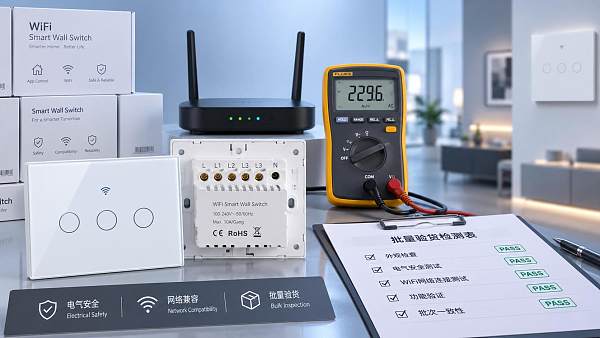
Wireless compatibility is more than “supports Wi-Fi”
A common post-shipment problem is a switch that works on the supplier’s test router but fails during onboarding in the end user’s network. Most lower-cost smart switches use 2.4 GHz Wi-Fi, often based on IEEE 802.11 b/g/n. This is not inherently a weakness: 2.4 GHz generally offers better penetration through walls than 5 GHz. The issue is that many household and commercial routers present combined 2.4 GHz and 5 GHz network names, apply band steering, use mesh systems, or operate with security settings that an inexpensive module cannot handle reliably.
The technical data sheet should state the supported Wi-Fi band, standards, security modes, provisioning method, and whether the device requires a dedicated 2.4 GHz SSID during setup. It is useful to verify compatibility with WPA2-Personal where relevant and clarify whether WPA3-only networks are supported. Avoid accepting “works with all routers” as a meaningful claim.
Network reliability is also shaped by the device’s behavior after a power outage, router replacement, password change, or internet interruption. Buyers should establish whether the switch:
- retains its local manual switching function when internet access is lost;
- reconnects automatically after power restoration;
- stores the previous relay state, defaults off, or follows a configurable power-on state;
- can be reset and re-paired without an installer-only tool;
- supports local network control, cloud-only control, or a mixture of both; and
- has a practical maximum device count for the selected app or gateway environment.
These details matter for hotels, rental properties, small offices, and distributed residential projects, where Wi-Fi credentials may change more often than in a single private home. They also affect the cost of support. A product that requires physical resets and repeated app setup can consume the apparent savings of a low purchase price.
Verify ecosystem claims at protocol level
“Compatible with Alexa,” “Google Home ready,” “Tuya compatible,” and “Matter supported” are not interchangeable claims. They describe different layers of compatibility and should be verified separately.
A switch may work through a branded mobile application that uses a third-party cloud platform. It may then expose basic on/off control to a voice assistant but not expose advanced functions such as timers, indicator settings, multi-way logic, or energy monitoring. If the commercial offer depends on a private-label application, determine who owns the developer account, who can issue updates, and what happens if the supplier changes its platform provider.
Matter deserves particular care. Matter is an application-layer interoperability standard, not a synonym for Wi-Fi. A device may use Wi-Fi, Thread, Ethernet, or another supported network method depending on its design. A claim of Matter compatibility should be supported by the exact product version, software version, and certification status. A supplier’s statement that the hardware is “Matter upgradeable” is not the same as a currently certified Matter product.
For private-label projects, request a clear map of the software chain: mobile app provider, cloud region, device identity management, firmware update authority, and third-party service dependencies. This is especially important where the buyer will sell under its own brand. Hardware continuity does not solve a software support failure.
Certification must cover the shipped variant, not a related product
Electrical and radio compliance are often the largest hidden sourcing risk in smart switches. A device combines mains circuitry with a Wi-Fi transmitter, so one document rarely proves suitability for every market.
For the United States, radio-frequency compliance requirements may involve Federal Communications Commission rules for the Wi-Fi function, while electrical safety expectations can involve certification by a Nationally Recognized Testing Laboratory, depending on the product, application, customer requirements, and local installation context. UL and ETL marks are common examples of third-party safety certification marks, but the relevant standard and scope must be checked. A test report alone is not equivalent to a valid listing mark for the exact finished product.
For Canada, requirements can involve ISED radio compliance and applicable electrical safety certification. In the European Union, CE marking is based on the manufacturer’s conformity assessment obligations; for Wi-Fi equipment, the Radio Equipment Directive is central, while RoHS and other applicable obligations may also be relevant. The UK has its own conformity marking framework. Destination-market obligations can also vary with product category, importer role, packaging, instructions, and electrical installation rules.
Rather than collecting logo images, request evidence tied to the precise bill of materials and model variant:
- certificate number, issuing body, model designation, and status;
- test reports that identify the tested configuration;
- product label artwork showing required markings and electrical ratings;
- the Declaration of Conformity where applicable;
- user instructions and installation warnings in the required market language; and
- confirmation that the selected faceplate, relay rating, Wi-Fi module, power supply board, and plug or mounting format are covered.
Model similarity is not sufficient. A certificate for a one-gang 10 A switch does not automatically cover a two-gang 16 A version, a dimmer version, or a version using a different wireless module. Changes in relay supplier, PCB revision, enclosure material, power module, antenna design, or factory location can also affect the relevance of compliance documentation.
Evaluate the physical product behind the polished sample
Smart switches are frequently judged by a glass faceplate, touch response, and app interface. These are visible features, but product reliability is often determined by less visible elements: terminal construction, relay source, PCB spacing, power-supply design, thermal behavior, solder quality, enclosure material, and assembly discipline.
A pre-production sample should be opened and checked against the approved specification where commercial terms allow. The objective is not to conduct a certification laboratory assessment; it is to identify whether the delivered build matches what was quoted. Confirm terminal labeling, screw or clamp design, grounding arrangements where applicable, board markings, antenna placement, module identification, and component substitutions.
Mechanical fit deserves its own review. Wall-box dimensions, mounting-hole spacing, faceplate format, depth behind the wall, and screw lengths vary by market. A switch that fits a common square box may not fit a round or shallow box. Multi-gang products can create additional space constraints because more electronics and terminals must fit behind the plate. A small dimensional mismatch can turn otherwise acceptable stock into an installation problem.
Touch-panel products should be tested with realistic installation conditions, including gloves where relevant, damp fingers only within the manufacturer’s stated conditions, and normal indoor lighting. For push-button designs, assess tactile consistency and mechanical alignment. These checks should be performed on multiple samples, not one engineering sample selected by the supplier.
Firmware support is a supply obligation, not an optional feature
The product’s software version should appear on the purchase specification alongside hardware revision and packaging requirements. Firmware can affect pairing behavior, security patches, app compatibility, power-recovery logic, and integration with voice-control platforms. A supplier that ships a new firmware version without notification may unintentionally create mixed stock behavior across the same SKU.
Before issuing a wholesale purchase order, establish who approves firmware changes, whether over-the-air updates are available, whether updates can be staged or rolled back, and how the supplier handles a security or connectivity defect found after delivery. If devices are cloud-dependent, clarify the service continuity commitment and the procedure if servers, app accounts, or application programming interfaces change.
Cybersecurity review need not become an open-ended technical audit, but several practical questions are essential: Are default credentials unique or removable? Is device onboarding protected by authenticated account access? Is data transmitted using protected connections? Can the product still be safely used if the cloud service is unavailable? Is there a documented vulnerability reporting channel? Vague answers here are a warning sign for any connected product intended for long-term distribution.
Turn supplier promises into measurable order controls
Supplier evaluation should separate trading capability from manufacturing control. A responsive sales team may not control the firmware, production line, certificates, or component purchasing. Ask whether the seller is the factory, brand owner, authorized exporter, or trading company, and identify which entity is responsible for quality claims and software support.
Useful production questions include whether the supplier maintains incoming inspection for critical parts, how relay and Wi-Fi module substitutions are controlled, whether each unit receives functional testing, how Wi-Fi pairing is checked, and whether serial or batch traceability is available. The purpose is not to demand a generic quality manual. It is to understand whether a complaint can be linked back to a production lot and whether an approved sample can remain representative of ongoing output.
For larger orders, define an inspection plan in the purchase order or quality agreement. It can include appearance, dimensions, terminal integrity, power-on operation, manual switching, app pairing, reset behavior, relay operation, packaging, labels, and the approved firmware version. The sampling basis, acceptance criteria, rework rules, and treatment of failed inspections should be agreed before production begins. If an AQL-based inspection is used, the inspection level and defect classifications should be written into the agreement rather than left to verbal understanding.
Packaging is also part of quality control. Glass panels, touch surfaces, and plastic faceplates are vulnerable to cosmetic damage. Carton drop resistance, inner protection, barcode accuracy, multilingual inserts, country-of-origin marking, and master-carton labels affect warehouse handling and downstream resale even though they do not alter electrical performance.
Calculate landed risk, not just landed cost
The purchase price is only one cost line. The more relevant comparison includes testing samples, compliance review, third-party inspection, freight, duty and tax treatment, packaging changes, expected warranty handling, replacement stock, technical support, and the cost of a delayed launch. A cheaper model with unstable app behavior or incomplete documents can create disproportionate cost after it reaches the destination market.
Quote comparisons should normalize the specification. Differences in Wi-Fi module, relay rating, certification coverage, faceplate material, included bypass component, packaging, firmware ownership, and warranty terms can explain price gaps that are invisible in a simple spreadsheet. A supplier should be asked to quote the approved configuration, not an entry-level version that cannot meet the intended sales or installation conditions.
Order terms should also address spare units, defect reporting windows, replacement responsibility, credit procedures, and whether the supplier must provide the same approved revision for repeat orders. If substitutions are permitted, require written approval before any change to electrical components, wireless modules, app platform, enclosure materials, or certifications.
A wholesale smart-switch order is ready to place when the buyer can trace one consistent line from the intended installation through electrical ratings, network conditions, ecosystem behavior, compliance evidence, approved sample, production controls, and after-sales responsibility. When that chain is incomplete, the unit price is not yet a reliable basis for a purchasing decision.
Get weekly intelligence in your inbox.
No noise. No sponsored content. Pure intelligence.
 Sep 15, 2026Wholesale WiFi Smart Switches: What Buyers Should Verify Before OrderingWholesale WiFi Smart Switches: What Buyers Should Verify Before Ordering
 Sep 14, 2026How to Select IoT Sensors for Reliable Monitoring in Harsh Industrial EnvironmentsHow to Select IoT Sensors for Reliable Monitoring in Harsh Industrial Environments
 Sep 13, 2026How Procurement Teams Can Improve Supplier Reliability With Supply Chain VisibilityHow Procurement Teams Can Improve Supplier Reliability With Supply Chain Visibility
 Sep 12, 2026Smart Manufacturing Trends 2026: What Leaders Should Prioritize for ROISmart Manufacturing Trends 2026: What Leaders Should Prioritize for ROI
 Sep 11, 2026B2B Market Analysis: How Buyers Evaluate Suppliers, Pricing, and Delivery RiskB2B Market Analysis: How Buyers Evaluate Suppliers, Pricing, and Delivery Risk
 Sep 10, 2026Residential Solar Kits in Canada: How to Size a System for Your Home and ClimateResidential Solar Kits in Canada: How to Size a System for Your Home and Climate
 Sep 09, 2026How to Specify a Syringe Assembly Line for High-Volume Sterile ProductionHow to Specify a Syringe Assembly Line for High-Volume Sterile Production
 Sep 08, 2026How to Evaluate Warehouse Robotics System Suppliers for Reliable Multi-Site DeploymentHow to Evaluate Warehouse Robotics System Suppliers for Reliable Multi-Site Deployment
 Sep 07, 2026Renewable Geothermal Energy Explained: How It Works for Heating and PowerRenewable Geothermal Energy Explained: How It Works for Heating and Power
 Sep 07, 2026How to Choose an Industrial Packaging Robot Manufacturer for Your Production LineHow to Choose an Industrial Packaging Robot Manufacturer for Your Production Line
 Sep 05, 2026How to Evaluate a Turnkey Hydro Turbine Generator Supplier for Remote Power ProjectsHow to Evaluate a Turnkey Hydro Turbine Generator Supplier for Remote Power Projects
 Sep 04, 2026Automated Ultrasonic Welding for Thermoplastic Assemblies: Process Controls That MatterAutomated Ultrasonic Welding for Thermoplastic Assemblies: Process Controls That Matter
 Sep 03, 2026Energy Forecasting for Grid Planning: Sizing Solar and Storage CapacityEnergy Forecasting for Grid Planning: Sizing Solar and Storage Capacity
 Sep 02, 2026Which Metrics Should an Energy Analytics Dashboard Track for Factory Energy Management?Which Metrics Should an Energy Analytics Dashboard Track for Factory Energy Management?
 Sep 01, 2026How Warehouse Voice Picking Improves Accuracy and Throughput in Order FulfillmentHow Warehouse Voice Picking Improves Accuracy and Throughput in Order Fulfillment
 Aug 31, 2026How to Automate Dropshipping Order Processing Without Overselling StockHow to Automate Dropshipping Order Processing Without Overselling Stock
 Aug 30, 2026How to Evaluate a Smart Lighting Supplier for Multi-Site Commercial ProjectsHow to Evaluate a Smart Lighting Supplier for Multi-Site Commercial Projects
 Aug 29, 2026Recent Advances in Smart Manufacturing and Materials Reshaping Factory InvestmentRecent Advances in Smart Manufacturing and Materials Reshaping Factory Investment
 Aug 29, 2026Selecting Lightweight Aluminum Extrusions for Strength-Critical Industrial DesignsSelecting Lightweight Aluminum Extrusions for Strength-Critical Industrial Designs
 Aug 29, 2026Vertical Powder Anodizing Explained: Process Controls for Uniform Coating QualityVertical Powder Anodizing Explained: Process Controls for Uniform Coating Quality
 Aug 29, 2026PV Module Product Due Diligence: What Buyers Should Verify Before ContractingPV Module Product Due Diligence: What Buyers Should Verify Before Contracting
 Aug 29, 2026Solar Design for Challenging Terrain: Managing Slope, Soil, and Shading RisksSolar Design for Challenging Terrain: Managing Slope, Soil, and Shading Risks
 Aug 29, 2026IS 16444 Smart Meter Requirements: Key Functions, Tests, and ComplianceIS 16444 Smart Meter Requirements: Key Functions, Tests, and Compliance
 Aug 29, 2026Rehabilitation Equipment Market Outlook: Demand Drivers and Growth SegmentsRehabilitation Equipment Market Outlook: Demand Drivers and Growth Segments
 Aug 29, 2026When Does Container Handling Automation Deliver ROI in Port Yard Operations?When Does Container Handling Automation Deliver ROI in Port Yard Operations?
 Aug 29, 2026Customs API Integration: A Practical Checklist for Automated Trade ComplianceCustoms API Integration: A Practical Checklist for Automated Trade Compliance
 Aug 29, 2026Returnable Packaging for Automotive: How to Cut Damage and Reverse Logistics CostsReturnable Packaging for Automotive: How to Cut Damage and Reverse Logistics Costs