B2B Market Analysis: How Buyers Evaluate Suppliers, Pricing, and Delivery Risk
A supplier comparison often looks settled until the first disruption appears: a quoted unit price changes after specifications are clarified, a production slot moves because another customer receives priority, or a shipment is delayed by a documentation gap that no one reviewed during onboarding. In these situations, the lowest quotation is rarely the real issue. The problem is that the buyer evaluated a claim rather than the operating conditions behind it.
A rigorous B2B Market analysis treats supplier selection as a combined assessment of capability, total cost, and delivery resilience. Buyers should not score price, quality, compliance, and logistics as isolated topics. A supplier with an attractive price but weak change control can create expensive rework. A technically capable producer with uncertain material access can still put a launch schedule at risk. The strongest decision is usually the one that identifies where risk sits, how it would surface, and whether the supplier can control it before a purchase order becomes difficult to change.
Start with the requirement, not the supplier presentation
Supplier evaluations become unreliable when the buying team has not converted internal needs into testable requirements. A product description such as “industrial grade,” “high precision,” or “fast delivery” leaves too much room for interpretation. Procurement, engineering, quality, operations, and finance may each assume they are evaluating the same requirement while using different standards.
Before comparing suppliers, establish the conditions that determine commercial fit. These normally include the required specification, tolerances, approved materials or components, expected order pattern, packaging needs, acceptance criteria, delivery location, documentation obligations, and the consequences of a late or nonconforming shipment. A supplier does not need to be ideal in every dimension, but the buyer needs to know which dimensions are non-negotiable.
This matters especially when an initial order is small but future demand could scale. Some suppliers can produce a prototype or trial batch well yet cannot maintain the same control during repeat production. Others have efficient large-volume processes but are poorly suited to low-volume, high-variation work. The question is not simply “Can they make this?” It is “Can they make it repeatedly, under the expected commercial conditions, without introducing unmanaged variation?”
Separate demonstrated capability from stated capability
Marketing materials, catalogs, and sales conversations are useful starting points, but they are not proof of operational capacity. Buyers should look for evidence that connects the supplier’s claimed capability to the actual product family, production method, and delivery model under review.
A meaningful capability review examines the production route rather than relying on broad statements about factory size or industry experience. For a manufactured product, this may involve understanding which stages are performed in-house, which are outsourced, where critical tooling is controlled, how inspection is performed, and what happens when a nonconformance is found. For technology or software-related suppliers, the equivalent questions may concern implementation ownership, integration dependencies, data handling, support coverage, and release management.
Questions that expose operational depth
- Which production or service steps are controlled directly, and which depend on subcontractors?
- What process parameter or component has the greatest effect on consistency?
- How is the first production run approved before full output begins?
- Who can authorize a material, design, tooling, or process change?
- What records accompany a shipment or completed service, and can they be traced to the relevant batch, serial number, or project stage?
- How does the supplier handle capacity conflicts when demand rises unexpectedly?
The purpose is not to force every supplier into a lengthy audit. It is to identify whether responses are specific, internally consistent, and supported by the kind of records that the product category requires. A supplier that can explain constraints clearly may be more dependable than one that promises unlimited flexibility without describing how it will be delivered.
When technical colleagues are involved, procurement should ask them to distinguish between critical and desirable criteria. A minor cosmetic variation may be manageable, while a material substitution, software revision, or dimensional deviation may affect safety, compatibility, warranty obligations, or downstream assembly. This distinction prevents the evaluation from becoming an unranked list of preferences.
Price is only one part of the cost decision
Quoted price is visible and easy to compare, which is why it can dominate early supplier discussions. Yet two quotations with similar unit prices may carry very different total cost profiles. The commercial comparison should account for the conditions that create cost after the order is placed, not only the number shown on the quotation.
Pricing transparency is more important than a superficially low number. Buyers need to understand what could legitimately change the price: raw material movements, exchange-rate exposure, component availability, specification changes, order consolidation, or freight volatility. These variables do not automatically make a supplier unsuitable. Hidden assumptions do.
A practical way to compare offers is to normalize them into a common basis. Use the same specification, volume assumption, delivery point, payment assumption, quality expectation, and lead-time definition for every supplier. Then record exceptions separately. This prevents a quotation with incomplete scope from appearing cheaper than a complete offer.
Assess delivery risk as a chain, not a promised date
Delivery risk is frequently underestimated because suppliers commonly provide a lead time as though it were a fixed property of the product. In reality, lead time is the outcome of several linked conditions: demand visibility, material availability, production scheduling, quality release, export documentation, carrier capacity, border processes, and final-mile arrangements. A delay can originate at any point in that chain.
Buyers should ask for the lead-time structure behind the promise. For example, when does the clock start: after purchase order receipt, after deposit, after drawing approval, after raw material arrival, or after sample confirmation? Does the stated period include testing and final inspection? Is transit included, estimated separately, or excluded entirely? Ambiguous definitions create disputes because each side may believe it agreed to a different delivery commitment.
Where delivery exposure usually hides
Material dependency is often the first pressure point. A supplier may have available labor and equipment but still be unable to begin because a specialized grade, electronic component, packaging material, or imported subassembly is delayed. The buyer should understand whether critical inputs are sourced from one provider, whether approved alternatives exist, and whether substitutions require customer approval.
Capacity allocation is another issue. A facility may have adequate annual capacity but lack available capacity during the specific period when the order is needed. Ask how production slots are assigned, whether a forecast reserves capacity, and how urgent orders are treated. A supplier that offers a short lead time without discussing scheduling priority may be relying on assumptions that disappear during a demand surge.
Quality release can also be a hidden delay. Products requiring inspection, testing, calibration, documentation, or customer approval should have those stages built into the schedule. A batch that is physically complete but awaiting test results is not ready to ship. Where quality documents are essential for customs clearance or site acceptance, their preparation should be treated as part of delivery performance rather than administrative follow-up.
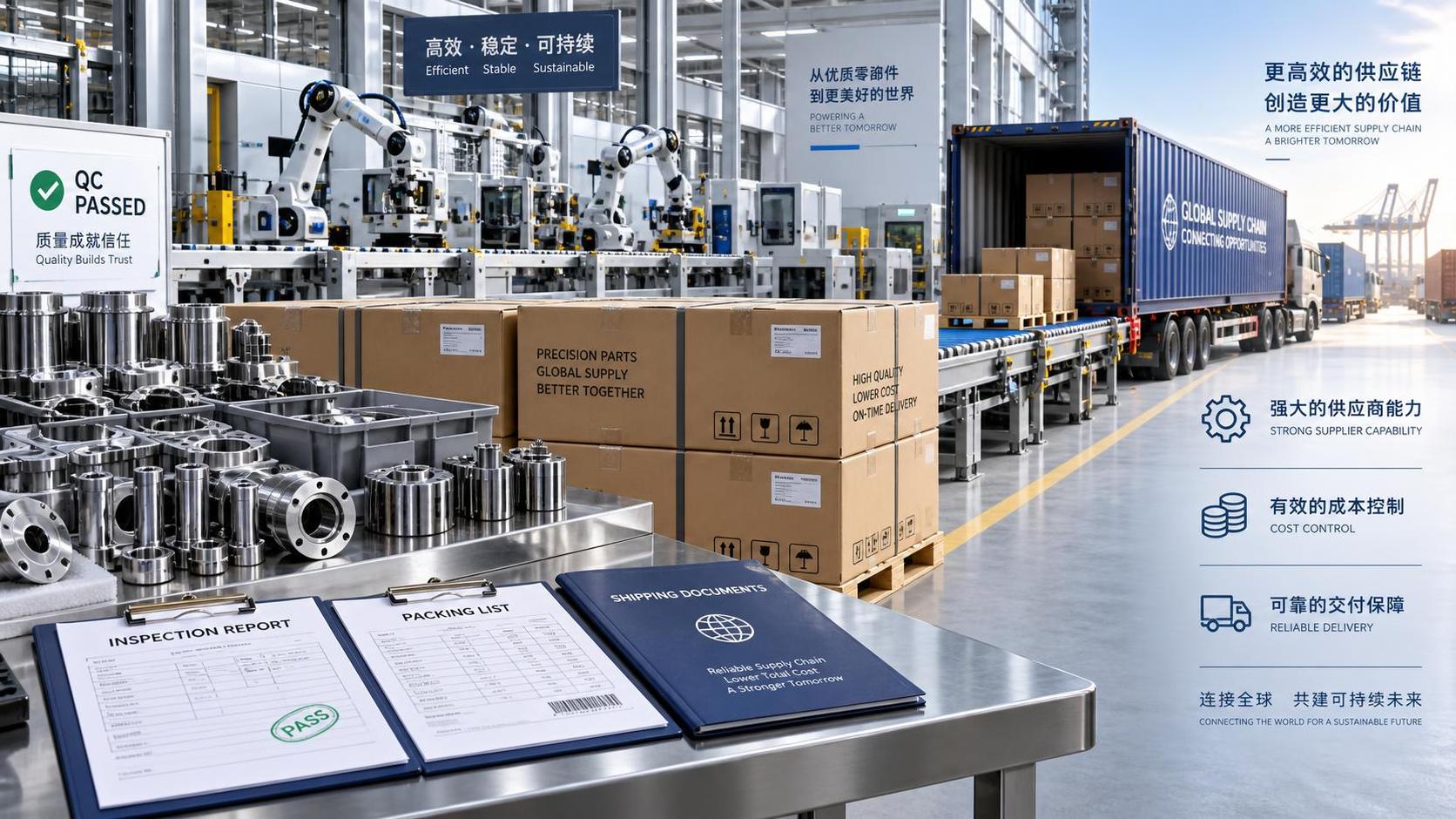
Cross-border delivery adds another layer. The buyer should confirm the responsible party for export paperwork, origin information, product classification, packing details, and shipping instructions. These details are especially important when goods require specific labeling, controlled handling, or evidence of conformity. A capable manufacturer can still create downstream disruption if shipping documentation is incomplete or inconsistent with the commercial invoice and packing list.
Use an evidence-based supplier scorecard
A scorecard is useful when it drives discussion rather than pretending to create mathematical certainty. It should reflect the actual impact of failure in the purchasing category. For a noncritical consumable, delivery flexibility may matter more than detailed engineering review. For a safety-sensitive part, traceability and change control may deserve much greater weight than marginal price differences.
Each criterion should be supported by a source of evidence, not just a rating. Evidence may include a technical response, sample review, production documentation, a commercial quotation, logistics clarification, quality records, or a structured interview with responsible personnel. Where evidence is absent, the correct status is not necessarily “poor”; it may be “unverified.” That distinction is valuable because it tells the team what must be confirmed before awarding business.
- Technical fit: ability to meet the defined specification and maintain revision control.
- Quality control: inspection method, nonconformance handling, traceability, and documentation discipline.
- Commercial clarity: complete pricing basis, payment terms, assumptions, and change conditions.
- Supply continuity: critical material sources, capacity planning, subcontractor dependence, and contingency options.
- Delivery execution: lead-time definition, release process, shipping readiness, and communication during disruptions.
- Business stability: responsiveness, contract accountability, and signs that the supplier can sustain the relationship.
Scoring becomes more reliable when evaluators add a short explanation beside each rating. A score of “good” for delivery should state why: perhaps the supplier provided a staged production plan, identified material lead times, and clarified shipment responsibilities. A score of “weak” should identify the missing control, such as an unconfirmed component source or no documented escalation process. This creates a record that can be revisited if circumstances change.
Do not confuse responsiveness with reliability
Fast replies can be a positive signal, but they do not prove delivery performance. Some suppliers respond quickly during quotation because commercial teams are incentivized to win business, while production, quality, and logistics teams are not yet involved. Reliability becomes clearer when questions require coordination across functions.
Ask for a response that combines technical, commercial, and operational inputs. For example, a request to confirm a revised specification, explain the impact on lead time, identify the approval needed, and state the resulting price basis will show whether internal handoffs work. Delayed or contradictory answers may indicate that important functions operate separately. That does not automatically disqualify a supplier, but it is a warning sign for programs where changes are likely.
Communication during uncertainty is also revealing. No supply chain is immune to disruption. The relevant question is whether the supplier identifies a risk early, explains its operational effect, presents realistic options, and follows through on the agreed path. Buyers should be cautious when a supplier provides repeated reassurance without dates, ownership, or a clear recovery plan.
Build safeguards into the award decision
Supplier selection should not end with choosing the preferred quote. The award stage is where the buyer converts the evaluation into operating controls. The right safeguards depend on the category, but they may include approved samples, defined inspection requirements, documented specifications, milestone updates, pre-shipment review, packaging standards, change notification rules, and agreed ownership of tooling or intellectual property where relevant.
For higher-risk purchases, consider a staged commitment. An initial order can be used to validate documentation, communication, production control, shipment execution, and issue handling before larger volumes are released. This is not simply a trial of product quality. It tests whether the supplier’s commercial and operational processes match what was presented during evaluation.
Supply concentration should be considered separately from supplier performance. A single supplier may be excellent, yet sole-source dependency can still create exposure if the product is critical and replacement qualification would take time. Dual sourcing is not always practical, particularly for specialized products or proprietary processes, but buyers should at least understand the time and effort required to create an alternative.
When a supplier looks attractive but evidence is incomplete
Not every decision can wait until every uncertainty is eliminated. A buyer may face limited sourcing options, a pressing launch date, or a supplier that is new to the category but offers a compelling technical fit. In these cases, the appropriate response is to identify the open risks explicitly and attach controls to them.
For example, a competitive price with uncertain material availability may justify a smaller initial release, more frequent production updates, or a requirement for confirmation before the supplier commits to the shipment date. A supplier with strong manufacturing capability but incomplete export-process evidence may require document review before final dispatch. The goal is not to demand perfection; it is to avoid accepting uncertainty without deciding who owns it and what action will be taken if it becomes real.
Effective B2B Market analysis therefore produces more than a ranked supplier list. It creates a shared decision record: what the supplier has demonstrated, which assumptions remain open, what delivery dependencies exist, and which contractual or operational controls protect the buyer. That record helps procurement teams defend the award decision and manage the relationship with clearer expectations once production begins.
Get weekly intelligence in your inbox.
No noise. No sponsored content. Pure intelligence.
 Sep 15, 2026Wholesale WiFi Smart Switches: What Buyers Should Verify Before OrderingWholesale WiFi Smart Switches: What Buyers Should Verify Before Ordering
 Sep 14, 2026How to Select IoT Sensors for Reliable Monitoring in Harsh Industrial EnvironmentsHow to Select IoT Sensors for Reliable Monitoring in Harsh Industrial Environments
 Sep 13, 2026How Procurement Teams Can Improve Supplier Reliability With Supply Chain VisibilityHow Procurement Teams Can Improve Supplier Reliability With Supply Chain Visibility
 Sep 12, 2026Smart Manufacturing Trends 2026: What Leaders Should Prioritize for ROISmart Manufacturing Trends 2026: What Leaders Should Prioritize for ROI
 Sep 11, 2026B2B Market Analysis: How Buyers Evaluate Suppliers, Pricing, and Delivery RiskB2B Market Analysis: How Buyers Evaluate Suppliers, Pricing, and Delivery Risk
 Sep 10, 2026Residential Solar Kits in Canada: How to Size a System for Your Home and ClimateResidential Solar Kits in Canada: How to Size a System for Your Home and Climate
 Sep 09, 2026How to Specify a Syringe Assembly Line for High-Volume Sterile ProductionHow to Specify a Syringe Assembly Line for High-Volume Sterile Production
 Sep 08, 2026How to Evaluate Warehouse Robotics System Suppliers for Reliable Multi-Site DeploymentHow to Evaluate Warehouse Robotics System Suppliers for Reliable Multi-Site Deployment
 Sep 07, 2026Renewable Geothermal Energy Explained: How It Works for Heating and PowerRenewable Geothermal Energy Explained: How It Works for Heating and Power
 Sep 07, 2026How to Choose an Industrial Packaging Robot Manufacturer for Your Production LineHow to Choose an Industrial Packaging Robot Manufacturer for Your Production Line
 Sep 05, 2026How to Evaluate a Turnkey Hydro Turbine Generator Supplier for Remote Power ProjectsHow to Evaluate a Turnkey Hydro Turbine Generator Supplier for Remote Power Projects
 Sep 04, 2026Automated Ultrasonic Welding for Thermoplastic Assemblies: Process Controls That MatterAutomated Ultrasonic Welding for Thermoplastic Assemblies: Process Controls That Matter
 Sep 03, 2026Energy Forecasting for Grid Planning: Sizing Solar and Storage CapacityEnergy Forecasting for Grid Planning: Sizing Solar and Storage Capacity
 Sep 02, 2026Which Metrics Should an Energy Analytics Dashboard Track for Factory Energy Management?Which Metrics Should an Energy Analytics Dashboard Track for Factory Energy Management?
 Sep 01, 2026How Warehouse Voice Picking Improves Accuracy and Throughput in Order FulfillmentHow Warehouse Voice Picking Improves Accuracy and Throughput in Order Fulfillment
 Aug 31, 2026How to Automate Dropshipping Order Processing Without Overselling StockHow to Automate Dropshipping Order Processing Without Overselling Stock
 Aug 30, 2026How to Evaluate a Smart Lighting Supplier for Multi-Site Commercial ProjectsHow to Evaluate a Smart Lighting Supplier for Multi-Site Commercial Projects
 Aug 29, 2026Recent Advances in Smart Manufacturing and Materials Reshaping Factory InvestmentRecent Advances in Smart Manufacturing and Materials Reshaping Factory Investment
 Aug 29, 2026Selecting Lightweight Aluminum Extrusions for Strength-Critical Industrial DesignsSelecting Lightweight Aluminum Extrusions for Strength-Critical Industrial Designs
 Aug 29, 2026Vertical Powder Anodizing Explained: Process Controls for Uniform Coating QualityVertical Powder Anodizing Explained: Process Controls for Uniform Coating Quality
 Aug 29, 2026PV Module Product Due Diligence: What Buyers Should Verify Before ContractingPV Module Product Due Diligence: What Buyers Should Verify Before Contracting
 Aug 29, 2026Solar Design for Challenging Terrain: Managing Slope, Soil, and Shading RisksSolar Design for Challenging Terrain: Managing Slope, Soil, and Shading Risks
 Aug 29, 2026IS 16444 Smart Meter Requirements: Key Functions, Tests, and ComplianceIS 16444 Smart Meter Requirements: Key Functions, Tests, and Compliance
 Aug 29, 2026Rehabilitation Equipment Market Outlook: Demand Drivers and Growth SegmentsRehabilitation Equipment Market Outlook: Demand Drivers and Growth Segments
 Aug 29, 2026When Does Container Handling Automation Deliver ROI in Port Yard Operations?When Does Container Handling Automation Deliver ROI in Port Yard Operations?
 Aug 29, 2026Customs API Integration: A Practical Checklist for Automated Trade ComplianceCustoms API Integration: A Practical Checklist for Automated Trade Compliance
 Aug 29, 2026Returnable Packaging for Automotive: How to Cut Damage and Reverse Logistics CostsReturnable Packaging for Automotive: How to Cut Damage and Reverse Logistics Costs