How to Evaluate a Mobility Scooter Exporter for Product Quality and Market Fit
Start with the exporter’s actual role in the supply chain
When dealers search for a mobility scooter exporter, the first mistake is treating every supplier profile the same. Some companies manufacture. Some assemble. Some trade under their own label but source from several factories. That difference affects product consistency, spare parts continuity, warranty handling, and how much control the exporter really has when something goes wrong.
Before you compare prices, pin down three things: who builds the scooter, who controls quality records, and who owns the product documentation. If the exporter cannot clearly explain that chain, you are already looking at a higher-risk relationship. For distributors and agents, that usually becomes a problem later, not at the quotation stage.
- Ask for the company’s role by product line, not just at company level.
- Check whether technical files, test reports, and user manuals come from the same source as the finished product.
- See whether the exporter can keep the same configuration over multiple orders instead of switching factories quietly.
Do not review the catalog before you review market fit
A wide catalog looks impressive, but it can distract from the real question: can this exporter supply scooters that match your market’s user profile, channel position, and after-sales model? A scooter that sells well in one country may be a poor fit somewhere else because of terrain, user weight range, indoor versus outdoor use, battery transport limits, or reimbursement-related expectations in the medical channel.
Good evaluation starts with your own shortlist of commercial conditions. Are you selling through mobility stores, pharmacy chains, online marketplaces, rehab equipment dealers, or regional sub-distributors? Are customers price-sensitive first-time users, or are they looking for better ride stability and service support? The exporter’s product range only matters after those answers are clear.
A practical filter: if the exporter cannot tell you which models are best suited for compact indoor use, pavement use, or longer-range outdoor use, they may be listing products rather than understanding the category.
Check the documents that prove legal and technical readiness
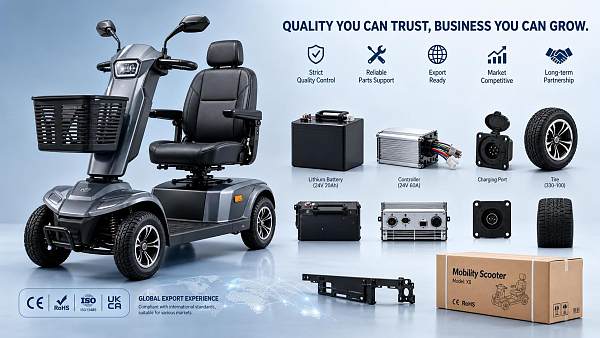
In this category, document quality says a lot about supplier quality. You do not need a lecture on every standard. You need to know whether the exporter can support entry into your target market with complete, consistent paperwork tied to the exact model you plan to buy.
The right set of documents depends on where the scooter will be sold and how it is classified there. That is why the useful question is never “Are you certified?” The useful question is “Show me the compliance documents for this exact model, this battery type, this user manual version, and this destination market.”
One common warning sign: the exporter sends a stack of documents quickly, but the model names, battery details, or manufacturer names do not line up. That usually means the file package was assembled for sales convenience rather than compliance control.
Look past the spec sheet and inspect the durability points
Mobility scooters are not hard to make look good on paper. Range claims, speed claims, and motor descriptions are easy to market. The parts that cause dealer headaches are more ordinary: frame rigidity, tiller stability, wiring layout, connector quality, brake response, seat hardware, tire wear, charger reliability, and how the scooter behaves after repeated folding or transport.
Ask the exporter for close-up photos or video of the service-sensitive points, not just showroom angles. If you can sample the product, inspect the areas your service team will touch first. If you cannot sample yet, request a video walkthrough of battery access, controller placement, fuse location, seat post locking, and front-to-rear cable routing.
This is where experienced buyers spot the difference between a scooter that survives distribution and one that comes back with small but expensive issues.
The parts worth checking early
- Battery removal and replacement: easy service access reduces support cost.
- Controller and wiring protection: poor layout can lead to moisture or vibration failures.
- Tiller adjustment mechanism: looseness here quickly becomes a user confidence issue.
- Seat swivel and armrest fittings: these wear faster in retail and rental-heavy channels.
- Charger interface and connectors: frequent small failures often start here.
Evaluate whether spare parts support is real or just promised
Most export deals look workable until the first batch needs support. A dealer can absorb occasional defects. What damages the business is slow parts supply, changing components between production runs, or no clear replacement list for wearable items.
Ask for a spare parts list tied to the exact scooter model, including photos or exploded references where possible. Then ask which parts are standard across several models and which are unique. Shared parts reduce stocking pressure. Unique parts are manageable only if the exporter has stable part numbering and restocking discipline.
A useful test is simple: ask how they handle replacement of a controller, charger, armrest, tire, key switch, and battery connector. If the answer stays vague, after-sales is probably not organized well enough for distribution.
Review packaging the way a claims manager would
For mobility scooters, shipping damage is not a side issue. It directly affects launch timing, reseller trust, and landed cost. Exporters often focus on the unit itself and under-explain packaging strength, battery isolation, accessory protection, and carton marking accuracy.
Do not stop at carton dimensions. Ask how the scooter is fixed inside the package, whether vulnerable points are protected, whether the seat and accessories are packed separately, and how the battery is secured for transport. For knockdown or partially assembled units, check how much assembly is left for your warehouse or dealers. Sometimes a slightly higher unit cost saves substantial local labor and damage claims.
Test commercial alignment, not just unit price
A cheap mobility scooter exporter can still be expensive if the line lacks margin room for freight swings, warranty reserve, local compliance work, demo units, and channel incentives. Dealers and distributors need a model that leaves enough commercial space after all the boring costs are added back in.
During evaluation, compare exporters on the total launch picture:
- Minimum order flexibility for first entry versus repeat orders.
- Lead time stability by model, not just a general production promise.
- Private label readiness, including carton, manual, and rating label updates.
- Availability of demo units or mixed-model trial orders.
- Clear warranty process with photos, videos, part shipment, and response timing.
A supplier that is slightly higher in price but cleaner in process often gives better market fit for a distributor building the category over time.
See how the exporter handles uncomfortable questions
This part matters more than many buyers admit. Ask about returns, field complaints, delayed parts, battery replacement cycles, and model revisions. You are not looking for perfect answers. You are looking for controlled answers. A serious exporter can explain how issues are logged, who signs off on changes, and what happens when the current shipment differs from the last one.
Be careful with suppliers who answer every question with marketing language. In this category, confidence without detail is usually a warning sign.
Use a short scoring framework before you commit
After a few supplier conversations, everything starts to blur. Put each exporter through the same decision screen. Keep it simple enough that your team will actually use it.
- Document control: are the files complete, model-specific, and internally consistent?
- Product robustness: do the vulnerable parts look serviceable and durable?
- Market fit: does the line match your user segment and channel strategy?
- After-sales support: can they supply parts, manuals, and troubleshooting quickly?
- Commercial structure: do MOQ, lead time, and margin logic work for your launch plan?
- Communication quality: do they answer technical and operational questions clearly?
You do not need a perfect score. You need to know where the risk sits and whether your business model can absorb it.
Make the final decision in the right order
A sound selection process usually runs like this: confirm your target market and channel position, screen exporters by role and document readiness, narrow the list by product-service fit, review packaging and parts support, then negotiate price with only the qualified suppliers left. Doing it the other way around creates avoidable noise.
For distributors, agents, and dealers, the best mobility scooter exporter is rarely the one with the broadest brochure or the fastest quote. It is the one that can show control over the product, support the market you are entering, and stay consistent after the first order ships. That is what protects margin, reputation, and repeat business.
Get weekly intelligence in your inbox.
No noise. No sponsored content. Pure intelligence.
 Sep 16, 2026When Low-Volume Electronics Manufacturing Makes More Sense Than Mass ProductionWhen Low-Volume Electronics Manufacturing Makes More Sense Than Mass Production
 Sep 15, 2026Wholesale WiFi Smart Switches: What Buyers Should Verify Before OrderingWholesale WiFi Smart Switches: What Buyers Should Verify Before Ordering
 Sep 14, 2026How to Select IoT Sensors for Reliable Monitoring in Harsh Industrial EnvironmentsHow to Select IoT Sensors for Reliable Monitoring in Harsh Industrial Environments
 Sep 13, 2026How Procurement Teams Can Improve Supplier Reliability With Supply Chain VisibilityHow Procurement Teams Can Improve Supplier Reliability With Supply Chain Visibility
 Sep 12, 2026Smart Manufacturing Trends 2026: What Leaders Should Prioritize for ROISmart Manufacturing Trends 2026: What Leaders Should Prioritize for ROI
 Sep 11, 2026B2B Market Analysis: How Buyers Evaluate Suppliers, Pricing, and Delivery RiskB2B Market Analysis: How Buyers Evaluate Suppliers, Pricing, and Delivery Risk
 Sep 10, 2026Residential Solar Kits in Canada: How to Size a System for Your Home and ClimateResidential Solar Kits in Canada: How to Size a System for Your Home and Climate
 Sep 09, 2026How to Specify a Syringe Assembly Line for High-Volume Sterile ProductionHow to Specify a Syringe Assembly Line for High-Volume Sterile Production
 Sep 08, 2026How to Evaluate Warehouse Robotics System Suppliers for Reliable Multi-Site DeploymentHow to Evaluate Warehouse Robotics System Suppliers for Reliable Multi-Site Deployment
 Sep 07, 2026Renewable Geothermal Energy Explained: How It Works for Heating and PowerRenewable Geothermal Energy Explained: How It Works for Heating and Power
 Sep 07, 2026How to Choose an Industrial Packaging Robot Manufacturer for Your Production LineHow to Choose an Industrial Packaging Robot Manufacturer for Your Production Line
 Sep 05, 2026How to Evaluate a Turnkey Hydro Turbine Generator Supplier for Remote Power ProjectsHow to Evaluate a Turnkey Hydro Turbine Generator Supplier for Remote Power Projects
 Sep 04, 2026Automated Ultrasonic Welding for Thermoplastic Assemblies: Process Controls That MatterAutomated Ultrasonic Welding for Thermoplastic Assemblies: Process Controls That Matter
 Sep 03, 2026Energy Forecasting for Grid Planning: Sizing Solar and Storage CapacityEnergy Forecasting for Grid Planning: Sizing Solar and Storage Capacity
 Sep 02, 2026Which Metrics Should an Energy Analytics Dashboard Track for Factory Energy Management?Which Metrics Should an Energy Analytics Dashboard Track for Factory Energy Management?
 Sep 01, 2026How Warehouse Voice Picking Improves Accuracy and Throughput in Order FulfillmentHow Warehouse Voice Picking Improves Accuracy and Throughput in Order Fulfillment
 Aug 31, 2026How to Automate Dropshipping Order Processing Without Overselling StockHow to Automate Dropshipping Order Processing Without Overselling Stock
 Aug 30, 2026How to Evaluate a Smart Lighting Supplier for Multi-Site Commercial ProjectsHow to Evaluate a Smart Lighting Supplier for Multi-Site Commercial Projects
 Aug 29, 2026Recent Advances in Smart Manufacturing and Materials Reshaping Factory InvestmentRecent Advances in Smart Manufacturing and Materials Reshaping Factory Investment
 Aug 29, 2026Selecting Lightweight Aluminum Extrusions for Strength-Critical Industrial DesignsSelecting Lightweight Aluminum Extrusions for Strength-Critical Industrial Designs
 Aug 29, 2026Vertical Powder Anodizing Explained: Process Controls for Uniform Coating QualityVertical Powder Anodizing Explained: Process Controls for Uniform Coating Quality
 Aug 29, 2026PV Module Product Due Diligence: What Buyers Should Verify Before ContractingPV Module Product Due Diligence: What Buyers Should Verify Before Contracting
 Aug 29, 2026Solar Design for Challenging Terrain: Managing Slope, Soil, and Shading RisksSolar Design for Challenging Terrain: Managing Slope, Soil, and Shading Risks
 Aug 29, 2026IS 16444 Smart Meter Requirements: Key Functions, Tests, and ComplianceIS 16444 Smart Meter Requirements: Key Functions, Tests, and Compliance
 Aug 29, 2026Rehabilitation Equipment Market Outlook: Demand Drivers and Growth SegmentsRehabilitation Equipment Market Outlook: Demand Drivers and Growth Segments
 Aug 29, 2026When Does Container Handling Automation Deliver ROI in Port Yard Operations?When Does Container Handling Automation Deliver ROI in Port Yard Operations?
 Aug 29, 2026Customs API Integration: A Practical Checklist for Automated Trade ComplianceCustoms API Integration: A Practical Checklist for Automated Trade Compliance