Electric Wheelchairs vs Mobility Scooters: Which Fits Daily Use?
Choosing between electric wheelchairs and mobility scooters for daily use depends on comfort, maneuverability, lifestyle, and long-term support needs. For many buyers, electric wheelchairs offer better indoor control and accessibility, while scooters may suit longer outdoor trips. This guide helps you compare both options clearly, so you can decide which mobility solution fits your routine, budget, and independence goals.
For end users, this decision is rarely about speed alone. It usually comes down to 4 practical questions: where you travel most often, how long you stay seated, how easily you can transfer on and off the device, and what kind of support you may need in 6 to 24 months. In healthcare technology and mobility equipment markets, these are the same factors dealers, caregivers, and procurement advisors use when narrowing down options.
Electric wheelchairs and scooters can both improve independence, but they solve different daily-use problems. A careful comparison helps you avoid buying a product that feels fine in a showroom for 15 minutes but becomes inconvenient after 3 weeks of real use at home, in shops, at clinics, and on sidewalks.
Understanding the Core Difference in Daily Mobility
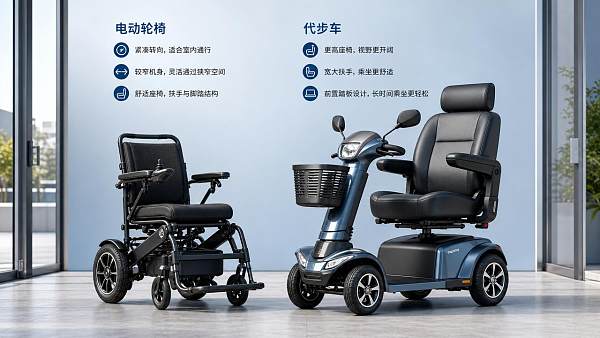
At a basic level, electric wheelchairs are designed around seated support, close control, and tighter maneuvering. Mobility scooters are built more for travel distance, simpler steering, and outdoor movement. That difference sounds small, but in daily use it affects turning radius, transfer safety, posture, and access through doorways as narrow as 28 to 32 inches.
Why electric wheelchairs often fit indoor routines better
Many electric wheelchairs use joystick control and a compact frame, which makes them easier to handle in apartments, elevators, kitchens, and medical offices. Typical mid-wheel or front-wheel designs can turn more tightly than many scooters, sometimes within a circle of roughly 20 to 35 inches depending on configuration. For people who move around furniture several times a day, that matters more than top speed.
Electric wheelchairs also tend to provide better seating support. Common features include adjustable armrests, pressure-relief cushions, headrests, reclining backs, and elevated leg support. If a user spends 4 to 8 hours seated each day, posture and pressure management may become more important than simple transportation range.
Where scooters can be the better choice
Mobility scooters often appeal to users who still have stable trunk control and can get on and off a seat without major assistance. Their handlebars are familiar, and many 3-wheel or 4-wheel models are well suited to paved outdoor routes, community spaces, shopping areas, and longer travel between charging cycles. A common travel range can fall between 10 and 25 miles per charge, depending on battery size, terrain, and rider weight.
Scooters can also feel more intuitive for users who do not want a highly clinical-looking mobility device. For light daily use and community access, that preference may be a valid part of the buying decision, especially when the user values independence but does not require complex seating support.
The table below compares daily-use factors that matter most when deciding between electric wheelchairs and scooters.
In practical terms, electric wheelchairs usually outperform scooters for home navigation and support needs, while scooters often win on simplicity and outdoor travel. If your day is split 70% indoors and 30% outdoors, electric wheelchairs are often the safer short-list. If that ratio is reversed and support needs are low, a scooter may be more comfortable and cost-efficient.
How to Match the Right Option to Your Daily Use Pattern
The best buying decision comes from mapping your real weekly routine, not your ideal one. A useful method is to review 7 days of movement: how many times you go outdoors, how often you pass through narrow spaces, whether you need to carry bags, and how long you remain seated in one stretch. This simple audit often reveals which product category makes daily life easier.
Scenario 1: Mostly indoor movement
If you live in a flat, senior residence, or compact home, electric wheelchairs usually offer a better fit. They are easier to position at a dining table, sink, desk, or bedside. In many homes, even a 2-inch difference in base width or turning radius can determine whether the user moves independently or repeatedly asks for help.
Best fit indicators
- You use the device indoors more than 5 days per week.
- You need to approach furniture closely for transfers or tasks.
- You sit for more than 3 continuous hours on many days.
- You benefit from pressure management, arm support, or tilt options.
Scenario 2: Frequent outdoor errands
If daily use means grocery trips, neighborhood visits, or community access over longer distances, a scooter may be practical. Many users prefer the larger foot platform, front basket options, and straightforward steering. On level surfaces, scooters can feel more stable for longer stretches, especially 4-wheel units designed for outdoor balance.
Best fit indicators
- You travel outdoors 1 to 3 miles per trip on average.
- You can independently transfer on and off the seat.
- You do not require advanced postural support.
- You have storage space for a larger turning radius at home.
Scenario 3: Progressive or uncertain support needs
When support needs may increase over the next 12 months, electric wheelchairs often offer better long-term value. A scooter that works today may become limiting if hand strength drops, fatigue increases, or transfers become harder. Adjustable seating, better control placement, and accessory compatibility make electric wheelchairs a stronger option for users planning ahead rather than reacting later.
This next table helps translate user routines into a clearer purchase direction.
A pattern-based approach removes much of the confusion. Instead of asking which category is better in general, ask which one solves the highest number of daily friction points with the fewest compromises. For many households, that answer points toward electric wheelchairs when independence inside the home is the top priority.
Decision Criteria That Matter Before You Buy
A smart purchase involves more than product shape and price. Whether you are buying direct, through a dealer, or with family support, there are at least 6 evaluation points that deserve attention before payment. These points reduce the risk of returns, poor fit, or expensive modifications after delivery.
1. Turning space and home access
Measure doorways, hallways, lift entries, and the path around the bed or dining area. A product that is 24 to 27 inches wide may still struggle if the approach angle is tight. Electric wheelchairs usually give buyers more flexibility here than scooters, particularly in older homes with narrow interior layouts.
2. User weight, seat time, and support level
Check the user’s weight and compare it to the device capacity, but do not stop there. Consider seat width, cushion firmness, back support, and whether the user leans to one side after 30 to 60 minutes. Electric wheelchairs often provide broader seating adjustments, which can be decisive for comfort over longer periods.
3. Battery range and charging routine
A battery range listed on paper may assume flat ground, moderate temperature, and average rider weight. Real performance can vary by 15% to 40% depending on slopes, stop-and-go travel, and cargo. If your routine includes daily trips beyond 5 miles, range planning becomes more critical for scooters and outdoor-focused electric wheelchairs alike.
4. Transport and storage
Some buyers need a device that fits in a vehicle, folds partially, or disassembles for transport. Others only need home and local use. Scooters can be bulky, while some electric wheelchairs are also heavy and not ideal for manual lifting. Clarify whether you need daily portability, occasional transport, or fixed-location use.
5. Maintenance and after-sales support
Maintenance should be planned, not treated as an afterthought. Batteries often need replacement after a certain number of charge cycles, tires wear unevenly, and controls may require calibration. A practical support checklist includes response time, spare part availability, service radius, and whether routine inspections are recommended every 6 or 12 months.
6. Budget over the full ownership cycle
Initial purchase cost matters, but so do accessories, batteries, cushions, weather covers, ramps, and service visits. For many users, the true ownership comparison should cover at least 24 months. A lower-priced scooter may cost more later if it needs replacement because support needs change, while a better-matched electric wheelchair may hold value longer through adaptability.
Common Buying Mistakes and How to Avoid Them
Many disappointing purchases follow a predictable pattern. The user tests a device on a smooth floor, likes the speed or appearance, and decides without checking door widths, transfer needs, or battery habits. Avoiding 5 common mistakes can save time, money, and frustration.
Mistake 1: Choosing for occasional use instead of daily reality
A weekly outing should not outweigh what happens every morning, afternoon, and evening. If most movement occurs indoors, electric wheelchairs usually deserve more serious consideration, even if a scooter feels appealing for outdoor trips.
Mistake 2: Underestimating seating needs
Discomfort often builds gradually. A simple seat may feel acceptable for 10 minutes but create fatigue or pressure after 2 hours. Users with reduced trunk control, pain, or swelling should pay close attention to seating options rather than treating them as upgrades to add later.
Mistake 3: Ignoring future mobility changes
Mobility needs can shift over 6 to 18 months due to age, recovery, or health progression. Buying only for current comfort can shorten the useful life of the device. Electric wheelchairs often provide better flexibility if the user may later need more support or easier controls.
Mistake 4: Skipping a home or route check
A device that works well in a store may struggle on rugs, thresholds, ramps, bathroom turns, or uneven sidewalks. Even a 1-inch threshold can affect confidence for some users. Testing against real conditions is more valuable than comparing brochure features alone.
Mistake 5: Overlooking service access
Repair delays can interrupt independence. Before purchase, ask how long standard parts usually take to supply, whether on-site support is available, and what happens if the battery or controller fails. A good buying decision includes the service model, not only the machine.
A Practical Shortlist for End Users
If you want a faster final decision, use this 4-step shortlist process. First, record your indoor versus outdoor use ratio for 1 week. Second, measure your narrowest doorway and turning space. Third, estimate your average seated time per day. Fourth, decide whether your support needs are likely to stay stable for the next 12 months.
When those answers point to compact movement, longer seated use, and a need for support, electric wheelchairs are usually the stronger daily-use option. When they point to lighter support needs, more open routes, and longer community trips, scooters remain a solid alternative. The right choice is the one that reduces dependence across the highest number of routine tasks.
For buyers comparing options in a serious and informed way, electric wheelchairs often stand out because they combine maneuverability, accessibility, and long-term adaptability more effectively than scooters in many real household settings. If you want help reviewing mobility requirements, evaluating product fit, or exploring broader healthcare technology solutions, contact us today to get tailored guidance, compare specifications, and learn more solutions for daily independence.
Get weekly intelligence in your inbox.
No noise. No sponsored content. Pure intelligence.
 Sep 21, 2026What to Look for in a Grid Integration Company for Utility-Scale Solar ProjectsWhat to Look for in a Grid Integration Company for Utility-Scale Solar Projects
 Sep 20, 2026Microgrid Controller Pricing: What Drives Cost in Commercial Energy Projects?Microgrid Controller Pricing: What Drives Cost in Commercial Energy Projects?
 Sep 19, 2026How to Choose a GaN Charger for Laptops Without Compromising Power or PortabilityHow to Choose a GaN Charger for Laptops Without Compromising Power or Portability
 Sep 18, 2026Floating Solar Farm Costs: CAPEX, OPEX, and the Site Factors That Shape ROIFloating Solar Farm Costs: CAPEX, OPEX, and the Site Factors That Shape ROI
 Sep 17, 2026Drone Delivery Solutions for Last-Mile Routes: Site, Payload, and Range PlanningDrone Delivery Solutions for Last-Mile Routes: Site, Payload, and Range Planning
 Sep 16, 2026When Low-Volume Electronics Manufacturing Makes More Sense Than Mass ProductionWhen Low-Volume Electronics Manufacturing Makes More Sense Than Mass Production
 Sep 15, 2026Wholesale WiFi Smart Switches: What Buyers Should Verify Before OrderingWholesale WiFi Smart Switches: What Buyers Should Verify Before Ordering
 Sep 14, 2026How to Select IoT Sensors for Reliable Monitoring in Harsh Industrial EnvironmentsHow to Select IoT Sensors for Reliable Monitoring in Harsh Industrial Environments
 Sep 13, 2026How Procurement Teams Can Improve Supplier Reliability With Supply Chain VisibilityHow Procurement Teams Can Improve Supplier Reliability With Supply Chain Visibility
 Sep 12, 2026Smart Manufacturing Trends 2026: What Leaders Should Prioritize for ROISmart Manufacturing Trends 2026: What Leaders Should Prioritize for ROI
 Sep 11, 2026B2B Market Analysis: How Buyers Evaluate Suppliers, Pricing, and Delivery RiskB2B Market Analysis: How Buyers Evaluate Suppliers, Pricing, and Delivery Risk
 Sep 10, 2026Residential Solar Kits in Canada: How to Size a System for Your Home and ClimateResidential Solar Kits in Canada: How to Size a System for Your Home and Climate
 Sep 09, 2026How to Specify a Syringe Assembly Line for High-Volume Sterile ProductionHow to Specify a Syringe Assembly Line for High-Volume Sterile Production
 Sep 08, 2026How to Evaluate Warehouse Robotics System Suppliers for Reliable Multi-Site DeploymentHow to Evaluate Warehouse Robotics System Suppliers for Reliable Multi-Site Deployment
 Sep 07, 2026Renewable Geothermal Energy Explained: How It Works for Heating and PowerRenewable Geothermal Energy Explained: How It Works for Heating and Power
 Sep 07, 2026How to Choose an Industrial Packaging Robot Manufacturer for Your Production LineHow to Choose an Industrial Packaging Robot Manufacturer for Your Production Line
 Sep 05, 2026How to Evaluate a Turnkey Hydro Turbine Generator Supplier for Remote Power ProjectsHow to Evaluate a Turnkey Hydro Turbine Generator Supplier for Remote Power Projects
 Sep 04, 2026Automated Ultrasonic Welding for Thermoplastic Assemblies: Process Controls That MatterAutomated Ultrasonic Welding for Thermoplastic Assemblies: Process Controls That Matter
 Sep 03, 2026Energy Forecasting for Grid Planning: Sizing Solar and Storage CapacityEnergy Forecasting for Grid Planning: Sizing Solar and Storage Capacity
 Sep 02, 2026Which Metrics Should an Energy Analytics Dashboard Track for Factory Energy Management?Which Metrics Should an Energy Analytics Dashboard Track for Factory Energy Management?
 Sep 01, 2026How Warehouse Voice Picking Improves Accuracy and Throughput in Order FulfillmentHow Warehouse Voice Picking Improves Accuracy and Throughput in Order Fulfillment
 Aug 31, 2026How to Automate Dropshipping Order Processing Without Overselling StockHow to Automate Dropshipping Order Processing Without Overselling Stock
 Aug 30, 2026How to Evaluate a Smart Lighting Supplier for Multi-Site Commercial ProjectsHow to Evaluate a Smart Lighting Supplier for Multi-Site Commercial Projects
 Aug 29, 2026Recent Advances in Smart Manufacturing and Materials Reshaping Factory InvestmentRecent Advances in Smart Manufacturing and Materials Reshaping Factory Investment
 Aug 29, 2026Selecting Lightweight Aluminum Extrusions for Strength-Critical Industrial DesignsSelecting Lightweight Aluminum Extrusions for Strength-Critical Industrial Designs
 Aug 29, 2026Vertical Powder Anodizing Explained: Process Controls for Uniform Coating QualityVertical Powder Anodizing Explained: Process Controls for Uniform Coating Quality
 Aug 29, 2026PV Module Product Due Diligence: What Buyers Should Verify Before ContractingPV Module Product Due Diligence: What Buyers Should Verify Before Contracting