Why Electric Wheelchairs Lose Range Faster Than Expected
Many users notice that electric wheelchairs do not always deliver the range promised on paper. In real-world use, factors like battery age, terrain, tire pressure, user weight, speed settings, and driving habits can reduce travel distance much faster than expected. Understanding these hidden causes helps operators extend battery life, improve daily reliability, and avoid unexpected interruptions during essential mobility tasks.
If your electric wheelchair seems to lose range faster than expected, the most likely explanation is simple: advertised range is usually measured under ideal test conditions, while daily use is not ideal. Hills, rough ground, frequent stops, low tire pressure, aging batteries, cold weather, and higher load weight all force the chair to use more energy than the brochure suggests.
For most users and operators, the key question is not whether range loss happens, but why it happens in their specific situation and what can be done about it. In practice, range problems are often caused by a combination of battery condition, environment, setup, and driving habits rather than a single defect.
This article focuses on the issues users care about most: why real-world range drops, how to identify the main cause, what actions improve performance, and when reduced range may point to a maintenance or replacement need.
Why the Published Range of Electric Wheelchairs Often Feels Unrealistic
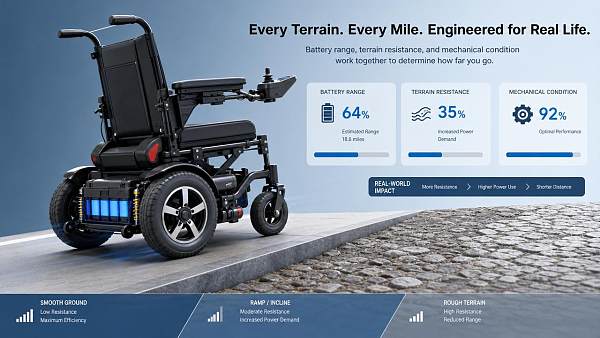
Many electric wheelchairs are sold with a stated maximum travel range, but that number is usually based on controlled testing. Manufacturers often calculate range using a fully charged battery, flat indoor-style surfaces, moderate speed, standard temperature, properly inflated tires, and a specific user weight. Real life rarely matches that setup.
That does not mean the range claim is false. It means the claim represents a best-case or near-best-case scenario. If you use the chair outdoors, go up ramps, carry bags, stop and start repeatedly, or travel on carpet, grass, cracked sidewalks, or gravel, energy consumption rises quickly.
Users also tend to think of battery performance like fuel in a car, but mobility batteries behave differently. Battery output changes with age, temperature, charging habits, and discharge depth. So even if your electric wheelchair once reached a certain distance, it may no longer do so consistently months or years later.
The practical takeaway is this: expected range should be treated as a reference point, not a guarantee. A better measure is your chair’s reliable real-world range under your normal daily route and routine.
Battery Age Is One of the Biggest Reasons Range Drops
Battery aging is one of the most common causes of declining electric wheelchair range. Over time, batteries lose their ability to store and deliver energy efficiently. Even when they appear to charge normally, their actual usable capacity may be much lower than when they were new.
This decline can happen gradually, so many users do not notice it immediately. Instead, they may first observe that the chair reaches low battery sooner, slows down earlier in the day, or feels less consistent on longer trips. These are often signs that the batteries are no longer holding a full practical charge.
Lead-acid batteries, which are common in many power chairs, are especially sensitive to age, incomplete charging, and long periods of storage. Lithium battery systems generally offer better cycle life and more stable performance, but they also degrade over time and can still lose capacity with heavy use or improper charging patterns.
If your chair is more than a year or two old and range has clearly dropped, battery condition should be one of the first things to investigate. A battery can still power the chair for short trips while no longer supporting the range needed for a full day of mobility.
Terrain and Surface Conditions Drain More Power Than Many Users Realize
Surface conditions have a major effect on how far electric wheelchairs can travel. Smooth indoor floors require much less effort than outdoor pavement, uneven sidewalks, thick carpet, grass, dirt, gravel, or sloped paths. Every increase in rolling resistance forces the motors to draw more power from the battery.
Hills and ramps are especially demanding. Climbing requires the chair to work harder, sometimes much harder, than traveling on level ground. Even short uphill sections can noticeably reduce total range, particularly when repeated throughout the day.
Users who compare their outdoor range to a manufacturer’s flat-surface estimate often feel disappointed, but the difference is expected. The more varied your route is, the more likely you are to see significant range reduction.
If you regularly travel outdoors, a more realistic way to evaluate battery life is to track how the chair performs on your actual route over several days. This reveals a more useful real-world baseline than relying on published specifications alone.
User Weight, Carried Items, and Seating Setup Matter
The total load on an electric wheelchair directly affects energy use. That load includes not only the user’s body weight but also bags, oxygen equipment, medical accessories, shopping items, and anything attached to the chair. More weight means more work for the motors, especially during starts, climbs, and turns.
Even when the added weight seems minor, the cumulative effect can be meaningful over a full day. Users who begin carrying more personal items than before may notice reduced range without realizing the connection.
Seating setup can also play a role. Power seating features such as tilt, recline, elevating leg rests, or seat lift systems may use additional battery power during operation. While these features are important for comfort and clinical support, frequent use can slightly reduce available driving range.
Weight distribution matters too. Poorly balanced loads can increase drag or make the chair less efficient to maneuver. Keeping necessary items secure, balanced, and limited to what is truly needed can help preserve battery performance.
Tire Pressure, Wheel Condition, and Mechanical Resistance Can Quietly Reduce Range
Low tire pressure is one of the easiest range killers to overlook. If your electric wheelchair uses pneumatic tires and they are underinflated, rolling resistance increases and the motors must work harder. The result is a noticeable drop in distance per charge.
Solid tires avoid air pressure issues, but they can still wear unevenly or create extra drag if damaged. Wheel alignment problems, worn bearings, or brake resistance can also make the chair less efficient, even if it still appears to function normally.
In some cases, users assume their batteries are failing when the real problem is mechanical resistance. A chair that pulls slightly, feels harder to push manually in freewheel mode, or sounds different during motion may need inspection.
Routine maintenance checks are essential. Tires, casters, wheel hubs, and moving parts should be examined regularly, especially if the chair is used outdoors or on rough surfaces. Small mechanical issues can have a large effect on both energy use and long-term reliability.
Speed Settings, Stop-and-Go Driving, and Daily Habits Affect Battery Consumption
Driving style has more influence on electric wheelchair range than many users expect. Fast acceleration, frequent stopping and starting, sharp turns, and consistently high speed settings all increase energy demand. Smooth, steady driving is usually more efficient.
This does not mean users should move unnaturally slowly. It means that aggressive driving patterns can reduce range, just as they do in electric vehicles. If your daily route includes crowded areas, frequent doorways, elevators, and repositioning, your chair may consume more battery than a simple distance estimate suggests.
Repeated short trips can also be less efficient than one steady trip of the same total distance. Constant restarts require extra motor effort. Users in busy care environments, hospitals, large residences, or urban sidewalks often experience this pattern.
Where your controller settings allow adjustment, using an appropriate speed mode for the environment can help. High speed may be useful in open areas, but lower, smoother settings can preserve energy in tighter spaces without sacrificing safety.
Temperature and Weather Change How Batteries Perform
Cold weather is a well-known cause of reduced battery performance. Batteries become less efficient in low temperatures, which can make an electric wheelchair lose range faster even when nothing else has changed. Users often notice this during winter or early mornings outdoors.
Very hot conditions can also affect battery health over time. While heat may not always cause the same immediate range drop as cold, repeated exposure to high temperatures can accelerate long-term battery wear.
Wet conditions create another challenge. Rain itself does not necessarily reduce range dramatically, but wet surfaces can increase rolling resistance, and users may rely on more frequent corrections and slower movement, which changes efficiency. More importantly, batteries and electronics should always be protected according to manufacturer guidelines.
If seasonal changes seem to affect your chair’s performance, that is normal to a point. The key is to distinguish expected environmental variation from a deeper battery or maintenance issue.
Charging Habits Can Shorten Useful Range Over Time
Improper charging is a common reason electric wheelchairs lose range earlier than expected. Batteries perform best when charged according to the manufacturer’s recommendations. Repeated partial charging, leaving batteries deeply discharged for long periods, or using the wrong charger can reduce battery life.
Many users unintentionally shorten battery lifespan by waiting too long to recharge after use. With some battery types, especially sealed lead-acid systems, frequent deep discharge can permanently reduce capacity. Once that happens, full range may never return.
Over time, charging habits become just as important as battery age. A newer battery that is poorly maintained may perform worse than an older one that has been charged correctly and consistently.
As a practical rule, charge the wheelchair fully after daily use unless the manufacturer states otherwise. Avoid storing the chair for long periods without recharging. If the chair will sit unused, follow the storage charging schedule in the user manual to prevent capacity loss.
How to Tell Whether the Problem Is Normal Range Loss or a Real Fault
Some range reduction is normal, especially as batteries age and usage conditions change. The challenge is knowing when the drop is expected and when it signals a fault that needs service.
Normal range loss usually happens gradually. You may notice shorter travel distance over months, more sensitivity to hills, or a stronger effect from cold weather. The chair still behaves predictably, just with less endurance.
A possible fault is more likely if range drops suddenly, the battery gauge behaves erratically, charging time changes sharply, the chair slows unexpectedly, or one day’s performance is drastically worse than another under similar conditions. These signs may point to a weak battery, charger problem, connection issue, or electrical fault.
Another warning sign is when the chair shows a full charge but loses power unusually fast shortly after use begins. That can indicate batteries with reduced capacity or cells that no longer balance correctly. In such cases, professional testing is often the safest and quickest way to confirm the cause.
Practical Ways to Extend Electric Wheelchair Range in Daily Use
If you want to get more distance from your electric wheelchair, start with the basics that produce the biggest real-world improvement. Keep batteries fully charged, follow the correct charging schedule, and replace old batteries before they become unreliable. This alone can make a major difference.
Check tire pressure regularly if your chair uses air-filled tires. Inspect wheels and casters for wear, debris, or drag. Schedule maintenance if the chair feels less smooth or requires more effort than before. Mechanical efficiency matters more than many users assume.
Plan routes with surface quality in mind. Whenever possible, use smoother paths and avoid repeated steep climbs. If you know a long day is ahead, reduce unnecessary cargo and use high-power seating features thoughtfully.
Drive smoothly rather than aggressively. Gentle acceleration, fewer abrupt stops, and appropriate speed settings can preserve battery energy. In colder weather, expect reduced range and leave extra margin for return trips or essential travel.
Most importantly, learn your chair’s actual dependable range in your own environment. A personal baseline is far more useful than a brochure estimate. Once you know what is normal for your use, it becomes easier to spot unusual changes early.
When It May Be Time to Replace Batteries or Seek Professional Service
If your electric wheelchair no longer supports your normal daily routine even after proper charging and basic maintenance, battery replacement may be necessary. Waiting too long can create safety and mobility risks, especially if the chair is used for work, appointments, shopping, or independent travel.
Users should consider professional service if the chair’s range has dropped sharply, if charging behavior has changed, if the battery indicator is unreliable, or if maintenance checks do not explain the problem. A technician can test battery health, charger output, wiring connections, and motor load more accurately than guesswork can.
Professional evaluation is also important when multiple factors may be involved. For example, an older battery combined with low tire pressure and increased user load can create confusing symptoms. A proper diagnosis helps avoid unnecessary part replacement and gets the chair back to dependable use faster.
For operators who depend on mobility equipment every day, reliability matters more than the theoretical last mile of battery life. Timely service is often more cost-effective than dealing with breakdowns, disrupted schedules, or unsafe low-power situations.
Conclusion: Real-World Range Depends on More Than the Battery Alone
Electric wheelchairs lose range faster than expected for many understandable reasons. The most common are battery aging, rough terrain, hills, load weight, low tire pressure, cold weather, charging habits, and stop-and-go driving. In most cases, reduced range is not caused by a single hidden defect but by the combined effect of everyday conditions.
For users and operators, the best approach is practical rather than theoretical. Focus on your real route, your real battery condition, and your real usage pattern. Maintain the chair well, charge it correctly, track changes over time, and respond early when performance declines.
When you understand what affects electric wheelchair range, you can make better daily decisions, reduce unexpected interruptions, and keep mobility dependable where it matters most: in real life, not just on paper.
Get weekly intelligence in your inbox.
No noise. No sponsored content. Pure intelligence.
 Sep 21, 2026What to Look for in a Grid Integration Company for Utility-Scale Solar ProjectsWhat to Look for in a Grid Integration Company for Utility-Scale Solar Projects
 Sep 20, 2026Microgrid Controller Pricing: What Drives Cost in Commercial Energy Projects?Microgrid Controller Pricing: What Drives Cost in Commercial Energy Projects?
 Sep 19, 2026How to Choose a GaN Charger for Laptops Without Compromising Power or PortabilityHow to Choose a GaN Charger for Laptops Without Compromising Power or Portability
 Sep 18, 2026Floating Solar Farm Costs: CAPEX, OPEX, and the Site Factors That Shape ROIFloating Solar Farm Costs: CAPEX, OPEX, and the Site Factors That Shape ROI
 Sep 17, 2026Drone Delivery Solutions for Last-Mile Routes: Site, Payload, and Range PlanningDrone Delivery Solutions for Last-Mile Routes: Site, Payload, and Range Planning
 Sep 16, 2026When Low-Volume Electronics Manufacturing Makes More Sense Than Mass ProductionWhen Low-Volume Electronics Manufacturing Makes More Sense Than Mass Production
 Sep 15, 2026Wholesale WiFi Smart Switches: What Buyers Should Verify Before OrderingWholesale WiFi Smart Switches: What Buyers Should Verify Before Ordering
 Sep 14, 2026How to Select IoT Sensors for Reliable Monitoring in Harsh Industrial EnvironmentsHow to Select IoT Sensors for Reliable Monitoring in Harsh Industrial Environments
 Sep 13, 2026How Procurement Teams Can Improve Supplier Reliability With Supply Chain VisibilityHow Procurement Teams Can Improve Supplier Reliability With Supply Chain Visibility
 Sep 12, 2026Smart Manufacturing Trends 2026: What Leaders Should Prioritize for ROISmart Manufacturing Trends 2026: What Leaders Should Prioritize for ROI
 Sep 11, 2026B2B Market Analysis: How Buyers Evaluate Suppliers, Pricing, and Delivery RiskB2B Market Analysis: How Buyers Evaluate Suppliers, Pricing, and Delivery Risk
 Sep 10, 2026Residential Solar Kits in Canada: How to Size a System for Your Home and ClimateResidential Solar Kits in Canada: How to Size a System for Your Home and Climate
 Sep 09, 2026How to Specify a Syringe Assembly Line for High-Volume Sterile ProductionHow to Specify a Syringe Assembly Line for High-Volume Sterile Production
 Sep 08, 2026How to Evaluate Warehouse Robotics System Suppliers for Reliable Multi-Site DeploymentHow to Evaluate Warehouse Robotics System Suppliers for Reliable Multi-Site Deployment
 Sep 07, 2026Renewable Geothermal Energy Explained: How It Works for Heating and PowerRenewable Geothermal Energy Explained: How It Works for Heating and Power
 Sep 07, 2026How to Choose an Industrial Packaging Robot Manufacturer for Your Production LineHow to Choose an Industrial Packaging Robot Manufacturer for Your Production Line
 Sep 05, 2026How to Evaluate a Turnkey Hydro Turbine Generator Supplier for Remote Power ProjectsHow to Evaluate a Turnkey Hydro Turbine Generator Supplier for Remote Power Projects
 Sep 04, 2026Automated Ultrasonic Welding for Thermoplastic Assemblies: Process Controls That MatterAutomated Ultrasonic Welding for Thermoplastic Assemblies: Process Controls That Matter
 Sep 03, 2026Energy Forecasting for Grid Planning: Sizing Solar and Storage CapacityEnergy Forecasting for Grid Planning: Sizing Solar and Storage Capacity
 Sep 02, 2026Which Metrics Should an Energy Analytics Dashboard Track for Factory Energy Management?Which Metrics Should an Energy Analytics Dashboard Track for Factory Energy Management?
 Sep 01, 2026How Warehouse Voice Picking Improves Accuracy and Throughput in Order FulfillmentHow Warehouse Voice Picking Improves Accuracy and Throughput in Order Fulfillment
 Aug 31, 2026How to Automate Dropshipping Order Processing Without Overselling StockHow to Automate Dropshipping Order Processing Without Overselling Stock
 Aug 30, 2026How to Evaluate a Smart Lighting Supplier for Multi-Site Commercial ProjectsHow to Evaluate a Smart Lighting Supplier for Multi-Site Commercial Projects
 Aug 29, 2026Recent Advances in Smart Manufacturing and Materials Reshaping Factory InvestmentRecent Advances in Smart Manufacturing and Materials Reshaping Factory Investment
 Aug 29, 2026Selecting Lightweight Aluminum Extrusions for Strength-Critical Industrial DesignsSelecting Lightweight Aluminum Extrusions for Strength-Critical Industrial Designs
 Aug 29, 2026Vertical Powder Anodizing Explained: Process Controls for Uniform Coating QualityVertical Powder Anodizing Explained: Process Controls for Uniform Coating Quality
 Aug 29, 2026PV Module Product Due Diligence: What Buyers Should Verify Before ContractingPV Module Product Due Diligence: What Buyers Should Verify Before Contracting