Sterile Surgical Drapes: Where Barrier Performance Really Differs
For quality control and safety teams, not all sterile surgical drapes deliver the same level of protection. Differences in material structure, fluid resistance, lint control, and compliance testing can directly affect infection prevention and operating room performance. This article examines where sterile surgical drapes truly differ, helping safety and sourcing decisions become more reliable, more consistent, and more aligned with clinical risk control.
What exactly makes one sterile surgical drape different from another?
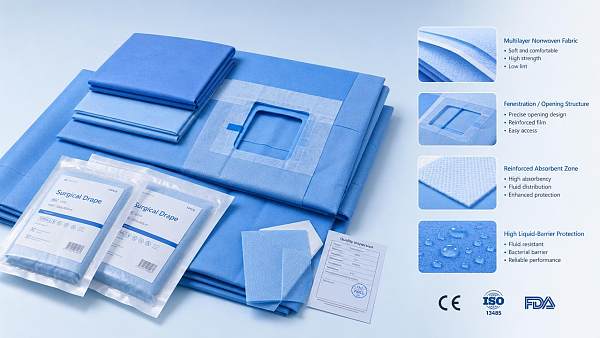
At first glance, many sterile surgical drapes look similar: blue sheets, fenestrated openings, absorbent zones, and sterile packaging. In practice, the real differences are found in the barrier system, fabric construction, reinforcement layout, adhesive quality, and the stability of the sterilization process. A drape that performs well in a low-fluid procedure may fail to provide the same protection in orthopedic, cardiovascular, or trauma settings.
The most important distinction is barrier performance under realistic operating room conditions. Dry-state protection alone is not enough. Surgical environments involve pressure, friction, fluid strike-through risk, instrument movement, and long procedure duration. When evaluating sterile surgical drapes, it is necessary to understand how the material behaves when wet, when stretched, and when exposed to mechanical stress around the fenestration or reinforced zones.
Another difference lies in consistency. Two products may claim similar protection levels, yet manufacturing variability can produce very different field outcomes. For that reason, decision-making should focus not only on product specifications but also on lot-to-lot reliability, packaging integrity, and traceable quality controls.
Which barrier performance factors matter most in sterile surgical drapes?
When comparing sterile surgical drapes, several technical factors matter more than marketing language. The first is fluid resistance. A drape should prevent blood, saline, and irrigation fluids from penetrating the sterile field. This is especially relevant in procedures with high fluid volume or prolonged exposure. Resistance to liquid penetration must be considered alongside seam construction, tape edges, and any integrated collection pouches.
The second factor is material composition. Multi-layer nonwoven structures often outperform simpler constructions because they combine absorbency on the top side with an impermeable barrier below. Some drapes prioritize comfort and flexibility, while others prioritize maximum protection. The best choice depends on the procedure profile, not on a single universal standard.
A third factor is lint and particle generation. Low-lint sterile surgical drapes help reduce airborne contamination risk and support cleaner surgical fields. Even strong barrier fabrics can create downstream problems if they shed particles during unfolding, repositioning, or instrument contact.
Finally, flame resistance, antistatic behavior, drapeability, and tear resistance should not be treated as secondary issues. A drape that tears at stress points or shifts during use may compromise the field even if the core barrier layer is technically compliant.
Quick comparison of high-impact performance criteria
How do standards and compliance testing reveal real performance differences?
Many buyers assume that if sterile surgical drapes are labeled sterile and compliant, performance differences must be minor. That assumption is risky. Regulatory compliance establishes a baseline, but not every test reflects every clinical scenario. It is important to look beyond broad claims and review how the product was validated.
For example, recognized standards such as EN 13795 are highly relevant because they address performance requirements for surgical drapes, gowns, and clean air suits used as medical devices. However, the presence of a standard reference should lead to further questions: Was testing done on the critical zone? Were dry and wet microbial barrier properties evaluated? How was resistance to liquid penetration measured? Were results generated by accredited laboratories?
Sterilization method also matters. Ethylene oxide, gamma irradiation, and steam-related compatibility can influence packaging stability, shelf life, and material behavior. Reliable sterile surgical drapes should demonstrate validated sterilization processes, intact seal strength, and packaging designed to preserve sterility through storage and transport.
In practical terms, documentation quality often separates higher-assurance products from generic alternatives. Technical data sheets, biocompatibility information, sterilization validation summaries, and batch traceability records all strengthen confidence in long-term use.
Where do application scenarios change the right drape choice?
The right sterile surgical drapes for one procedure may be unsuitable for another. Minor outpatient procedures, short-duration interventions, and low-fluid cases often require a different balance of comfort, manageability, and cost than major surgeries with heavy fluid exposure. Using the same drape specification across all cases can create hidden inefficiencies or unnecessary risk.
High-fluid surgeries benefit from reinforced zones, collection features, and stronger liquid barrier layers. Long procedures may require better adhesive retention and higher tear resistance. Procedures involving repositioning, imaging equipment, or multiple access points may need drapes that maintain placement without bunching or edge lift.
There is also a workflow dimension. Some sterile surgical drapes save time through integrated components, clearer folding logic, or procedure-specific layouts. Others create setup inefficiencies, increase waste, or complicate aseptic technique. In a broad healthcare supply environment, operational fit matters almost as much as lab-tested performance.
A practical review should therefore match drape type to procedure category, fluid load, duration, staff handling patterns, and disposal requirements. This prevents overbuying low-value features while avoiding under-specification where barrier performance is critical.
What are the most common mistakes when selecting sterile surgical drapes?
One common mistake is treating all sterile surgical drapes as interchangeable commodities. Price pressure often pushes evaluation toward unit cost only, but lower upfront cost can be offset by higher waste, setup delays, inconsistent adhesion, or increased exposure to contamination events.
A second mistake is overreliance on brochure language such as “high barrier” or “premium material” without reviewing test methods. Performance claims should be connected to measurable criteria, validated standards, and usable evidence. If a supplier cannot explain where the critical zone is or how the drape performs under fluid challenge, the risk profile remains unclear.
Another frequent issue is ignoring packaging and storage conditions. Even high-quality sterile surgical drapes can become a weak link if cartons are poorly protected in transit, if sterile pouches are prone to seal failure, or if warehouse controls are inconsistent. Sterility assurance is not only about the drape material itself.
- Do not compare only by size and unit price.
- Check reinforced area coverage, not just total fabric weight.
- Review packaging integrity and shelf-life evidence.
- Confirm documentation for sterilization validation and traceability.
- Assess usability during actual setup, not only bench data.
How can sterile surgical drapes be evaluated more reliably before wider adoption?
A more reliable evaluation process combines documentation review, controlled product trials, and post-use feedback. For sterile surgical drapes, that means looking at both technical conformance and practical behavior in real procedure conditions. Small pilot programs often reveal problems that are invisible in catalogs, such as awkward unfolding, poor conformability, or inconsistent adhesive performance.
A structured evaluation can include several checkpoints: material specification review, applicable standard verification, packaging inspection, simulated fluid testing, handling assessment, and waste analysis. It is also useful to compare equivalent products across the same procedure type rather than across mixed use cases.
FAQ-style decision table for sterile surgical drapes
Across global healthcare supply chains, the best-performing sterile surgical drapes are rarely defined by a single feature. They are defined by fit-for-purpose design, validated barrier protection, consistent manufacturing quality, and usability in real-world operating conditions. A disciplined evaluation approach reduces the chance of choosing a product that looks compliant on paper but underperforms when conditions become demanding.
For any organization reviewing sterile surgical drapes, the next step should be practical and evidence-based: map procedure risk levels, compare technical files, test representative samples, and document field performance before scaling adoption. That process creates a stronger foundation for infection prevention, supply continuity, and long-term value.
Get weekly intelligence in your inbox.
No noise. No sponsored content. Pure intelligence.
 Sep 21, 2026What to Look for in a Grid Integration Company for Utility-Scale Solar ProjectsWhat to Look for in a Grid Integration Company for Utility-Scale Solar Projects
 Sep 20, 2026Microgrid Controller Pricing: What Drives Cost in Commercial Energy Projects?Microgrid Controller Pricing: What Drives Cost in Commercial Energy Projects?
 Sep 19, 2026How to Choose a GaN Charger for Laptops Without Compromising Power or PortabilityHow to Choose a GaN Charger for Laptops Without Compromising Power or Portability
 Sep 18, 2026Floating Solar Farm Costs: CAPEX, OPEX, and the Site Factors That Shape ROIFloating Solar Farm Costs: CAPEX, OPEX, and the Site Factors That Shape ROI
 Sep 17, 2026Drone Delivery Solutions for Last-Mile Routes: Site, Payload, and Range PlanningDrone Delivery Solutions for Last-Mile Routes: Site, Payload, and Range Planning
 Sep 16, 2026When Low-Volume Electronics Manufacturing Makes More Sense Than Mass ProductionWhen Low-Volume Electronics Manufacturing Makes More Sense Than Mass Production
 Sep 15, 2026Wholesale WiFi Smart Switches: What Buyers Should Verify Before OrderingWholesale WiFi Smart Switches: What Buyers Should Verify Before Ordering
 Sep 14, 2026How to Select IoT Sensors for Reliable Monitoring in Harsh Industrial EnvironmentsHow to Select IoT Sensors for Reliable Monitoring in Harsh Industrial Environments
 Sep 13, 2026How Procurement Teams Can Improve Supplier Reliability With Supply Chain VisibilityHow Procurement Teams Can Improve Supplier Reliability With Supply Chain Visibility
 Sep 12, 2026Smart Manufacturing Trends 2026: What Leaders Should Prioritize for ROISmart Manufacturing Trends 2026: What Leaders Should Prioritize for ROI
 Sep 11, 2026B2B Market Analysis: How Buyers Evaluate Suppliers, Pricing, and Delivery RiskB2B Market Analysis: How Buyers Evaluate Suppliers, Pricing, and Delivery Risk
 Sep 10, 2026Residential Solar Kits in Canada: How to Size a System for Your Home and ClimateResidential Solar Kits in Canada: How to Size a System for Your Home and Climate
 Sep 09, 2026How to Specify a Syringe Assembly Line for High-Volume Sterile ProductionHow to Specify a Syringe Assembly Line for High-Volume Sterile Production
 Sep 08, 2026How to Evaluate Warehouse Robotics System Suppliers for Reliable Multi-Site DeploymentHow to Evaluate Warehouse Robotics System Suppliers for Reliable Multi-Site Deployment
 Sep 07, 2026Renewable Geothermal Energy Explained: How It Works for Heating and PowerRenewable Geothermal Energy Explained: How It Works for Heating and Power
 Sep 07, 2026How to Choose an Industrial Packaging Robot Manufacturer for Your Production LineHow to Choose an Industrial Packaging Robot Manufacturer for Your Production Line
 Sep 05, 2026How to Evaluate a Turnkey Hydro Turbine Generator Supplier for Remote Power ProjectsHow to Evaluate a Turnkey Hydro Turbine Generator Supplier for Remote Power Projects
 Sep 04, 2026Automated Ultrasonic Welding for Thermoplastic Assemblies: Process Controls That MatterAutomated Ultrasonic Welding for Thermoplastic Assemblies: Process Controls That Matter
 Sep 03, 2026Energy Forecasting for Grid Planning: Sizing Solar and Storage CapacityEnergy Forecasting for Grid Planning: Sizing Solar and Storage Capacity
 Sep 02, 2026Which Metrics Should an Energy Analytics Dashboard Track for Factory Energy Management?Which Metrics Should an Energy Analytics Dashboard Track for Factory Energy Management?
 Sep 01, 2026How Warehouse Voice Picking Improves Accuracy and Throughput in Order FulfillmentHow Warehouse Voice Picking Improves Accuracy and Throughput in Order Fulfillment
 Aug 31, 2026How to Automate Dropshipping Order Processing Without Overselling StockHow to Automate Dropshipping Order Processing Without Overselling Stock
 Aug 30, 2026How to Evaluate a Smart Lighting Supplier for Multi-Site Commercial ProjectsHow to Evaluate a Smart Lighting Supplier for Multi-Site Commercial Projects
 Aug 29, 2026Recent Advances in Smart Manufacturing and Materials Reshaping Factory InvestmentRecent Advances in Smart Manufacturing and Materials Reshaping Factory Investment
 Aug 29, 2026Selecting Lightweight Aluminum Extrusions for Strength-Critical Industrial DesignsSelecting Lightweight Aluminum Extrusions for Strength-Critical Industrial Designs
 Aug 29, 2026Vertical Powder Anodizing Explained: Process Controls for Uniform Coating QualityVertical Powder Anodizing Explained: Process Controls for Uniform Coating Quality
 Aug 29, 2026PV Module Product Due Diligence: What Buyers Should Verify Before ContractingPV Module Product Due Diligence: What Buyers Should Verify Before Contracting