Electronic shelf labels and the hidden cost of system rollout
Electronic shelf labels promise pricing accuracy, labor savings, and faster in-store updates, but many business evaluators underestimate the hidden cost of system rollout. Beyond hardware, success depends on integration, training, maintenance, and supplier coordination. This article examines where electronic shelf labels create value, where budgets often slip, and how decision-makers can assess total deployment risk before scaling.
Why scenario differences matter before approving an electronic shelf labels rollout
For business evaluators, the biggest mistake is treating electronic shelf labels as a simple hardware purchase. In practice, the business case changes sharply by store format, pricing model, product turnover, IT maturity, and labor structure. A supermarket with thousands of daily price adjustments has different needs from a specialty retailer with premium product storytelling. A chain that already runs centralized pricing and ERP workflows will face a very different rollout profile from an operator still relying on spreadsheets and manual shelf checks.
That is why deployment risk should be judged by application scenario rather than by unit tag cost alone. Electronic shelf labels can reduce pricing errors, improve compliance, support omnichannel fulfillment, and accelerate promotions. Yet hidden cost often appears in radio infrastructure tuning, data synchronization, battery replacement planning, API development, installer coordination, staff adoption, and exception handling. The more complex the operating environment, the more likely these costs will erode the projected return.
For organizations comparing suppliers or preparing pilot programs, the right question is not simply “Do electronic shelf labels save labor?” but “In which business scenario do they save labor, who absorbs the transition cost, and how quickly can process discipline turn technology into measurable benefit?”
Where electronic shelf labels create the clearest value
Electronic shelf labels tend to perform best in environments where pricing changes are frequent, assortments are broad, compliance risk is material, and store teams spend too much time updating paper labels. Business evaluators should map value by scenario rather than assume universal suitability.
High-SKU grocery and hypermarket environments
This is one of the strongest use cases. Thousands of SKUs, promotional cycles, perishable inventory, and high customer sensitivity to price accuracy create a natural fit for electronic shelf labels. Benefits typically include faster promotion execution, reduced mismatch between shelf and point-of-sale pricing, and lower manual relabeling workload. In these settings, labor savings are real, but only if product master data and promotion rules are already well controlled.
Consumer electronics and smart retail stores
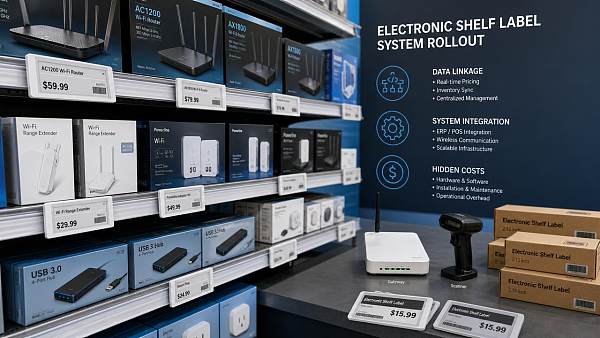
In smart electronics retail, electronic shelf labels often support more than pricing. They may display specifications, QR-based product information, stock indicators, or campaign messaging. Because products are technical and margin-sensitive, errors can be costly. However, integration complexity is higher because pricing, product content, and promotional assets often come from multiple systems.
Pharmacy, healthcare-related retail, and regulated categories
In regulated environments, the value proposition goes beyond convenience. Electronic shelf labels can support consistency, reduce manual update delays, and improve audit readiness. Yet regulated categories also raise stricter validation expectations. Business evaluators should account for governance cost, approval workflows, and possible legal review of displayed data.
Warehouse-like retail, click-and-collect, and omnichannel fulfillment
Retailers using stores as micro-fulfillment nodes may benefit from electronic shelf labels that help staff identify items faster, align picks with system prices, and reduce confusion during rapid promotions. Still, the economics depend on whether the labels are being used only for shelf pricing or as part of a broader digital workflow.
Scenario comparison: where budgets hold and where hidden costs appear
The table below helps business evaluators compare common scenarios for electronic shelf labels and identify where hidden rollout costs are most likely to emerge.
The hidden cost categories most often missed in electronic shelf labels projects
When a project underperforms, the cause is rarely the label device alone. Electronic shelf labels become expensive when supporting processes are immature or underestimated. The following cost categories deserve close review during supplier evaluation and pilot design.
Integration and data cleanup
If product data, prices, promotions, and inventory signals come from disconnected systems, integration can become the largest hidden cost. Evaluators should ask whether the rollout requires middleware, custom APIs, or changes to ERP, POS, pricing engine, or store management software. Data quality work is especially important because electronic shelf labels expose operational inconsistency immediately.
Site survey, installation, and store readiness
Physical installation looks straightforward on paper, but real stores vary. Shelf materials, fixture formats, interference sources, power planning for gateways, and legacy layout constraints can extend timelines. If stores differ significantly across a chain, standard installation assumptions may fail, increasing project management cost and delaying benefits.
Training and process adoption
Electronic shelf labels do not eliminate store work; they change it. Teams need to manage exceptions, device replacements, template checks, and escalation procedures. If staff still print backup labels or ignore system alerts, expected savings will not materialize. Adoption cost is often higher in multi-country or multi-format operations where procedures differ by region.
Maintenance, batteries, and support contracts
Battery life claims can look attractive in proposals, but actual consumption depends on update frequency, display type, temperature conditions, and network behavior. Evaluators should model replacement cycles, breakage rates, and service response requirements. A low hardware price can become less attractive if long-term support or spare management is weak.
Supplier coordination and rollout governance
A chainwide deployment often involves label vendors, software providers, system integrators, fixture partners, and store operations teams. Hidden cost appears when responsibilities are not clearly assigned. Who owns data mapping? Who resolves store-level installation variance? Who validates promotional timing? Without governance, electronic shelf labels can create a visible digital layer on top of invisible organizational gaps.
How business evaluators should judge fit by store type and operating model
A disciplined evaluation should separate technical feasibility from business suitability. The following scenario-based questions can improve decision quality.
- How many price changes occur per week per store, and how much labor is currently consumed?
- What is the financial impact of shelf-to-checkout price mismatch, compliance fines, or customer complaints?
- Are stores standardized enough to support repeatable installation and training?
- Does the retailer already have stable pricing governance and product data discipline?
- Will electronic shelf labels support broader use cases such as inventory signals, pick assistance, or customer engagement?
If the answer to most of these questions is weak or uncertain, a full deployment may be premature. In that case, a narrower pilot in high-change categories is often more informative than a chainwide commitment.
Common scenario misjudgments that weaken ROI
Several recurring misjudgments appear across electronic shelf labels projects. First, some organizations assume that labor savings are immediate. In reality, labor may shift from printing and replacing labels to monitoring exceptions and maintaining system discipline. Second, some retailers deploy the same label strategy across very different store formats, ignoring local economics. Third, pilot stores are sometimes too well controlled, creating unrealistic expectations for broad rollout.
Another frequent error is underestimating the cost of change management. Electronic shelf labels affect merchandising, store operations, pricing teams, IT, procurement, and finance. If these groups measure success differently, the program can stall even when the technology works. Finally, buyers sometimes compare suppliers primarily on tag price rather than on integration support, network stability, battery performance in real conditions, and post-launch service quality.
A practical rollout path: from selective pilot to scalable deployment
For most enterprises, the safest path is phased adoption. Start with store types where electronic shelf labels solve a visible operational pain point, such as high promotion frequency or chronic pricing discrepancies. Define success metrics before launch: update speed, error reduction, staff time saved, service ticket volume, and sales impact where measurable.
Then test not only technology performance but process resilience. Can the system handle incomplete product data? How are failed updates detected? How long does issue resolution take? Can store managers follow procedures without vendor intervention? These questions matter more than a polished demonstration environment.
Once pilot results are validated, segment rollout priorities. High-volume, high-change stores may justify full deployment first, while low-change specialty formats may benefit from selective use in promotional zones or premium categories only. This scenario-based sequencing helps protect cash flow and reduces organizational friction.
FAQ for evaluating electronic shelf labels in real business settings
Are electronic shelf labels worth it for smaller retail networks?
They can be, but only if pricing changes are frequent, labor is constrained, or accuracy risk is high. Smaller networks with low update volume should be cautious about full deployment and may prefer selective implementation.
What hidden cost should be reviewed first?
Integration and process alignment usually deserve the first review. If data sources are fragmented or pricing governance is weak, electronic shelf labels will expose those issues and increase remediation cost.
Which scenario tends to produce the fastest payback?
Large-format retail with many SKUs and frequent promotions often shows the fastest payback, provided installation can be standardized and central pricing workflows are mature.
Final decision lens for business evaluators
Electronic shelf labels can be a powerful operational upgrade, but the right decision depends on scenario fit, not vendor promise alone. For business evaluators, the most reliable approach is to connect each deployment case to a specific operating environment, define what value should look like there, and pressure-test every hidden cost behind the rollout. The strongest programs begin where pricing complexity, compliance pressure, and labor inefficiency are already visible. Before scaling, confirm data readiness, installation repeatability, support ownership, and user adoption discipline. In electronic shelf labels projects, sustainable ROI comes from matching the system to the right scenario and managing the rollout as an enterprise process, not just a store technology purchase.
Get weekly intelligence in your inbox.
No noise. No sponsored content. Pure intelligence.
 Sep 21, 2026What to Look for in a Grid Integration Company for Utility-Scale Solar ProjectsWhat to Look for in a Grid Integration Company for Utility-Scale Solar Projects
 Sep 20, 2026Microgrid Controller Pricing: What Drives Cost in Commercial Energy Projects?Microgrid Controller Pricing: What Drives Cost in Commercial Energy Projects?
 Sep 19, 2026How to Choose a GaN Charger for Laptops Without Compromising Power or PortabilityHow to Choose a GaN Charger for Laptops Without Compromising Power or Portability
 Sep 18, 2026Floating Solar Farm Costs: CAPEX, OPEX, and the Site Factors That Shape ROIFloating Solar Farm Costs: CAPEX, OPEX, and the Site Factors That Shape ROI
 Sep 17, 2026Drone Delivery Solutions for Last-Mile Routes: Site, Payload, and Range PlanningDrone Delivery Solutions for Last-Mile Routes: Site, Payload, and Range Planning
 Sep 16, 2026When Low-Volume Electronics Manufacturing Makes More Sense Than Mass ProductionWhen Low-Volume Electronics Manufacturing Makes More Sense Than Mass Production
 Sep 15, 2026Wholesale WiFi Smart Switches: What Buyers Should Verify Before OrderingWholesale WiFi Smart Switches: What Buyers Should Verify Before Ordering
 Sep 14, 2026How to Select IoT Sensors for Reliable Monitoring in Harsh Industrial EnvironmentsHow to Select IoT Sensors for Reliable Monitoring in Harsh Industrial Environments
 Sep 13, 2026How Procurement Teams Can Improve Supplier Reliability With Supply Chain VisibilityHow Procurement Teams Can Improve Supplier Reliability With Supply Chain Visibility
 Sep 12, 2026Smart Manufacturing Trends 2026: What Leaders Should Prioritize for ROISmart Manufacturing Trends 2026: What Leaders Should Prioritize for ROI
 Sep 11, 2026B2B Market Analysis: How Buyers Evaluate Suppliers, Pricing, and Delivery RiskB2B Market Analysis: How Buyers Evaluate Suppliers, Pricing, and Delivery Risk
 Sep 10, 2026Residential Solar Kits in Canada: How to Size a System for Your Home and ClimateResidential Solar Kits in Canada: How to Size a System for Your Home and Climate
 Sep 09, 2026How to Specify a Syringe Assembly Line for High-Volume Sterile ProductionHow to Specify a Syringe Assembly Line for High-Volume Sterile Production
 Sep 08, 2026How to Evaluate Warehouse Robotics System Suppliers for Reliable Multi-Site DeploymentHow to Evaluate Warehouse Robotics System Suppliers for Reliable Multi-Site Deployment
 Sep 07, 2026Renewable Geothermal Energy Explained: How It Works for Heating and PowerRenewable Geothermal Energy Explained: How It Works for Heating and Power
 Sep 07, 2026How to Choose an Industrial Packaging Robot Manufacturer for Your Production LineHow to Choose an Industrial Packaging Robot Manufacturer for Your Production Line
 Sep 05, 2026How to Evaluate a Turnkey Hydro Turbine Generator Supplier for Remote Power ProjectsHow to Evaluate a Turnkey Hydro Turbine Generator Supplier for Remote Power Projects
 Sep 04, 2026Automated Ultrasonic Welding for Thermoplastic Assemblies: Process Controls That MatterAutomated Ultrasonic Welding for Thermoplastic Assemblies: Process Controls That Matter
 Sep 03, 2026Energy Forecasting for Grid Planning: Sizing Solar and Storage CapacityEnergy Forecasting for Grid Planning: Sizing Solar and Storage Capacity
 Sep 02, 2026Which Metrics Should an Energy Analytics Dashboard Track for Factory Energy Management?Which Metrics Should an Energy Analytics Dashboard Track for Factory Energy Management?
 Sep 01, 2026How Warehouse Voice Picking Improves Accuracy and Throughput in Order FulfillmentHow Warehouse Voice Picking Improves Accuracy and Throughput in Order Fulfillment
 Aug 31, 2026How to Automate Dropshipping Order Processing Without Overselling StockHow to Automate Dropshipping Order Processing Without Overselling Stock
 Aug 30, 2026How to Evaluate a Smart Lighting Supplier for Multi-Site Commercial ProjectsHow to Evaluate a Smart Lighting Supplier for Multi-Site Commercial Projects
 Aug 29, 2026Recent Advances in Smart Manufacturing and Materials Reshaping Factory InvestmentRecent Advances in Smart Manufacturing and Materials Reshaping Factory Investment
 Aug 29, 2026Selecting Lightweight Aluminum Extrusions for Strength-Critical Industrial DesignsSelecting Lightweight Aluminum Extrusions for Strength-Critical Industrial Designs
 Aug 29, 2026Vertical Powder Anodizing Explained: Process Controls for Uniform Coating QualityVertical Powder Anodizing Explained: Process Controls for Uniform Coating Quality
 Aug 29, 2026PV Module Product Due Diligence: What Buyers Should Verify Before ContractingPV Module Product Due Diligence: What Buyers Should Verify Before Contracting