
How to Choose IBC Totes for Chemical Storage: Material Compatibility and Safety Checks
How to Choose IBC Totes for Chemical Storage: Material Compatibility and Safety Checks
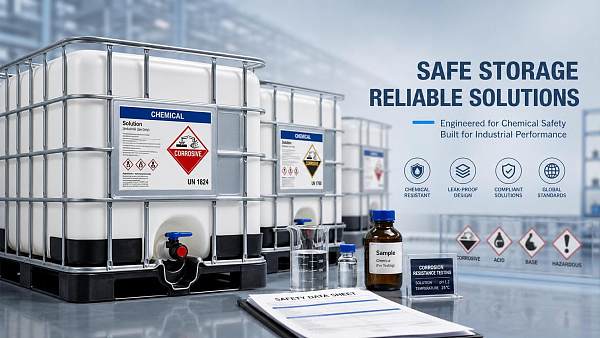
Choosing the right ibc totes for chemical storage is not just a packaging decision.
It directly affects leak control, operator safety, product stability, and audit readiness.
In practice, many storage failures start with small selection mistakes.
A tote may look robust, yet still react with the fill material.
Seals may swell, vents may clog, or labels may fail before inspection catches the issue.
That is why ibc totes for chemical storage should be evaluated as a full risk-control system.
This guide breaks the process into practical checks you can apply before purchase.
It focuses on compatibility, containment, compliance, and service conditions.
Start with the Chemical, Not the Container
The first rule is simple.
Never choose ibc totes for chemical storage by size or price alone.
Begin with the exact chemical profile and expected storage conditions.
Check the product name, concentration, pH, solvent content, oxidizing strength, and flash point.
Also review temperature range, fill cycle frequency, and storage duration.
A tote that works for diluted cleaners may fail with aggressive acids or aromatic solvents.
Recent market changes make this even more important.
Chemical formulations now change faster due to raw material substitution and compliance updates.
That means historical packaging choices may no longer be safe.
Key chemical data to collect first
- Full SDS details and composition range
- Transport classification and packing group
- Specific gravity and viscosity
- Expected maximum fill temperature
- UV sensitivity and contamination limits
- Required storage life after filling
Check Material Compatibility in Layers
Most buyers focus on the bottle material first.
That matters, but it is only one part of the decision.
For ibc totes for chemical storage, compatibility must be reviewed across every contact point.
This includes the inner bottle, cap, gasket, valve, outlet, and any venting component.
High-density polyethylene is common because it balances strength and cost.
Still, standard HDPE is not universally suitable.
Some chemicals can soften it, stress crack it, or allow permeation over time.
This is where barrier options, fluorination, or specialized resins may be necessary.
Common compatibility checks
- Verify bottle resin against supplier chemical resistance charts
- Confirm gasket materials such as EPDM, Viton, or PTFE
- Review valve body material and outlet thread resistance
- Ask for permeation data for volatile or hazardous contents
- Check if fluorinated bottles are recommended
A useful question is not only “Will it hold?”
It is also “Will it stay stable through the full storage cycle?”
That small shift in thinking improves selection quality.
Evaluate Sealing Performance and Leak Risk
Even chemically resistant totes can fail at the closure points.
For many facilities, leakage starts at the valve or cap seal.
When choosing ibc totes for chemical storage, inspect sealing performance with the same care as material selection.
Torque consistency, tamper evidence, vent design, and drain control all matter.
This is especially true for corrosive, fuming, or high-value contents.
In real operations, repeated handling creates wear that static product sheets do not show.
Request test data for drop resistance, hydrostatic performance, and valve cycle durability.
Practical leak-prevention checklist
- Inspect cap thread quality and closure fit.
- Confirm gasket compression under expected temperatures.
- Review valve shutoff reliability after repeated dispensing.
- Check whether venting is needed for pressure changes.
- Validate compatibility with site spill-control connectors.
Confirm Regulatory and Labeling Requirements
A chemically suitable tote is still the wrong choice if it misses compliance requirements.
For ibc totes for chemical storage, the approval pathway depends on product hazard class and transport mode.
You may need UN certification, food-contact separation, or local hazardous storage compliance.
Markings should stay legible through handling, washdown, and warehouse exposure.
If labels peel or fade, traceability weakens quickly.
That creates avoidable audit issues and misidentification risk.
This is also where supplier transparency becomes a decision factor.
Reliable suppliers provide test reports, not just generic claims.
Review Handling Conditions Inside the Facility
Selection should reflect how the tote will actually be used.
The best ibc totes for chemical storage on paper may still underperform in your warehouse.
Look at forklift movement, stacking height, discharge setup, and exposure to sunlight or heat.
If totes are stored outdoors, UV resistance becomes more relevant.
If they are moved often, cage strength and pallet design deserve closer review.
For clean production zones, discharge hygiene and residue control may be critical.
Operational questions worth asking
- Will the tote be single-use or reconditioned?
- How long will chemical contents remain in storage?
- Will operators use pumps, gravity discharge, or closed transfer?
- Are secondary containment rules already defined on site?
- Is there a cleaning or return process after emptying?
These details shape the safer choice more than catalog language does.
Assess Supplier Reliability Before Final Approval
Chemical packaging quality depends heavily on supplier discipline.
That is why buyer teams should compare more than unit price.
When sourcing ibc totes for chemical storage, ask how consistency is controlled from batch to batch.
Review resin source stability, molding controls, valve supplier quality, and inspection routines.
A low-cost tote becomes expensive when leakage, waste, or nonconformance enters the process.
From a procurement perspective, decision-grade information matters.
This is where structured supplier intelligence can reduce uncertainty before contracts are signed.
Platforms such as TradeNexus Pro help teams compare supplier credibility, market focus, and technical positioning more efficiently.
Supplier review points
- Request recent test and compliance documents.
- Ask for compatibility guidance for your exact formulation.
- Review incident response and complaint handling process.
- Confirm production traceability and lot identification.
- Check whether samples can be trialed under site conditions.
Build a Simple Selection Framework
A practical buying decision needs structure.
One useful method is to score ibc totes for chemical storage across five categories.
Use material compatibility, sealing reliability, compliance status, handling fit, and supplier confidence.
Assign weighted scores based on your risk profile.
For corrosive or regulated products, compatibility and compliance should carry the highest weight.
For frequent internal movement, handling durability may deserve more emphasis.
This approach keeps decisions consistent across sites and purchasing cycles.
The safest choice is rarely based on one feature alone.
It comes from matching the container to the chemical, the operation, and the compliance environment.
If you are reviewing new suppliers or entering unfamiliar markets, stronger technical validation should come first.
Use that discipline early, and ibc totes for chemical storage become a controlled decision rather than a hidden risk.
Get weekly intelligence in your inbox.
No noise. No sponsored content. Pure intelligence.
 Oct 08, 2026How Digital Health Improves Diagnostic Accuracy and Workflow in Clinical LabsHow Digital Health Improves Diagnostic Accuracy and Workflow in Clinical Labs
 Oct 07, 2026Selecting Voice Picking Systems for German Warehouses: Integration, Languages and ROISelecting Voice Picking Systems for German Warehouses: Integration, Languages and ROI
 Oct 06, 2026How to Choose Last Mile Dispatch Software for On-Time Delivery at ScaleHow to Choose Last Mile Dispatch Software for On-Time Delivery at Scale
 Oct 05, 2026Vietnam’s Consumer Electronics Market: Demand Shifts and Sourcing OpportunitiesVietnam’s Consumer Electronics Market: Demand Shifts and Sourcing Opportunities
 Oct 04, 2026Digital Health Investment Priorities for Providers: Improving Access, Outcomes, and EfficiencyDigital Health Investment Priorities for Providers: Improving Access, Outcomes, and Efficiency
 Oct 03, 2026How to Specify an FR4 Custom PCB Board for High-Voltage and High-Heat DesignsHow to Specify an FR4 Custom PCB Board for High-Voltage and High-Heat Designs
 Oct 02, 2026ERP Software Market Intelligence: Adoption, Pricing, and Vendor Signals to WatchERP Software Market Intelligence: Adoption, Pricing, and Vendor Signals to Watch
 Oct 01, 2026How to Select Calibrated Temperature Data Loggers for GMP Cold Storage MonitoringHow to Select Calibrated Temperature Data Loggers for GMP Cold Storage Monitoring
 Sep 30, 2026Custom Molded Rubber Pricing: What Drives Unit Cost and Tooling Fees?Custom Molded Rubber Pricing: What Drives Unit Cost and Tooling Fees?
 Sep 29, 2026How to Evaluate Energy Management Software Vendors for Multi-Site OperationsHow to Evaluate Energy Management Software Vendors for Multi-Site Operations
 Sep 28, 2026How to Select a DIN Rail Smart Meter for Multi-Circuit Energy MonitoringHow to Select a DIN Rail Smart Meter for Multi-Circuit Energy Monitoring
 Sep 27, 2026TWS Earbuds in Vietnam: Demand Drivers, Price Tiers, and Retail Channel OpportunitiesTWS Earbuds in Vietnam: Demand Drivers, Price Tiers, and Retail Channel Opportunities
 Sep 26, 2026How UAE Clinics Can Qualify a Smart Glucometer Supplier for Accuracy and ComplianceHow UAE Clinics Can Qualify a Smart Glucometer Supplier for Accuracy and Compliance
 Sep 25, 2026Buying Aesthetic Lasers in the USA: FDA Status, Wavelengths, and Service SupportBuying Aesthetic Lasers in the USA: FDA Status, Wavelengths, and Service Support
 Sep 24, 2026Laser Cutting Brass Sheet: How to Prevent Burrs and Heat Marks on Thin PartsLaser Cutting Brass Sheet: How to Prevent Burrs and Heat Marks on Thin Parts
 Sep 23, 2026How to Choose Lightweight ANC Headphones for Comfortable All-Day TravelHow to Choose Lightweight ANC Headphones for Comfortable All-Day Travel
 Sep 22, 2026IPX5 TWS Bluetooth Earbuds: What Protection Do They Offer for Workouts?IPX5 TWS Bluetooth Earbuds: What Protection Do They Offer for Workouts?
 Sep 21, 2026What to Look for in a Grid Integration Company for Utility-Scale Solar ProjectsWhat to Look for in a Grid Integration Company for Utility-Scale Solar Projects
 Sep 20, 2026Microgrid Controller Pricing: What Drives Cost in Commercial Energy Projects?Microgrid Controller Pricing: What Drives Cost in Commercial Energy Projects?
 Sep 19, 2026How to Choose a GaN Charger for Laptops Without Compromising Power or PortabilityHow to Choose a GaN Charger for Laptops Without Compromising Power or Portability
 Sep 18, 2026Floating Solar Farm Costs: CAPEX, OPEX, and the Site Factors That Shape ROIFloating Solar Farm Costs: CAPEX, OPEX, and the Site Factors That Shape ROI
 Sep 17, 2026Drone Delivery Solutions for Last-Mile Routes: Site, Payload, and Range PlanningDrone Delivery Solutions for Last-Mile Routes: Site, Payload, and Range Planning
 Sep 16, 2026When Low-Volume Electronics Manufacturing Makes More Sense Than Mass ProductionWhen Low-Volume Electronics Manufacturing Makes More Sense Than Mass Production
 Sep 15, 2026Wholesale WiFi Smart Switches: What Buyers Should Verify Before OrderingWholesale WiFi Smart Switches: What Buyers Should Verify Before Ordering
 Sep 14, 2026How to Select IoT Sensors for Reliable Monitoring in Harsh Industrial EnvironmentsHow to Select IoT Sensors for Reliable Monitoring in Harsh Industrial Environments
 Sep 13, 2026How Procurement Teams Can Improve Supplier Reliability With Supply Chain VisibilityHow Procurement Teams Can Improve Supplier Reliability With Supply Chain Visibility
 Sep 12, 2026Smart Manufacturing Trends 2026: What Leaders Should Prioritize for ROISmart Manufacturing Trends 2026: What Leaders Should Prioritize for ROI



























