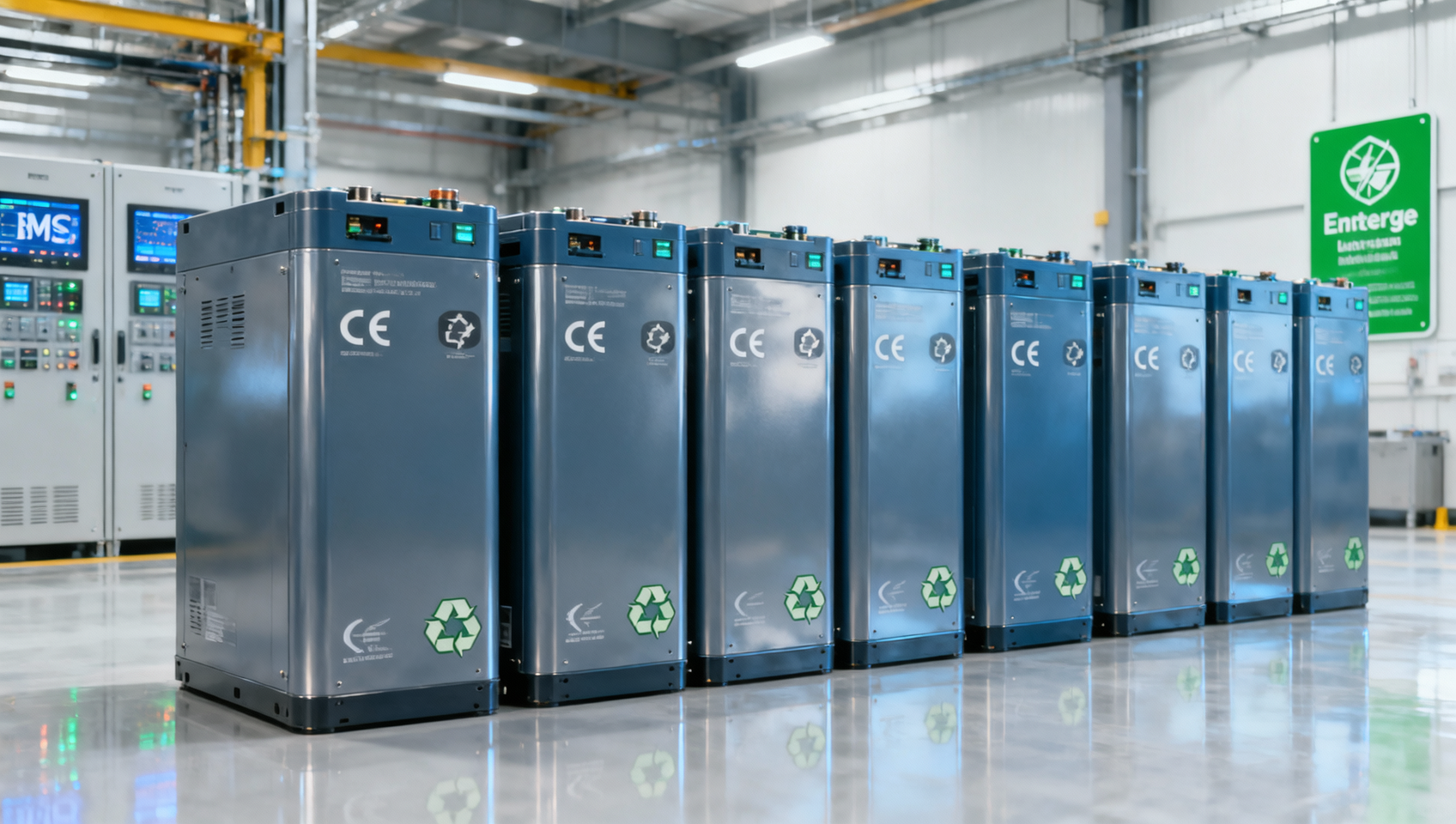
EU New Battery Regulation Fully Enforced Apr 24, 2026
On April 24, 2026, the EU’s new Battery Regulation (EU 2023/1542) enters full mandatory application, requiring all industrial and energy storage batteries placed on the EU market to carry a Digital Battery Passport (DBP) and a recycling responsibility statement compliant with EN IEC 63397:2025. This development directly impacts Chinese battery storage exporters — products lacking DBP system integration and third-party conformity certification (e.g., issued by TÜV Rheinland or SGS) will be denied customs clearance, and manufacturers must report full-lifecycle carbon footprint data.
Event Overview
The EU Battery Regulation (EU 2023/1542) becomes fully enforceable on April 24, 2026. As confirmed in official texts, it mandates that all industrial and energy storage batteries placed on the EU market must be equipped with a unique Digital Battery Passport (DBP) and accompanied by a recycling responsibility statement aligned with EN IEC 63397:2025. The regulation applies to batteries placed on the market after this date and requires verified third-party certification for DBP compliance, as well as ongoing reporting of lifecycle carbon footprint data.
Impact on Specific Industry Segments
Direct Exporters of Battery Storage Systems
These companies face immediate regulatory gatekeeping at EU customs. Without a functional DBP integrated into their product data infrastructure and validated by an EU-recognized conformity assessment body (e.g., TÜV Rheinland or SGS), shipments will not clear import formalities. Impact manifests as shipment delays, rework costs, and potential contract penalties under Incoterms where delivery obligations are unmet.
Manufacturers of Battery Packs and Modules
As upstream suppliers to system integrators and OEMs, pack/module makers must ensure traceability and data readiness for each unit — including cell origin, material composition, manufacturing location, and assembly batch. Their role shifts from hardware supplier to data steward: failure to provide structured, auditable inputs prevents downstream DBP generation and triggers compliance liability across the supply chain.
Supply Chain & Certification Service Providers
Third-party testing, certification, and digital identity platform providers see increased demand for DBP implementation support and audit services. However, capacity constraints are emerging: only a limited number of EU-notified bodies currently offer DBP-related conformity assessments under the regulation’s specific requirements. This creates lead-time pressure and potential bottlenecks for clients seeking timely certification.
What Relevant Companies or Practitioners Should Focus On — And How to Respond Now
Confirm DBP technical architecture compatibility with EU-mandated data schema
Companies should verify whether their current battery data management systems align with the EU’s required DBP data structure (e.g., ISO/IEC 19845:2024-based identifiers, mandatory fields per Annex II of EU 2023/1542). Integration with existing ERP or MES platforms may require API-level updates — not just documentation uploads.
Secure third-party certification well ahead of Q2 2026 deadlines
Given reported capacity constraints among notified bodies, exporters should initiate engagement with TÜV Rheinland, SGS, or other EU-recognized assessors no later than Q4 2025. Pre-assessment audits and documentation readiness checks should precede formal submission to avoid extended turnaround times.
Map and validate upstream material traceability for carbon footprint reporting
Compliance with the regulation’s carbon footprint requirement depends on verifiable primary data from raw material suppliers (e.g., cathode active material producers, cobalt refiners). Exporters must now formally request EPDs (Environmental Product Declarations) or equivalent verified emissions data — not estimates — and retain evidence of due diligence in procurement records.
Editorial Perspective / Industry Observation
From industry perspective, this regulation marks a structural shift from product-level compliance to data-enabled accountability. It is less a one-time certification hurdle and more the institutionalization of digital traceability as a market access condition. Analysis来看, the April 24, 2026 enforcement date represents a hard operational inflection point — not merely a policy signal — given its binding legal status and direct linkage to customs control. Current more appropriate interpretation is that the regulation functions as a de facto technical barrier to trade unless proactively embedded in product development and supply chain governance. Continued monitoring is warranted for guidance documents from the European Commission on DBP interoperability standards and transitional arrangements for legacy stock.

In summary, the EU Battery Regulation’s full enforcement signals the normalization of digital product passports and lifecycle transparency as non-negotiable elements of international battery trade. Its significance lies not in novelty alone, but in enforceability: it transforms sustainability and circularity commitments from voluntary reporting into legally binding, machine-verifiable obligations. For affected stakeholders, this is best understood not as a future risk, but as an active operational requirement effective April 24, 2026.
Source: Official Journal of the European Union, Regulation (EU) 2023/1542; EN IEC 63397:2025 standard publication; public statements by TÜV Rheinland and SGS on DBP conformity assessment scope. Note: Ongoing observation is recommended for European Commission guidance documents on DBP implementation timelines and verification protocols, which remain pending as of mid-2025.
Get weekly intelligence in your inbox.
No noise. No sponsored content. Pure intelligence.
") Apr 26, 2026China Releases Green Design Guidelines for Industrial Products (2026)China Releases Green Design Guidelines for Industrial Products (2026)
Apr 26, 2026China Releases Green Design Guidelines for Industrial Products (2026)China Releases Green Design Guidelines for Industrial Products (2026) Apr 26, 2026ANATEL Mandates Portuguese Offline Voice Assistant for Smart Home Devices in BrazilANATEL Mandates Portuguese Offline Voice Assistant for Smart Home Devices in Brazil
 Apr 26, 2026Vietnam Enforces Bilingual Safety Labels for Electronic Components from Apr 22, 2026Vietnam Enforces Bilingual Safety Labels for Electronic Components from Apr 22, 2026
 Apr 26, 2026Japan Updates JIS for Rehab Devices: IEC 62366-1:2024 RequiredJapan Updates JIS for Rehab Devices: IEC 62366-1:2024 Required
 Apr 26, 2026THE Alliance Cuts Ningbo–Rotterdam Transit to 18 Days, Spot Rates Up 35%THE Alliance Cuts Ningbo–Rotterdam Transit to 18 Days, Spot Rates Up 35%
 Apr 26, 2026India BIS Mandates PLC & HMI Certification under IS 13252:2025 by Oct 2026India BIS Mandates PLC & HMI Certification under IS 13252:2025 by Oct 2026
") Apr 26, 2026SASO Enforces New EV Charger Rules in Saudi Arabia (2026)SASO Enforces New EV Charger Rules in Saudi Arabia (2026)
Apr 26, 2026SASO Enforces New EV Charger Rules in Saudi Arabia (2026)SASO Enforces New EV Charger Rules in Saudi Arabia (2026) Apr 26, 2026TÜV Rheinland Updates IoT EMC Guidelines: AI Edge Modules Now Mandatory for Immunity TestingTÜV Rheinland Updates IoT EMC Guidelines: AI Edge Modules Now Mandatory for Immunity Testing
 Apr 26, 2026USTR Launches First Annual Review of China Solar PV AD/CVD OrdersUSTR Launches First Annual Review of China Solar PV AD/CVD Orders
 Apr 26, 2026EU New Battery Regulation Fully Enforced Apr 24, 2026EU New Battery Regulation Fully Enforced Apr 24, 2026
 Apr 25, 2026Vietnam Enforces CN-EN Bilingual Safety Labels on Electronic Components from Apr 22, 2026Vietnam Enforces CN-EN Bilingual Safety Labels on Electronic Components from Apr 22, 2026
 Apr 25, 2026ANATEL Mandates Portuguese Offline Voice Assistants for Smart Home Devices in BrazilANATEL Mandates Portuguese Offline Voice Assistants for Smart Home Devices in Brazil
 Apr 25, 2026India BIS Mandates IS 13252:2025 for PLCs & HMIs by Oct 2026India BIS Mandates IS 13252:2025 for PLCs & HMIs by Oct 2026
 Apr 25, 2026SASO EV Charger Rules: Grid Compatibility & Sand Resistance RequiredSASO EV Charger Rules: Grid Compatibility & Sand Resistance Required
 Apr 25, 2026JIS T 0011:2026 Enforces IEC 62366-1:2024 for Rehab Devices in JapanJIS T 0011:2026 Enforces IEC 62366-1:2024 for Rehab Devices in Japan
 Apr 25, 2026THE Alliance Cuts Ningbo–Rotterdam Transit to 18 Days, +35% Spot RateTHE Alliance Cuts Ningbo–Rotterdam Transit to 18 Days, +35% Spot Rate
 Apr 25, 2026TÜV Rheinland Updates IoT EMC Standard: AI Edge Module Immunity Now MandatoryTÜV Rheinland Updates IoT EMC Standard: AI Edge Module Immunity Now Mandatory
 Apr 25, 2026USTR Launches Five-Year China Solar PV AD/CVD ReviewUSTR Launches Five-Year China Solar PV AD/CVD Review
 Apr 25, 2026EU New Battery Regulation Enters Force Apr 24, 2026EU New Battery Regulation Enters Force Apr 24, 2026
 Apr 25, 2026China Customs Launches RCEP Origin Smart Pre-Review for ASEAN机电 ExportsChina Customs Launches RCEP Origin Smart Pre-Review for ASEAN机电 Exports
 Apr 24, 2026India BIS Mandates IS 13252:2025 for PLCs & HMIs by Oct 2026India BIS Mandates IS 13252:2025 for PLCs & HMIs by Oct 2026
 Apr 24, 2026SASO EV Charger Regulation: Sand-Resistant Grid Compatibility Testing RequiredSASO EV Charger Regulation: Sand-Resistant Grid Compatibility Testing Required
 Apr 24, 2026Japan Updates JIS for Rehab Devices: IEC 62366-1:2024 Usability Compliance RequiredJapan Updates JIS for Rehab Devices: IEC 62366-1:2024 Usability Compliance Required
 Apr 24, 2026China Customs Launches RCEP Origin Smart Pre-Review SystemChina Customs Launches RCEP Origin Smart Pre-Review System
 Apr 24, 2026ANATEL Mandates Localized Voice Assistants for Smart Home Devices in BrazilANATEL Mandates Localized Voice Assistants for Smart Home Devices in Brazil
 Apr 24, 2026TÜV Rheinland Updates IoT EMC Standard with AI Edge抗扰度 RequirementTÜV Rheinland Updates IoT EMC Standard with AI Edge抗扰度 Requirement
 Apr 24, 20262M Alliance Shortens Ningbo–Rotterdam Route to 18 Days Amid 35% Slot Premium2M Alliance Shortens Ningbo–Rotterdam Route to 18 Days Amid 35% Slot Premium