
VDE-AR-E 2510-50:2026 Enforces AI Module EMC Testing for Industrial Automation
On May 14, 2026, the German Electrical Engineers’ Association (VDE) officially implemented VDE-AR-E 2510-50:2026 — a new mandatory standard introducing dedicated electromagnetic compatibility (EMC) immunity requirements for AI control modules embedded in industrial automation equipment. The regulation directly impacts manufacturers and exporters targeting the EU market, as non-compliant products will be barred from CE marking and subsequent EU distribution.
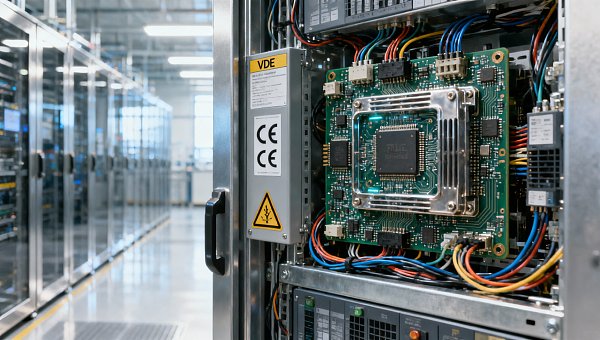
Event Overview
The VDE announced on May 14, 2026, that VDE-AR-E 2510-50:2026 has entered full force. This standard mandates that all industrial automation devices sold into the European Union — including programmable logic controllers (PLCs), human-machine interfaces (HMIs), and servo drives — undergo specific EMC immunity testing for their integrated AI control modules. Compliance is now a prerequisite for CE marking; failure to meet the requirements renders affected products ineligible for EU market access.
Industries Affected
Direct trading enterprises: Exporters and EU-based distributors of industrial automation hardware face immediate compliance verification burdens. Their product portfolios must now include test reports validating AI module immunity under specified RF, transient, and conducted disturbance conditions. Delays in certification may trigger contractual penalties, shipment holds, or loss of shelf space in EU industrial channels.
Raw material procurement enterprises: Suppliers of semiconductors, AI-accelerator SoCs, and high-integrity PCB substrates are seeing revised specification requests from OEMs. These now include EMC-resilient packaging, shielding-ready die layouts, and documented noise coupling margins — shifting sourcing criteria from performance-only to performance-plus-immunity.
Manufacturing enterprises: Original equipment manufacturers (OEMs) and contract manufacturers must integrate AI module-level EMC validation into design verification (DV) and production verification (PV) phases. This requires updated test fixtures, cross-functional collaboration between firmware, hardware, and EMC engineering teams, and potential redesign of signal integrity paths near AI inference units.
Supply chain service enterprises: Third-party test laboratories, certification bodies, and technical documentation providers are adjusting service offerings — notably expanding AI-aware EMC test capabilities and updating conformity assessment templates. Some labs report a 30–45-day backlog for AI module immunity tests, indicating capacity constraints ahead of peak Q3 2026 audit cycles.
Key Focus Areas and Recommended Actions
Verify AI module scope and architecture mapping
Enterprises must first identify which functional blocks constitute the ‘AI control module’ per VDE-AR-E 2510-50:2026 Annex A — e.g., neural network accelerators, real-time inference engines, or adaptive control loops. Modular hardware/software boundaries must be explicitly defined before test planning begins.
Update EMC test plans to include AI-specific stress profiles
Standard IEC 61000-4 series tests remain applicable, but VDE-AR-E 2510-50:2026 adds three new immunity stress profiles: (1) RF-modulated burst interference during inference latency measurement, (2) fast transient bursts coinciding with model weight update intervals, and (3) conducted low-frequency harmonics synchronized to AI scheduler ticks. Legacy test plans require revision accordingly.
Engage notified bodies early for gap analysis
Given the novelty of AI module EMC evaluation, early engagement with EU-notified bodies (e.g., TÜV Rheinland, DEKRA, SGS) is advised. Pre-assessment helps clarify interpretation of Clause 7.2 (‘functional disturbance threshold’) and avoids late-stage retesting due to ambiguous pass/fail criteria.
Editorial Perspective / Industry Observation
Analysis shows this standard marks the first enforceable regulatory pivot toward treating AI components not as ‘black-box software’ but as safety- and reliability-critical hardware subsystems subject to physical-layer robustness requirements. Observably, it reflects growing regulatory attention on AI’s role in closed-loop industrial control — where misprediction under EMI could cascade into motion faults or process deviations. From an industry perspective, this is less about adding another test and more about redefining the interface between AI engineering and electromagnetic design disciplines. Current evidence suggests adoption is uneven: Tier-1 automation suppliers have initiated internal AI-EMC task forces, while SMEs largely rely on external lab support — creating a near-term capability gap.
Conclusion
VDE-AR-E 2510-50:2026 does not merely extend existing EMC frameworks — it repositions AI functionality as an integral part of the electromagnetic safety case for industrial systems. Its enforcement signals a broader shift: future industrial standards will increasingly demand co-validation of algorithmic behavior and physical resilience. A rational interpretation is that this represents the beginning of ‘AI-aware functional safety’, where compliance hinges on demonstrable robustness across both computational and electromagnetic domains.
Source Attribution
Official text published by VDE on May 14, 2026 (VDE-AR-E 2510-50:2026, Edition 1.0). Harmonization status with EN/IEC standards remains pending; stakeholders should monitor updates from CENELEC TC 211 and the EU Commission’s Official Journal for potential inclusion in the EU EMC Directive 2014/30/EU Annex III list. Ongoing review of test methodology harmonization and national transposition timelines is recommended.
Get weekly intelligence in your inbox.
No noise. No sponsored content. Pure intelligence.
 Oct 08, 2026How Digital Health Improves Diagnostic Accuracy and Workflow in Clinical LabsHow Digital Health Improves Diagnostic Accuracy and Workflow in Clinical Labs
 Oct 07, 2026Selecting Voice Picking Systems for German Warehouses: Integration, Languages and ROISelecting Voice Picking Systems for German Warehouses: Integration, Languages and ROI
 Oct 06, 2026How to Choose Last Mile Dispatch Software for On-Time Delivery at ScaleHow to Choose Last Mile Dispatch Software for On-Time Delivery at Scale
 Oct 05, 2026Vietnam’s Consumer Electronics Market: Demand Shifts and Sourcing OpportunitiesVietnam’s Consumer Electronics Market: Demand Shifts and Sourcing Opportunities
 Oct 04, 2026Digital Health Investment Priorities for Providers: Improving Access, Outcomes, and EfficiencyDigital Health Investment Priorities for Providers: Improving Access, Outcomes, and Efficiency
 Oct 03, 2026How to Specify an FR4 Custom PCB Board for High-Voltage and High-Heat DesignsHow to Specify an FR4 Custom PCB Board for High-Voltage and High-Heat Designs
 Oct 02, 2026ERP Software Market Intelligence: Adoption, Pricing, and Vendor Signals to WatchERP Software Market Intelligence: Adoption, Pricing, and Vendor Signals to Watch
 Oct 01, 2026How to Select Calibrated Temperature Data Loggers for GMP Cold Storage MonitoringHow to Select Calibrated Temperature Data Loggers for GMP Cold Storage Monitoring
 Sep 30, 2026Custom Molded Rubber Pricing: What Drives Unit Cost and Tooling Fees?Custom Molded Rubber Pricing: What Drives Unit Cost and Tooling Fees?
 Sep 29, 2026How to Evaluate Energy Management Software Vendors for Multi-Site OperationsHow to Evaluate Energy Management Software Vendors for Multi-Site Operations
 Sep 28, 2026How to Select a DIN Rail Smart Meter for Multi-Circuit Energy MonitoringHow to Select a DIN Rail Smart Meter for Multi-Circuit Energy Monitoring
 Sep 27, 2026TWS Earbuds in Vietnam: Demand Drivers, Price Tiers, and Retail Channel OpportunitiesTWS Earbuds in Vietnam: Demand Drivers, Price Tiers, and Retail Channel Opportunities
 Sep 26, 2026How UAE Clinics Can Qualify a Smart Glucometer Supplier for Accuracy and ComplianceHow UAE Clinics Can Qualify a Smart Glucometer Supplier for Accuracy and Compliance
 Sep 25, 2026Buying Aesthetic Lasers in the USA: FDA Status, Wavelengths, and Service SupportBuying Aesthetic Lasers in the USA: FDA Status, Wavelengths, and Service Support
 Sep 24, 2026Laser Cutting Brass Sheet: How to Prevent Burrs and Heat Marks on Thin PartsLaser Cutting Brass Sheet: How to Prevent Burrs and Heat Marks on Thin Parts
 Sep 23, 2026How to Choose Lightweight ANC Headphones for Comfortable All-Day TravelHow to Choose Lightweight ANC Headphones for Comfortable All-Day Travel
 Sep 22, 2026IPX5 TWS Bluetooth Earbuds: What Protection Do They Offer for Workouts?IPX5 TWS Bluetooth Earbuds: What Protection Do They Offer for Workouts?
 Sep 21, 2026What to Look for in a Grid Integration Company for Utility-Scale Solar ProjectsWhat to Look for in a Grid Integration Company for Utility-Scale Solar Projects
 Sep 20, 2026Microgrid Controller Pricing: What Drives Cost in Commercial Energy Projects?Microgrid Controller Pricing: What Drives Cost in Commercial Energy Projects?
 Sep 19, 2026How to Choose a GaN Charger for Laptops Without Compromising Power or PortabilityHow to Choose a GaN Charger for Laptops Without Compromising Power or Portability
 Sep 18, 2026Floating Solar Farm Costs: CAPEX, OPEX, and the Site Factors That Shape ROIFloating Solar Farm Costs: CAPEX, OPEX, and the Site Factors That Shape ROI
 Sep 17, 2026Drone Delivery Solutions for Last-Mile Routes: Site, Payload, and Range PlanningDrone Delivery Solutions for Last-Mile Routes: Site, Payload, and Range Planning
 Sep 16, 2026When Low-Volume Electronics Manufacturing Makes More Sense Than Mass ProductionWhen Low-Volume Electronics Manufacturing Makes More Sense Than Mass Production
 Sep 15, 2026Wholesale WiFi Smart Switches: What Buyers Should Verify Before OrderingWholesale WiFi Smart Switches: What Buyers Should Verify Before Ordering
 Sep 14, 2026How to Select IoT Sensors for Reliable Monitoring in Harsh Industrial EnvironmentsHow to Select IoT Sensors for Reliable Monitoring in Harsh Industrial Environments
 Sep 13, 2026How Procurement Teams Can Improve Supplier Reliability With Supply Chain VisibilityHow Procurement Teams Can Improve Supplier Reliability With Supply Chain Visibility
 Sep 12, 2026Smart Manufacturing Trends 2026: What Leaders Should Prioritize for ROISmart Manufacturing Trends 2026: What Leaders Should Prioritize for ROI



























