Plastic Injection Molding Process Guide: Steps, Cycle Time, and Defects to Watch For
Understanding the plastic injection molding process guide matters long before a tool is cut.
Many molded parts look simple from the outside, yet the process behind them is tightly linked to cost, speed, and defect risk.
For early research, the real question is not only how injection molding works.
It is how to read the process well enough to judge feasibility, compare suppliers, and avoid weak assumptions.
That is why a practical plastic injection molding process guide should connect factory steps with commercial decisions.
In advanced manufacturing research, this process often sits at the intersection of tooling strategy, material performance, and production planning.
Platforms such as TradeNexus Pro also frame these topics in a broader supply and market context, which helps when technical choices affect sourcing confidence.
What actually happens during the plastic injection molding process?
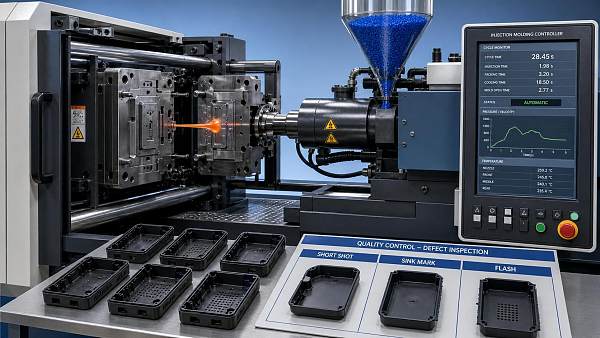
At a basic level, plastic pellets are melted, injected into a mold, cooled, and ejected as a finished part.
That sounds straightforward, but each stage affects dimensional accuracy and repeatability.
A clear plastic injection molding process guide usually breaks the cycle into a few key steps.
- Clamping: the mold closes and holds pressure against injection force.
- Injection: molten resin fills the cavity through runners and gates.
- Packing and holding: extra pressure offsets material shrinkage.
- Cooling: the part solidifies enough for stable ejection.
- Ejection: pins or plates push the part out of the mold.
In real production, these steps are not equally important for every part.
Thin-wall housings, medical components, appliance parts, and electronics enclosures each stress the process differently.
That is why process understanding should always be tied to geometry, resin, tolerance, and end-use conditions.
Where does this process make the most sense, and where does it not?
Injection molding is usually chosen when part volumes are medium to high and consistency matters.
It is especially common in smart electronics, healthcare components, consumer goods, automotive interiors, and industrial assemblies.
The strong case for it comes from repeatability and low unit cost after tooling is amortized.
Still, this is not always the right answer.
If volumes are uncertain, design changes are still frequent, or highly complex undercuts require expensive tooling, other methods may be more practical first.
Early-stage comparisons often become clearer with a simple judgment table.
This is also where broader market intelligence helps.
A platform like TradeNexus Pro is useful when technical suitability must be viewed together with supplier positioning, regional manufacturing trends, and industry credibility.
Why does cycle time vary so much from one molded part to another?
Cycle time is one of the most searched topics in any plastic injection molding process guide because it directly shapes output and unit economics.
The short answer is that cooling usually dominates the cycle, but it is not the only driver.
Part thickness, resin behavior, mold cooling layout, machine settings, and ejection stability all matter.
A thicker wall often means slower cooling.
A crystalline resin may shrink differently from an amorphous resin.
A part with deep ribs or delicate features may need slower ejection to avoid damage.
In practice, cycle time discussions should include these checkpoints.
- Wall thickness consistency, not only average thickness.
- Cooling channel design inside the mold.
- Gate location and how evenly the cavity fills.
- Material drying and melt temperature control.
- Automation level for part removal and handling.
It is tempting to compare suppliers by quoted cycle time alone.
A more useful question is whether that cycle time is sustainable without raising scrap rates or hidden maintenance costs.
Fast numbers on paper are not always reliable numbers in production.
Which defects deserve the closest attention before approving production?
Defects are not just quality annoyances.
They often reveal whether the process window is narrow, the tool is weak, or the design is pushing beyond practical limits.
A strong plastic injection molding process guide should help identify both the defect and its likely source.
What matters is not only whether defects appear during sampling.
More important is whether the corrective action is robust or merely temporary.
If a part only passes under a narrow machine setting, the long-term production risk is higher.
That risk becomes especially relevant in regulated or high-precision sectors.
When comparing suppliers, what should be checked beyond price and tooling cost?
This question usually separates surface-level sourcing from informed evaluation.
Quoted mold cost tells very little about process maturity.
A better review looks at how the supplier manages consistency, documentation, and engineering communication.
Useful checks include the following.
- Whether DFM feedback is specific, not generic.
- How material traceability is handled.
- Whether sampling reports show process logic.
- How mold maintenance intervals are documented.
- Whether defect analysis includes root cause, not guesswork.
For cross-border decisions, market context also matters.
Regional capacity, export experience, compliance familiarity, and communication depth can influence delivery stability as much as machine count.
This is where an editorial intelligence platform such as TradeNexus Pro becomes relevant in a subtle way.
Instead of treating suppliers as isolated listings, it supports a more informed view of sector specialization, manufacturing credibility, and strategic fit.
What is the smartest next step after reading a plastic injection molding process guide?
The next step is usually not asking for the lowest quote.
It is defining the few variables that will drive cost, risk, and manufacturability.
Start with part geometry, annual volume, resin choice, tolerance expectations, cosmetic requirements, and the likely defect sensitivity of the application.
Then compare process assumptions, not only supplier promises.
A useful plastic injection molding process guide should leave you with sharper questions.
How long is the stable cycle, not the theoretical one?
Which defects are acceptable, and which are not?
What tool changes may be needed if demand grows?
Can the supplier explain process control in clear technical terms?
When those answers are documented early, production decisions become much easier to defend.
For broader research, it also helps to follow sector-focused sources that connect manufacturing knowledge with supplier intelligence and market movement.
That combination is often more useful than process theory alone.
Get weekly intelligence in your inbox.
No noise. No sponsored content. Pure intelligence.
 Sep 16, 2026When Low-Volume Electronics Manufacturing Makes More Sense Than Mass ProductionWhen Low-Volume Electronics Manufacturing Makes More Sense Than Mass Production
 Sep 15, 2026Wholesale WiFi Smart Switches: What Buyers Should Verify Before OrderingWholesale WiFi Smart Switches: What Buyers Should Verify Before Ordering
 Sep 14, 2026How to Select IoT Sensors for Reliable Monitoring in Harsh Industrial EnvironmentsHow to Select IoT Sensors for Reliable Monitoring in Harsh Industrial Environments
 Sep 13, 2026How Procurement Teams Can Improve Supplier Reliability With Supply Chain VisibilityHow Procurement Teams Can Improve Supplier Reliability With Supply Chain Visibility
 Sep 12, 2026Smart Manufacturing Trends 2026: What Leaders Should Prioritize for ROISmart Manufacturing Trends 2026: What Leaders Should Prioritize for ROI
 Sep 11, 2026B2B Market Analysis: How Buyers Evaluate Suppliers, Pricing, and Delivery RiskB2B Market Analysis: How Buyers Evaluate Suppliers, Pricing, and Delivery Risk
 Sep 10, 2026Residential Solar Kits in Canada: How to Size a System for Your Home and ClimateResidential Solar Kits in Canada: How to Size a System for Your Home and Climate
 Sep 09, 2026How to Specify a Syringe Assembly Line for High-Volume Sterile ProductionHow to Specify a Syringe Assembly Line for High-Volume Sterile Production
 Sep 08, 2026How to Evaluate Warehouse Robotics System Suppliers for Reliable Multi-Site DeploymentHow to Evaluate Warehouse Robotics System Suppliers for Reliable Multi-Site Deployment
 Sep 07, 2026Renewable Geothermal Energy Explained: How It Works for Heating and PowerRenewable Geothermal Energy Explained: How It Works for Heating and Power
 Sep 07, 2026How to Choose an Industrial Packaging Robot Manufacturer for Your Production LineHow to Choose an Industrial Packaging Robot Manufacturer for Your Production Line
 Sep 05, 2026How to Evaluate a Turnkey Hydro Turbine Generator Supplier for Remote Power ProjectsHow to Evaluate a Turnkey Hydro Turbine Generator Supplier for Remote Power Projects
 Sep 04, 2026Automated Ultrasonic Welding for Thermoplastic Assemblies: Process Controls That MatterAutomated Ultrasonic Welding for Thermoplastic Assemblies: Process Controls That Matter
 Sep 03, 2026Energy Forecasting for Grid Planning: Sizing Solar and Storage CapacityEnergy Forecasting for Grid Planning: Sizing Solar and Storage Capacity
 Sep 02, 2026Which Metrics Should an Energy Analytics Dashboard Track for Factory Energy Management?Which Metrics Should an Energy Analytics Dashboard Track for Factory Energy Management?
 Sep 01, 2026How Warehouse Voice Picking Improves Accuracy and Throughput in Order FulfillmentHow Warehouse Voice Picking Improves Accuracy and Throughput in Order Fulfillment
 Aug 31, 2026How to Automate Dropshipping Order Processing Without Overselling StockHow to Automate Dropshipping Order Processing Without Overselling Stock
 Aug 30, 2026How to Evaluate a Smart Lighting Supplier for Multi-Site Commercial ProjectsHow to Evaluate a Smart Lighting Supplier for Multi-Site Commercial Projects
 Aug 29, 2026Recent Advances in Smart Manufacturing and Materials Reshaping Factory InvestmentRecent Advances in Smart Manufacturing and Materials Reshaping Factory Investment
 Aug 29, 2026Selecting Lightweight Aluminum Extrusions for Strength-Critical Industrial DesignsSelecting Lightweight Aluminum Extrusions for Strength-Critical Industrial Designs
 Aug 29, 2026Vertical Powder Anodizing Explained: Process Controls for Uniform Coating QualityVertical Powder Anodizing Explained: Process Controls for Uniform Coating Quality
 Aug 29, 2026PV Module Product Due Diligence: What Buyers Should Verify Before ContractingPV Module Product Due Diligence: What Buyers Should Verify Before Contracting
 Aug 29, 2026Solar Design for Challenging Terrain: Managing Slope, Soil, and Shading RisksSolar Design for Challenging Terrain: Managing Slope, Soil, and Shading Risks
 Aug 29, 2026IS 16444 Smart Meter Requirements: Key Functions, Tests, and ComplianceIS 16444 Smart Meter Requirements: Key Functions, Tests, and Compliance
 Aug 29, 2026Rehabilitation Equipment Market Outlook: Demand Drivers and Growth SegmentsRehabilitation Equipment Market Outlook: Demand Drivers and Growth Segments
 Aug 29, 2026When Does Container Handling Automation Deliver ROI in Port Yard Operations?When Does Container Handling Automation Deliver ROI in Port Yard Operations?
 Aug 29, 2026Customs API Integration: A Practical Checklist for Automated Trade ComplianceCustoms API Integration: A Practical Checklist for Automated Trade Compliance