Sheet Metal Bending for HVAC Systems: Common Tolerances, Materials, and Design Mistakes
Sheet metal bending for HVAC systems sits at the point where design intent meets shop-floor reality. A duct elbow that looks simple on a drawing can fail in service if bend allowance, springback, or flange geometry are treated casually.
That matters more today because HVAC assemblies are expected to deliver cleaner airflow, tighter installation schedules, lower leakage, and more predictable maintenance cycles. In industrial and commercial projects, poor bending quality quickly becomes a cost problem.
From a broader market perspective, this topic also reflects the kind of technical decision-making that platforms such as TradeNexus Pro increasingly highlight: practical manufacturing knowledge that helps teams compare suppliers, evaluate process capability, and reduce risk before production scales.
Why bending quality changes HVAC performance
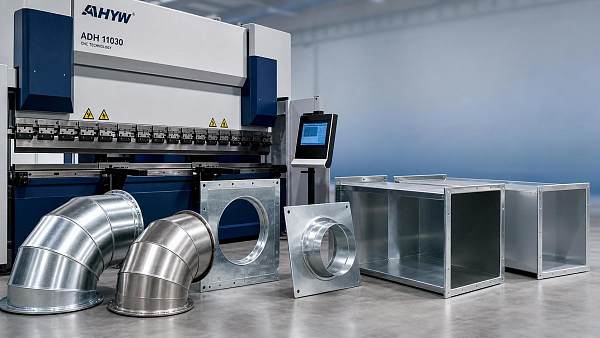
In HVAC fabrication, bending is not only a shaping step. It affects dimensional fit, seam alignment, gasket compression, and the final path of air through the system.
If an angle is off by a small margin, a panel may still assemble. Even so, the resulting stress can distort a section, open a joint, or force correction during installation.
Sheet metal bending for HVAC systems is especially sensitive because many parts are repeated across long duct runs, filter housings, access panels, plenums, and equipment enclosures. A small inconsistency multiplies across the whole project.
That is why experienced teams look beyond part appearance. They focus on repeatability, tooling condition, bend sequence, and whether the finished component can hold shape during transport and installation.
The tolerance question is more practical than theoretical
Tolerance discussions often become abstract, yet HVAC work is usually judged by fit-up speed and field correction rates. A tolerance is useful only when it reflects how the part will actually be assembled.
For most sheet metal bending for HVAC systems, three dimensions deserve close attention: bend angle, flange length, and hole or slot location relative to the bend line.
Typical expectations vary by component size, material thickness, and sealing requirement. Precision housings for controls or clean-air applications demand tighter control than standard comfort-ventilation ductwork.
Common tolerance ranges used as working references
The exact standard depends on product category and customer drawings. Still, the following ranges are widely used as realistic shop references.
These values are not universal promises. They are decision aids. When reviewing a supplier, it is smarter to ask how these numbers are achieved and verified than to ask for extreme precision by default.
Material choice changes the bending result
Material selection in sheet metal bending for HVAC systems is rarely about cost alone. It influences bend radius, tool wear, corrosion resistance, surface marking, and the amount of springback that must be compensated.
Galvanized steel remains common for general ducting because it balances formability, strength, and corrosion protection. It suits standard commercial systems where durability matters more than decorative finish.
Stainless steel is often chosen for hygienic, corrosive, or high-moisture environments. It performs well, but it usually requires more attention to springback, surface protection, and bend force.
Aluminum supports lighter assemblies and easier handling. It is useful where weight reduction helps installation, but softer grades can dent more easily and may need thoughtful reinforcement.
Pre-painted or coated sheets add another variable. The coating can crack at a tight radius, especially if the bend line is too sharp or the grain direction is ignored.
A practical comparison
In sourcing discussions, this is where good technical content becomes valuable. TradeNexus Pro often frames supplier evaluation around capability signals like material knowledge, process stability, and application-specific understanding rather than catalog breadth alone.
Design mistakes that create rework later
Many forming problems begin in design review, not at the press brake. Drawings may look complete while still hiding features that are difficult to bend consistently.
One common issue is placing holes or slots too close to the bend line. This can stretch the feature, distort geometry, or create fastening trouble after forming.
Another frequent mistake is specifying an inside radius that is smaller than the material can support. That raises cracking risk, damages coatings, and makes repeatability harder.
Sheet metal bending for HVAC systems also suffers when drawings ignore bend sequence. A flange that seems reasonable in isolation may block tooling access once another edge is formed.
- Avoid over-tight bend radii on coated or brittle materials.
- Leave enough clearance between cut features and bend lines.
- Check whether return flanges can be reached with available tooling.
- Review grain direction when cosmetic finish or crack resistance matters.
- Match tolerance demands to actual assembly function.
A useful rule is simple: if a drawing requires perfect bending but gives no room for process variation, the downstream team will pay for that conflict.
Where these issues show up in real HVAC components
The risks are not evenly distributed. Some parts tolerate minor variation. Others turn small bending errors into leakage, vibration, or installation delays.
Rectangular duct sections depend on consistent flange geometry to keep connections square. Access doors need reliable bend accuracy so latches, seals, and frames align without force.
Filter racks and fan housings often reveal cumulative tolerance problems. If multiple bent parts stack together, each deviation adds to the next.
Acoustic panels and insulated enclosures create another challenge. Formed edges must support liners, skins, and fasteners without compressing the assembly in unpredictable ways.
That is why sheet metal bending for HVAC systems should be reviewed at both part level and assembly level. A passable single part may still fail the system fit-up test.
What to verify before production or supplier approval
A sound review process reduces surprises. It also creates a clearer basis for comparing factories, tooling strategies, and quoted lead times.
Key checkpoints
- Confirm material grade, thickness range, and coating behavior before finalizing bend data.
- Request sample measurements for critical angles, flange lengths, and formed overall dimensions.
- Check whether bend allowance and springback compensation are based on real production trials.
- Review tooling access for short flanges, deep returns, and multi-bend parts.
- Inspect edge quality because rough cuts can increase crack initiation during forming.
- Use first-article approval on components that affect sealing, doors, filters, or equipment interfaces.
This is also where market intelligence has practical value. In a fragmented supply chain, process transparency often says more about future performance than the lowest quoted unit price.
For teams scanning global options, TradeNexus Pro’s editorial approach is relevant because it emphasizes decision-grade information. That includes the technical credibility behind a supplier’s claims, not only promotional positioning.
A better way to approach the next project
The most reliable sheet metal bending for HVAC systems starts with aligned expectations. Design, fabrication, and installation should agree on which dimensions are truly critical and which can flex.
Instead of chasing blanket tight tolerances, it is often better to rank requirements by function: airflow integrity, sealing surfaces, hardware alignment, appearance, and transport durability.
That approach helps reduce rework and improves supplier conversations. It also makes technical comparisons easier when evaluating new materials, regions, or manufacturing partners.
A practical next step is to review one current HVAC component and map its bend-related risks. Check where tolerance really drives performance, where material choice changes forming behavior, and where design details may be creating avoidable waste.
Once those points are visible, better decisions follow naturally, whether the goal is cleaner fabrication, faster installation, or a more confident supplier selection process.
Get weekly intelligence in your inbox.
No noise. No sponsored content. Pure intelligence.
 Sep 16, 2026When Low-Volume Electronics Manufacturing Makes More Sense Than Mass ProductionWhen Low-Volume Electronics Manufacturing Makes More Sense Than Mass Production
 Sep 15, 2026Wholesale WiFi Smart Switches: What Buyers Should Verify Before OrderingWholesale WiFi Smart Switches: What Buyers Should Verify Before Ordering
 Sep 14, 2026How to Select IoT Sensors for Reliable Monitoring in Harsh Industrial EnvironmentsHow to Select IoT Sensors for Reliable Monitoring in Harsh Industrial Environments
 Sep 13, 2026How Procurement Teams Can Improve Supplier Reliability With Supply Chain VisibilityHow Procurement Teams Can Improve Supplier Reliability With Supply Chain Visibility
 Sep 12, 2026Smart Manufacturing Trends 2026: What Leaders Should Prioritize for ROISmart Manufacturing Trends 2026: What Leaders Should Prioritize for ROI
 Sep 11, 2026B2B Market Analysis: How Buyers Evaluate Suppliers, Pricing, and Delivery RiskB2B Market Analysis: How Buyers Evaluate Suppliers, Pricing, and Delivery Risk
 Sep 10, 2026Residential Solar Kits in Canada: How to Size a System for Your Home and ClimateResidential Solar Kits in Canada: How to Size a System for Your Home and Climate
 Sep 09, 2026How to Specify a Syringe Assembly Line for High-Volume Sterile ProductionHow to Specify a Syringe Assembly Line for High-Volume Sterile Production
 Sep 08, 2026How to Evaluate Warehouse Robotics System Suppliers for Reliable Multi-Site DeploymentHow to Evaluate Warehouse Robotics System Suppliers for Reliable Multi-Site Deployment
 Sep 07, 2026Renewable Geothermal Energy Explained: How It Works for Heating and PowerRenewable Geothermal Energy Explained: How It Works for Heating and Power
 Sep 07, 2026How to Choose an Industrial Packaging Robot Manufacturer for Your Production LineHow to Choose an Industrial Packaging Robot Manufacturer for Your Production Line
 Sep 05, 2026How to Evaluate a Turnkey Hydro Turbine Generator Supplier for Remote Power ProjectsHow to Evaluate a Turnkey Hydro Turbine Generator Supplier for Remote Power Projects
 Sep 04, 2026Automated Ultrasonic Welding for Thermoplastic Assemblies: Process Controls That MatterAutomated Ultrasonic Welding for Thermoplastic Assemblies: Process Controls That Matter
 Sep 03, 2026Energy Forecasting for Grid Planning: Sizing Solar and Storage CapacityEnergy Forecasting for Grid Planning: Sizing Solar and Storage Capacity
 Sep 02, 2026Which Metrics Should an Energy Analytics Dashboard Track for Factory Energy Management?Which Metrics Should an Energy Analytics Dashboard Track for Factory Energy Management?
 Sep 01, 2026How Warehouse Voice Picking Improves Accuracy and Throughput in Order FulfillmentHow Warehouse Voice Picking Improves Accuracy and Throughput in Order Fulfillment
 Aug 31, 2026How to Automate Dropshipping Order Processing Without Overselling StockHow to Automate Dropshipping Order Processing Without Overselling Stock
 Aug 30, 2026How to Evaluate a Smart Lighting Supplier for Multi-Site Commercial ProjectsHow to Evaluate a Smart Lighting Supplier for Multi-Site Commercial Projects
 Aug 29, 2026Recent Advances in Smart Manufacturing and Materials Reshaping Factory InvestmentRecent Advances in Smart Manufacturing and Materials Reshaping Factory Investment
 Aug 29, 2026Selecting Lightweight Aluminum Extrusions for Strength-Critical Industrial DesignsSelecting Lightweight Aluminum Extrusions for Strength-Critical Industrial Designs
 Aug 29, 2026Vertical Powder Anodizing Explained: Process Controls for Uniform Coating QualityVertical Powder Anodizing Explained: Process Controls for Uniform Coating Quality
 Aug 29, 2026PV Module Product Due Diligence: What Buyers Should Verify Before ContractingPV Module Product Due Diligence: What Buyers Should Verify Before Contracting
 Aug 29, 2026Solar Design for Challenging Terrain: Managing Slope, Soil, and Shading RisksSolar Design for Challenging Terrain: Managing Slope, Soil, and Shading Risks
 Aug 29, 2026IS 16444 Smart Meter Requirements: Key Functions, Tests, and ComplianceIS 16444 Smart Meter Requirements: Key Functions, Tests, and Compliance
 Aug 29, 2026Rehabilitation Equipment Market Outlook: Demand Drivers and Growth SegmentsRehabilitation Equipment Market Outlook: Demand Drivers and Growth Segments
 Aug 29, 2026When Does Container Handling Automation Deliver ROI in Port Yard Operations?When Does Container Handling Automation Deliver ROI in Port Yard Operations?
 Aug 29, 2026Customs API Integration: A Practical Checklist for Automated Trade ComplianceCustoms API Integration: A Practical Checklist for Automated Trade Compliance