How to Choose Endoscopy Equipment: Key Features, Imaging Options, and Budget Factors
Choosing endoscopy equipment is rarely a simple price comparison. Image clarity, procedure type, reprocessing demands, service response, and upgrade flexibility all shape long-term value. In a healthcare technology market influenced by digital procurement and tighter compliance expectations, better buying decisions come from understanding how clinical performance and supply risk connect, not from comparing brochures alone.
Why endoscopy equipment selection matters now
Endoscopy sits at the intersection of diagnosis, minimally invasive care, workflow management, and capital planning. A poor fit can affect case throughput, staff efficiency, maintenance spending, and patient confidence.
That is why endoscopy equipment has become a strategic purchasing category rather than a routine device order. Hospitals, specialty centers, and cross-border buyers now expect stronger evidence on reliability, lifecycle cost, and compatibility.
This shift also reflects broader market behavior. Platforms such as TradeNexus Pro highlight how healthcare technology decisions are increasingly tied to supplier credibility, technical transparency, and decision-grade market intelligence.
What counts as endoscopy equipment in practical terms
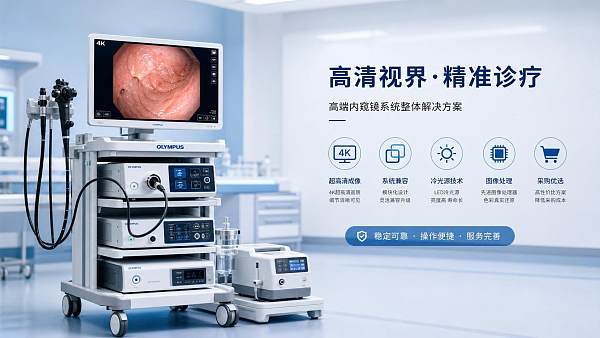
The term covers more than the scope itself. A complete endoscopy equipment setup often includes the endoscope, light source, camera head, processor, monitor, insufflation unit, suction, recording system, and accessories.
In some settings, software integration matters just as much as hardware. Video capture, image archiving, reporting tools, and data export can influence how useful the system becomes after installation.
Buyers therefore need to distinguish between a standalone component and a procedure-ready platform. A lower initial quote may exclude critical modules, service packages, or reusable accessories.
Start with procedure mix, not product catalogs
The most effective way to choose endoscopy equipment is to begin with actual use conditions. Gastrointestinal, ENT, urology, pulmonology, and surgical endoscopy each place different demands on optics, maneuverability, and accessory support.
Case volume also changes the calculation. High-throughput centers often prioritize durability, rapid turnaround, and service continuity. Lower-volume facilities may place more weight on versatility and compact system design.
It helps to map needs across several variables before contacting suppliers.
Key features that separate strong systems from risky purchases
When comparing endoscopy equipment, feature lists can look similar. The real difference usually appears in image consistency, ergonomics, repair rates, and support documentation.
Optical performance and image stability
Resolution matters, but it is not the only measure. Color accuracy, low-light performance, contrast handling, and motion stability affect whether subtle lesions are easier to identify during real procedures.
Ask whether the system maintains image quality across different scope types and procedure durations. Consistency is often more valuable than a headline specification.
Scope handling and durability
Insertion tube flexibility, angulation response, grip comfort, and button layout all influence operator fatigue. Over time, comfort and control can affect procedure speed and training outcomes.
Durability should be verified with repair records, not just warranty language. Endoscopy equipment that needs frequent service can erase any upfront savings.
Compatibility and expandability
A modular system may support phased procurement. That can be useful when budgets are constrained but future upgrades are expected.
Check whether processors, scopes, monitors, and data systems work across the same platform generation. Compatibility limits are a common hidden cost in endoscopy equipment planning.
Imaging options and how to evaluate them
Imaging technology is often the headline issue, yet it should be matched to clinical relevance and budget discipline. Not every facility needs the same level of advanced visualization.
Standard HD, Full HD, and 4K
HD remains workable for many routine procedures. Full HD is commonly seen as the practical baseline for clearer visualization and stronger documentation quality.
4K can improve detail perception, especially on larger displays, but the benefit depends on camera chain quality, monitor quality, and procedure type. Higher resolution alone does not guarantee better outcomes.
Image enhancement technologies
Many endoscopy equipment platforms now include narrow band imaging, spectral enhancement, digital chromoendoscopy, or similar tools. These features may support lesion detection and mucosal assessment.
The key question is whether teams will use them routinely. If advanced imaging remains underused, the return on investment becomes weaker.
Documentation and data capture
Imaging should also be assessed as information output. Storage format, export quality, integration with reporting systems, and audit readiness matter in regulated healthcare environments.
- Verify image and video recording formats.
- Check connectivity with existing archiving systems.
- Confirm whether reporting software is included or optional.
- Review cybersecurity and update support policies.
Budget factors beyond the purchase quote
Budgeting for endoscopy equipment should be approached as a lifecycle exercise. The invoice value is only one part of ownership cost.
More useful comparisons include service contracts, consumables, reprocessing requirements, spare scopes, software licenses, training, and downtime risk. In some cases, a mid-priced system offers the best total value.
This is especially important in cross-border sourcing, where logistics, local technical coverage, and parts availability may differ significantly between suppliers.
A practical cost framework
Supplier evaluation is part of equipment evaluation
Endoscopy equipment should never be reviewed apart from supplier capability. The product may be technically sound, yet procurement risk rises if documentation is weak or local support is unclear.
Useful checks include regulatory certifications, quality management systems, repair infrastructure, training resources, and reference installations. Response discipline during the quoting stage often signals post-sale reliability.
This is where curated B2B intelligence becomes valuable. In markets crowded with similar claims, stronger editorial and supplier visibility ecosystems help narrow attention toward verifiable, decision-ready options.
How to move from shortlist to confident decision
A sound selection process turns abstract preferences into measurable criteria. That usually means building a comparison matrix before final negotiation begins.
- Define procedure priorities and expected case volume.
- Separate essential features from desirable upgrades.
- Request full configuration details, not summary quotations.
- Compare service terms, spare availability, and training scope.
- Review total ownership cost over several years.
- Test image quality and workflow fit in realistic settings.
The best endoscopy equipment choice is usually the one that fits clinical reality, digital infrastructure, and service expectations at the same time. A structured review makes that balance easier to see.
From here, the next step is not chasing the longest feature sheet. It is refining evaluation criteria, validating supplier claims, and comparing endoscopy equipment against the operational conditions it must support over time.
Get weekly intelligence in your inbox.
No noise. No sponsored content. Pure intelligence.
 Sep 21, 2026What to Look for in a Grid Integration Company for Utility-Scale Solar ProjectsWhat to Look for in a Grid Integration Company for Utility-Scale Solar Projects
 Sep 20, 2026Microgrid Controller Pricing: What Drives Cost in Commercial Energy Projects?Microgrid Controller Pricing: What Drives Cost in Commercial Energy Projects?
 Sep 19, 2026How to Choose a GaN Charger for Laptops Without Compromising Power or PortabilityHow to Choose a GaN Charger for Laptops Without Compromising Power or Portability
 Sep 18, 2026Floating Solar Farm Costs: CAPEX, OPEX, and the Site Factors That Shape ROIFloating Solar Farm Costs: CAPEX, OPEX, and the Site Factors That Shape ROI
 Sep 17, 2026Drone Delivery Solutions for Last-Mile Routes: Site, Payload, and Range PlanningDrone Delivery Solutions for Last-Mile Routes: Site, Payload, and Range Planning
 Sep 16, 2026When Low-Volume Electronics Manufacturing Makes More Sense Than Mass ProductionWhen Low-Volume Electronics Manufacturing Makes More Sense Than Mass Production
 Sep 15, 2026Wholesale WiFi Smart Switches: What Buyers Should Verify Before OrderingWholesale WiFi Smart Switches: What Buyers Should Verify Before Ordering
 Sep 14, 2026How to Select IoT Sensors for Reliable Monitoring in Harsh Industrial EnvironmentsHow to Select IoT Sensors for Reliable Monitoring in Harsh Industrial Environments
 Sep 13, 2026How Procurement Teams Can Improve Supplier Reliability With Supply Chain VisibilityHow Procurement Teams Can Improve Supplier Reliability With Supply Chain Visibility
 Sep 12, 2026Smart Manufacturing Trends 2026: What Leaders Should Prioritize for ROISmart Manufacturing Trends 2026: What Leaders Should Prioritize for ROI
 Sep 11, 2026B2B Market Analysis: How Buyers Evaluate Suppliers, Pricing, and Delivery RiskB2B Market Analysis: How Buyers Evaluate Suppliers, Pricing, and Delivery Risk
 Sep 10, 2026Residential Solar Kits in Canada: How to Size a System for Your Home and ClimateResidential Solar Kits in Canada: How to Size a System for Your Home and Climate
 Sep 09, 2026How to Specify a Syringe Assembly Line for High-Volume Sterile ProductionHow to Specify a Syringe Assembly Line for High-Volume Sterile Production
 Sep 08, 2026How to Evaluate Warehouse Robotics System Suppliers for Reliable Multi-Site DeploymentHow to Evaluate Warehouse Robotics System Suppliers for Reliable Multi-Site Deployment
 Sep 07, 2026Renewable Geothermal Energy Explained: How It Works for Heating and PowerRenewable Geothermal Energy Explained: How It Works for Heating and Power
 Sep 07, 2026How to Choose an Industrial Packaging Robot Manufacturer for Your Production LineHow to Choose an Industrial Packaging Robot Manufacturer for Your Production Line
 Sep 05, 2026How to Evaluate a Turnkey Hydro Turbine Generator Supplier for Remote Power ProjectsHow to Evaluate a Turnkey Hydro Turbine Generator Supplier for Remote Power Projects
 Sep 04, 2026Automated Ultrasonic Welding for Thermoplastic Assemblies: Process Controls That MatterAutomated Ultrasonic Welding for Thermoplastic Assemblies: Process Controls That Matter
 Sep 03, 2026Energy Forecasting for Grid Planning: Sizing Solar and Storage CapacityEnergy Forecasting for Grid Planning: Sizing Solar and Storage Capacity
 Sep 02, 2026Which Metrics Should an Energy Analytics Dashboard Track for Factory Energy Management?Which Metrics Should an Energy Analytics Dashboard Track for Factory Energy Management?
 Sep 01, 2026How Warehouse Voice Picking Improves Accuracy and Throughput in Order FulfillmentHow Warehouse Voice Picking Improves Accuracy and Throughput in Order Fulfillment
 Aug 31, 2026How to Automate Dropshipping Order Processing Without Overselling StockHow to Automate Dropshipping Order Processing Without Overselling Stock
 Aug 30, 2026How to Evaluate a Smart Lighting Supplier for Multi-Site Commercial ProjectsHow to Evaluate a Smart Lighting Supplier for Multi-Site Commercial Projects
 Aug 29, 2026Recent Advances in Smart Manufacturing and Materials Reshaping Factory InvestmentRecent Advances in Smart Manufacturing and Materials Reshaping Factory Investment
 Aug 29, 2026Selecting Lightweight Aluminum Extrusions for Strength-Critical Industrial DesignsSelecting Lightweight Aluminum Extrusions for Strength-Critical Industrial Designs
 Aug 29, 2026Vertical Powder Anodizing Explained: Process Controls for Uniform Coating QualityVertical Powder Anodizing Explained: Process Controls for Uniform Coating Quality
 Aug 29, 2026PV Module Product Due Diligence: What Buyers Should Verify Before ContractingPV Module Product Due Diligence: What Buyers Should Verify Before Contracting