Portable Ultrasound Scanners: Key Specs to Compare for Clinic and Home Use
Portable ultrasound scanners have moved from niche devices to practical diagnostic tools across outpatient clinics, community care, emergency response, and selected home-use pathways.
That shift matters because mobility alone no longer defines value. The stronger question is whether a compact system can deliver dependable imaging, secure data handling, and workable clinical integration.
For organizations comparing portable ultrasound scanners, the decision now sits at the intersection of healthcare technology, smart electronics, compliance, and long-term operational fit.
This is also why platforms such as TradeNexus Pro pay attention to diagnostic equipment trends. In cross-border markets, technical clarity and decision-grade evaluation increasingly shape which products gain trust.
Why portable ultrasound scanners are getting closer scrutiny
Healthcare delivery is becoming more distributed. Imaging is no longer confined to large radiology departments or fixed carts in central hospitals.
Portable ultrasound scanners support bedside assessment, rural outreach, rehabilitation follow-up, sports medicine, prenatal checks, and rapid triage where speed matters.
At the same time, buyers are under pressure to compare more than headline features. A lightweight unit may look attractive, yet fail under demanding workflows or data governance requirements.
More worth noticing is the market mix behind these devices. Advances in probes, battery design, image processing chips, wireless connectivity, and cloud-linked workflows now influence purchasing decisions as much as the transducer itself.
In practical terms, portable ultrasound scanners are being judged less as accessories and more as serious diagnostic endpoints within broader healthcare systems.
What counts as a portable system in real use
The category covers several product forms. Not every portable model is designed for the same clinical depth or operating environment.
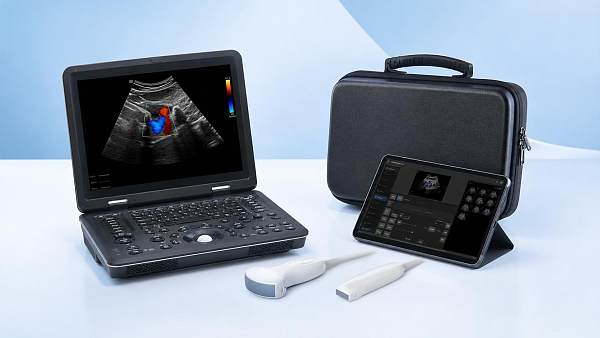
Some units are handheld and app-connected. Others are laptop-style platforms with built-in displays, broader controls, and stronger battery reserves.
There are also compact trolley-compatible systems that can move easily between rooms while retaining more advanced imaging functions.
Simple classification helps avoid a common mistake: comparing portable ultrasound scanners only by dimensions, while ignoring whether the intended use is screening, procedural guidance, or follow-up monitoring.
The specs that usually matter most
Image quality remains the first filter. Resolution, penetration depth, frame rate, Doppler capability, and artifact control determine whether a device is clinically useful or merely convenient.
Imaging performance
Probe frequency range should match intended anatomy. High-frequency linear probes fit vascular and musculoskeletal work, while lower-frequency convex probes support abdominal or obstetric assessment.
If portable ultrasound scanners will be used in mixed settings, multi-probe compatibility becomes more valuable than peak performance in one narrow application.
Probe ecosystem
The probe is both a clinical and cost decision. Evaluators should check connector design, sterilization tolerance, replacement pricing, and long-term supply availability.
This matters in international sourcing, where a good base unit can become difficult to support if probes are proprietary, delayed, or regionally restricted.
Battery and uptime
Battery specifications need more context than advertised operating hours. Real-world performance changes with brightness, wireless transfer, Doppler use, and scan duration.
Hot-swappable batteries, fast charging, and visible battery-health reporting are often more useful than a single headline runtime number.
Display and controls
A bright screen with stable touch response helps in field environments. In home visits or temporary care sites, glare resistance and one-handed operation can noticeably affect usability.
Workflow, software, and data handling often decide long-term value
Portable ultrasound scanners do not operate in isolation. Their value rises or falls based on how images move, how reports are stored, and how quickly staff can work with the system.
A technically strong unit may still create friction if export formats are limited or if integration with PACS, EMR, or cloud review tools is weak.
- Check DICOM compatibility, not just generic image export.
- Review whether annotations, measurements, and presets are customizable.
- Confirm user access controls for shared devices.
- Assess offline operation if connectivity is unstable.
- Look for encrypted transfer and secure local storage.
This software layer matters even more as healthcare technology becomes part of wider digital procurement strategies. TradeNexus Pro often highlights this type of cross-functional evaluation because hardware alone rarely tells the full sourcing story.
Clinic and home use are not the same comparison exercise
The phrase portable ultrasound scanners covers very different operating realities. A clinic may need throughput, device sharing, and service documentation. Home-use pathways emphasize portability, intuitive setup, and safe data transfer.
In other words, the best portable ultrasound scanners for clinic deployment may not be the best options for decentralized or home-linked care models.
Compliance, service, and supplier credibility should not be secondary
Technical comparisons become incomplete if regulatory and support factors are left until the end. Medical imaging devices carry documentation, training, service, and cybersecurity responsibilities.
Usual checkpoints include FDA clearance, CE marking under applicable rules, ISO 13485 alignment, electrical safety standards, and country-specific registration pathways.
Portable ultrasound scanners sourced across borders also require closer review of warranty terms, spare parts access, software updates, and response time for technical issues.
This is where curated B2B intelligence becomes useful. In fragmented markets, reliable comparison depends on evidence of manufacturing consistency, transparent specifications, and a visible service ecosystem rather than brochure claims.
A practical framework for comparing options
A workable evaluation starts with the intended scan types and operating environments, then moves outward to integration and lifecycle questions.
- Define the required clinical applications and probe mix.
- Set minimum imaging thresholds for depth, Doppler, and measurement tools.
- Test portability under real transport and charging conditions.
- Map software compatibility with existing records and review systems.
- Verify regulatory fit and after-sales support before shortlisting.
- Compare total ownership cost, including probes, updates, and training.
That sequence keeps portable ultrasound scanners in a business context, not just a specification sheet. It also reduces the risk of selecting a device that performs well in demos but poorly in routine use.
The next step is usually straightforward: build a comparison matrix around image performance, workflow fit, compliance, and service depth, then review candidates against the actual care setting rather than a generic product category.
As the healthcare technology market becomes more connected and competitive, clearer evaluation standards will matter more than faster purchasing cycles. That is often where better decisions begin.
Get weekly intelligence in your inbox.
No noise. No sponsored content. Pure intelligence.
 Sep 20, 2026Microgrid Controller Pricing: What Drives Cost in Commercial Energy Projects?Microgrid Controller Pricing: What Drives Cost in Commercial Energy Projects?
 Sep 19, 2026How to Choose a GaN Charger for Laptops Without Compromising Power or PortabilityHow to Choose a GaN Charger for Laptops Without Compromising Power or Portability
 Sep 18, 2026Floating Solar Farm Costs: CAPEX, OPEX, and the Site Factors That Shape ROIFloating Solar Farm Costs: CAPEX, OPEX, and the Site Factors That Shape ROI
 Sep 17, 2026Drone Delivery Solutions for Last-Mile Routes: Site, Payload, and Range PlanningDrone Delivery Solutions for Last-Mile Routes: Site, Payload, and Range Planning
 Sep 16, 2026When Low-Volume Electronics Manufacturing Makes More Sense Than Mass ProductionWhen Low-Volume Electronics Manufacturing Makes More Sense Than Mass Production
 Sep 15, 2026Wholesale WiFi Smart Switches: What Buyers Should Verify Before OrderingWholesale WiFi Smart Switches: What Buyers Should Verify Before Ordering
 Sep 14, 2026How to Select IoT Sensors for Reliable Monitoring in Harsh Industrial EnvironmentsHow to Select IoT Sensors for Reliable Monitoring in Harsh Industrial Environments
 Sep 13, 2026How Procurement Teams Can Improve Supplier Reliability With Supply Chain VisibilityHow Procurement Teams Can Improve Supplier Reliability With Supply Chain Visibility
 Sep 12, 2026Smart Manufacturing Trends 2026: What Leaders Should Prioritize for ROISmart Manufacturing Trends 2026: What Leaders Should Prioritize for ROI
 Sep 11, 2026B2B Market Analysis: How Buyers Evaluate Suppliers, Pricing, and Delivery RiskB2B Market Analysis: How Buyers Evaluate Suppliers, Pricing, and Delivery Risk
 Sep 10, 2026Residential Solar Kits in Canada: How to Size a System for Your Home and ClimateResidential Solar Kits in Canada: How to Size a System for Your Home and Climate
 Sep 09, 2026How to Specify a Syringe Assembly Line for High-Volume Sterile ProductionHow to Specify a Syringe Assembly Line for High-Volume Sterile Production
 Sep 08, 2026How to Evaluate Warehouse Robotics System Suppliers for Reliable Multi-Site DeploymentHow to Evaluate Warehouse Robotics System Suppliers for Reliable Multi-Site Deployment
 Sep 07, 2026Renewable Geothermal Energy Explained: How It Works for Heating and PowerRenewable Geothermal Energy Explained: How It Works for Heating and Power
 Sep 07, 2026How to Choose an Industrial Packaging Robot Manufacturer for Your Production LineHow to Choose an Industrial Packaging Robot Manufacturer for Your Production Line
 Sep 05, 2026How to Evaluate a Turnkey Hydro Turbine Generator Supplier for Remote Power ProjectsHow to Evaluate a Turnkey Hydro Turbine Generator Supplier for Remote Power Projects
 Sep 04, 2026Automated Ultrasonic Welding for Thermoplastic Assemblies: Process Controls That MatterAutomated Ultrasonic Welding for Thermoplastic Assemblies: Process Controls That Matter
 Sep 03, 2026Energy Forecasting for Grid Planning: Sizing Solar and Storage CapacityEnergy Forecasting for Grid Planning: Sizing Solar and Storage Capacity
 Sep 02, 2026Which Metrics Should an Energy Analytics Dashboard Track for Factory Energy Management?Which Metrics Should an Energy Analytics Dashboard Track for Factory Energy Management?
 Sep 01, 2026How Warehouse Voice Picking Improves Accuracy and Throughput in Order FulfillmentHow Warehouse Voice Picking Improves Accuracy and Throughput in Order Fulfillment
 Aug 31, 2026How to Automate Dropshipping Order Processing Without Overselling StockHow to Automate Dropshipping Order Processing Without Overselling Stock
 Aug 30, 2026How to Evaluate a Smart Lighting Supplier for Multi-Site Commercial ProjectsHow to Evaluate a Smart Lighting Supplier for Multi-Site Commercial Projects
 Aug 29, 2026Recent Advances in Smart Manufacturing and Materials Reshaping Factory InvestmentRecent Advances in Smart Manufacturing and Materials Reshaping Factory Investment
 Aug 29, 2026Selecting Lightweight Aluminum Extrusions for Strength-Critical Industrial DesignsSelecting Lightweight Aluminum Extrusions for Strength-Critical Industrial Designs
 Aug 29, 2026Vertical Powder Anodizing Explained: Process Controls for Uniform Coating QualityVertical Powder Anodizing Explained: Process Controls for Uniform Coating Quality
 Aug 29, 2026PV Module Product Due Diligence: What Buyers Should Verify Before ContractingPV Module Product Due Diligence: What Buyers Should Verify Before Contracting
 Aug 29, 2026Solar Design for Challenging Terrain: Managing Slope, Soil, and Shading RisksSolar Design for Challenging Terrain: Managing Slope, Soil, and Shading Risks