Smart Factory Solutions for Discrete Manufacturing: Connecting Machines and MES
Machines can run reliably for years while remaining almost invisible to the manufacturing execution system (MES). That gap leaves supervisors reconciling production counts, downtime, quality records, and work orders by hand. For project managers, smart factory solutions for discrete manufacturing must solve this operational problem without interrupting the equipment that keeps orders moving.
The challenge is rarely a shortage of connectivity products. It is deciding which machine signals support a production decision, how those signals acquire business context, and who owns the integration when data stops flowing. A practical project starts with a narrow use case, establishes a defensible data model, and expands only after the first connection proves useful on the shop floor.
Define the production decision before connecting the machine
Discrete manufacturing produces identifiable items such as machined parts, assemblies, electronic devices, or industrial equipment. Production may involve changing routings, short runs, manual stations, rework, and multiple product variants. A machine cycle count alone therefore does not establish how many conforming units were produced against a particular order.
Start by identifying a decision that operators or supervisors cannot make reliably today. For example, a production team may need to distinguish unplanned machine stoppages from scheduled changeovers, or a quality team may need to associate a test result with a serial number. Each objective requires different signals and MES context.
- Downtime management: Capture machine state transitions and timestamps; provide a practical way to classify stoppages that the controller cannot explain.
- Order progress: Link validated production events to the active work order, operation, and shift; address partial cycles and rework.
- Traceability: Capture the relevant serial or lot identifier, process result, station, and time; define what happens when a scan or identifier is missing.
- Quality response: Deliver inspection or test results with enough context for an operator to contain affected production.
For the initial scope, document the current workflow, the person who will act on the information, and the response expected. If a dashboard reveals a stoppage but no one owns escalation, the integration has exposed a problem without improving control.
Design the path from shop-floor signals to MES transactions
A typical architecture has four functions: acquire data from equipment, interpret it at an edge or integration layer, exchange it with the MES, and present it in the operator workflow. These functions may sit in different products, but their responsibilities should remain explicit.

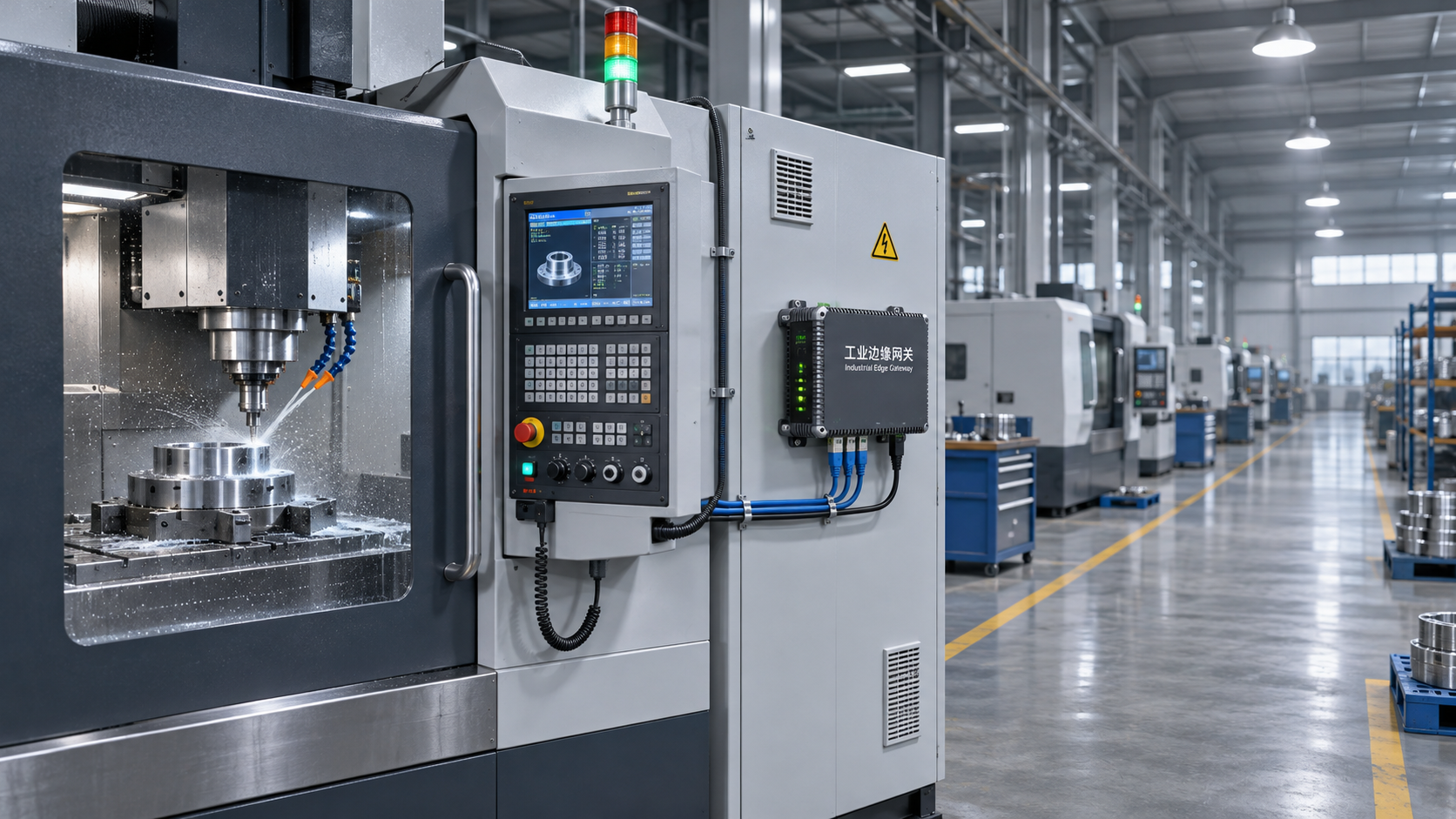
A CNC controller might expose an operating mode, alarm code, and part counter. An edge service can collect those values, buffer them during a network interruption, and attach a machine identifier. The MES can then associate a validated event with an active operation and work order. Whether the edge service or MES performs each mapping is an architectural choice that should be recorded and tested.
Connectivity is not the same as context. “Counter increased by one” may mean a completed cycle, a rejected part, or a counter reset, depending on the machine and process. Define the meaning, unit, source, update frequency, and owner of every data item before using it in an operational metric.
Choose an interface that fits the equipment and the use case
No single protocol covers every machine or guarantees that useful data will be available. Check the actual controller model, software version, licensed interfaces, and supplier documentation during equipment assessment. A standard interface can still expose a limited or differently named set of values.
For MES integration, confirm whether the application accepts APIs, messages, files, or another supported mechanism. Avoid assuming that a machine protocol can post directly into the MES. The interface also needs an agreed contract for acknowledgments, rejected records, duplicate handling, and recovery after outages.
Set the boundary between monitoring and control
A read-only monitoring connection is often a sensible first step because it limits the scope of operational change. Writing setpoints, dispatching commands, or changing machine behavior introduces a different risk profile. Such functions need explicit authorization, equipment supplier input, safety assessment, testing, and a defined fallback; they should not be treated as a routine extension of data collection.
Build a data contract that survives production reality
Before implementation, bring operations, manufacturing engineering, IT, operational technology (OT), quality, and the MES owner together to agree on a small set of definitions. The contract should describe the source and destination of each event, its required fields, and the rules for interpreting exceptions.
- Identity: Use controlled identifiers for machine, station, product, work order, operation, and serial or lot where applicable. Establish how identifiers are maintained when equipment moves or routings change.
- Time: Define timestamp source, time zone, synchronization method, and acceptable delay. Preserve the original event time when buffered data arrives late.
- State: Map controller modes and alarms to agreed operational states. Leave an explicit unknown state rather than forcing ambiguous signals into a confident category.
- Counts: Specify how cycle counts, good units, rejects, rework, resets, and manual adjustments are handled. Reconcile totals against an agreed source.
- Delivery: Define local buffering limits, retry behavior, event identifiers, and duplicate detection. Decide who investigates gaps and how records are corrected.
A common failure appears at shift change: the machine keeps counting while the MES order is closed, the next order has not started, or an operator is correcting a previous entry. The integration needs an agreed treatment for that interval. Assigning every event automatically to the most recent order may create clean-looking but misleading records.
Acceptance should depend on whether production records remain understandable and reconcilable through normal exceptions, not merely on whether a live signal appears on a screen.
Plan smart factory solutions for discrete manufacturing in stages
- Inventory the equipment and interfaces. Record controller models, available signals, network access, vendor support, maintenance windows, and any restrictions on connecting third-party devices. Include manual operations and inspection stations if the chosen use case depends on them.
- Select a bounded pilot. Choose a representative cell with an operational owner, a measurable problem, and accessible equipment. A cell that is unusually modern or unusually isolated may teach little about the wider plant.
- Agree on the event contract and workflow. Map machine events to MES records, document exceptions, and decide how operators confirm or correct ambiguous data. Obtain sign-off from the people responsible for production and quality records.
- Test outside normal production where possible. Verify interface behavior, permissions, timestamps, counter resets, duplicate messages, and loss of connection. Then run a controlled production trial with a rollback procedure and named support contacts.
- Reconcile and improve. Compare machine-derived records with the agreed reference, investigate discrepancies, and observe whether operators can use the workflow without creating extra bottlenecks.
- Approve expansion against evidence. Reuse validated mappings and deployment procedures where equipment is comparable. Reassess differences in controller versions, routing, product mix, and local work practices before connecting the next area.
Keep an issue register that separates equipment access, data interpretation, MES behavior, network reliability, and operator workflow. This makes ownership visible and prevents every discrepancy from becoming an undifferentiated “integration problem.”
Protect availability while connecting production systems
Adding a data path changes the plant’s attack surface and can affect fragile equipment. Security and availability planning should involve the OT and IT teams before a connection is installed, with responsibilities defined for both routine support and incidents.
- Use network segmentation and controlled communication paths appropriate to the site; avoid exposing controllers directly to enterprise or public networks.
- Apply least-privilege access, manage credentials and certificates, and record who can modify configurations or mappings.
- Check controller and vendor limits before polling; excessive requests or unsupported tools can affect older devices.
- Define patching, backup, monitoring, and restoration responsibilities for gateways, brokers, integrations, and MES interfaces.
- Test what happens when the network, gateway, or MES is unavailable, including buffer exhaustion and safe return to normal operation.
IEC 62443 provides a relevant framework for industrial automation and control system security. Applying it requires a scope and risk assessment; installing a gateway or using an encrypted protocol does not by itself establish compliance. Where production records support regulated or contractual requirements, involve quality and compliance teams in defining validation, retention, access, and change-control needs.
Make the business case measurable and complete
A project budget should cover more than connectors and MES licenses. Include equipment assessment, supplier interface fees, network work, edge hardware, integration development, testing, downtime windows, operator training, cybersecurity, support, and future upgrades. Estimate recurring costs and identify which supplier or internal team owns each component after commissioning.
For benefits, establish a baseline over a representative period before changing the process. Use measures tied to the original decision, and specify the calculation and data source. Useful candidates include time spent reconciling production records, delay between a stoppage and a response, completeness of required traceability fields, and the number of records requiring manual correction.
Overall equipment effectiveness can be useful when its availability, performance, and quality definitions are agreed. It can also obscure the cause of a problem if teams use inconsistent planned-production time, ideal cycle time, or good-count rules. Track its components and definitions alongside the headline measure.
Compare documented annual benefits with annual operating costs and the initial investment, while keeping assumptions visible. For instance, labor time released from manual entry is a potential capacity benefit; it becomes a cash saving only if the organization can actually reduce expenditure or redeploy that capacity to work with an attributable value. Record uncertainty around adoption, integration effort, and maintenance rather than presenting an unqualified payback date.
Questions to settle before authorizing the pilot
- Which production decision will improve, and who is accountable for acting on the information?
- Which machine signals are available, what do they mean, and how will they be matched to an MES order or unit?
- What happens to records during a network outage, counter reset, order change, or rejected MES transaction?
- Who owns security, interface support, data corrections, and changes after the equipment or MES is upgraded?
- What evidence will justify expansion: reconciled records, a usable workflow, an agreed performance measure, and a supportable cost?
Use the answers to produce a pilot charter with a named owner, equipment list, data contract, acceptance criteria, budget, and rollback plan. That document gives engineering and operations a shared basis for deciding whether the first connected cell is ready to become a repeatable factory capability.
Get weekly intelligence in your inbox.
No noise. No sponsored content. Pure intelligence.
 Nov 26, 2026How Negative Pressure Works in a Biosafety Cabinet to Contain AerosolsHow Negative Pressure Works in a Biosafety Cabinet to Contain Aerosols
 Nov 25, 2026Trump Administration Plans New Tariff Measures Affecting 16 Trading PartnersTrump Administration Plans New Tariff Measures Affecting 16 Trading Partners
 Nov 25, 2026UK Energy Price Cap to Rise 26%, Adding £443 to Typical Annual BillUK Energy Price Cap to Rise 26%, Adding £443 to Typical Annual Bill
 Nov 25, 2026German Solar Developers and Battery Makers Hit by Third-Quarter BankruptciesGerman Solar Developers and Battery Makers Hit by Third-Quarter Bankruptcies
 Nov 25, 2026Remote Site Microgrids: How to Plan Reliable Power for Off-Grid OperationsRemote Site Microgrids: How to Plan Reliable Power for Off-Grid Operations
 Nov 24, 2026China to Suspend Some Critical Materials Export Controls on the US Until JanuaryChina to Suspend Some Critical Materials Export Controls on the US Until January
 Nov 24, 2026Japan's Battery Storage Market Expands Amid Revenue UncertaintyJapan's Battery Storage Market Expands Amid Revenue Uncertainty
 Nov 24, 2026Ukraine Finds Over 16,000 Foreign-Made Components in Russian DronesUkraine Finds Over 16,000 Foreign-Made Components in Russian Drones
 Nov 24, 2026Bulk Pricing for Stretch Wrapping Machines: What Affects Your Quote?Bulk Pricing for Stretch Wrapping Machines: What Affects Your Quote?
 Nov 23, 2026Lidar Q3 Earnings Point to Rising Robotics Demand and Automotive WeaknessLidar Q3 Earnings Point to Rising Robotics Demand and Automotive Weakness
 Nov 23, 2026Australia's AEMO Relies on 5.3 GW of New Battery Storage for SummerAustralia's AEMO Relies on 5.3 GW of New Battery Storage for Summer
 Nov 23, 2026US Energy Storage Capacity Surpasses 200 GWhUS Energy Storage Capacity Surpasses 200 GWh
 Nov 23, 2026Smart Factory Solutions for Discrete Manufacturing: Connecting Machines and MESSmart Factory Solutions for Discrete Manufacturing: Connecting Machines and MES
 Nov 22, 2026Golmud's 60 MW Liquid Air Storage Project Uses Fully Domestic EquipmentGolmud's 60 MW Liquid Air Storage Project Uses Fully Domestic Equipment
 Nov 22, 2026Precision Engineering for Medical Devices: Tolerances and MaterialsPrecision Engineering for Medical Devices: Tolerances and Materials
 Nov 21, 2026EDF Acquires 1GWh Holloway Battery Storage Project in AustraliaEDF Acquires 1GWh Holloway Battery Storage Project in Australia
 Nov 21, 2026Choosing Carbon Steel Grades for OEM Machined Parts: Key FactorsChoosing Carbon Steel Grades for OEM Machined Parts: Key Factors
 Nov 20, 2026China’s First Virtual Power Plant Report Says Capacity Target Met EarlyChina’s First Virtual Power Plant Report Says Capacity Target Met Early
 Nov 20, 2026Choosing an OEM Heavy Equipment Manufacturer: Capabilities and Quality ChecksChoosing an OEM Heavy Equipment Manufacturer: Capabilities and Quality Checks
 Nov 19, 2026India Adds Record 8.4 GW of Open-Access Solar in First Nine Months of 2026India Adds Record 8.4 GW of Open-Access Solar in First Nine Months of 2026
 Nov 19, 2026B2B Intelligence for Green Energy: Finding New Market OpportunitiesB2B Intelligence for Green Energy: Finding New Market Opportunities
 Nov 18, 2026Global Solar Additions Hit Record in 2025, Forecast to Fall in 2026Global Solar Additions Hit Record in 2025, Forecast to Fall in 2026
 Nov 18, 2026Supply Chain Visibility for Supplier Management: How to Spot Delivery RisksSupply Chain Visibility for Supplier Management: How to Spot Delivery Risks
 Nov 17, 2026US Battery Storage Deployment Tops 200 GWh; 74 GWh Forecast for 2026US Battery Storage Deployment Tops 200 GWh; 74 GWh Forecast for 2026
 Nov 17, 2026Choosing a Solar Tracker for Ground-Mount PV: Site and Design FactorsChoosing a Solar Tracker for Ground-Mount PV: Site and Design Factors
 Nov 16, 2026US Polysilicon and Solar Product Tariffs and Import Price Floor Take Effect December 4US Polysilicon and Solar Product Tariffs and Import Price Floor Take Effect December 4
 Nov 16, 2026How Industrial Buyers Can Evaluate B2B Intelligence Reports on SuppliersHow Industrial Buyers Can Evaluate B2B Intelligence Reports on Suppliers