Choosing a Solar Tracker for Ground-Mount PV: Site and Design Factors
The right solar tracker for ground mount PV is the one that delivers the best project outcome after terrain, structural loads, energy production, construction, and operating costs are considered together. A tracker with a strong yield forecast can become a weaker choice if it requires extensive grading, unusually deep foundations, or a layout that reduces usable capacity.
Start with a fixed-tilt baseline and a site-specific comparison of feasible tracking systems. Use the same site boundary, module assumptions, electrical limits, and financial framework for each option. The purpose is to understand not just how much energy a tracker might produce, but what it takes to build and operate that design on the available land.
Start with the site, not the tracker catalog
A preliminary selection begins with a topographic survey, geotechnical information, and the project’s environmental and permitting constraints. These inputs determine where tracker rows can go, how they can be supported, and how much earthwork the design may require.
Separate the site into areas with different characteristics. A parcel may look suitable on an overall slope map but contain local ridges, drainage channels, or abrupt changes in grade that interrupt row continuity. Access roads, setbacks, underground services, and equipment pads can further reduce the area available for tracking rows.
For a site with broad, consistent grades and good access, a standard single-axis layout may be straightforward. On irregular ground, a design with shorter rows or greater terrain adaptability may fit better, though it can also change the number of foundations, drives, controls, and electrical connections. Compare the complete layout rather than treating terrain-following capability as a benefit in isolation.
Slope and grading can change the economics
Tracker suppliers often state allowable slopes, but the direction of the slope matters. A limit along the tracker axis does not automatically apply across rows, and a site that falls within an average limit may still have local grade changes that exceed the system’s tolerances.
Ask each supplier to review the proposed row layout against the actual terrain model. The review should address adjacent row elevations, changes in slope along each row, foundation reveal, module clearance, and the points where rows need to be shortened or split. A tracker that can accommodate slope on paper may still need substantial grading to maintain clearances or meet its installation tolerances.
Grading has consequences beyond the earthwork invoice. It can affect drainage, erosion control, vegetation, access, and the time needed to prepare the site. Conversely, avoiding grading by using many short rows may increase equipment quantities and installation labor. The better option depends on the balance between civil work and the added complexity of a terrain-following design.
Match the foundation design to the ground
Soil conditions influence both the foundation type and the confidence of the construction schedule. Weak soils may need longer or alternative foundations; hard layers, shallow rock, or buried obstructions can make driving piles difficult. Corrosive soil conditions may also affect material selection and the expected life of buried components.
A geotechnical report provides the starting point, but a tracker foundation design also depends on the loads transferred through the structure. Pullout, lateral resistance, and other relevant ground responses should be assessed for the proposed system and site. Where appropriate, field testing can help the design team understand how the selected foundation performs in representative ground conditions.
Ask bidders how their foundation quantities and assumptions were developed. A proposal based on a generic pile length is useful for an early estimate, but it is not equivalent to a site-specific foundation design. Identify who carries the cost and schedule risk if installation encounters refusal, unexpected rock, or soils that do not support the assumed design.
Wind and snow affect more than structural strength
Trackers must withstand the loads and combinations relevant to the site, including conditions when the modules are moving and when they are parked in a protective position. The structural design, control system, foundations, and site layout all contribute to that response.
For wind, examine how the supplier accounts for site exposure, row position, terrain, and the behavior of the complete array. Ask for the design basis and supporting engineering for the proposed configuration, including any wind-tunnel work or other analysis used for the system. A generic statement that a tracker is suitable for high winds does not explain the conditions under which the claim applies.
Wind stow deserves particular attention. Some systems move to a defined angle when a wind threshold is reached; others may use different strategies. Establish what data triggers stow, how quickly the system responds, how it behaves during a communications or power failure, and when normal tracking resumes. The structural design must be consistent with the stow strategy and the conditions the system can actually detect and respond to.
In snowy conditions, check module clearance, potential snow accumulation, access, and any snow-stow function. A steeper parked position may help snow slide off under some conditions, but the benefit depends on temperature, snow characteristics, wind, and site geometry. Snow management should not be assumed to eliminate loading or maintenance concerns.
Stow has an energy consequence as well. If a site experiences frequent conditions that interrupt tracking, model those interruptions using a defensible site-specific approach. Comparing suppliers on ideal tracking output alone can overstate the difference between their expected operating results.
Row spacing is an energy, land, and electrical decision
Wider spacing can reduce shading between rows, but it also uses more land and may increase cable runs. Tighter spacing can fit more capacity into a constrained area, while increasing shading and making access or maintenance more difficult. The appropriate spacing depends on the site boundary, tracker geometry, production profile, and project economics.
Backtracking adjusts the tracker angle to reduce row-to-row shading when the sun is low. Its effectiveness depends on the assumed row geometry and terrain. On uneven ground, a control strategy designed for uniform rows may not represent every part of the site equally well. Ask how the proposed system handles slopes, irregular row lengths, and sections with different spacing.
Energy models should use the actual module dimensions, row configuration, rotation limits, and obstructions. If bifacial modules are proposed, also examine the ground reflectance assumptions, rear-side shading from structural members, and vegetation management. Rear-side energy gain is a project-specific estimate, not a fixed benefit that can be added to every tracker design.
Electrical design can alter the apparent winner. Tracker row lengths must work with string design, cable routing, inverter locations, and voltage constraints. Compare expected delivered energy after relevant electrical losses and inverter clipping, not only the energy incident on the modules. A layout that increases installed DC capacity may provide less additional delivered energy if the rest of the system cannot use it at the same times.
Choose the tracking architecture for the layout
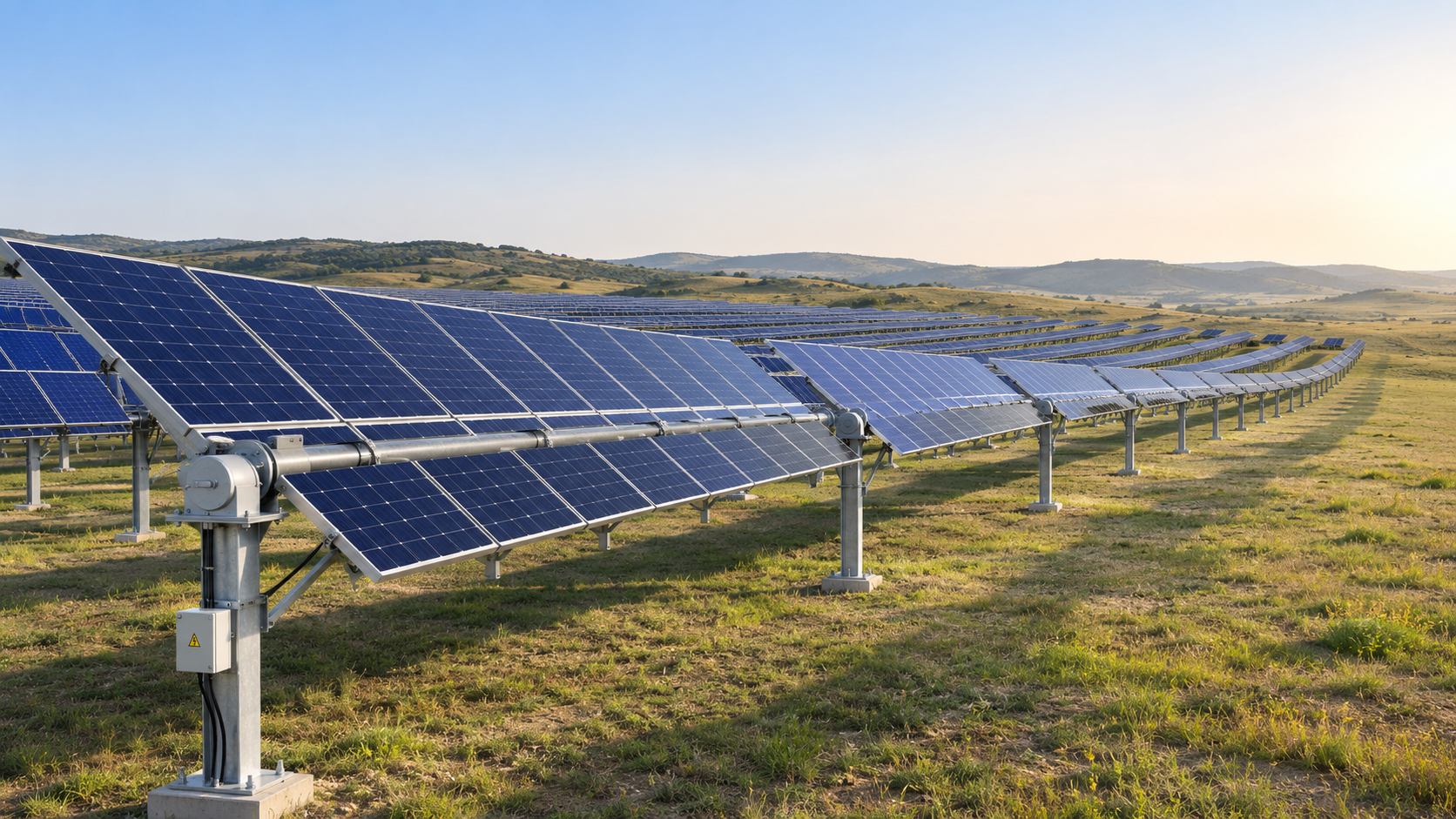
Single-axis trackers are a common option for ground-mounted projects because they combine tracking with layouts that can be deployed across larger sites. Their suitability still depends on row orientation, terrain, structural design, and access. Dual-axis systems can follow the sun in two directions, but their additional movement and structure can bring different land-use, maintenance, and cost implications. They merit consideration where the project has a specific reason to value their production profile and the site supports the design.
Within single-axis systems, compare how rows are driven and controlled. Some designs use a drive for each row; others link multiple rows through a shared drive arrangement. A shared system may reduce certain component counts, while independent rows may offer more flexibility around obstacles or irregular boundaries. The practical result depends on the supplier’s design, the number and length of rows, and the impact of a drive fault on production.
Fixed tilt should remain in the comparison when land is constrained, the terrain is difficult, or the incremental production from tracking does not justify the added cost and operational complexity. The decision may differ across a single site: a tracking layout can suit the main area while a fixed-tilt section fits an isolated or irregular parcel, provided the combined design works electrically and commercially.
Look beyond equipment price when comparing bids
A tracker quotation is only one part of the installed system cost. Differences in foundations, earthwork, assembly methods, wiring, commissioning, and site access can outweigh a lower equipment price. Request a consistent scope of supply so that exclusions are visible.
The comparison should account for:
- Civil and foundation work: grading volumes, drainage changes, pile quantities, installation tolerances, and treatment of refusal or rock.
- Mechanical installation: component counts, lifting needs, assembly sequence, and available installation equipment.
- Electrical and controls: power supply, communications, cabling, monitoring integration, and commissioning responsibilities.
- Long-term operation: inspection tasks, lubrication where applicable, vegetation access, spare parts, and expected repair procedures.
- Commercial assumptions: warranty scope, exclusions, response obligations, and the allocation of design and interface risks.
Use a financial comparison appropriate to the project, such as modeled energy value and lifecycle cost or levelized cost of energy. Keep assumptions consistent across options, including degradation, financing, operating costs, and plant availability. A lower cost per installed capacity does not necessarily mean lower cost per unit of delivered energy; equally, a higher modeled yield does not automatically justify higher construction and operating costs.
Test supplier claims against a common design
Before requesting final proposals, issue each shortlisted supplier the same site information and evaluation basis. Include the terrain model, geotechnical data, environmental constraints, module and inverter assumptions, required clearances, applicable design criteria, and preferred operating approach. Where information is preliminary, identify the assumptions all bidders should use.
Request a layout and an energy model that correspond to the quoted equipment. A supplier’s production estimate is difficult to compare if it assumes different row spacing, module capacity, shading losses, stow behavior, or available land. Ask bidders to identify deviations from the common basis and show their effect on layout, quantities, and expected output.
The technical review should also establish the boundaries between parties. Who designs and supplies foundations? Who validates the tracker against the selected modules and mounting arrangement? Who integrates weather inputs, plant controls, and monitoring? Who is responsible for commissioning and for resolving a fault that spans the tracker and electrical systems? Clear interfaces help prevent omissions that only become visible during construction.
Finish the evaluation with a short list of unresolved design sensitivities: for example, foundation depth, grading volume, wind-stow losses, or the amount of capacity that fits around site constraints. Recalculate the leading options as those inputs change. The preferred tracker is the one whose performance, cost, and installation plan remain credible across the conditions the project is likely to face.
Get weekly intelligence in your inbox.
No noise. No sponsored content. Pure intelligence.
 Nov 22, 2026Golmud's 60 MW Liquid Air Storage Project Uses Fully Domestic EquipmentGolmud's 60 MW Liquid Air Storage Project Uses Fully Domestic Equipment
 Nov 22, 2026Precision Engineering for Medical Devices: Tolerances and MaterialsPrecision Engineering for Medical Devices: Tolerances and Materials
 Nov 21, 2026EDF Acquires 1GWh Holloway Battery Storage Project in AustraliaEDF Acquires 1GWh Holloway Battery Storage Project in Australia
 Nov 21, 2026Choosing Carbon Steel Grades for OEM Machined Parts: Key FactorsChoosing Carbon Steel Grades for OEM Machined Parts: Key Factors
 Nov 20, 2026China’s First Virtual Power Plant Report Says Capacity Target Met EarlyChina’s First Virtual Power Plant Report Says Capacity Target Met Early
 Nov 20, 2026Choosing an OEM Heavy Equipment Manufacturer: Capabilities and Quality ChecksChoosing an OEM Heavy Equipment Manufacturer: Capabilities and Quality Checks
 Nov 19, 2026India Adds Record 8.4 GW of Open-Access Solar in First Nine Months of 2026India Adds Record 8.4 GW of Open-Access Solar in First Nine Months of 2026
 Nov 19, 2026B2B Intelligence for Green Energy: Finding New Market OpportunitiesB2B Intelligence for Green Energy: Finding New Market Opportunities
 Nov 18, 2026Global Solar Additions Hit Record in 2025, Forecast to Fall in 2026Global Solar Additions Hit Record in 2025, Forecast to Fall in 2026
 Nov 18, 2026Supply Chain Visibility for Supplier Management: How to Spot Delivery RisksSupply Chain Visibility for Supplier Management: How to Spot Delivery Risks
 Nov 17, 2026US Battery Storage Deployment Tops 200 GWh; 74 GWh Forecast for 2026US Battery Storage Deployment Tops 200 GWh; 74 GWh Forecast for 2026
 Nov 17, 2026Choosing a Solar Tracker for Ground-Mount PV: Site and Design FactorsChoosing a Solar Tracker for Ground-Mount PV: Site and Design Factors
 Nov 16, 2026US Polysilicon and Solar Product Tariffs and Import Price Floor Take Effect December 4US Polysilicon and Solar Product Tariffs and Import Price Floor Take Effect December 4
 Nov 16, 2026How Industrial Buyers Can Evaluate B2B Intelligence Reports on SuppliersHow Industrial Buyers Can Evaluate B2B Intelligence Reports on Suppliers
 Nov 15, 2026CATL Sets Tener Sodium Delivery Timeline, Targeting LFP on CostCATL Sets Tener Sodium Delivery Timeline, Targeting LFP on Cost
 Nov 15, 2026Electric Wheelchairs for Disabled Adults: Choosing the Right Fit and RangeElectric Wheelchairs for Disabled Adults: Choosing the Right Fit and Range
 Nov 14, 2026China Expects Clean Energy to Meet All New Electricity Demand by 2030China Expects Clean Energy to Meet All New Electricity Demand by 2030
 Nov 14, 2026Choosing a Digital X-Ray Detector Supplier: Compatibility and SupportChoosing a Digital X-Ray Detector Supplier: Compatibility and Support
 Nov 13, 2026Ecuador Sets Zero VAT and Currency Outflow Tax Rates for Solar and Storage EquipmentEcuador Sets Zero VAT and Currency Outflow Tax Rates for Solar and Storage Equipment
 Nov 13, 2026Choosing an OEM Machined Parts Manufacturer: Quality, Capacity and Lead TimesChoosing an OEM Machined Parts Manufacturer: Quality, Capacity and Lead Times
 Nov 12, 2026South Africa Registers 2 GW of New Solar PV Capacity in Q3 2026South Africa Registers 2 GW of New Solar PV Capacity in Q3 2026
 Nov 12, 2026Mexico Supply Chain Market Research: Nearshoring Opportunities and RisksMexico Supply Chain Market Research: Nearshoring Opportunities and Risks
 Nov 11, 2026US Senate Advances Bipartisan BAAJA Energy Permitting BillUS Senate Advances Bipartisan BAAJA Energy Permitting Bill
 Nov 11, 2026Inventory Management Decision Support: When and How Much to ReorderInventory Management Decision Support: When and How Much to Reorder
 Nov 10, 2026China's Trade Surplus Tops $1 Trillion Through October as Exports Rise 35.2%China's Trade Surplus Tops $1 Trillion Through October as Exports Rise 35.2%
 Nov 10, 2026Choosing Surgical PPE: Gowns, Gloves, Masks and Eye ProtectionChoosing Surgical PPE: Gowns, Gloves, Masks and Eye Protection
 Nov 09, 2026US Solar Imports Shift as Domestic Manufacturing Investment Reshapes Global TradeUS Solar Imports Shift as Domestic Manufacturing Investment Reshapes Global Trade