Choosing a Digital X-Ray Detector Supplier: Compatibility and Support
Choosing a digital x ray detectors supplier involves more than comparing image quality and purchase prices. Procurement teams must also assess whether detectors integrate with existing X-ray systems, software, and clinical workflows, as well as whether the supplier can provide reliable installation, training, maintenance, and spare parts. The cheapest detector can become the most expensive option if integration work is underestimated or a failed unit leaves a system idle.
The question is not simply whether a detector works. It is whether it works with your equipment, for your intended examinations or inspections, under a support arrangement your organization can rely on.
Start with the System, Not the Detector Catalog
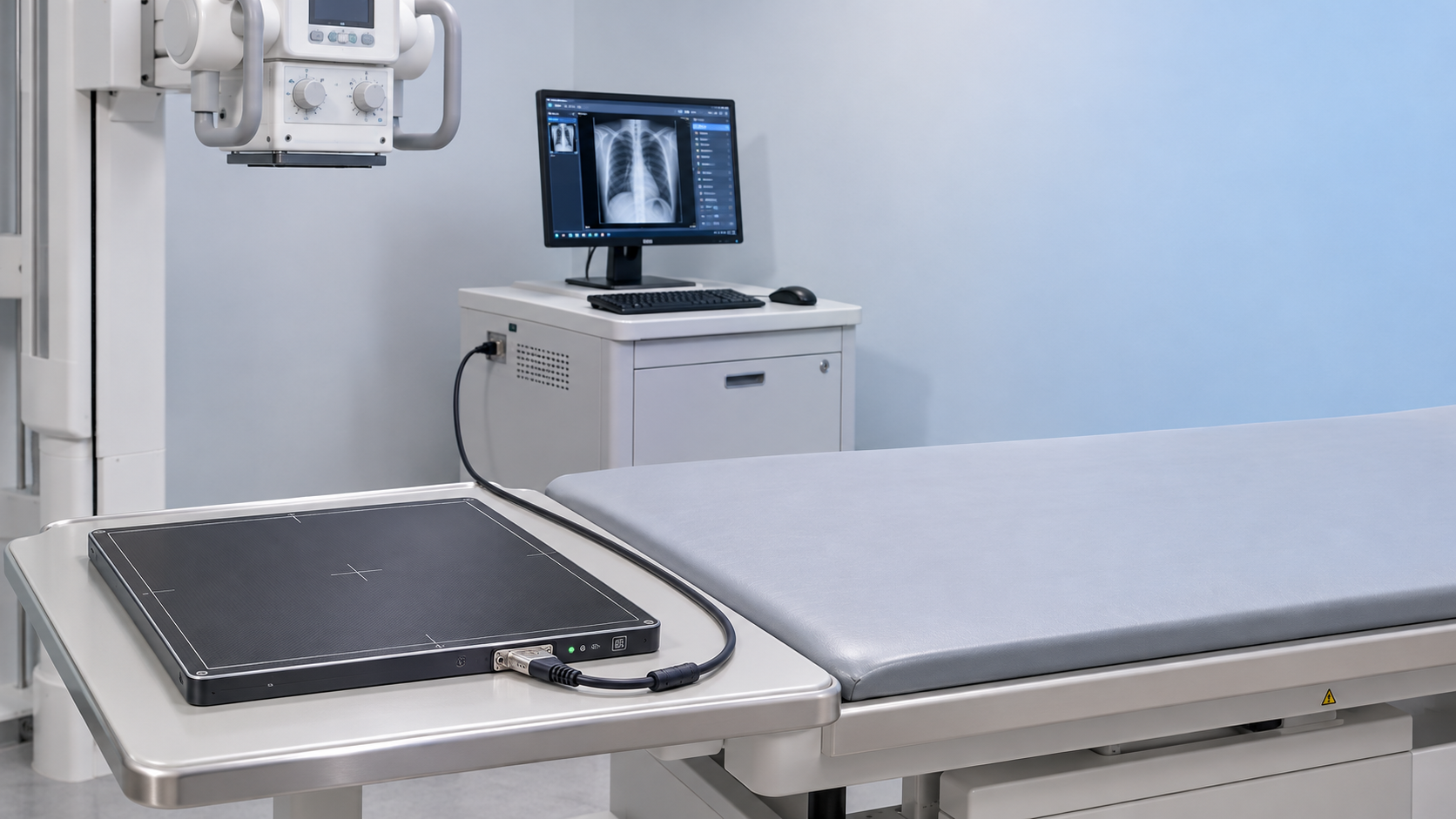
Before requesting prices, document the system into which the detector will be installed. Record the X-ray generator and console models, software versions, existing detector interface, available network connections, and any physical constraints. For a retrofit, include photographs and measurements of the table, wall stand, bucky, cables, and mounting arrangement where relevant.
This preparation exposes an important distinction: a detector may fit physically without being integrated operationally. An image might appear on a workstation, yet the exposure controls, patient worklist, image processing, or archive transfer may still require separate work.
Ask each supplier to identify what has been verified with the exact equipment and software versions in your facility. A general statement such as “compatible with most X-ray systems” is not an integration plan. If the proposed combination has not been tested, that does not automatically rule it out, but the quotation should identify who will perform the development, testing, and troubleshooting—and who pays if additional work is needed.
A healthcare retrofit and an industrial inspection system should not share the same specification by default. Medical buyers may prioritize patient positioning, clinical image processing, and hospital system connectivity. Industrial users may need to assess inspection geometry, exposure conditions, automation, or integration with image-analysis software. State the intended use early so suppliers are not pricing fundamentally different solutions.
Where Compatibility Problems Usually Appear
The most useful supplier discussion follows the path from exposure to usable image. Ask for a diagram showing the detector, generator, acquisition workstation, network, and destination system, including any interface hardware or third-party software. It should also show which company owns each part of the integration.
Mechanical fit and operating conditions
Check the active imaging area as well as the detector’s external dimensions. A unit that fits a tray may still provide a smaller usable field than the application requires. Weight, edge design, load limits, ingress protection, cleaning requirements, and battery access can also affect daily use. Confirm the figures for the quoted configuration rather than relying on a family-level brochure.
For mobile or bedside imaging, wireless operation may reduce cable handling, but battery life, charging arrangements, network coverage, and availability of spare batteries become procurement issues. A wired detector avoids some of those dependencies but introduces cable routing and replacement considerations. Neither choice is inherently cheaper over its service life.
Exposure synchronization and software
Determine how the detector and generator coordinate exposure. Depending on the system, integration may use a wired trigger, generator interface, or automatic exposure detection. The supplier should explain the proposed method, its limitations, and how it will be tested across the intended range of use.
For medical workflows, DICOM support is useful shorthand, but it is not a guarantee that every function will work with every system. Request the relevant DICOM conformance statements and verify the specific services needed, such as modality worklist or image storage. Test those functions against the actual systems and versions in use. Also ask whether image processing, annotation, user accounts, and export functions are included or licensed separately.
For industrial applications, ask whether the software can deliver images in the format and bit depth required by downstream analysis or inspection records. If a software development kit is needed, confirm its licensing terms, supported operating systems, documentation, and upgrade policy before the purchase order is issued.
Compare Image Performance in the Intended Workflow
Pixel pitch, active area, scintillator material, detective quantum efficiency, and frame rate can all matter, but none should be judged in isolation. A smaller pixel pitch, for example, does not by itself establish that a detector will produce the best result for a particular task. Exposure conditions, system geometry, processing, and the feature being imaged all affect the outcome.
Ask suppliers to explain which specifications are relevant to your application and provide the conditions under which performance figures were measured. Frame rate is especially worth checking: the rate advertised for one acquisition mode or image format may not apply to another. For dynamic imaging or automated inspection, request the sustained performance expected in the proposed configuration, including any transfer and processing limitations.
Where feasible, arrange a demonstration or evaluation using representative objects, established test tools, and your normal workflow. In a clinical setting, involve the appropriate imaging professionals and medical physics personnel; any testing involving patients or radiation must follow local requirements and institutional procedures. Industrial teams should include the people responsible for inspection acceptance criteria. The aim is not to produce an impressive sample image—it is to determine whether the system supports the decision it is being bought to make.
Build a Comparable Cost of Ownership
A detector quotation can omit costs that are essential to making the system usable. Request an itemized offer and compare suppliers on the same scope. If one bid includes workstation software and commissioning while another prices only the detector, the headline prices are not comparable.
- Integration: interfaces, software licenses, development, cabling, network configuration, and third-party charges.
- Deployment: shipping, import charges where applicable, installation, calibration, acceptance testing, and user training.
- Operating costs: batteries, chargers, cables, protective accessories, software subscriptions, and periodic servicing.
- Failure costs: diagnostic visits, replacement parts, shipping for repairs, loan equipment, and downtime.
- End-of-life exposure: the expected support period, availability of components, and options if software or hardware is discontinued.
Use a planning period that matches your organization’s expected ownership, then distinguish firm prices from estimates. A supplier may quote a low annual support fee but exclude travel, replacement batteries, or coverage outside business hours. Another may include a broader service package but require an expensive software renewal. Ask for the exclusions in writing; they often explain more than the discount.
Also consider the cost of keeping an existing system in service while the new detector is installed. For a facility with limited imaging capacity, scheduling an installation around operational demand may be more valuable than a small reduction in hardware price.
Support Promises Need an Address and a Process
“Global support” can mean anything from a local engineer with stocked parts to an email address that forwards requests to the manufacturer. Ask who answers the first call, where service personnel are based, which languages they support, and whether they are authorized to work on the proposed equipment.
The service agreement should distinguish response time from resolution time. A prompt acknowledgement is useful, but it does not tell you when an engineer will arrive or whether a replacement detector is available. Where a guaranteed repair or replacement time cannot be offered, ask what practical contingency is available and what it costs.
Warranty language deserves the same scrutiny. Confirm coverage for the detector panel, batteries, cables, workstation, and software; the starting date; and the treatment of accidental damage or liquid ingress. Ask how a defect is diagnosed, who authorizes a return, who pays freight and customs costs, and whether a loaner is offered. For cross-border purchases, a repair process that looks straightforward on paper can become slow if import and return responsibilities are undefined.
Training should cover more than image acquisition. Operators need to know handling and cleaning requirements, battery management where applicable, basic fault reporting, and when to stop using a unit. Technical staff may need separate instruction on calibration, software administration, and escalation. Specify who receives training and whether refresher sessions or documentation are included.
Put Acceptance and Compliance Responsibilities in Writing
Before awarding the contract, agree on an acceptance test tied to the actual configuration. It might include mechanical fit, exposure synchronization, representative image acquisition, transfer to the destination system, and verification of the agreed workflow. Record the test method, responsible participants, pass criteria, documentation, and remedy if the system fails.
Avoid making final payment depend on a vague promise that the detector is “fully operational.” Define the conditions that demonstrate this. Equally, allow for dependencies outside the supplier’s control, such as access to the facility network or cooperation from an existing equipment vendor. Clear boundaries reduce disputes during commissioning.
Regulatory status must be checked against the intended use and destination market. For medical devices, request the applicable documentation for the specific detector, configuration, and jurisdiction; do not assume that a certificate for one product or market covers another. A retrofit may also affect responsibilities for the assembled system, so involve the appropriate regulatory and technical advisers before committing. Industrial applications have their own applicable safety and operational requirements, which should be confirmed for the site and use case.
Making the Final Supplier Comparison
A practical shortlist should separate proven compatibility from proposed compatibility, and contractual support from informal assurances. Ask for references relevant to a similar application or integration, subject to customer consent, and use them to understand installation difficulty and service responsiveness rather than simply confirming that equipment was delivered.
For international sourcing, TradeNexus Pro’s healthcare technology and supply-chain coverage can provide context for evaluating market and supplier risks. It should complement—not replace—verification of the supplier’s documentation, local service arrangements, and ability to support the exact configuration being purchased.
If two offers remain close, favor the one with fewer unresolved interfaces and clearer responsibility for failure. Before signing, ask the preferred supplier to walk through one scenario: the detector stops working after installation. Who diagnoses it, what equipment keeps the workflow running, where does the replacement come from, and which charges apply? The specificity of that answer is often more useful than another round of price negotiation.
Get weekly intelligence in your inbox.
No noise. No sponsored content. Pure intelligence.
 Nov 22, 2026Golmud's 60 MW Liquid Air Storage Project Uses Fully Domestic EquipmentGolmud's 60 MW Liquid Air Storage Project Uses Fully Domestic Equipment
 Nov 22, 2026Precision Engineering for Medical Devices: Tolerances and MaterialsPrecision Engineering for Medical Devices: Tolerances and Materials
 Nov 21, 2026EDF Acquires 1GWh Holloway Battery Storage Project in AustraliaEDF Acquires 1GWh Holloway Battery Storage Project in Australia
 Nov 21, 2026Choosing Carbon Steel Grades for OEM Machined Parts: Key FactorsChoosing Carbon Steel Grades for OEM Machined Parts: Key Factors
 Nov 20, 2026China’s First Virtual Power Plant Report Says Capacity Target Met EarlyChina’s First Virtual Power Plant Report Says Capacity Target Met Early
 Nov 20, 2026Choosing an OEM Heavy Equipment Manufacturer: Capabilities and Quality ChecksChoosing an OEM Heavy Equipment Manufacturer: Capabilities and Quality Checks
 Nov 19, 2026India Adds Record 8.4 GW of Open-Access Solar in First Nine Months of 2026India Adds Record 8.4 GW of Open-Access Solar in First Nine Months of 2026
 Nov 19, 2026B2B Intelligence for Green Energy: Finding New Market OpportunitiesB2B Intelligence for Green Energy: Finding New Market Opportunities
 Nov 18, 2026Global Solar Additions Hit Record in 2025, Forecast to Fall in 2026Global Solar Additions Hit Record in 2025, Forecast to Fall in 2026
 Nov 18, 2026Supply Chain Visibility for Supplier Management: How to Spot Delivery RisksSupply Chain Visibility for Supplier Management: How to Spot Delivery Risks
 Nov 17, 2026US Battery Storage Deployment Tops 200 GWh; 74 GWh Forecast for 2026US Battery Storage Deployment Tops 200 GWh; 74 GWh Forecast for 2026
 Nov 17, 2026Choosing a Solar Tracker for Ground-Mount PV: Site and Design FactorsChoosing a Solar Tracker for Ground-Mount PV: Site and Design Factors
 Nov 16, 2026US Polysilicon and Solar Product Tariffs and Import Price Floor Take Effect December 4US Polysilicon and Solar Product Tariffs and Import Price Floor Take Effect December 4
 Nov 16, 2026How Industrial Buyers Can Evaluate B2B Intelligence Reports on SuppliersHow Industrial Buyers Can Evaluate B2B Intelligence Reports on Suppliers
 Nov 15, 2026CATL Sets Tener Sodium Delivery Timeline, Targeting LFP on CostCATL Sets Tener Sodium Delivery Timeline, Targeting LFP on Cost
 Nov 15, 2026Electric Wheelchairs for Disabled Adults: Choosing the Right Fit and RangeElectric Wheelchairs for Disabled Adults: Choosing the Right Fit and Range
 Nov 14, 2026China Expects Clean Energy to Meet All New Electricity Demand by 2030China Expects Clean Energy to Meet All New Electricity Demand by 2030
 Nov 14, 2026Choosing a Digital X-Ray Detector Supplier: Compatibility and SupportChoosing a Digital X-Ray Detector Supplier: Compatibility and Support
 Nov 13, 2026Ecuador Sets Zero VAT and Currency Outflow Tax Rates for Solar and Storage EquipmentEcuador Sets Zero VAT and Currency Outflow Tax Rates for Solar and Storage Equipment
 Nov 13, 2026Choosing an OEM Machined Parts Manufacturer: Quality, Capacity and Lead TimesChoosing an OEM Machined Parts Manufacturer: Quality, Capacity and Lead Times
 Nov 12, 2026South Africa Registers 2 GW of New Solar PV Capacity in Q3 2026South Africa Registers 2 GW of New Solar PV Capacity in Q3 2026
 Nov 12, 2026Mexico Supply Chain Market Research: Nearshoring Opportunities and RisksMexico Supply Chain Market Research: Nearshoring Opportunities and Risks
 Nov 11, 2026US Senate Advances Bipartisan BAAJA Energy Permitting BillUS Senate Advances Bipartisan BAAJA Energy Permitting Bill
 Nov 11, 2026Inventory Management Decision Support: When and How Much to ReorderInventory Management Decision Support: When and How Much to Reorder
 Nov 10, 2026China's Trade Surplus Tops $1 Trillion Through October as Exports Rise 35.2%China's Trade Surplus Tops $1 Trillion Through October as Exports Rise 35.2%
 Nov 10, 2026Choosing Surgical PPE: Gowns, Gloves, Masks and Eye ProtectionChoosing Surgical PPE: Gowns, Gloves, Masks and Eye Protection
 Nov 09, 2026US Solar Imports Shift as Domestic Manufacturing Investment Reshapes Global TradeUS Solar Imports Shift as Domestic Manufacturing Investment Reshapes Global Trade