Choosing Surgical PPE: Gowns, Gloves, Masks and Eye Protection
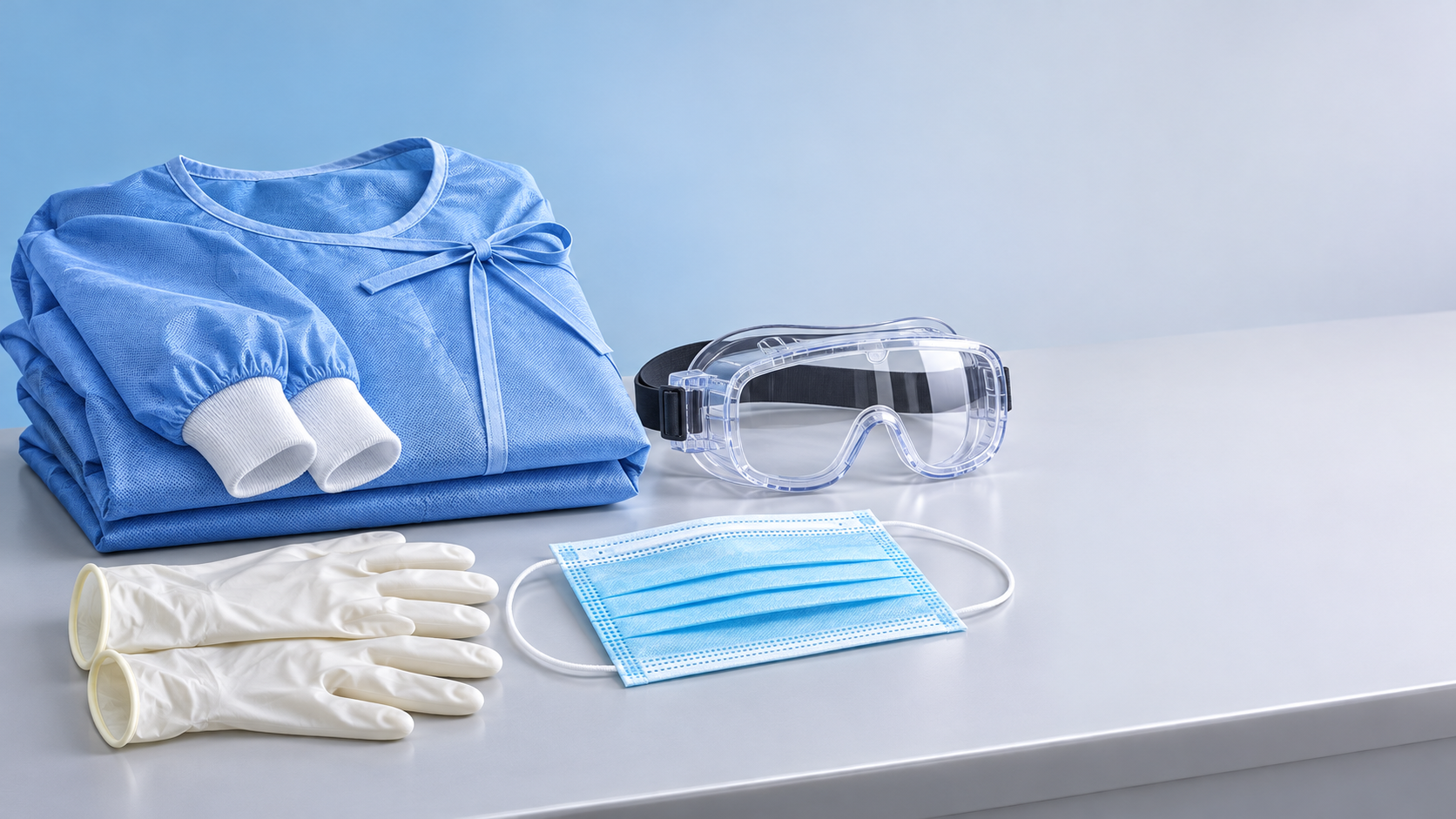
Choosing medical ppe for surgical use starts with the procedure, not the product catalog. The right combination of gown, gloves, mask, and eye protection depends on the likely exposure to blood and other fluids, the need to maintain a sterile field, and whether an airborne hazard calls for respiratory protection. Each item must also work with the others throughout the procedure.
A higher barrier classification can be useful when substantial fluid exposure is expected, but it does not automatically make an entire PPE set suitable. A gown may protect well across its critical zones yet leave a gap at the glove cuff. A mask may meet a fluid-resistance specification while eyewear fogs enough to impair vision. Selection should therefore combine documented product performance with an assessment of fit, movement, and compatibility in the intended setting.
Start with the exposure, then define the PPE set
Describe what staff will actually do before comparing products. Consider the expected amount and direction of fluid exposure, the duration of the procedure, the possibility of splashes or sprays, and the need to handle sharp instruments. A short procedure with limited anticipated fluid contact may call for a different gown from a prolonged operation where sleeves and the front of the torso are likely to be exposed.
Separate the risks that PPE must address. Surgical attire may help protect the sterile field, while barrier products help reduce the wearer’s contact with blood and body fluids. Airborne infectious hazards require a separate respiratory protection assessment. These purposes overlap, but a product selected for one purpose should not be assumed to cover all the others.
Build an evaluation around the full set: gown, gloves, surgical mask or respirator as indicated, and eye protection. Include representative wearers and the actual sizes and models under consideration. A satisfactory result with one combination does not necessarily carry over when the glove cuff, mask shape, or eyewear frame changes.
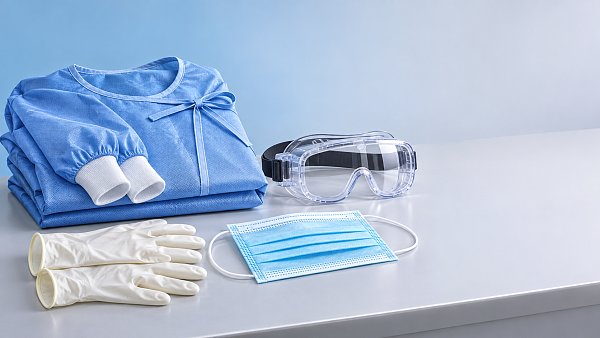
Surgical gowns: assess the barrier where exposure occurs
Compare gowns by intended use and documented barrier performance, paying particular attention to the front and sleeves. These areas are commonly treated as critical zones because they are more likely to contact fluids during a procedure. Ask which parts of the gown are covered by the performance claim: the same level of protection should not be assumed across every seam, panel, or closure.
For a procedure with limited fluid exposure, a lighter gown with an appropriate barrier may support movement and reduce discomfort. When heavier fluid exposure is anticipated, a gown with a higher documented liquid barrier may be more appropriate. The trade-off can include added stiffness or heat burden, so staff should assess whether the wearer can reach, bend, and work without the gown pulling away from the gloves.
Sterility is a separate purchasing criterion. A sterile surgical gown intended for use within the sterile field is different from a nonsterile isolation gown, even if both describe fluid resistance. Check the intended use on the packaging and instructions, along with the gown’s size range, closure design, sleeve length, and method of presentation. For reusable gowns, assess the manufacturer’s validated reprocessing instructions and the facility’s ability to follow them consistently.
During a wear trial, inspect the glove-to-gown interface while the wearer moves through typical tasks. Sleeves that ride upward, cuffs that are too loose, or a gown that restricts reaching can undermine an otherwise suitable barrier. Include removal in the trial: closures and ties should support the facility’s doffing process without unnecessary contact with contaminated surfaces.
Surgical gloves: balance barrier, fit, and instrument control
Surgical gloves must support sterile work while allowing the wearer to feel tissue, handle sutures, and control instruments. Fit is central to that balance. Gloves that are too tight may restrict movement or place stress on the material; gloves that are too loose can bunch at the fingertips or make fine handling less precise.
Compare materials in the context of the users and tasks. Latex, nitrile, and synthetic alternatives can differ in feel, elasticity, and sensitivity considerations. Latex sensitivity or allergy within the workforce or patient population may rule out latex for a particular setting. Material name alone, however, does not establish how a specific glove will perform: examine the manufacturer’s intended use and product documentation.
Some teams use double gloving when there is a higher risk of glove damage or blood exposure. If it is part of the local procedure, evaluate the two gloves as a combination. An inner glove that fits well on its own may feel restrictive under an outer glove, while an outer glove with a poorly matched cuff may shift during use. An indicator system can make some breaches easier to notice, but it does not detect every puncture.
Include the way gloves are opened, donned, changed, and removed in the assessment. Check cuff length against the selected gown and ask wearers to perform representative tasks. A glove that passes a document review but impairs secure instrument handling deserves further evaluation.
Masks, respirators, and eye protection solve different problems
A surgical mask is selected for its intended medical use and, where appropriate, its documented resistance to splashes or sprays. It should cover the nose and mouth, fit reasonably close to the face, and remain in position during the procedure. Compare the product’s fluid-resistance information when a splash is foreseeable, rather than assuming all masks provide the same barrier.
A surgical mask is not a substitute for a respirator when the exposure assessment requires respiratory protection against airborne hazards. In that situation, use a respirator appropriate to the hazard and the facility’s respiratory protection program. The assessment must include fit testing where required, user training, and compatibility with other equipment. Some respirators are also intended for medical use, but that capability should be established from the specific product documentation rather than inferred from appearance.
Eye protection addresses a different route of exposure. Goggles or a face shield may be selected when splashes or sprays could reach the eyes. Ordinary prescription glasses alone generally leave openings around the eyes; wearers who need corrective lenses should trial compatible protective eyewear or a suitable face shield. Coverage at the sides and around the eyes matters, as does stability when the wearer looks down or turns.
Test the mask or respirator together with the selected eyewear. Exhaled air can fog lenses, while a bulky frame can disturb the face seal of a respirator. A face shield may provide useful facial coverage, but it does not replace the mask or respirator required for the procedure. Visibility, freedom of movement, and the ability to use magnification equipment should all be part of the practical assessment.
Compare documentation before comparing prices
A meaningful supplier comparison starts with a clear specification for each item. Ask for documentation that identifies the exact product and model, intended use, applicable standards or test methods, and the performance claimed for relevant features. A broad statement such as “meets medical standards” does not show which property was tested or whether the claim applies to the item being offered.
For gowns, connect barrier claims to the tested areas and conditions. For gloves, review the intended surgical use, material, sizing, and any relevant allergy information. For masks, distinguish filtration-related claims from fluid resistance; they describe different properties. For respirators, review the specific model’s approval or certification and fit requirements. For eye protection, examine the coverage and the manufacturer’s cleaning or replacement instructions.
Documentation also needs to match the supplied product. Check the manufacturer, model, labeling, packaging configuration, and version of the instructions against the evaluation sample. For sterile items, examine how packaging protects sterility and how staff can identify damaged or compromised packs. For reusable products, include cleaning, inspection, and retirement criteria in the comparison.
When sourcing across borders, establish which regulatory requirements apply in the destination market and how the supplier supports traceability. Ask how changes in materials, manufacturing location, or product design are communicated. A replacement that looks similar may fit differently or have different performance characteristics, so substitution should trigger a review before routine use.
Run a practical evaluation before standardizing
A short, structured trial can reveal problems that specification sheets cannot. Use the same procedure scenarios and acceptance criteria across competing products, and record both failures and trade-offs. The goal is to establish whether the proposed set remains usable and protective during the work for which it is being purchased.
- Define the task and exposure. Record the procedure type, anticipated fluid contact, sterility needs, and any respiratory protection requirement.
- Screen the documentation. Remove products whose intended use, barrier claims, sizing, or other required characteristics do not match the task.
- Trial the complete combination. Have representative users don the equipment, perform typical movements and instrument handling, and remove it using the facility’s procedure.
- Record specific observations. Note cuff gaps, glove movement, fogging, restricted vision, discomfort, packaging difficulties, and any interference with other equipment.
- Review the supply arrangement. Consider size availability, continuity of supply, traceability, and the process for assessing substitutions alongside the purchase price.
Keep the procedure context with the results. A gown accepted for a low-fluid task should not automatically become the default for procedures with substantial splashing. Likewise, a glove that performs well for one wearer or instrument set may need a different size or design for another.
Before placing an order, document the approved product combination, the situations it is intended to cover, and the conditions that call for a different selection. That gives purchasing teams a usable specification and gives clinical staff a clear basis for recognizing when the chosen PPE set needs to change.
Get weekly intelligence in your inbox.
No noise. No sponsored content. Pure intelligence.
 Nov 22, 2026Golmud's 60 MW Liquid Air Storage Project Uses Fully Domestic EquipmentGolmud's 60 MW Liquid Air Storage Project Uses Fully Domestic Equipment
 Nov 22, 2026Precision Engineering for Medical Devices: Tolerances and MaterialsPrecision Engineering for Medical Devices: Tolerances and Materials
 Nov 21, 2026EDF Acquires 1GWh Holloway Battery Storage Project in AustraliaEDF Acquires 1GWh Holloway Battery Storage Project in Australia
 Nov 21, 2026Choosing Carbon Steel Grades for OEM Machined Parts: Key FactorsChoosing Carbon Steel Grades for OEM Machined Parts: Key Factors
 Nov 20, 2026China’s First Virtual Power Plant Report Says Capacity Target Met EarlyChina’s First Virtual Power Plant Report Says Capacity Target Met Early
 Nov 20, 2026Choosing an OEM Heavy Equipment Manufacturer: Capabilities and Quality ChecksChoosing an OEM Heavy Equipment Manufacturer: Capabilities and Quality Checks
 Nov 19, 2026India Adds Record 8.4 GW of Open-Access Solar in First Nine Months of 2026India Adds Record 8.4 GW of Open-Access Solar in First Nine Months of 2026
 Nov 19, 2026B2B Intelligence for Green Energy: Finding New Market OpportunitiesB2B Intelligence for Green Energy: Finding New Market Opportunities
 Nov 18, 2026Global Solar Additions Hit Record in 2025, Forecast to Fall in 2026Global Solar Additions Hit Record in 2025, Forecast to Fall in 2026
 Nov 18, 2026Supply Chain Visibility for Supplier Management: How to Spot Delivery RisksSupply Chain Visibility for Supplier Management: How to Spot Delivery Risks
 Nov 17, 2026US Battery Storage Deployment Tops 200 GWh; 74 GWh Forecast for 2026US Battery Storage Deployment Tops 200 GWh; 74 GWh Forecast for 2026
 Nov 17, 2026Choosing a Solar Tracker for Ground-Mount PV: Site and Design FactorsChoosing a Solar Tracker for Ground-Mount PV: Site and Design Factors
 Nov 16, 2026US Polysilicon and Solar Product Tariffs and Import Price Floor Take Effect December 4US Polysilicon and Solar Product Tariffs and Import Price Floor Take Effect December 4
 Nov 16, 2026How Industrial Buyers Can Evaluate B2B Intelligence Reports on SuppliersHow Industrial Buyers Can Evaluate B2B Intelligence Reports on Suppliers
 Nov 15, 2026CATL Sets Tener Sodium Delivery Timeline, Targeting LFP on CostCATL Sets Tener Sodium Delivery Timeline, Targeting LFP on Cost
 Nov 15, 2026Electric Wheelchairs for Disabled Adults: Choosing the Right Fit and RangeElectric Wheelchairs for Disabled Adults: Choosing the Right Fit and Range
 Nov 14, 2026China Expects Clean Energy to Meet All New Electricity Demand by 2030China Expects Clean Energy to Meet All New Electricity Demand by 2030
 Nov 14, 2026Choosing a Digital X-Ray Detector Supplier: Compatibility and SupportChoosing a Digital X-Ray Detector Supplier: Compatibility and Support
 Nov 13, 2026Ecuador Sets Zero VAT and Currency Outflow Tax Rates for Solar and Storage EquipmentEcuador Sets Zero VAT and Currency Outflow Tax Rates for Solar and Storage Equipment
 Nov 13, 2026Choosing an OEM Machined Parts Manufacturer: Quality, Capacity and Lead TimesChoosing an OEM Machined Parts Manufacturer: Quality, Capacity and Lead Times
 Nov 12, 2026South Africa Registers 2 GW of New Solar PV Capacity in Q3 2026South Africa Registers 2 GW of New Solar PV Capacity in Q3 2026
 Nov 12, 2026Mexico Supply Chain Market Research: Nearshoring Opportunities and RisksMexico Supply Chain Market Research: Nearshoring Opportunities and Risks
 Nov 11, 2026US Senate Advances Bipartisan BAAJA Energy Permitting BillUS Senate Advances Bipartisan BAAJA Energy Permitting Bill
 Nov 11, 2026Inventory Management Decision Support: When and How Much to ReorderInventory Management Decision Support: When and How Much to Reorder
 Nov 10, 2026China's Trade Surplus Tops $1 Trillion Through October as Exports Rise 35.2%China's Trade Surplus Tops $1 Trillion Through October as Exports Rise 35.2%
 Nov 10, 2026Choosing Surgical PPE: Gowns, Gloves, Masks and Eye ProtectionChoosing Surgical PPE: Gowns, Gloves, Masks and Eye Protection
 Nov 09, 2026US Solar Imports Shift as Domestic Manufacturing Investment Reshapes Global TradeUS Solar Imports Shift as Domestic Manufacturing Investment Reshapes Global Trade