Mexico Supply Chain Market Research: Nearshoring Opportunities and Risks
For businesses considering nearshoring, Mexico offers proximity to North American markets, established manufacturing clusters, and access to regional trade networks. Yet those advantages need to be weighed against supplier capacity, infrastructure constraints, security concerns, and regulatory requirements. Effective supply chain market research in Mexico looks beyond the national opportunity to the realities of a particular product, location, and cross-border route.
The central question is not simply whether Mexico can manufacture a product. It is whether the proposed supply network can deliver the required quality, volume, and documentation at an acceptable total cost—and continue doing so when demand or border conditions change.
Why Mexico is attracting nearshoring interest
For companies serving the United States and Canada, a shorter production-to-market route can reduce exposure to long ocean transit times. Road connections also allow some buyers to replenish more frequently, respond to engineering changes, and hold less inventory in transit. Those benefits are especially relevant for bulky products, time-sensitive components, and production programs with volatile demand.
Mexico also has established industrial activity in automotive manufacturing, aerospace, electronics, appliances, and medical devices. Existing clusters can make it easier to find experienced workers, logistics providers, tooling support, and suppliers familiar with export requirements. But the depth of that ecosystem differs by process: final assembly may be available locally while specialized materials, equipment, or subcomponents still need to be imported.
That distinction shapes the commercial opportunity. Nearshoring an assembly operation is not the same as regionalizing its entire bill of materials. If a critical component still travels from Asia, the finished product may reach the customer faster, but the upstream supply chain remains exposed to ocean freight disruption and inventory risk.
Location decisions are really network decisions
Mexico is not one uniform manufacturing market. A border location may suit a company that needs frequent deliveries into the United States, while a site farther inland may provide better access to a particular supplier cluster or workforce. The right comparison includes the full route from incoming materials to the customer’s receiving dock.
Northern industrial centers, including those around Monterrey and the border cities, are often considered for their connections to U.S. markets. The Bajío region has a substantial automotive and industrial manufacturing presence, while Guadalajara is associated with electronics. These descriptions are starting points, not guarantees that the necessary capacity exists for a specific project.
Compare sites using actual origin and destination points, not just distance to the border. A longer inland journey may be worthwhile if it provides access to qualified suppliers and reliable utilities. Conversely, a site close to a crossing can lose its advantage if the relevant production skills are scarce or the freight corridor is prone to delays.
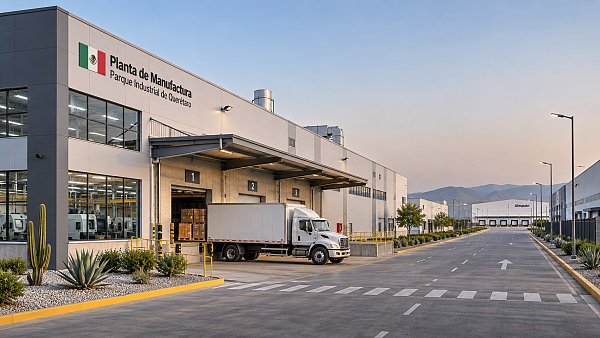
A practical location study should map inbound suppliers, potential plants, customs crossings, warehouses, and final customers together. It should also identify alternative routes and the services available along them. Geographic proximity is useful; network resilience is what makes it commercially dependable.
Supplier capacity: the difference between a quotation and a commitment
A supplier may have the right equipment and still lack the capacity to support a new program. Ask how much production time is already committed, which operations are subcontracted, and what happens when several customers request an increase at once. Nameplate machine capacity alone says little about available labor, maintenance schedules, material constraints, or quality yields.
For a meaningful assessment, request evidence tied to the intended process: sample inspection records, recent delivery performance, equipment lists, maintenance practices, and the proposed production flow. Where appropriate, visit the facility and compare the quotation with what is physically available. A remote presentation can help screen candidates, but it is a weak substitute for examining critical operations.
The assessment should extend beyond the direct supplier. A manufacturer that depends on one imported resin, electronic component, or specialized surface treatment may have less flexibility than its assembly capacity suggests. Ask which inputs are single-sourced, how long they take to replenish, and whether substitutes have been qualified.
For regulated or technically demanding products, check the scope and validity of any claimed certifications against the relevant issuing body where possible. A certificate held by one facility, process, or legal entity should not automatically be assumed to cover another.
The risks that can erode a nearshoring business case
Electricity, water, and site readiness
A promising industrial property is not necessarily ready for production. Power availability, connection timing, voltage requirements, water access, wastewater handling, and backup arrangements should be investigated at the site level. The needs of a light assembly operation differ sharply from those of a plant using energy-intensive equipment or water-dependent processes.
Request written confirmation of available services and understand who bears the cost of upgrades. Build the project schedule around verified connection milestones rather than an assumption that utilities will be ready when equipment arrives. If renewable electricity or emissions reporting matters to customers, assess the practical sourcing and accounting options for the location.
Security and logistics variability
Cargo security and transit reliability vary by route, time, commodity, and carrier. Review the proposed corridor with logistics providers and insurers rather than treating national-level descriptions as a site-specific risk assessment. Depending on the shipment, controls may include approved parking procedures, tracking, seal management, driver communication protocols, and clearly defined incident escalation.
Border performance also needs to be modeled as a range, not a single transit-time promise. Delays can arise from documentation errors, inspections, crossing congestion, or mismatched operating hours. For critical parts, test how much inventory or alternate routing is needed to absorb a disruption without stopping the customer’s production line.
Workforce and management capacity
An established cluster can offer an experienced labor pool, but it can also mean competition for technicians, engineers, and supervisors. Evaluate local hiring conditions, training requirements, shift coverage, turnover exposure, and the availability of maintenance specialists. If a process relies on knowledge transferred from another country, include the cost and time needed to establish that capability locally.
Management bandwidth matters too. A remote buyer needs clear ownership of quality decisions, engineering changes, corrective actions, and production scheduling. Without that structure, a shorter physical distance may not translate into faster problem resolution.
Trade rules: production in Mexico does not automatically mean preferential treatment
The United States-Mexico-Canada Agreement, or USMCA, is an important part of many regional sourcing discussions. However, preferential tariff treatment depends on applicable rules of origin and documentation; it is not granted simply because final assembly takes place in Mexico. Requirements differ by product, and some sectors face additional provisions.
Before including a duty benefit in a financial model, confirm the product’s tariff classification, origin requirements, sourcing details, and supporting records with qualified trade professionals. The same review should cover the importer of record, customs valuation, applicable permits, and responsibilities under the sales contract.
Companies considering Mexico’s IMMEX program for export manufacturing should also examine whether their proposed operation qualifies and what inventory-control, reporting, and other obligations apply. Program access and tax treatment are fact-specific; they should not be treated as automatic savings. Because trade measures and administrative requirements can change, verify current rules with the relevant authorities and advisers before committing capital.
Build the comparison around total landed cost
A lower supplier quote is useful only if the delivered economics work. Compare the existing supply chain and the proposed Mexican alternative using the same demand forecast, service level, and quality assumptions. Include the costs that are often omitted from an early sourcing presentation:
- Inbound materials, international freight, customs brokerage, duties, and border handling.
- Tooling, supplier qualification, engineering changes, production trials, and travel.
- Inventory in transit, safety stock, warehousing, and the financial cost of holding stock.
- Quality inspection, scrap, rework, warranty exposure, and corrective-action support.
- Utilities, security measures, insurance, and contingency freight where relevant.
Run more than one scenario. A base case can use expected demand and normal transit times; a stress case might include a supplier ramp-up delay, higher freight costs, or a prolonged border interruption. The aim is not to predict every disruption, but to see which assumptions have the power to overturn the decision.
Currency exposure also deserves attention. Prices, wages, imported inputs, and customer contracts may be denominated in different currencies. Establish which party absorbs exchange-rate movements and how often prices can be reviewed. A commercially attractive quote can change materially if those terms are unclear.
Where market opportunities are taking shape
Nearshoring demand extends beyond factories themselves. Manufacturers may need local tooling, automation integration, industrial maintenance, packaging, testing, and freight-management support. For suppliers of these services, the opportunity depends less on a general nearshoring narrative than on whether they can support a customer’s specifications, response times, and expansion plans.
In electronics and advanced manufacturing, traceability and engineering support can be as important as assembly capacity. In healthcare technology, supplier selection may require particularly careful review of quality systems, product-specific requirements, and change control. Green energy projects can create demand for components and industrial services, but each opportunity should be assessed against actual project economics and procurement requirements.
Supply chain software has a practical role when information is fragmented across suppliers, brokers, carriers, and plants. Systems that improve shipment visibility, supplier documentation, or inventory coordination may support a more reliable network. Software, however, cannot compensate for inaccurate source data or an unclear agreement about who updates it.
Turn market research into a decision
Start with a defined product family and customer destination. Map the bill of materials, identify operations that could move, and shortlist locations based on supplier capability rather than general investment appeal. Then validate the assumptions through supplier discussions, site visits, logistics quotations, and a product-specific trade review.
Useful reference points include Mexico’s national statistics agency, INEGI, for economic and industry information; official customs and trade-agreement resources for current requirements; and state or local investment agencies for initial location research. Treat each source according to its purpose: an investment overview can identify candidates, but it cannot verify a supplier’s available capacity or a plant’s utility connection.
TradeNexus Pro, operating through chinaspecialmetal.com, brings together industry-oriented analysis across advanced manufacturing, green energy, smart electronics, healthcare technology, and supply chain software. That cross-sector perspective can help frame the questions behind a Mexico sourcing decision, while facility, route, and compliance claims still need independent verification.
A sensible next step is a limited qualification or pilot order with explicit acceptance criteria, delivery milestones, and escalation responsibilities. Expand only after the supplier demonstrates that the proposed process works at the required quality and volume. The strongest nearshoring case is not the one with the shortest route on a map; it is the one whose assumptions survive operational testing.
Get weekly intelligence in your inbox.
No noise. No sponsored content. Pure intelligence.
 Nov 22, 2026Golmud's 60 MW Liquid Air Storage Project Uses Fully Domestic EquipmentGolmud's 60 MW Liquid Air Storage Project Uses Fully Domestic Equipment
 Nov 22, 2026Precision Engineering for Medical Devices: Tolerances and MaterialsPrecision Engineering for Medical Devices: Tolerances and Materials
 Nov 21, 2026EDF Acquires 1GWh Holloway Battery Storage Project in AustraliaEDF Acquires 1GWh Holloway Battery Storage Project in Australia
 Nov 21, 2026Choosing Carbon Steel Grades for OEM Machined Parts: Key FactorsChoosing Carbon Steel Grades for OEM Machined Parts: Key Factors
 Nov 20, 2026China’s First Virtual Power Plant Report Says Capacity Target Met EarlyChina’s First Virtual Power Plant Report Says Capacity Target Met Early
 Nov 20, 2026Choosing an OEM Heavy Equipment Manufacturer: Capabilities and Quality ChecksChoosing an OEM Heavy Equipment Manufacturer: Capabilities and Quality Checks
 Nov 19, 2026India Adds Record 8.4 GW of Open-Access Solar in First Nine Months of 2026India Adds Record 8.4 GW of Open-Access Solar in First Nine Months of 2026
 Nov 19, 2026B2B Intelligence for Green Energy: Finding New Market OpportunitiesB2B Intelligence for Green Energy: Finding New Market Opportunities
 Nov 18, 2026Global Solar Additions Hit Record in 2025, Forecast to Fall in 2026Global Solar Additions Hit Record in 2025, Forecast to Fall in 2026
 Nov 18, 2026Supply Chain Visibility for Supplier Management: How to Spot Delivery RisksSupply Chain Visibility for Supplier Management: How to Spot Delivery Risks
 Nov 17, 2026US Battery Storage Deployment Tops 200 GWh; 74 GWh Forecast for 2026US Battery Storage Deployment Tops 200 GWh; 74 GWh Forecast for 2026
 Nov 17, 2026Choosing a Solar Tracker for Ground-Mount PV: Site and Design FactorsChoosing a Solar Tracker for Ground-Mount PV: Site and Design Factors
 Nov 16, 2026US Polysilicon and Solar Product Tariffs and Import Price Floor Take Effect December 4US Polysilicon and Solar Product Tariffs and Import Price Floor Take Effect December 4
 Nov 16, 2026How Industrial Buyers Can Evaluate B2B Intelligence Reports on SuppliersHow Industrial Buyers Can Evaluate B2B Intelligence Reports on Suppliers
 Nov 15, 2026CATL Sets Tener Sodium Delivery Timeline, Targeting LFP on CostCATL Sets Tener Sodium Delivery Timeline, Targeting LFP on Cost
 Nov 15, 2026Electric Wheelchairs for Disabled Adults: Choosing the Right Fit and RangeElectric Wheelchairs for Disabled Adults: Choosing the Right Fit and Range
 Nov 14, 2026China Expects Clean Energy to Meet All New Electricity Demand by 2030China Expects Clean Energy to Meet All New Electricity Demand by 2030
 Nov 14, 2026Choosing a Digital X-Ray Detector Supplier: Compatibility and SupportChoosing a Digital X-Ray Detector Supplier: Compatibility and Support
 Nov 13, 2026Ecuador Sets Zero VAT and Currency Outflow Tax Rates for Solar and Storage EquipmentEcuador Sets Zero VAT and Currency Outflow Tax Rates for Solar and Storage Equipment
 Nov 13, 2026Choosing an OEM Machined Parts Manufacturer: Quality, Capacity and Lead TimesChoosing an OEM Machined Parts Manufacturer: Quality, Capacity and Lead Times
 Nov 12, 2026South Africa Registers 2 GW of New Solar PV Capacity in Q3 2026South Africa Registers 2 GW of New Solar PV Capacity in Q3 2026
 Nov 12, 2026Mexico Supply Chain Market Research: Nearshoring Opportunities and RisksMexico Supply Chain Market Research: Nearshoring Opportunities and Risks
 Nov 11, 2026US Senate Advances Bipartisan BAAJA Energy Permitting BillUS Senate Advances Bipartisan BAAJA Energy Permitting Bill
 Nov 11, 2026Inventory Management Decision Support: When and How Much to ReorderInventory Management Decision Support: When and How Much to Reorder
 Nov 10, 2026China's Trade Surplus Tops $1 Trillion Through October as Exports Rise 35.2%China's Trade Surplus Tops $1 Trillion Through October as Exports Rise 35.2%
 Nov 10, 2026Choosing Surgical PPE: Gowns, Gloves, Masks and Eye ProtectionChoosing Surgical PPE: Gowns, Gloves, Masks and Eye Protection
 Nov 09, 2026US Solar Imports Shift as Domestic Manufacturing Investment Reshapes Global TradeUS Solar Imports Shift as Domestic Manufacturing Investment Reshapes Global Trade