Electric Wheelchairs for Disabled Adults: Choosing the Right Fit and Range
The right electric wheelchair is one that supports your body, fits the places you use every day, and has enough practical range for your usual trips. Start with seating and access, then compare driving performance and battery capacity. A chair with an impressive advertised range is less useful if it cannot turn into your bathroom or leaves you uncomfortable after an hour.
When comparing electric wheelchairs for disabled adults, picture a complete day: getting into the chair, moving around the home, going outdoors, and returning to a place where it can be charged. Each part of that routine can reveal a requirement that is easy to miss in a product listing.
Start with the fit, not the battery
Seat dimensions affect more than comfort. They influence posture, pressure distribution, access to the controls, and how easily you can enter or leave the chair. A seat that is too narrow may cause rubbing; one that is too wide can make it harder to maintain a stable position or reach the armrests.
Measure while seated in the position you expect to use, wearing usual clothing and footwear. Consider the space needed for a cushion or positioning support. Measurements are a starting point rather than a complete prescription, especially if you have limited trunk control, a history of pressure injuries, or changing support needs.
- Seat width: Check the widest part of the hips or thighs, allowing appropriate clearance without leaving so much room that you lean to one side.
- Seat depth: The seat should support the thighs without pressing into the backs of the knees. A cushion can change the effective seating position.
- Seat and back height: Check whether your feet can be supported and whether the backrest provides the support you need without restricting movement.
- Armrests and foot supports: Look for adjustment that keeps shoulders relaxed and feet supported, and check whether these parts move out of the way for transfers.
Ask whether the listed seat dimensions describe the frame, the cushion, or the usable space between armrests. These measurements are not always interchangeable. Also check the overall width and height of the assembled chair: a comfortable seat still needs to pass through the spaces you use.
For people who remain seated for long periods or need support to maintain posture, an occupational therapist, physical therapist, or qualified seating specialist can help assess cushions and positioning. A powered tilt or recline feature may be relevant for some users, but its suitability depends on the individual; it should not be treated as a substitute for a pressure-management plan.
Match the chair to your actual routes
A narrow hallway, a lift, a front threshold, and a rough pavement each place different demands on a wheelchair. Before comparing models, note the tightest doors and turns on your regular routes, as well as the surfaces and slopes you expect to encounter.
Overall width is only part of the indoor picture. A chair may fit through a doorway in a straight line but struggle if the approach requires a sharp turn. Measure the clear opening with the door in its usual position, and account for projecting handles, footplates, and the user’s legs. Manufacturer turning-radius figures help with comparison, but they do not replace trying the maneuver in a similar space.
Drive-wheel position changes the feel
Mid-wheel-drive chairs often turn in a compact footprint, which can suit confined indoor spaces. Front-wheel-drive chairs may handle some obstacles well, but the rear of the chair swings outward during turns. Rear-wheel-drive chairs can feel familiar to people accustomed to steering a vehicle, although their turning space may be less convenient indoors. Individual designs vary, so test the specific chair rather than choosing solely by drive-wheel position.
For outdoor use, check the manufacturer’s stated limits for slopes, obstacles, and surfaces. Do not assume that a powered chair can safely climb every curb or cross soft ground. Wet leaves, gravel, steep side slopes, and uneven paving can reduce traction or stability. Use an accessible route and follow the chair’s instructions for ramps and inclines.
Read the range figure as a comparison, not a promise
Published range is usually obtained under specified test conditions. Your distance per charge can differ because of total load, hills, frequent starts, tire condition, temperature, battery age, and the surface under the wheels. Powered seating functions and other electrical accessories may also draw from the battery.
Estimate your longest routine round trip, including detours within shops or buildings, rather than measuring only the distance between two addresses. Then look for capacity beyond that distance so the chair is not routinely returned with an almost empty battery. There is no single reserve that works for every user: a hilly route, cold weather, or limited access to charging calls for more margin than a short, flat indoor journey.
When comparing claims, ask the supplier for the test conditions and battery configuration behind each figure. Two chairs with the same stated range may not perform alike if one was tested with a different load or on a different surface. Battery capacity figures can help compare versions of the same chair, but capacity alone does not reliably predict distance across different motors, chair weights, and drive systems.
Consider charging as part of the route. Is there an accessible socket near the chair’s parking space? Can you reach the charging port and handle the connector? If someone else normally plugs it in, is that help available when needed? Use the charger specified for the chair, follow the manufacturer’s charging instructions, and ask about replacement battery availability before buying.
Weight capacity includes more than the person
Check the manufacturer’s maximum user or load limit and clarify what it includes. Clothing, a cushion, a bag, medical equipment, and any mounted accessories can add weight. Do not assume that a chair with a suitable weight rating also has an appropriately sized seat or the support you need.
A heavier configuration can also affect range, acceleration, braking, and transport. If you are close to a listed limit, ask the supplier how the chair is rated and whether the seating and accessories are approved for that configuration. Never exceed the stated limit to obtain a smaller or lighter chair.
Controls, transfers, and day-to-day handling
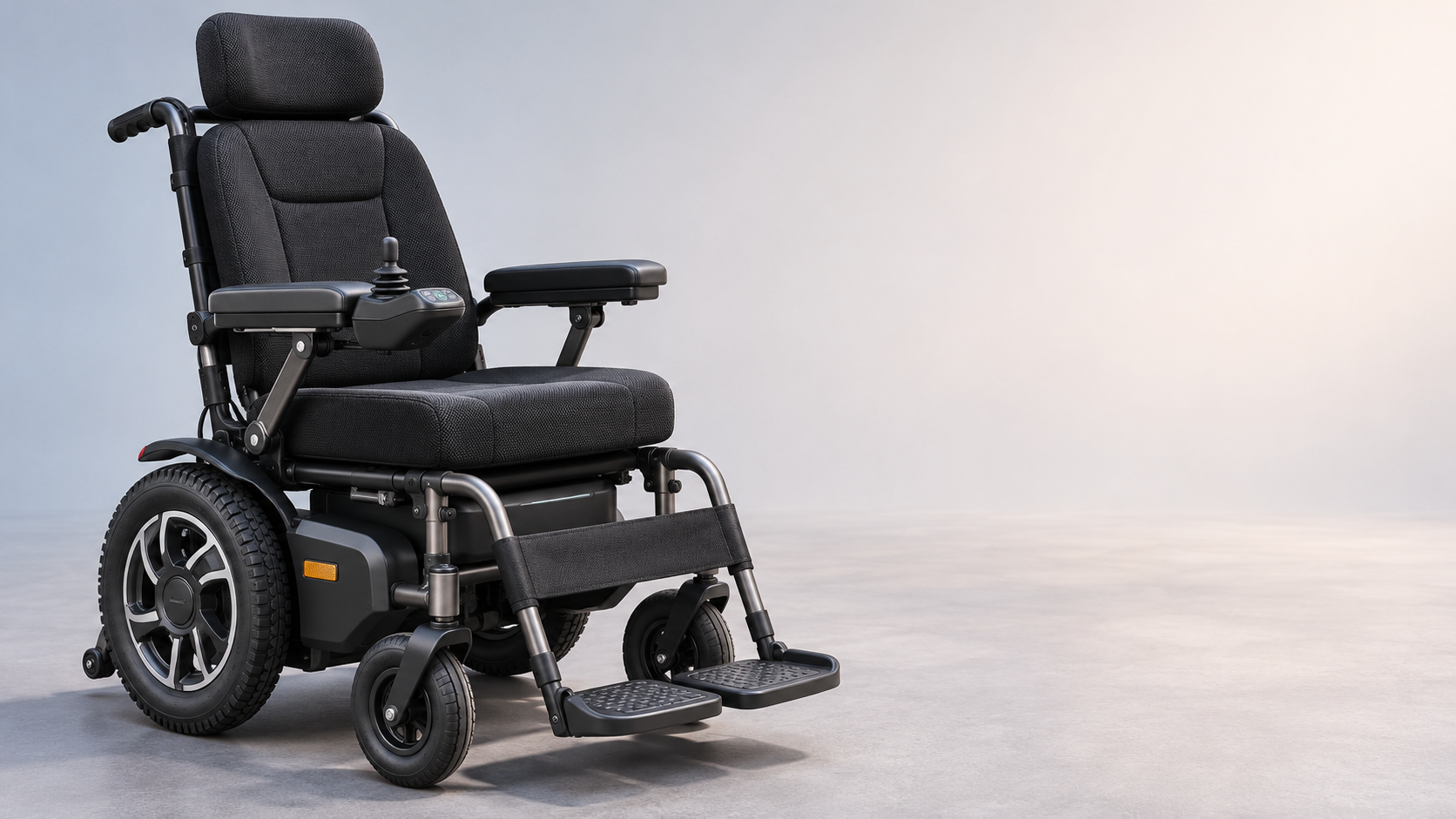
A standard joystick works for many people, but placement and sensitivity matter. During a demonstration, check whether you can reach the control without stretching, keep your hand supported, and release it comfortably. Try starting slowly, stopping, reversing, and turning around an obstacle. Ask whether the joystick can be mounted on either side and whether the speed settings can be adjusted to suit your environment.
People with limited hand movement may need an alternative control or a different mounting arrangement. Compatibility should be confirmed for the specific chair, not assumed from a photograph. If another person will sometimes steer, ask about attendant controls and where they are fitted.
Transfers deserve the same attention. Check the position of the wheels, armrests, and footplates against the bed, toilet, or vehicle seat you use. Removable or swing-away components can create space, but they should be manageable for the person operating them. Follow the instructions for switching power off and positioning the chair before transferring; a clinician can help assess a safe method when assistance or transfer equipment is needed.
Folding is not the same as easy transport
A folding power wheelchair may fit into a vehicle, but someone still has to move it there. Ask for the total weight, the weight with batteries removed if removal is permitted, and the weight of the heaviest individual part. Check folded dimensions against the vehicle opening as well as the available luggage space. A chair that fits inside may still be difficult to lift over the loading edge.
If you intend to remain seated in the wheelchair while traveling in a vehicle, do not assume that a folding frame or a restraint strap makes it suitable as a vehicle seat. Confirm that the specific chair and configuration are approved for that use, and follow the transport and securement instructions. For air travel, contact the airline in advance with the battery type and chair details; acceptance and preparation requirements can vary.
Arrange a meaningful trial before committing
Ask to try the chair with the intended cushion, controls, footrests, and battery configuration. A brief drive across a showroom floor may not reveal whether the seat remains comfortable or whether the chair clears a tight turn. Where possible, practice tasks that resemble your routine: approach a doorway, turn toward a table, drive over a suitable threshold, and position the chair for a transfer.
During the trial, pay attention to signs that the fit needs adjustment: sliding forward, pressure behind the knees, shoulders lifting to reach the armrests, or difficulty keeping a hand on the control. Do not dismiss discomfort simply because the chair folds neatly or offers a longer stated range. Ask which dimensions and components can be adjusted, and which would require a different model or seating system.
Before ordering, get the practical details in writing: the exact configuration, delivery and setup arrangements, warranty coverage, service access, replacement parts, and return conditions. Custom seating and modified controls may have different return terms from a standard chair. Knowing who will make adjustments after delivery is particularly important if your first fitting reveals a problem.
Get weekly intelligence in your inbox.
No noise. No sponsored content. Pure intelligence.
 Nov 22, 2026Golmud's 60 MW Liquid Air Storage Project Uses Fully Domestic EquipmentGolmud's 60 MW Liquid Air Storage Project Uses Fully Domestic Equipment
 Nov 22, 2026Precision Engineering for Medical Devices: Tolerances and MaterialsPrecision Engineering for Medical Devices: Tolerances and Materials
 Nov 21, 2026EDF Acquires 1GWh Holloway Battery Storage Project in AustraliaEDF Acquires 1GWh Holloway Battery Storage Project in Australia
 Nov 21, 2026Choosing Carbon Steel Grades for OEM Machined Parts: Key FactorsChoosing Carbon Steel Grades for OEM Machined Parts: Key Factors
 Nov 20, 2026China’s First Virtual Power Plant Report Says Capacity Target Met EarlyChina’s First Virtual Power Plant Report Says Capacity Target Met Early
 Nov 20, 2026Choosing an OEM Heavy Equipment Manufacturer: Capabilities and Quality ChecksChoosing an OEM Heavy Equipment Manufacturer: Capabilities and Quality Checks
 Nov 19, 2026India Adds Record 8.4 GW of Open-Access Solar in First Nine Months of 2026India Adds Record 8.4 GW of Open-Access Solar in First Nine Months of 2026
 Nov 19, 2026B2B Intelligence for Green Energy: Finding New Market OpportunitiesB2B Intelligence for Green Energy: Finding New Market Opportunities
 Nov 18, 2026Global Solar Additions Hit Record in 2025, Forecast to Fall in 2026Global Solar Additions Hit Record in 2025, Forecast to Fall in 2026
 Nov 18, 2026Supply Chain Visibility for Supplier Management: How to Spot Delivery RisksSupply Chain Visibility for Supplier Management: How to Spot Delivery Risks
 Nov 17, 2026US Battery Storage Deployment Tops 200 GWh; 74 GWh Forecast for 2026US Battery Storage Deployment Tops 200 GWh; 74 GWh Forecast for 2026
 Nov 17, 2026Choosing a Solar Tracker for Ground-Mount PV: Site and Design FactorsChoosing a Solar Tracker for Ground-Mount PV: Site and Design Factors
 Nov 16, 2026US Polysilicon and Solar Product Tariffs and Import Price Floor Take Effect December 4US Polysilicon and Solar Product Tariffs and Import Price Floor Take Effect December 4
 Nov 16, 2026How Industrial Buyers Can Evaluate B2B Intelligence Reports on SuppliersHow Industrial Buyers Can Evaluate B2B Intelligence Reports on Suppliers
 Nov 15, 2026CATL Sets Tener Sodium Delivery Timeline, Targeting LFP on CostCATL Sets Tener Sodium Delivery Timeline, Targeting LFP on Cost
 Nov 15, 2026Electric Wheelchairs for Disabled Adults: Choosing the Right Fit and RangeElectric Wheelchairs for Disabled Adults: Choosing the Right Fit and Range
 Nov 14, 2026China Expects Clean Energy to Meet All New Electricity Demand by 2030China Expects Clean Energy to Meet All New Electricity Demand by 2030
 Nov 14, 2026Choosing a Digital X-Ray Detector Supplier: Compatibility and SupportChoosing a Digital X-Ray Detector Supplier: Compatibility and Support
 Nov 13, 2026Ecuador Sets Zero VAT and Currency Outflow Tax Rates for Solar and Storage EquipmentEcuador Sets Zero VAT and Currency Outflow Tax Rates for Solar and Storage Equipment
 Nov 13, 2026Choosing an OEM Machined Parts Manufacturer: Quality, Capacity and Lead TimesChoosing an OEM Machined Parts Manufacturer: Quality, Capacity and Lead Times
 Nov 12, 2026South Africa Registers 2 GW of New Solar PV Capacity in Q3 2026South Africa Registers 2 GW of New Solar PV Capacity in Q3 2026
 Nov 12, 2026Mexico Supply Chain Market Research: Nearshoring Opportunities and RisksMexico Supply Chain Market Research: Nearshoring Opportunities and Risks
 Nov 11, 2026US Senate Advances Bipartisan BAAJA Energy Permitting BillUS Senate Advances Bipartisan BAAJA Energy Permitting Bill
 Nov 11, 2026Inventory Management Decision Support: When and How Much to ReorderInventory Management Decision Support: When and How Much to Reorder
 Nov 10, 2026China's Trade Surplus Tops $1 Trillion Through October as Exports Rise 35.2%China's Trade Surplus Tops $1 Trillion Through October as Exports Rise 35.2%
 Nov 10, 2026Choosing Surgical PPE: Gowns, Gloves, Masks and Eye ProtectionChoosing Surgical PPE: Gowns, Gloves, Masks and Eye Protection
 Nov 09, 2026US Solar Imports Shift as Domestic Manufacturing Investment Reshapes Global TradeUS Solar Imports Shift as Domestic Manufacturing Investment Reshapes Global Trade