5 Axis Milling Machine for Mold Making: Accuracy, Travel Range, and Spindle Specs Explained
5 Axis Milling Machine for Mold Making: Accuracy, Travel Range, and Spindle Specs Explained
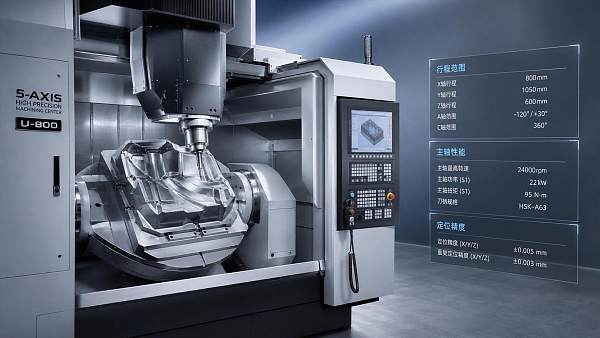
Choosing a 5 axis milling machine for mold making is not only a speed decision.
In real production, accuracy, travel range, and spindle behavior shape the final mold quality more than headline feed rates.
That matters even more when molds include deep cavities, fine ribs, tight shut-off surfaces, and complex freeform geometry.
A capable 5 axis milling machine for mold making helps reduce hand polishing, improve surface consistency, and control dimensional drift across long runs.
The challenge is that machine catalogs often present impressive numbers without enough operating context.
This guide breaks down the specifications that actually matter when comparing equipment for mold work.
Why mold making pushes 5-axis machines harder
Mold machining is demanding because it mixes precision, surface finish, and material difficulty in one process.
Toolpaths often involve steep walls, narrow channels, and continuous contour changes.
On a standard 3-axis setup, those features may require extra setups, longer tools, and more polishing later.
A 5 axis milling machine for mold making keeps the cutter better aligned with the surface.
That usually means shorter tools, better rigidity, smoother finishes, and fewer repositioning errors.
Typical mold applications that benefit most
- Injection molds with deep cavities and polished surfaces
- Die-casting molds using hardened tool steel inserts
- Automotive trim molds with large contoured surfaces
- Medical and electronics molds with micro features
- Prototype tools needing fewer setups and faster iteration
Accuracy: the first spec to verify, not assume
Accuracy is the core reason to invest in a 5 axis milling machine for mold making.
But accuracy should never be read as one isolated number from a brochure.
For mold work, three layers matter together: positioning accuracy, repeatability, and dynamic contouring accuracy.
If one layer is weak, the machine may still struggle on real-world parts.
What to check behind the accuracy claim
- Linear axis positioning and repeatability values
- Rotary axis accuracy under interpolation
- Thermal compensation stability over long cycles
- Machine geometry calibration method
- Ball bar, laser, or volumetric test reports
In mold making, poor dynamic accuracy often shows up as witness lines, mismatch at blend areas, or extra stock left in corners.
That is why a machine can look precise on paper but still create rework in finishing.
From a technical evaluation standpoint, test cuts on representative mold geometry are more useful than isolated spec-sheet claims.
Practical tolerance targets
Many mold shops look for stable micron-level repeatability on finishing operations.
However, the real benchmark depends on cavity size, steel hardness, electrode strategy, and downstream polishing allowance.
The right 5 axis milling machine for mold making should hold tolerance consistently across shifts, not only during a short acceptance run.
Travel range: more than part size alone
Travel range is often reduced to X, Y, and Z dimensions.
For mold applications, that is only the starting point.
A 5 axis milling machine for mold making also needs enough rotary freedom to avoid collisions and maintain ideal tool angles.
Without that, a nominally large machine can become restrictive during actual five-axis motion.
Travel questions that buyers should ask
- What is the usable travel after fixture, tool holder, and tilt clearance are considered?
- Does the machine maintain full performance near travel limits?
- How much Z-axis room remains with long tools and tall workholding?
- Are rotary axes designed for large mold blocks or mainly smaller precision inserts?
This is especially important for large automotive, appliance, and die-casting tools.
A machine may fit the workpiece physically, yet still lack practical movement for full five-axis access.
When comparing options, ask for a digital reach study using one of your actual mold models.
Table-table or head-table design?
Kinematics affect usable travel just as much as axis stroke.
Table-table machines often suit smaller, high-precision mold inserts.
Head-table designs can offer better flexibility for heavier molds.
The better choice depends on part mass, required tilt angles, and expected production mix.
Spindle specs: where roughing and finishing both win or fail
Spindle performance has a direct effect on cycle time, tool life, and finish quality.
For a 5 axis milling machine for mold making, spindle speed alone is not enough.
Torque curve, bearing stability, vibration control, and thermal behavior are equally important.
These factors decide whether the spindle performs well in hardened steel, copper, graphite, or aluminum mold bases.
How to read spindle specifications correctly
For example, a high-speed spindle helps with fine-detail finishing, but weak torque may limit efficient roughing.
That may force a two-machine workflow, which increases handling time and alignment risk.
So the best 5 axis milling machine for mold making is usually the one with balanced spindle performance, not the highest RPM headline.
Other machine factors that influence real mold performance
Recent buying decisions show a clearer shift toward system-level evaluation.
That means the machine structure, control system, and automation readiness now carry more weight.
In practice, these details strongly affect whether a 5 axis milling machine for mold making stays productive over time.
Key supporting criteria
- Machine base rigidity and damping for stable cutting
- Controller smoothing and look-ahead capability for fine surfaces
- Tool magazine size for combined roughing and finishing workflows
- Probe systems for in-process measurement and setup reduction
- Chip evacuation and coolant design for unattended operation
- Service support, parts access, and calibration response time
These points may seem secondary during quotation review.
Still, they often decide maintenance cost, process repeatability, and actual return on investment.
That is also why leading industrial intelligence platforms such as TradeNexus Pro increasingly frame machine selection as a risk and capability decision, not only a price comparison.
A practical evaluation checklist for machine comparison
If several models appear similar, a structured review makes differences much easier to see.
Use the checklist below when evaluating any 5 axis milling machine for mold making.
- Match machine size to your largest molds and your most common inserts.
- Review usable five-axis reach, not only nominal axis travel.
- Request contouring tests on hardened steel or equivalent sample materials.
- Check spindle power and torque across the real operating range.
- Verify thermal stability over a long machining cycle.
- Compare controller performance on dense surfacing toolpaths.
- Confirm after-sales calibration, training, and application support.
This approach helps separate a good demonstration machine from a reliable production asset.
It also lowers the chance of hidden bottlenecks appearing after installation.
Final take: choose specs that support the mold, not the brochure
The best 5 axis milling machine for mold making is the one that delivers stable accuracy, usable travel, and spindle performance aligned with your actual mold mix.
A machine with excellent numbers but weak application fit can still create rework, longer cycles, and higher process risk.
By contrast, a well-matched configuration improves machining stability, reduces manual finishing, and supports more predictable delivery schedules.
When evaluating suppliers or technologies, keep the focus on measurable mold outcomes.
Ask for evidence, test under realistic conditions, and compare total process capability rather than isolated specifications.
That is the most practical way to choose a 5 axis milling machine for mold making that performs well beyond the initial sales presentation.
Get weekly intelligence in your inbox.
No noise. No sponsored content. Pure intelligence.
 Sep 21, 2026What to Look for in a Grid Integration Company for Utility-Scale Solar ProjectsWhat to Look for in a Grid Integration Company for Utility-Scale Solar Projects
 Sep 20, 2026Microgrid Controller Pricing: What Drives Cost in Commercial Energy Projects?Microgrid Controller Pricing: What Drives Cost in Commercial Energy Projects?
 Sep 19, 2026How to Choose a GaN Charger for Laptops Without Compromising Power or PortabilityHow to Choose a GaN Charger for Laptops Without Compromising Power or Portability
 Sep 18, 2026Floating Solar Farm Costs: CAPEX, OPEX, and the Site Factors That Shape ROIFloating Solar Farm Costs: CAPEX, OPEX, and the Site Factors That Shape ROI
 Sep 17, 2026Drone Delivery Solutions for Last-Mile Routes: Site, Payload, and Range PlanningDrone Delivery Solutions for Last-Mile Routes: Site, Payload, and Range Planning
 Sep 16, 2026When Low-Volume Electronics Manufacturing Makes More Sense Than Mass ProductionWhen Low-Volume Electronics Manufacturing Makes More Sense Than Mass Production
 Sep 15, 2026Wholesale WiFi Smart Switches: What Buyers Should Verify Before OrderingWholesale WiFi Smart Switches: What Buyers Should Verify Before Ordering
 Sep 14, 2026How to Select IoT Sensors for Reliable Monitoring in Harsh Industrial EnvironmentsHow to Select IoT Sensors for Reliable Monitoring in Harsh Industrial Environments
 Sep 13, 2026How Procurement Teams Can Improve Supplier Reliability With Supply Chain VisibilityHow Procurement Teams Can Improve Supplier Reliability With Supply Chain Visibility
 Sep 12, 2026Smart Manufacturing Trends 2026: What Leaders Should Prioritize for ROISmart Manufacturing Trends 2026: What Leaders Should Prioritize for ROI
 Sep 11, 2026B2B Market Analysis: How Buyers Evaluate Suppliers, Pricing, and Delivery RiskB2B Market Analysis: How Buyers Evaluate Suppliers, Pricing, and Delivery Risk
 Sep 10, 2026Residential Solar Kits in Canada: How to Size a System for Your Home and ClimateResidential Solar Kits in Canada: How to Size a System for Your Home and Climate
 Sep 09, 2026How to Specify a Syringe Assembly Line for High-Volume Sterile ProductionHow to Specify a Syringe Assembly Line for High-Volume Sterile Production
 Sep 08, 2026How to Evaluate Warehouse Robotics System Suppliers for Reliable Multi-Site DeploymentHow to Evaluate Warehouse Robotics System Suppliers for Reliable Multi-Site Deployment
 Sep 07, 2026Renewable Geothermal Energy Explained: How It Works for Heating and PowerRenewable Geothermal Energy Explained: How It Works for Heating and Power
 Sep 07, 2026How to Choose an Industrial Packaging Robot Manufacturer for Your Production LineHow to Choose an Industrial Packaging Robot Manufacturer for Your Production Line
 Sep 05, 2026How to Evaluate a Turnkey Hydro Turbine Generator Supplier for Remote Power ProjectsHow to Evaluate a Turnkey Hydro Turbine Generator Supplier for Remote Power Projects
 Sep 04, 2026Automated Ultrasonic Welding for Thermoplastic Assemblies: Process Controls That MatterAutomated Ultrasonic Welding for Thermoplastic Assemblies: Process Controls That Matter
 Sep 03, 2026Energy Forecasting for Grid Planning: Sizing Solar and Storage CapacityEnergy Forecasting for Grid Planning: Sizing Solar and Storage Capacity
 Sep 02, 2026Which Metrics Should an Energy Analytics Dashboard Track for Factory Energy Management?Which Metrics Should an Energy Analytics Dashboard Track for Factory Energy Management?
 Sep 01, 2026How Warehouse Voice Picking Improves Accuracy and Throughput in Order FulfillmentHow Warehouse Voice Picking Improves Accuracy and Throughput in Order Fulfillment
 Aug 31, 2026How to Automate Dropshipping Order Processing Without Overselling StockHow to Automate Dropshipping Order Processing Without Overselling Stock
 Aug 30, 2026How to Evaluate a Smart Lighting Supplier for Multi-Site Commercial ProjectsHow to Evaluate a Smart Lighting Supplier for Multi-Site Commercial Projects
 Aug 29, 2026Recent Advances in Smart Manufacturing and Materials Reshaping Factory InvestmentRecent Advances in Smart Manufacturing and Materials Reshaping Factory Investment
 Aug 29, 2026Selecting Lightweight Aluminum Extrusions for Strength-Critical Industrial DesignsSelecting Lightweight Aluminum Extrusions for Strength-Critical Industrial Designs
 Aug 29, 2026Vertical Powder Anodizing Explained: Process Controls for Uniform Coating QualityVertical Powder Anodizing Explained: Process Controls for Uniform Coating Quality
 Aug 29, 2026PV Module Product Due Diligence: What Buyers Should Verify Before ContractingPV Module Product Due Diligence: What Buyers Should Verify Before Contracting