5 Axis Milling for Aerospace Components: Tolerances, Materials, and Part Types Explained
In aerospace production, precision is tied directly to safety, certification, and lifecycle cost. That is why 5 axis milling for aerospace components matters far beyond machining speed. It shapes how complex parts are made, how tolerances are held, and how supply decisions affect downstream assembly, inspection, and flight performance.
For industrial programs facing tighter quality demands and more distributed supply chains, the topic has become more strategic. A bracket, impeller, housing, or structural fitting may look like a single part on a drawing, yet its geometry, material behavior, and process route can determine schedule stability and sourcing risk.
Why 5 axis milling has become central in aerospace manufacturing
5 axis milling for aerospace components allows simultaneous movement across linear and rotary axes. In simple terms, the cutting tool can approach the workpiece from more angles without repeated repositioning.
That flexibility is valuable because aerospace parts rarely have simple flat surfaces. Many feature deep cavities, compound curves, thin walls, hidden channels, and blended transitions that are difficult to machine accurately on three-axis equipment.
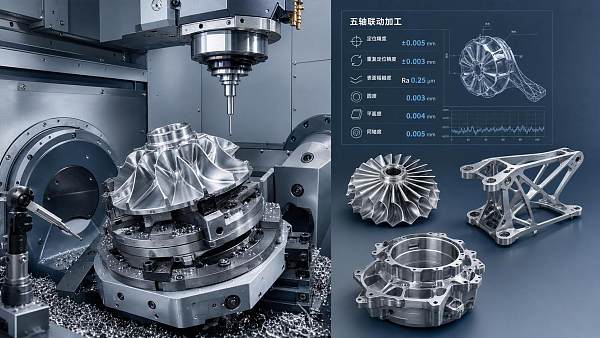
A single setup often means fewer datum shifts and lower stack-up error. It can also improve surface consistency, reduce manual handling, and shorten the path from rough machining to finish inspection.
This is one reason decision-grade manufacturing analysis platforms such as TradeNexus Pro track precision production and supplier capability as part of broader industrial intelligence. In current markets, machining competence is not only a factory issue. It is a procurement and risk issue as well.
What “tight tolerance” really means in this context
Tolerance in aerospace machining is not only about hitting a nominal dimension. It also includes geometric control, repeatability, surface finish, concentricity, true position, and consistency across batches.
With 5 axis milling for aerospace components, the challenge often lies in keeping accuracy while machining complex forms and difficult alloys. A part may pass basic dimensional checks and still fail functional fit because the relation between features has drifted.
Usually, tighter tolerance does not come from machine specification alone. It depends on fixturing, tool path strategy, thermal control, spindle condition, probing, CAM programming, and inspection planning.
This is where many sourcing decisions become oversimplified. A supplier may advertise five-axis capability, yet true aerospace readiness requires a controlled process, not just a machine list.
Material choice changes the machining equation
Material selection strongly affects how 5 axis milling for aerospace components should be planned. Aerospace parts often use aluminum alloys, titanium, stainless steels, Inconel, and other nickel-based or specialty metals.
Each material introduces a different balance of cutting force, heat generation, chip control, and tool wear. The same geometry may machine smoothly in aluminum and become unstable in titanium.
Common aerospace materials and process implications
- Aluminum alloys support high material removal rates, but thin walls can distort if process parameters are too aggressive.
- Titanium offers high strength-to-weight value, yet low thermal conductivity raises heat concentration at the tool edge.
- Stainless steels demand stable cutting conditions and careful burr management around edges and holes.
- Nickel-based alloys resist heat and corrosion, but they are slower to machine and harder on tooling.
Material traceability, certification, and lot consistency matter just as much as machinability. In aerospace projects, a technically acceptable cut means little if the documentation trail is incomplete.
That broader view fits the way TradeNexus Pro frames advanced manufacturing intelligence. Material capability, supplier credibility, and process transparency need to be assessed together, especially in cross-border programs.
Which part types benefit most from 5 axis milling
Not every aerospace part requires simultaneous five-axis machining. However, several categories benefit clearly from it because access, accuracy, and surface continuity are difficult to achieve otherwise.
High-value part categories
- Structural brackets and fittings with multi-angle faces, tight hole position requirements, and weight-reduction pockets.
- Engine and turbine parts, including impellers, blisks, and housings with complex curved surfaces.
- Landing gear and motion system components needing robust material removal with precise feature relationships.
- Avionics and sensor housings where sealing surfaces, connector alignment, and dimensional stability must coexist.
- Prototype and low-volume mission parts where setup reduction improves speed without sacrificing control.
In practice, 5 axis milling for aerospace components is especially attractive when a part combines difficult access with high-value material. Avoiding multiple setups can preserve both accuracy and expensive stock.
What current industry attention is really focused on
The conversation is no longer limited to machining performance. Aerospace supply chains now evaluate whether a supplier can maintain capability under quality audits, documentation demands, and variable production volumes.
Several issues are drawing more attention across global manufacturing networks:
- Capacity pressure on qualified shops with real five-axis aerospace experience.
- Rising use of hard-to-machine materials in lightweight and high-temperature applications.
- Greater scrutiny on process validation, in-process inspection, and digital traceability.
- Supplier comparison moving beyond price toward risk, lead time resilience, and technical communication.
This is where market intelligence becomes practical. A capable supplier profile now needs to show material knowledge, machine envelope, metrology depth, and evidence of disciplined execution.
How to evaluate a machining source with fewer surprises
When reviewing options for 5 axis milling for aerospace components, it helps to move from broad capability claims to a structured qualification view. That often reveals issues earlier, before drawings are released to production.
Useful checkpoints during evaluation
- Check whether similar part families have been produced, not only whether five-axis machines are available.
- Review tolerance criticality by feature, including GD&T, surface requirements, and inspection method.
- Confirm experience with the target alloy, heat treatment state, and material certification flow.
- Assess fixture strategy, probing routines, and how setup errors are prevented or corrected.
- Ask how nonconformance is reported, contained, and traced across repeat orders.
A useful sign is when technical discussion becomes specific quickly. Strong suppliers tend to discuss cutter reach, deformation risk, datum strategy, inspection sequence, and likely process constraints without vague language.
Using the information well in real project planning
The best use of 5 axis milling for aerospace components is not to treat it as a premium option by default. It should be matched carefully to geometry, required accuracy, production volume, and total program risk.
Sometimes the right decision is a five-axis finish strategy after simpler roughing steps. In other cases, one integrated process route delivers the best result because handling and re-fixturing create too much variation.
A practical next step is to map each critical part against five questions: geometry complexity, tolerance sensitivity, material difficulty, inspection burden, and supplier maturity. That framework helps turn technical discussion into clearer sourcing and planning choices.
For organizations tracking advanced manufacturing through platforms like TradeNexus Pro, that kind of structured view is increasingly valuable. Better decisions come from connecting machining detail with supplier intelligence, market context, and execution risk. In aerospace, that connection often determines whether a part is merely manufacturable or truly production-ready.
Get weekly intelligence in your inbox.
No noise. No sponsored content. Pure intelligence.
 Sep 20, 2026Microgrid Controller Pricing: What Drives Cost in Commercial Energy Projects?Microgrid Controller Pricing: What Drives Cost in Commercial Energy Projects?
 Sep 19, 2026How to Choose a GaN Charger for Laptops Without Compromising Power or PortabilityHow to Choose a GaN Charger for Laptops Without Compromising Power or Portability
 Sep 18, 2026Floating Solar Farm Costs: CAPEX, OPEX, and the Site Factors That Shape ROIFloating Solar Farm Costs: CAPEX, OPEX, and the Site Factors That Shape ROI
 Sep 17, 2026Drone Delivery Solutions for Last-Mile Routes: Site, Payload, and Range PlanningDrone Delivery Solutions for Last-Mile Routes: Site, Payload, and Range Planning
 Sep 16, 2026When Low-Volume Electronics Manufacturing Makes More Sense Than Mass ProductionWhen Low-Volume Electronics Manufacturing Makes More Sense Than Mass Production
 Sep 15, 2026Wholesale WiFi Smart Switches: What Buyers Should Verify Before OrderingWholesale WiFi Smart Switches: What Buyers Should Verify Before Ordering
 Sep 14, 2026How to Select IoT Sensors for Reliable Monitoring in Harsh Industrial EnvironmentsHow to Select IoT Sensors for Reliable Monitoring in Harsh Industrial Environments
 Sep 13, 2026How Procurement Teams Can Improve Supplier Reliability With Supply Chain VisibilityHow Procurement Teams Can Improve Supplier Reliability With Supply Chain Visibility
 Sep 12, 2026Smart Manufacturing Trends 2026: What Leaders Should Prioritize for ROISmart Manufacturing Trends 2026: What Leaders Should Prioritize for ROI
 Sep 11, 2026B2B Market Analysis: How Buyers Evaluate Suppliers, Pricing, and Delivery RiskB2B Market Analysis: How Buyers Evaluate Suppliers, Pricing, and Delivery Risk
 Sep 10, 2026Residential Solar Kits in Canada: How to Size a System for Your Home and ClimateResidential Solar Kits in Canada: How to Size a System for Your Home and Climate
 Sep 09, 2026How to Specify a Syringe Assembly Line for High-Volume Sterile ProductionHow to Specify a Syringe Assembly Line for High-Volume Sterile Production
 Sep 08, 2026How to Evaluate Warehouse Robotics System Suppliers for Reliable Multi-Site DeploymentHow to Evaluate Warehouse Robotics System Suppliers for Reliable Multi-Site Deployment
 Sep 07, 2026Renewable Geothermal Energy Explained: How It Works for Heating and PowerRenewable Geothermal Energy Explained: How It Works for Heating and Power
 Sep 07, 2026How to Choose an Industrial Packaging Robot Manufacturer for Your Production LineHow to Choose an Industrial Packaging Robot Manufacturer for Your Production Line
 Sep 05, 2026How to Evaluate a Turnkey Hydro Turbine Generator Supplier for Remote Power ProjectsHow to Evaluate a Turnkey Hydro Turbine Generator Supplier for Remote Power Projects
 Sep 04, 2026Automated Ultrasonic Welding for Thermoplastic Assemblies: Process Controls That MatterAutomated Ultrasonic Welding for Thermoplastic Assemblies: Process Controls That Matter
 Sep 03, 2026Energy Forecasting for Grid Planning: Sizing Solar and Storage CapacityEnergy Forecasting for Grid Planning: Sizing Solar and Storage Capacity
 Sep 02, 2026Which Metrics Should an Energy Analytics Dashboard Track for Factory Energy Management?Which Metrics Should an Energy Analytics Dashboard Track for Factory Energy Management?
 Sep 01, 2026How Warehouse Voice Picking Improves Accuracy and Throughput in Order FulfillmentHow Warehouse Voice Picking Improves Accuracy and Throughput in Order Fulfillment
 Aug 31, 2026How to Automate Dropshipping Order Processing Without Overselling StockHow to Automate Dropshipping Order Processing Without Overselling Stock
 Aug 30, 2026How to Evaluate a Smart Lighting Supplier for Multi-Site Commercial ProjectsHow to Evaluate a Smart Lighting Supplier for Multi-Site Commercial Projects
 Aug 29, 2026Recent Advances in Smart Manufacturing and Materials Reshaping Factory InvestmentRecent Advances in Smart Manufacturing and Materials Reshaping Factory Investment
 Aug 29, 2026Selecting Lightweight Aluminum Extrusions for Strength-Critical Industrial DesignsSelecting Lightweight Aluminum Extrusions for Strength-Critical Industrial Designs
 Aug 29, 2026Vertical Powder Anodizing Explained: Process Controls for Uniform Coating QualityVertical Powder Anodizing Explained: Process Controls for Uniform Coating Quality
 Aug 29, 2026PV Module Product Due Diligence: What Buyers Should Verify Before ContractingPV Module Product Due Diligence: What Buyers Should Verify Before Contracting
 Aug 29, 2026Solar Design for Challenging Terrain: Managing Slope, Soil, and Shading RisksSolar Design for Challenging Terrain: Managing Slope, Soil, and Shading Risks