Steel Forging for Automotive Parts: When to Choose Closed-Die vs Open-Die
Steel Forging for Automotive Parts: When to Choose Closed-Die vs Open-Die
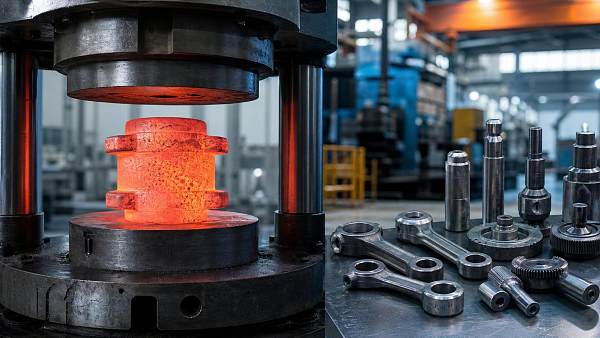
In steel forging for automotive parts, process choice shapes performance long before machining or heat treatment begins.
A wrong selection can raise scrap, delay launch timing, or leave strength margins too thin for real service loads.
That is why the closed-die versus open-die question matters early in sourcing, design review, and supplier qualification.
Closed-die forging uses shaped dies to form near-net geometry under controlled, repeated compression.
Open-die forging compresses heated steel between simpler dies, allowing gradual shaping of larger, less detailed forms.
Both are valuable in steel forging for automotive parts, but they solve different engineering and business problems.
The practical decision comes down to geometry, volume, tolerances, grain flow, machining allowance, and total landed cost.
How the Two Forging Routes Really Differ
Closed-die forging is typically the better fit when the part shape is complex and production volume is stable.
The die cavity controls material flow, which improves repeatability and reduces downstream machining time.
Open-die forging is more flexible.
It works well for simpler sections, larger cross-sections, and lower production volumes where tooling investment must stay moderate.
In automotive supply chains, that usually means closed-die for finished component blanks, and open-die for larger preforms or specialty items.
When Closed-Die Forging Makes More Sense
For steel forging for automotive parts, closed-die is usually the first choice when component geometry drives performance.
Think connecting rods, steering knuckles, gear blanks, yokes, hubs, and transmission parts.
These parts need directional grain flow and consistent dimensions across many production cycles.
Closed-die forging also becomes attractive when machining centers are already loaded.
A more precise forged blank removes unnecessary metal earlier and shortens finishing time.
That can improve throughput across the full automotive manufacturing line, not just at the forge shop.
Best-fit conditions for closed-die
- Annual demand is predictable and high enough to absorb die cost.
- Part geometry includes shoulders, fillets, webs, or controlled section transitions.
- Mechanical properties must be repeatable across batches and production sites.
- Dimensional control affects assembly fit, NVH behavior, or fatigue reliability.
- Material savings and lower machining costs matter over the program life.
In practical sourcing, this route often wins when the total cost model includes scrap, cycle time, and quality variation.
The unit price may not look lowest at first glance.
Still, the program cost often comes down once rework and machining are measured honestly.
When Open-Die Forging Is the Smarter Choice
Open-die is not a lower-grade option.
In steel forging for automotive parts, it is the more rational route for certain shapes and buying conditions.
It suits large rings, shafts, bars, blocks, and heavy-duty preforms that later undergo extensive machining.
It also helps when a development program is still changing and final dimensions are not fully frozen.
That flexibility reduces the risk of cutting expensive dies too early.
Best-fit conditions for open-die
- Production volume is low, irregular, or project-based.
- The forged part is large and simple enough for machining to define final features.
- Design changes remain likely during validation or vehicle platform updates.
- Lead time and tooling flexibility matter more than near-net precision.
- Internal soundness and forged structure are needed in heavy sections.
From a supply chain view, open-die can also widen the supplier pool.
Not every forge shop can manage complex closed-die tooling at consistent quality levels.
For simpler blanks, open-die sourcing may reduce qualification risk.
Decision Factors That Matter Most in Automotive Selection
The easiest mistake is comparing forging methods only by piece price.
Better decisions come from a broader evaluation model.
1. Geometry and feature density
If the part contains many transitions, closed-die usually controls material flow better.
If the shape is basically a shaft, block, or ring, open-die may be enough.
2. Load path and fatigue life
Automotive parts under cyclic stress benefit from optimized grain orientation.
Closed-die often delivers stronger alignment around the final shape.
3. Volume and program life
A five-year vehicle program with stable volumes supports closed-die economics.
Prototype, aftermarket, or niche platforms often point toward open-die.
4. Machining strategy
If a plant already expects heavy machining, open-die blanks can still be efficient.
If machining capacity is tight, closed-die can relieve pressure quickly.
5. Supplier capability and quality systems
Steel forging for automotive parts depends as much on execution as process category.
Ask about die design, process simulation, traceability, heat treatment control, and destructive testing history.
Common Evaluation Risks and How to Avoid Them
Several sourcing mistakes repeat across automotive projects.
Most are avoidable with earlier technical alignment.
- Choosing closed-die too early for an unstable design, then paying for repeated die changes.
- Choosing open-die for a fatigue-critical part that actually needs controlled grain flow.
- Ignoring flash loss, trim operations, and machining stock in cost comparisons.
- Reviewing drawings without checking forgeability, draft angles, and section balance.
- Approving a supplier based on samples without verifying repeatability at production volume.
A simple cross-functional checklist helps.
Review metallurgy, tooling, machining, logistics, and quality assumptions in one decision gate.
That step alone often prevents expensive late-stage corrections.
A Practical Selection Framework
For steel forging for automotive parts, a structured decision process is more reliable than rule-of-thumb selection.
- Start with function: define load case, safety margin, and failure mode.
- Map geometry: separate forged form from machined features.
- Estimate volume: include ramp-up, service parts, and platform variants.
- Model total cost: tooling, scrap, machining, inspection, and lead time.
- Audit suppliers: compare process control, not just quotation speed.
If the answer still looks borderline, request two things.
First, ask for a manufacturability review.
Second, ask for a side-by-side total cost scenario over the full production horizon.
That tends to make the right forging route much clearer.
Final Takeaway
Closed-die is usually the better option when steel forging for automotive parts requires complex geometry, repeatable strength, and production scale.
Open-die makes more sense when parts are larger, simpler, lower-volume, or still evolving in design.
The best decision is rarely about one process being universally better.
It is about matching process capability to part function, program economics, and supplier execution.
When that match is made carefully, sourcing becomes faster, quality risk drops, and the forging choice supports long-term vehicle performance.
Get weekly intelligence in your inbox.
No noise. No sponsored content. Pure intelligence.
 Sep 20, 2026Microgrid Controller Pricing: What Drives Cost in Commercial Energy Projects?Microgrid Controller Pricing: What Drives Cost in Commercial Energy Projects?
 Sep 19, 2026How to Choose a GaN Charger for Laptops Without Compromising Power or PortabilityHow to Choose a GaN Charger for Laptops Without Compromising Power or Portability
 Sep 18, 2026Floating Solar Farm Costs: CAPEX, OPEX, and the Site Factors That Shape ROIFloating Solar Farm Costs: CAPEX, OPEX, and the Site Factors That Shape ROI
 Sep 17, 2026Drone Delivery Solutions for Last-Mile Routes: Site, Payload, and Range PlanningDrone Delivery Solutions for Last-Mile Routes: Site, Payload, and Range Planning
 Sep 16, 2026When Low-Volume Electronics Manufacturing Makes More Sense Than Mass ProductionWhen Low-Volume Electronics Manufacturing Makes More Sense Than Mass Production
 Sep 15, 2026Wholesale WiFi Smart Switches: What Buyers Should Verify Before OrderingWholesale WiFi Smart Switches: What Buyers Should Verify Before Ordering
 Sep 14, 2026How to Select IoT Sensors for Reliable Monitoring in Harsh Industrial EnvironmentsHow to Select IoT Sensors for Reliable Monitoring in Harsh Industrial Environments
 Sep 13, 2026How Procurement Teams Can Improve Supplier Reliability With Supply Chain VisibilityHow Procurement Teams Can Improve Supplier Reliability With Supply Chain Visibility
 Sep 12, 2026Smart Manufacturing Trends 2026: What Leaders Should Prioritize for ROISmart Manufacturing Trends 2026: What Leaders Should Prioritize for ROI
 Sep 11, 2026B2B Market Analysis: How Buyers Evaluate Suppliers, Pricing, and Delivery RiskB2B Market Analysis: How Buyers Evaluate Suppliers, Pricing, and Delivery Risk
 Sep 10, 2026Residential Solar Kits in Canada: How to Size a System for Your Home and ClimateResidential Solar Kits in Canada: How to Size a System for Your Home and Climate
 Sep 09, 2026How to Specify a Syringe Assembly Line for High-Volume Sterile ProductionHow to Specify a Syringe Assembly Line for High-Volume Sterile Production
 Sep 08, 2026How to Evaluate Warehouse Robotics System Suppliers for Reliable Multi-Site DeploymentHow to Evaluate Warehouse Robotics System Suppliers for Reliable Multi-Site Deployment
 Sep 07, 2026Renewable Geothermal Energy Explained: How It Works for Heating and PowerRenewable Geothermal Energy Explained: How It Works for Heating and Power
 Sep 07, 2026How to Choose an Industrial Packaging Robot Manufacturer for Your Production LineHow to Choose an Industrial Packaging Robot Manufacturer for Your Production Line
 Sep 05, 2026How to Evaluate a Turnkey Hydro Turbine Generator Supplier for Remote Power ProjectsHow to Evaluate a Turnkey Hydro Turbine Generator Supplier for Remote Power Projects
 Sep 04, 2026Automated Ultrasonic Welding for Thermoplastic Assemblies: Process Controls That MatterAutomated Ultrasonic Welding for Thermoplastic Assemblies: Process Controls That Matter
 Sep 03, 2026Energy Forecasting for Grid Planning: Sizing Solar and Storage CapacityEnergy Forecasting for Grid Planning: Sizing Solar and Storage Capacity
 Sep 02, 2026Which Metrics Should an Energy Analytics Dashboard Track for Factory Energy Management?Which Metrics Should an Energy Analytics Dashboard Track for Factory Energy Management?
 Sep 01, 2026How Warehouse Voice Picking Improves Accuracy and Throughput in Order FulfillmentHow Warehouse Voice Picking Improves Accuracy and Throughput in Order Fulfillment
 Aug 31, 2026How to Automate Dropshipping Order Processing Without Overselling StockHow to Automate Dropshipping Order Processing Without Overselling Stock
 Aug 30, 2026How to Evaluate a Smart Lighting Supplier for Multi-Site Commercial ProjectsHow to Evaluate a Smart Lighting Supplier for Multi-Site Commercial Projects
 Aug 29, 2026Recent Advances in Smart Manufacturing and Materials Reshaping Factory InvestmentRecent Advances in Smart Manufacturing and Materials Reshaping Factory Investment
 Aug 29, 2026Selecting Lightweight Aluminum Extrusions for Strength-Critical Industrial DesignsSelecting Lightweight Aluminum Extrusions for Strength-Critical Industrial Designs
 Aug 29, 2026Vertical Powder Anodizing Explained: Process Controls for Uniform Coating QualityVertical Powder Anodizing Explained: Process Controls for Uniform Coating Quality
 Aug 29, 2026PV Module Product Due Diligence: What Buyers Should Verify Before ContractingPV Module Product Due Diligence: What Buyers Should Verify Before Contracting
 Aug 29, 2026Solar Design for Challenging Terrain: Managing Slope, Soil, and Shading RisksSolar Design for Challenging Terrain: Managing Slope, Soil, and Shading Risks