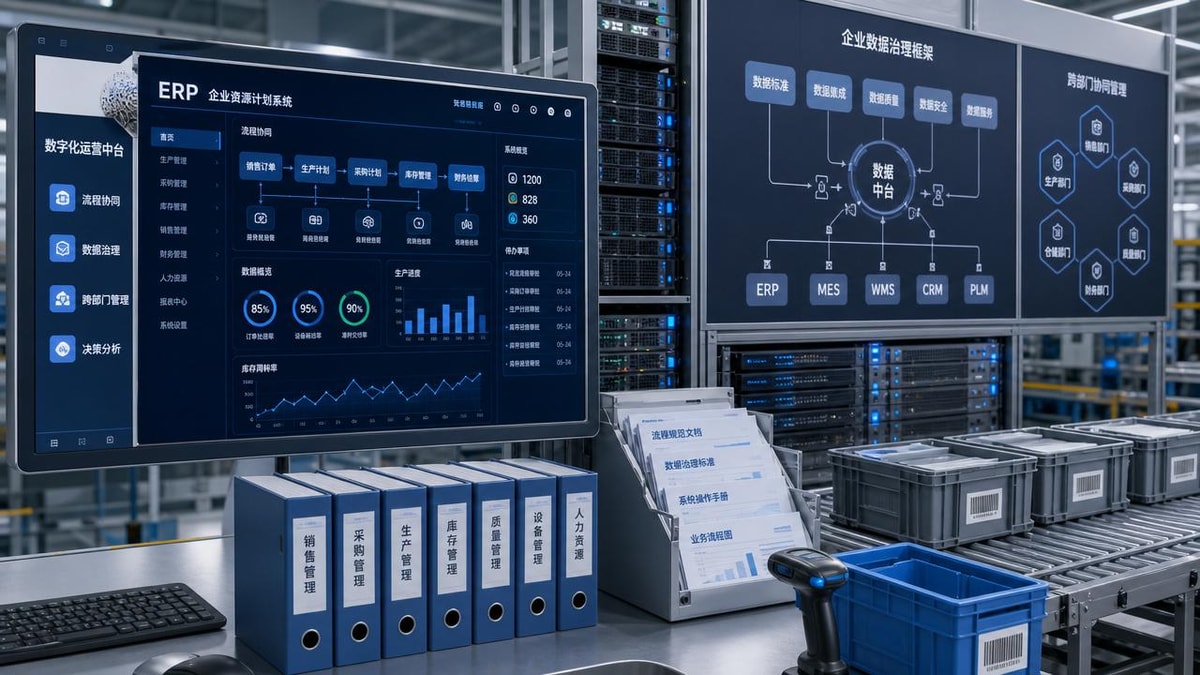
Inventory management systems that fix stock errors at the source
Inventory management systems are only valuable when they eliminate stock errors before they spread across purchasing, warehousing, and fulfillment. For enterprise decision-makers, the real advantage lies in fixing inaccuracies at the source through better data capture, process control, and cross-functional visibility. This article explores how modern systems reduce costly miscounts, improve planning accuracy, and strengthen supply chain resilience at scale.
Why stock accuracy has become a board-level issue
A noticeable shift is happening across global operations: inventory accuracy is no longer treated as a warehouse problem alone. Volatile demand, longer supplier lead times, omnichannel fulfillment, and tighter working-capital expectations have turned stock integrity into a strategic concern. When inventory records are wrong, the impact moves quickly from the shop floor to procurement, customer service, finance, and executive planning. That is why inventory management systems are now being evaluated less as recordkeeping tools and more as control platforms that prevent error creation in the first place.
This change matters especially in complex B2B environments where a single data mismatch can trigger purchase of unnecessary stock, delay outbound orders, distort forecast models, or weaken supplier negotiations. In sectors such as advanced manufacturing, healthcare technology, smart electronics, and supply chain software, leaders are increasingly asking a tougher question: not “Do we track inventory?” but “Where do stock errors begin, and can our system stop them there?”
The new trend: fixing stock errors at the source
The strongest trend in inventory management systems is a move away from reactive reconciliation. Older practices often depended on end-of-day adjustments, periodic counts, and manual correction after discrepancies were found. That model is becoming too slow for today’s operating tempo. Modern platforms are shifting upstream, targeting the moments when errors are introduced: receiving, put-away, picking, production issue, returns handling, and item master maintenance.
For enterprise decision-makers, this is an important distinction. A system that merely reports mismatches can improve visibility, but a system that controls workflows, validates transactions, and standardizes data entry can reduce the frequency of mismatches altogether. That translates into fewer emergency purchases, more reliable available-to-promise calculations, and stronger confidence in enterprise planning.
This operational shift is one of the clearest indicators that inventory management systems are becoming more central to enterprise control architecture, not just warehouse administration.

What is driving this change in the market
Several converging forces are pushing companies toward source-level correction. First is the cost of uncertainty. In a high-interest-rate and margin-sensitive environment, excess safety stock is harder to justify, yet insufficient stock still damages service levels. Businesses need cleaner inventory data to balance both risks.
Second is process complexity. More companies now operate mixed channels, distributed fulfillment nodes, outsourced production, or multi-site inventory pools. As complexity rises, manual reconciliation breaks down faster. Inventory management systems must coordinate transactions across teams and sites in near real time, or errors multiply faster than they can be corrected.
Third is the growing availability of enabling technology. Mobile scanning, IoT signals, machine-readable labels, API integration, and workflow automation have made it practical to capture inventory events where they occur. This allows businesses to reduce dependence on spreadsheet patchwork and delayed ERP updates.
Finally, there is a governance driver. Enterprise leaders are under pressure to improve auditability, traceability, and accountability. That is particularly relevant in regulated or quality-sensitive sectors, where inventory inaccuracies can create not only financial waste but compliance exposure. As a result, investment in inventory management systems increasingly aligns with risk management as much as with efficiency.
The business impact is spreading beyond the warehouse
One reason this trend deserves attention is that the effects of better stock control are increasingly cross-functional. Cleaner inventory records improve purchasing precision, planning reliability, customer promise dates, labor productivity, and financial visibility. In contrast, unresolved stock errors can silently weaken multiple departments at once.
For business leaders, the implication is clear: evaluating inventory management systems only through a warehouse lens will understate both the risk of inaction and the return on improvement.
What leading enterprises are starting to prioritize
The market is also showing a change in buying criteria. Enterprises are no longer satisfied with broad promises of visibility. They want proof that inventory management systems can enforce process discipline in the exact places where stock errors originate. This has led to a stronger focus on five decision areas.
First, data capture quality is becoming a frontline requirement. Systems must support barcode scanning, lot and serial validation, unit-of-measure consistency, and real-time transaction recording. If frontline teams can still bypass controls easily, the software may digitize mistakes rather than prevent them.
Second, integration depth matters more than feature count. Inventory management systems should connect cleanly with ERP, procurement, MES, transportation, and customer platforms. Source-level accuracy weakens when systems operate in isolation or sync too slowly.
Third, exception management is becoming a major buying signal. High-performing businesses want alerts for unusual adjustments, repetitive discrepancies, negative inventory events, receiving mismatches, and process bottlenecks. This enables managers to identify root-cause patterns instead of repeatedly correcting symptoms.
Fourth, workflow standardization is gaining importance across distributed operations. Multi-site businesses need inventory management systems that apply common logic while allowing local execution. That balance is essential for growth, acquisitions, and regional expansion.
Fifth, user adoption is being judged more realistically. Elegant dashboards do not solve inventory inaccuracy if warehouse, production, and receiving teams find the process cumbersome. Practical interface design, mobile usability, and role-specific guidance are becoming strategic, not cosmetic.
Signals decision-makers should monitor over the next 12 to 24 months
Not every operational issue requires a full system replacement, but several signals suggest that current controls are no longer enough. One signal is rising manual adjustment activity. When teams are frequently correcting balances after the fact, the business is probably treating symptoms instead of eliminating causes.
Another signal is persistent disagreement between physical counts and system records in the same item categories, locations, or shifts. Repetition usually points to process design flaws, training gaps, or missing validation rules. A third signal is increasing planner distrust. When procurement and planning teams maintain separate “shadow” spreadsheets because they do not trust inventory data, enterprise coordination is already compromised.
Decision-makers should also monitor how stock accuracy affects strategic agility. Can the business launch new SKUs, add contract manufacturers, open new fulfillment nodes, or respond to demand swings without losing control? If scaling complexity immediately reduces data reliability, then current inventory management systems may not be fit for the next growth phase.
How to respond without turning the initiative into a technology-only project
A common mistake is to frame inventory improvement as a software purchase alone. The stronger approach is to treat it as an operating model decision supported by technology. That means mapping where stock errors are created, identifying who touches inventory data, and defining which controls belong in process, training, governance, and system logic.
In practice, many enterprises benefit from a phased response. Start with the highest-cost error points, such as receiving discrepancies, production consumption variance, or mis-picks in high-value product lines. Then confirm whether the issue is caused by missing data capture, weak workflow enforcement, poor master data, or delayed cross-system updates. This approach helps leaders prioritize inventory management systems capabilities that solve the right operational problem.
Why this trend matters for long-term resilience
The broader direction is clear: resilient enterprises are building supply chains on trusted data, not on corrective effort. Inventory management systems sit at the center of that transition because inventory is the operational truth set that connects demand, supply, fulfillment, and cash. When that truth set is unstable, even strong planning tools and analytics models lose value.
For organizations navigating supplier risk, product proliferation, regionalization, or digital transformation, source-level stock accuracy is becoming a foundational capability. It supports faster decisions, lowers avoidable working-capital pressure, and reduces the hidden operational friction that often limits scale.
Practical questions to confirm your next move
If your business is reassessing inventory management systems, the most useful next step is not to begin with a feature checklist. Instead, confirm a few strategic questions. Which stock errors create the highest downstream cost? At what transaction point do they begin? Which teams are compensating manually for weak inventory trust? And can your current processes support growth without increasing correction work?
Enterprises that answer these questions clearly are better positioned to select or refine inventory management systems that improve accuracy at the source rather than merely documenting failure after it happens. For decision-makers, that is the difference between software that stores inventory records and systems that actively protect operational performance.
Get weekly intelligence in your inbox.
No noise. No sponsored content. Pure intelligence.
 May 05, 2026Inventory management systems that fix stock errors at the sourceInventory management systems that fix stock errors at the source
 May 05, 2026Medical disposables sourcing gets risky when prices drop too fastMedical disposables sourcing gets risky when prices drop too fast
 May 05, 2026Supply Chain Management gaps that create hidden inventory costsSupply Chain Management gaps that create hidden inventory costs
 May 05, 2026Why ERP software rollouts fail even with strong vendor supportWhy ERP software rollouts fail even with strong vendor support
 May 05, 2026Patient monitors: which features actually improve bedside responsePatient monitors: which features actually improve bedside response
 May 05, 2026Medical PPE shortages are easing, but quality gaps remainMedical PPE shortages are easing, but quality gaps remain
 May 05, 2026Portable oxygen concentrators: what matters beyond battery lifePortable oxygen concentrators: what matters beyond battery life
 May 05, 2026Medical diagnostic equipment buying mistakes that cost more laterMedical diagnostic equipment buying mistakes that cost more later
 May 05, 2026Cold chain logistics failures often start before transitCold chain logistics failures often start before transit
 May 05, 2026Hydrogen energy projects face one cost issue few plan forHydrogen energy projects face one cost issue few plan for
 May 05, 2026Digital Footprint risks that grow when suppliers scale fastDigital Footprint risks that grow when suppliers scale fast
 May 05, 2026Cross border ecommerce fulfillment problems that hurt repeat salesCross border ecommerce fulfillment problems that hurt repeat sales
 May 05, 2026N95 respirators: why fit matters more than many expectN95 respirators: why fit matters more than many expect
 May 05, 2026Ultrasound machines: when image quality and workflow clashUltrasound machines: when image quality and workflow clash
 May 05, 2026LED displays for retail spaces: brightness is not the only issueLED displays for retail spaces: brightness is not the only issue
 May 05, 2026What to check before placing wheelchairs wholesale ordersWhat to check before placing wheelchairs wholesale orders
 May 05, 2026Freight forwarding services that help avoid customs delaysFreight forwarding services that help avoid customs delays
 May 05, 2026Aesthetic lasers: the difference between power and precisionAesthetic lasers: the difference between power and precision
 May 05, 2026How rehabilitation equipment choices affect recovery routinesHow rehabilitation equipment choices affect recovery routines
 May 05, 2026Robot vacuum cleaners with mapping: what changes in daily useRobot vacuum cleaners with mapping: what changes in daily use
 May 05, 2026Where logistics drones make sense and where they still do notWhere logistics drones make sense and where they still do not
 May 05, 2026B2B SaaS solutions that reduce manual trade workflowsB2B SaaS solutions that reduce manual trade workflows
 May 05, 2026What makes 3PL logistics performance hard to measure fairlyWhat makes 3PL logistics performance hard to measure fairly
 May 05, 2026Shipping rates are shifting again: what costs are easy to missShipping rates are shifting again: what costs are easy to miss
 May 05, 2026Trade Leaders in 2026: what will separate winners from the restTrade Leaders in 2026: what will separate winners from the rest
 May 05, 2026Why smart warehousing projects stall after the pilot stageWhy smart warehousing projects stall after the pilot stage
 May 05, 2026AGV robots or forklifts: which fits busy warehouses better?AGV robots or forklifts: which fits busy warehouses better?