What Is Supply Chain Visibility? Key Data, Benefits, and Challenges
Supply chain visibility is the ability to see relevant information about goods, inventory, suppliers, and operational events as products move through a supply network. For procurement and supply chain teams, that view can reveal disruptions earlier, support better decisions, and improve coordination with partners.
But visibility is more than knowing where a shipment is. A container may be on schedule while a component inside it is unsuitable for production, or a supplier may report adequate inventory without explaining that a critical subcomponent comes from a vulnerable source. Useful visibility connects operational data to the decisions people need to make—and makes clear where the picture is incomplete.
What does supply chain visibility include?
At its simplest, supply chain visibility answers four questions: What is happening, where is it happening, when did the information become available, and what might be affected? The scope can extend from raw-material suppliers through manufacturing, warehousing, transportation, distribution, and customer delivery.
Visibility does not mean that every participant shares every detail. An organization may have a strong view of shipments from its direct suppliers but little information about the factories or material sources those suppliers depend on. That distinction matters when a disruption occurs upstream.
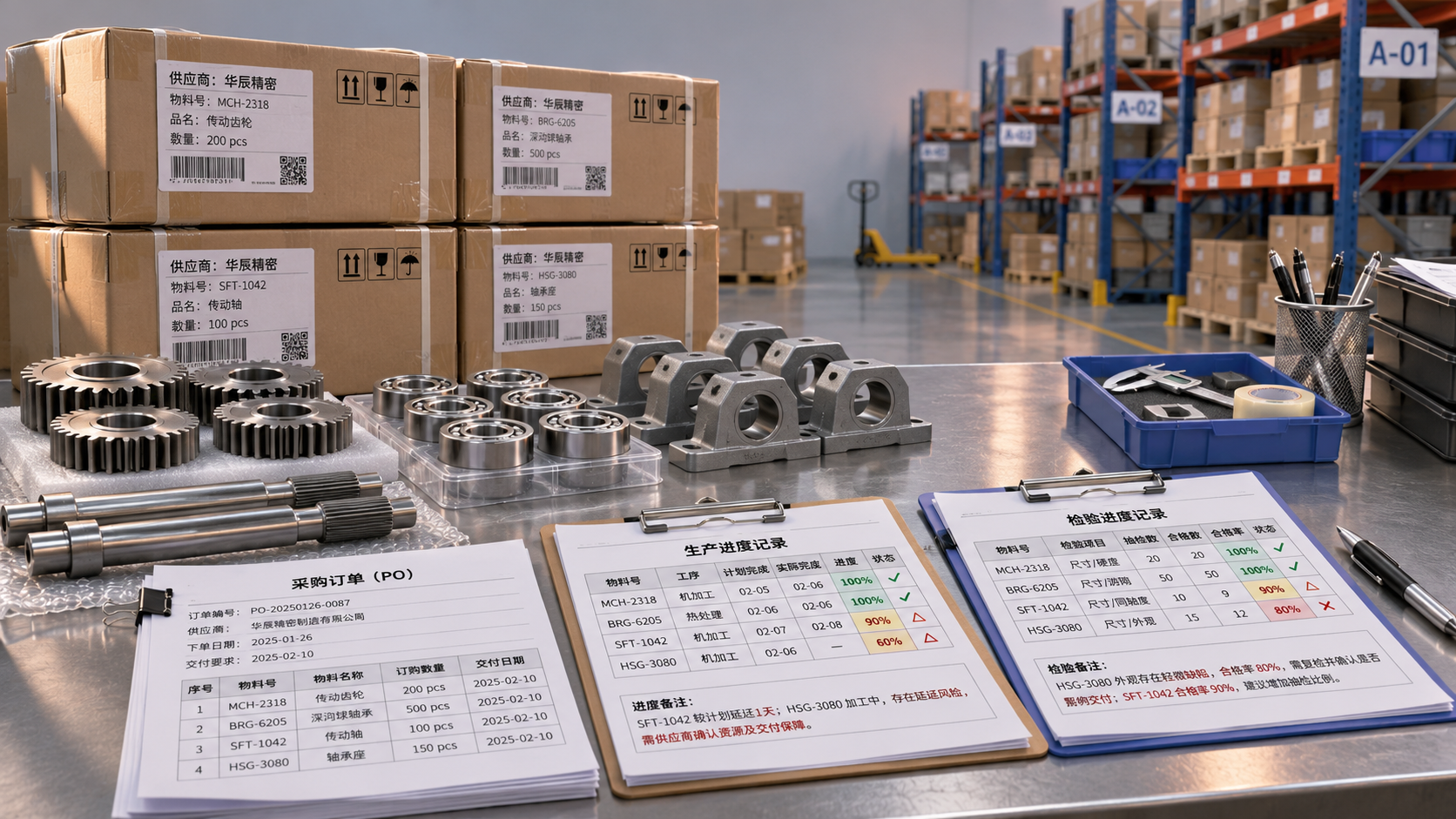
A practical visibility system brings together information from internal systems and external partners, identifies relevant changes, and presents them in a form that someone can act on. Depending on the business, the information may come from purchase orders, supplier updates, warehouse transactions, carrier milestones, or product-level records.

Visibility, traceability, and supply chain management
These terms overlap, but they are not interchangeable:
- Visibility provides a view of the status and location of relevant supply chain activities, often across multiple organizations.
- Traceability links a specific product, batch, lot, or material to its history and movements. It is particularly useful for investigations, recalls, and provenance claims.
- Supply chain management is the broader discipline of planning and coordinating sourcing, production, inventory, logistics, and related activities.
A business can know that a shipment arrived without knowing which production lots were inside it. Conversely, it may have detailed lot records for a finished product but limited visibility into a delayed inbound shipment. The right level of detail depends on the decision at hand.
Which data matters for supply chain visibility?
More data is not automatically better. The most useful information connects a business object—such as a purchase order, shipment, item, or lot—to an event and its context. At minimum, teams need to know what happened, where, when, and which record the event relates to.
Each category has limits. A carrier’s estimated arrival time is a prediction, not a confirmed delivery. A supplier’s inventory figure may include stock already promised to another customer. A risk alert may indicate that a facility is near a disruption without confirming that production has stopped.
Useful context includes the source, event time, last update, and confidence or verification status. Without these details, a dashboard can make stale or unconfirmed information look authoritative.
For a common approach to identifying products, locations, and supply chain events, see the GS1 EPCIS standard, which defines a way to share event data about the “what, when, where, why and how” of products and other assets: https://www.gs1.org/standards/epcis.
How visibility improves decisions
Visibility creates value when it changes what a team can do, not merely what it can see. Consider a manufacturer waiting for a critical electronic component. If a supplier reports a production delay and links it to affected purchase orders, the buyer can check available inventory, assess alternative sources, and communicate a revised production plan. If the same update arrives only after the scheduled delivery date, those options may be narrower.
Common benefits include:
- Earlier exception management. Teams can investigate missed milestones, unconfirmed orders, or quality holds before they become larger problems.
- Better inventory decisions. A more reliable view of stock and inbound materials can help planners distinguish a genuine shortage from inventory that is delayed or recorded elsewhere.
- Clearer partner coordination. Shared order and shipment references reduce time spent reconciling different versions of the same situation.
- More targeted disruption response. Mapping products and purchase orders to suppliers or facilities helps teams identify which operations may be exposed.
- Faster quality investigations. Connecting materials, lots, and destinations can help narrow the scope of an investigation when an issue is discovered.
These are potential outcomes, not automatic results. A company still needs ownership, escalation rules, and realistic response options. Knowing that a sole-source part is late does not create a substitute; it does give the organization a better basis for deciding what to do next.
Why supply chain visibility is difficult
Partners see different parts of the network
A buyer usually has a contractual relationship with its direct, or tier-one, supplier. That supplier may depend on other manufacturers, processors, or raw-material providers. The buyer may not know all of those upstream relationships, and its supplier may be unable or unwilling to disclose them.
Start by mapping the products and facilities that matter most. Ask direct suppliers which upstream dependencies are essential, what information they can share, and how changes will be communicated. An incomplete map should be labeled as incomplete rather than treated as proof that no further risk exists.
Identifiers and definitions do not match
One company’s product code may differ from its supplier’s code. A shipment can be referenced by a purchase order, container number, booking number, or carrier tracking number. Even a familiar term such as “shipped” may mean dispatched from a factory to one partner and handed to a carrier to another.
Agreeing on shared identifiers, milestone definitions, units of measure, and update responsibilities is often as important as connecting software. If records cannot be matched, a stream of timely events may still be difficult to use.
Data can be late, missing, or misleading
Some events are captured automatically; others depend on a person entering an update. A missing scan does not necessarily mean goods have stopped moving, and a recent update does not guarantee that the underlying information is correct.
Measure data quality by checking completeness, timeliness, consistency, and accuracy where verification is possible. Give users a way to distinguish an actual event from an estimate, and define what should happen when no update arrives.
Sharing creates commercial and security concerns
Suppliers may regard customer lists, production volumes, pricing, or sub-supplier relationships as sensitive. Broader access also creates information-security and privacy responsibilities. The answer is not to demand unrestricted access by default, but to agree on the minimum information needed for a specific purpose, who can see it, and how long it is retained.
For a recognized framework for managing cybersecurity risk, including supply chain considerations, consult the U.S. National Institute of Standards and Technology Cybersecurity Framework 2.0: https://www.nist.gov/cyberframework. Legal and contractual requirements vary by jurisdiction and the type of data involved.
How to start building a clearer view
A focused pilot is usually more informative than an attempt to map every product and partner at once. Choose an operational problem with a clear owner and a decision that could improve if better information were available.
- Define the decision. For example, determine which inbound material shortages could interrupt a production line, or which customer orders are exposed to a late shipment.
- Set the scope. Select a product family, lane, facility, or group of suppliers. Include the internal teams and external partners who can provide or use the information.
- Identify the minimum data. List the order references, milestones, quantities, locations, and timestamps required. Record where each field originates and who maintains it.
- Agree on exception rules. Specify what counts as a meaningful deviation, who investigates it, and when it should be escalated. Avoid alerts that do not lead to a possible action.
- Test data and workflow together. Reconcile a sample of events with source records, then follow an exception through to a decision. A technically successful connection is not enough if no one owns the response.
- Review and expand selectively. Examine missing updates, unresolved exceptions, and user feedback before adding more suppliers, products, or data sources.
Possible measures include the share of in-scope orders with a supplier-confirmed date, the proportion of required milestones received on time, and the time between an exception being identified and its review. Choose measures that match the pilot’s objective; a high volume of updates alone does not demonstrate better decisions.
What to look for in a visibility tool
Software can bring fragmented information together, but it cannot compensate for undefined processes or partner data that does not exist. When evaluating a supply chain visibility platform, ask vendors to demonstrate how it would handle a real workflow rather than only a polished dashboard.
- Coverage: Which suppliers, carriers, regions, and transport modes can provide data, and where are there gaps?
- Integration: How are purchase orders, inventory records, and shipment events linked to existing systems?
- Data provenance: Can users see the source, update time, and whether a milestone is actual or estimated?
- Exception handling: Can teams assign, investigate, and resolve issues without relying entirely on email?
- Access and governance: Can information be restricted by role and partner, with responsibilities for maintaining records?
- Practical adoption: What must suppliers do to participate, and can smaller partners contribute without complex integration?
Request a pilot using representative records, including missing and conflicting updates. This reveals more about operational fit than a demonstration built entirely on complete data.
Frequently asked questions
Is real-time tracking necessary for supply chain visibility?
Not always. The appropriate update frequency depends on how quickly a decision must be made and how often conditions change. A daily supplier commitment may be sufficient for a long-lead material, while a time-sensitive delivery may justify more frequent transport updates. More frequent data is only useful if someone can act on it.
Can a company have visibility beyond its direct suppliers?
Yes, but it generally requires cooperation from direct suppliers and, in some cases, their suppliers. The resulting view may be partial. Businesses should identify which upstream facilities are known, how the information was verified, and where dependencies remain unknown.
What is the difference between visibility and control?
Visibility provides information about a situation; control is the ability to influence the outcome. A company may see that a port is disrupted without being able to reopen it. It can still use that information to evaluate alternatives, update stakeholders, and prioritize scarce inventory.
Get weekly intelligence in your inbox.
No noise. No sponsored content. Pure intelligence.
 Nov 27, 2026What Is Supply Chain Visibility? Key Data, Benefits, and ChallengesWhat Is Supply Chain Visibility? Key Data, Benefits, and Challenges
 Nov 26, 2026Fluence Says US Production Delays Are Under Control as Backlog Reaches $8.9 BillionFluence Says US Production Delays Are Under Control as Backlog Reaches $8.9 Billion
 Nov 26, 2026Guangzhou Lithium Hydroxide Futures Fall Over 6% on Debut as Demand WeakensGuangzhou Lithium Hydroxide Futures Fall Over 6% on Debut as Demand Weakens
 Nov 26, 2026EU Hybrid Import Limits Spark Demand Fears as CATL Shares Fall 12%EU Hybrid Import Limits Spark Demand Fears as CATL Shares Fall 12%
 Nov 26, 2026How Negative Pressure Works in a Biosafety Cabinet to Contain AerosolsHow Negative Pressure Works in a Biosafety Cabinet to Contain Aerosols
 Nov 25, 2026Trump Administration Plans New Tariff Measures Affecting 16 Trading PartnersTrump Administration Plans New Tariff Measures Affecting 16 Trading Partners
 Nov 25, 2026UK Energy Price Cap to Rise 26%, Adding £443 to Typical Annual BillUK Energy Price Cap to Rise 26%, Adding £443 to Typical Annual Bill
 Nov 25, 2026German Solar Developers and Battery Makers Hit by Third-Quarter BankruptciesGerman Solar Developers and Battery Makers Hit by Third-Quarter Bankruptcies
 Nov 25, 2026Remote Site Microgrids: How to Plan Reliable Power for Off-Grid OperationsRemote Site Microgrids: How to Plan Reliable Power for Off-Grid Operations
 Nov 24, 2026China to Suspend Some Critical Materials Export Controls on the US Until JanuaryChina to Suspend Some Critical Materials Export Controls on the US Until January
 Nov 24, 2026Japan's Battery Storage Market Expands Amid Revenue UncertaintyJapan's Battery Storage Market Expands Amid Revenue Uncertainty
 Nov 24, 2026Ukraine Finds Over 16,000 Foreign-Made Components in Russian DronesUkraine Finds Over 16,000 Foreign-Made Components in Russian Drones
 Nov 24, 2026Bulk Pricing for Stretch Wrapping Machines: What Affects Your Quote?Bulk Pricing for Stretch Wrapping Machines: What Affects Your Quote?
 Nov 23, 2026Lidar Q3 Earnings Point to Rising Robotics Demand and Automotive WeaknessLidar Q3 Earnings Point to Rising Robotics Demand and Automotive Weakness
 Nov 23, 2026Australia's AEMO Relies on 5.3 GW of New Battery Storage for SummerAustralia's AEMO Relies on 5.3 GW of New Battery Storage for Summer
 Nov 23, 2026US Energy Storage Capacity Surpasses 200 GWhUS Energy Storage Capacity Surpasses 200 GWh
 Nov 23, 2026Smart Factory Solutions for Discrete Manufacturing: Connecting Machines and MESSmart Factory Solutions for Discrete Manufacturing: Connecting Machines and MES
 Nov 22, 2026Golmud's 60 MW Liquid Air Storage Project Uses Fully Domestic EquipmentGolmud's 60 MW Liquid Air Storage Project Uses Fully Domestic Equipment
 Nov 22, 2026Precision Engineering for Medical Devices: Tolerances and MaterialsPrecision Engineering for Medical Devices: Tolerances and Materials
 Nov 21, 2026EDF Acquires 1GWh Holloway Battery Storage Project in AustraliaEDF Acquires 1GWh Holloway Battery Storage Project in Australia
 Nov 21, 2026Choosing Carbon Steel Grades for OEM Machined Parts: Key FactorsChoosing Carbon Steel Grades for OEM Machined Parts: Key Factors
 Nov 20, 2026China’s First Virtual Power Plant Report Says Capacity Target Met EarlyChina’s First Virtual Power Plant Report Says Capacity Target Met Early
 Nov 20, 2026Choosing an OEM Heavy Equipment Manufacturer: Capabilities and Quality ChecksChoosing an OEM Heavy Equipment Manufacturer: Capabilities and Quality Checks
 Nov 19, 2026India Adds Record 8.4 GW of Open-Access Solar in First Nine Months of 2026India Adds Record 8.4 GW of Open-Access Solar in First Nine Months of 2026
 Nov 19, 2026B2B Intelligence for Green Energy: Finding New Market OpportunitiesB2B Intelligence for Green Energy: Finding New Market Opportunities
 Nov 18, 2026Global Solar Additions Hit Record in 2025, Forecast to Fall in 2026Global Solar Additions Hit Record in 2025, Forecast to Fall in 2026
 Nov 18, 2026Supply Chain Visibility for Supplier Management: How to Spot Delivery RisksSupply Chain Visibility for Supplier Management: How to Spot Delivery Risks