Flexible Printed Circuits: Rigid-Flex or FPC?
As smart electronics and medical devices evolve, choosing between rigid-flex designs and flexible printed circuits can directly affect reliability, cost, and manufacturability. From portable ultrasound scanners and wearable ECG monitors to custom PCB boards and SMT assembly services, today’s buyers need clearer benchmarks. This article explores how flexible printed circuits compare with rigid-flex solutions for performance, integration, and sourcing decisions.
For most buyers, engineers, and sourcing teams, the real question is not “Which technology is better in general?” but “Which option fits my product, budget, assembly process, and risk tolerance?” The short answer is this: standard flexible printed circuits (FPC) are usually the better choice when low weight, tight bending, compact routing, and cost control matter most. Rigid-flex is often the stronger option when you need higher interconnect reliability, more stable assembly, fewer connectors, and better performance in complex or space-constrained products. The right decision depends on use case, lifecycle expectations, and total project cost rather than material price alone.
How should buyers decide between rigid-flex and FPC in real projects?
The most effective way to compare rigid-flex and FPC is to evaluate them across five practical dimensions: mechanical demands, electrical complexity, assembly requirements, reliability risk, and total cost of ownership.
Choose FPC when:
- The design needs repeated or static bending with minimal structure.
- The product is cost-sensitive and high-volume.
- The circuit mainly serves as a lightweight interconnect.
- The assembly architecture can tolerate connectors or ZIF interfaces.
- The design is relatively simple and does not require mounting many components on the flexible area.
Choose rigid-flex when:
- You want to replace multiple connectors, cables, or board-to-board interfaces.
- The product has a compact 3D form factor.
- Assembly reliability is more important than achieving the lowest unit price.
- Space is limited and component integration is high.
- The application faces shock, vibration, or repeated handling.
For procurement directors and project managers, this distinction matters because a cheaper FPC-based design can become more expensive if it requires extra connectors, manual assembly, higher failure rates, or more field service. Conversely, rigid-flex may look expensive upfront but reduce system-level complexity and long-term quality risk.
What is the actual difference between rigid-flex and flexible printed circuits?
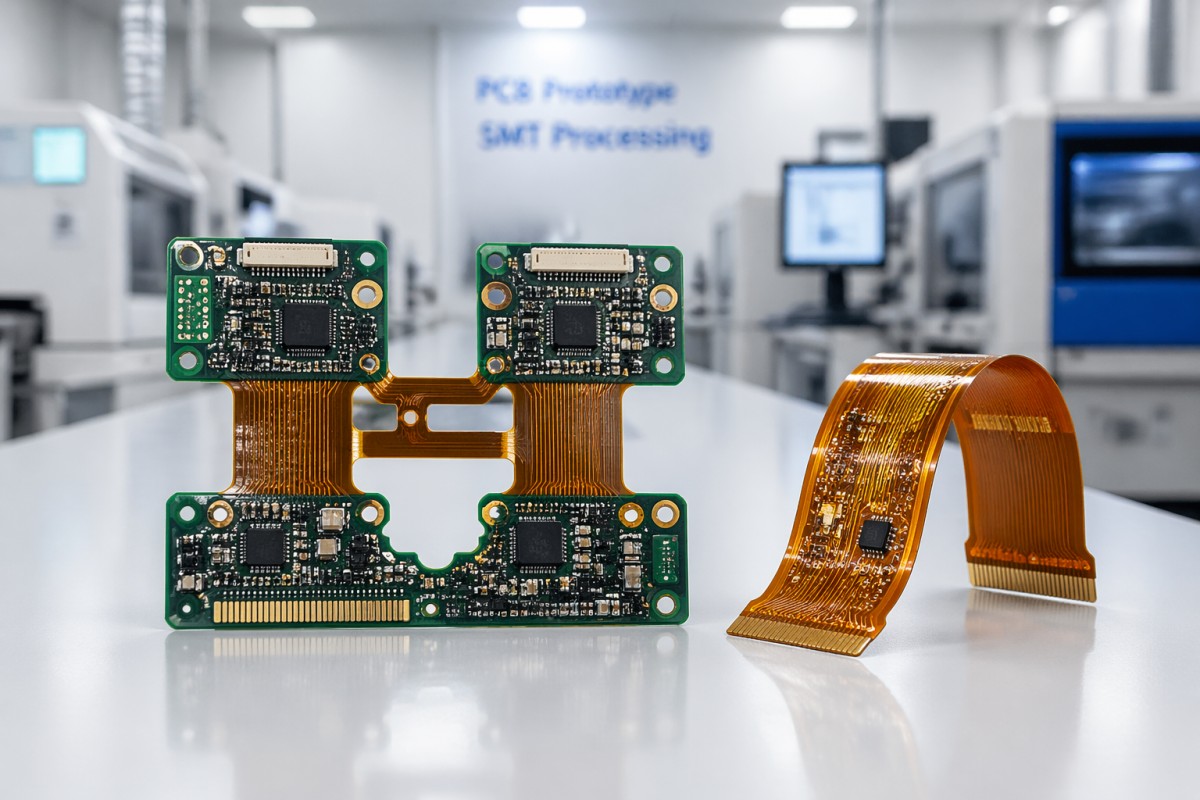
A flexible printed circuit is a circuit built on flexible substrate materials such as polyimide, allowing the board to bend, fold, or fit into compact spaces. FPCs are widely used in cameras, displays, battery connections, wearables, printers, and medical handhelds.
A rigid-flex PCB combines rigid board sections and flexible circuit sections into one integrated structure. It allows components to be mounted on rigid areas while the flex sections connect them through folds or bends. This architecture reduces cable harnesses and connector interfaces.
In simple terms:
- FPC = flexible interconnect-focused solution, often simpler and lighter.
- Rigid-flex = integrated board architecture, often more robust and function-dense.
This is why the comparison is not purely technical. It affects design freedom, assembly workflow, supplier qualification, testing, and maintenance planning.
Which option performs better for reliability and product lifespan?
Reliability is often the deciding factor in medical devices, industrial electronics, automotive subsystems, and premium portable products. In these scenarios, rigid-flex frequently has the advantage because it eliminates connector points that can loosen, corrode, or fail under vibration.
However, FPC can also be highly reliable when used correctly. Problems usually arise not because FPC is inherently weak, but because the design ignores bend radius limits, reinforcement needs, strain relief, or insertion cycle requirements.
Rigid-flex reliability strengths:
- Fewer connectors and solder joints between separate boards
- Better mechanical stability for component mounting
- Improved resistance to vibration-related interconnect failure
- More controlled system integration in compact devices
FPC reliability strengths:
- Excellent for dynamic or repeated bending if designed for motion
- Lightweight and thin, reducing stress in portable devices
- Suitable for tightly packaged electronics with low mass
Quality teams should pay attention to copper trace design, coverlay quality, stiffener placement, impedance requirements, bend zone rules, and cycle-life validation. A poor design will fail regardless of technology choice. A capable supplier should provide DFM feedback before production, not after tooling issues appear.
How do cost and total sourcing economics really compare?
This is where many decisions go wrong. Buyers often compare only the board price, but the better metric is total delivered system cost. That includes materials, tooling, assembly labor, testing, scrap risk, rework, field reliability, and qualification time.
FPC usually wins on direct unit cost when:
- The circuit is relatively simple
- Production volumes are high
- The product architecture already uses connectors efficiently
- The design does not need multiple rigid component zones
Rigid-flex may win on total cost when:
- It replaces several separate PCBs and cable assemblies
- It reduces assembly steps and manual wiring
- It lowers service failure rates
- It saves internal space and enables a smaller product enclosure
For financial approvers, the key question is whether paying more for the interconnect structure reduces downstream cost and quality exposure. In regulated or high-reliability sectors such as healthcare technology, that tradeoff is often justified.
What should engineers and sourcing teams check before selecting a supplier?
Whether you are sourcing custom PCB boards, SMT assembly services, or full box-build support, supplier capability matters as much as the design choice itself. Not every PCB manufacturer handles FPC and rigid-flex with the same process maturity.
Ask suppliers these questions early:
- Do you have proven experience with both rigid-flex and multilayer FPC fabrication?
- What are your minimum trace/space, bend area, and layer stackup capabilities?
- Can you support impedance control and high-density interconnect requirements?
- How do you manage coverlay alignment, stiffeners, and flex-to-rigid transitions?
- Can you provide design for manufacturability review before tooling release?
- Do you offer SMT assembly for flex and rigid-flex structures?
- What reliability tests do you perform, such as bend testing, thermal cycling, and continuity checks?
- What quality standards and certifications do you hold?
Distributors, agents, and procurement managers should also assess communication quality, engineering responsiveness, prototype lead times, and ability to scale from pilot builds to volume production. A technically advanced supplier that responds slowly or inconsistently can still become a project risk.
Which applications are best suited to FPC, and which are better for rigid-flex?
Typical FPC-friendly applications:
- Display connections
- Battery modules
- Consumer wearables
- Compact sensors
- Portable scanners
- Camera modules
Typical rigid-flex-friendly applications:
- Portable medical devices
- Wearable ECG monitors with dense electronics
- Aerospace or industrial handheld equipment
- Complex smart electronics with folded 3D packaging
- Products where connector reduction is a reliability priority
In healthcare technology especially, the decision often comes down to balancing compact design, sterilization or handling conditions, reliability expectations, and service life. If the product must survive transport, repeated use, and constrained packaging, rigid-flex often provides a stronger platform. If the objective is a thin, lightweight signal path with efficient high-volume production, FPC may be the better fit.
What is the smartest decision framework for procurement and project teams?
A practical selection framework is to score both options across the following criteria:
- Mechanical requirement: static bend, dynamic bend, folding, vibration
- Electrical complexity: layer count, impedance, signal integrity, component density
- Assembly model: connectors, SMT process, handling difficulty, fixture needs
- Reliability target: expected lifespan, service environment, maintenance cost
- Commercial fit: tooling budget, annual volume, prototype urgency, supply risk
If a project scores high on integration complexity, reliability sensitivity, and connector reduction value, rigid-flex is often the stronger business case. If it scores high on flexibility, thinness, and direct cost sensitivity with manageable assembly complexity, FPC is typically the better choice.
This framework helps cross-functional teams align engineering logic with sourcing realities and executive approval criteria.
Conclusion: rigid-flex or FPC?
There is no universal winner between rigid-flex and flexible printed circuits. FPC is often ideal for lightweight, compact, and cost-conscious designs that require bending or flexible routing. Rigid-flex is often the better investment when reliability, assembly simplification, and 3D integration are critical.
For enterprise buyers and product teams, the best decision is not based on board price alone. It should reflect the full product context: application demands, assembly design, expected lifespan, failure risk, and supplier capability. When evaluated this way, the rigid-flex versus FPC decision becomes much clearer and far more strategic.
If your project involves portable medical devices, smart electronics, or custom PCB assembly, comparing these two options early can prevent redesigns, sourcing delays, and avoidable lifecycle costs.
Get weekly intelligence in your inbox.
No noise. No sponsored content. Pure intelligence.
 Apr 28, 2026Suez Canal Fee Hike & China-Europe Rail Premium: Q2 2026 ImpactSuez Canal Fee Hike & China-Europe Rail Premium: Q2 2026 Impact
 Apr 28, 2026TÜV Rheinland Launches Fast-Track Certification for Chinese Warehouse RobotsTÜV Rheinland Launches Fast-Track Certification for Chinese Warehouse Robots
 Apr 28, 2026EU Enforces Battery Passport Rule for Chinese ESS Exports from 2027EU Enforces Battery Passport Rule for Chinese ESS Exports from 2027
 Apr 28, 2026ADB Raises Vietnam GDP Forecast to 7.2%: SMT & Precision Fixture Demand RisesADB Raises Vietnam GDP Forecast to 7.2%: SMT & Precision Fixture Demand Rises
 Apr 28, 2026US ITC Launches Section 337 Investigation into Chinese Wi-Fi 7 RF FEMsUS ITC Launches Section 337 Investigation into Chinese Wi-Fi 7 RF FEMs
 Apr 28, 2026Côte d'Ivoire Opens $500M Power Tender: Chinese BESS Get Fast-Track AccessCôte d'Ivoire Opens $500M Power Tender: Chinese BESS Get Fast-Track Access
 Apr 28, 2026BP’s Algeria East Basin Permit Spurs Valve Demand, Lead Times Extend to 18 WeeksBP’s Algeria East Basin Permit Spurs Valve Demand, Lead Times Extend to 18 Weeks
") Apr 28, 2026Vietnam Mandates V-Trust for Smart Appliances Export (July 2026)Vietnam Mandates V-Trust for Smart Appliances Export (July 2026)
Apr 28, 2026Vietnam Mandates V-Trust for Smart Appliances Export (July 2026)Vietnam Mandates V-Trust for Smart Appliances Export (July 2026) Apr 28, 2026Morocco Enforces PV Mounting Structure Certification from Q3 2026Morocco Enforces PV Mounting Structure Certification from Q3 2026
 Apr 28, 2026UAE Establishes AI Hub Status, Opens CE-ADAS+ Pathway for Chinese Smart Industrial EquipmentUAE Establishes AI Hub Status, Opens CE-ADAS+ Pathway for Chinese Smart Industrial Equipment
 Apr 27, 2026Algeria’s Oil & Steel FDI Push Opens Valve, Corrosion-Resistant Material OrdersAlgeria’s Oil & Steel FDI Push Opens Valve, Corrosion-Resistant Material Orders
 Apr 27, 2026Azerbaijan’s New PV Mounting Standard Opens Path for Chinese SuppliersAzerbaijan’s New PV Mounting Standard Opens Path for Chinese Suppliers
 Apr 27, 2026Fitch Cuts East Africa Growth Forecasts, Raises Cross-Border Trade RisksFitch Cuts East Africa Growth Forecasts, Raises Cross-Border Trade Risks
 Apr 27, 2026ADB Raises Vietnam GDP Forecast to 7.2% on Electronics Export GrowthADB Raises Vietnam GDP Forecast to 7.2% on Electronics Export Growth
 Apr 27, 2026Maine Halts Large Data Centers: AI Server Export ImpactMaine Halts Large Data Centers: AI Server Export Impact
 Apr 27, 2026OFID $500M for Côte d'Ivoire: Boost to Factory Automation & Warehouse RoboticsOFID $500M for Côte d'Ivoire: Boost to Factory Automation & Warehouse Robotics
 Apr 27, 2026Morocco Ranks 4th in EU Energy Aid to AfricaMorocco Ranks 4th in EU Energy Aid to Africa
 Apr 27, 2026UAE Emerges as Global AI Hub, Opening Fast-Track for Chinese Smart DevicesUAE Emerges as Global AI Hub, Opening Fast-Track for Chinese Smart Devices
") Apr 26, 2026China Releases Green Design Guidelines for Industrial Products (2026)China Releases Green Design Guidelines for Industrial Products (2026)
Apr 26, 2026China Releases Green Design Guidelines for Industrial Products (2026)China Releases Green Design Guidelines for Industrial Products (2026) Apr 26, 2026ANATEL Mandates Portuguese Offline Voice Assistant for Smart Home Devices in BrazilANATEL Mandates Portuguese Offline Voice Assistant for Smart Home Devices in Brazil
 Apr 26, 2026Vietnam Enforces Bilingual Safety Labels for Electronic Components from Apr 22, 2026Vietnam Enforces Bilingual Safety Labels for Electronic Components from Apr 22, 2026
 Apr 26, 2026Japan Updates JIS for Rehab Devices: IEC 62366-1:2024 RequiredJapan Updates JIS for Rehab Devices: IEC 62366-1:2024 Required
 Apr 26, 2026THE Alliance Cuts Ningbo–Rotterdam Transit to 18 Days, Spot Rates Up 35%THE Alliance Cuts Ningbo–Rotterdam Transit to 18 Days, Spot Rates Up 35%
 Apr 26, 2026India BIS Mandates PLC & HMI Certification under IS 13252:2025 by Oct 2026India BIS Mandates PLC & HMI Certification under IS 13252:2025 by Oct 2026
") Apr 26, 2026SASO Enforces New EV Charger Rules in Saudi Arabia (2026)SASO Enforces New EV Charger Rules in Saudi Arabia (2026)
Apr 26, 2026SASO Enforces New EV Charger Rules in Saudi Arabia (2026)SASO Enforces New EV Charger Rules in Saudi Arabia (2026) Apr 26, 2026TÜV Rheinland Updates IoT EMC Guidelines: AI Edge Modules Now Mandatory for Immunity TestingTÜV Rheinland Updates IoT EMC Guidelines: AI Edge Modules Now Mandatory for Immunity Testing
 Apr 26, 2026USTR Launches First Annual Review of China Solar PV AD/CVD OrdersUSTR Launches First Annual Review of China Solar PV AD/CVD Orders