How to Quote Custom PCB Boards Faster
Need custom pcb boards quoted faster without sacrificing accuracy? For buyers and project teams working across smart electronics and healthcare devices—from MRI machine components and portable ultrasound scanners to smart glucometers, digital blood pressure monitors, wearable ECG monitors, remote patient monitoring systems, telemedicine carts, SMT assembly services, and flexible printed circuits—speed depends on having the right files, specs, and supplier communication aligned from the start.
If you want faster PCB quotes, the main answer is simple: suppliers can only quote quickly when your technical package is complete, your commercial requirements are clear, and your risk points are identified upfront. In most cases, quote delays are not caused by pricing itself—they come from missing Gerber files, unclear stack-up requirements, unspecified testing standards, uncertain component sourcing, or back-and-forth questions about volume, lead time, and quality expectations.
For procurement teams, engineers, project managers, and approvers, the goal is not just to get a number fast. It is to get a quote that is usable for comparison, realistic for production, and low-risk for delivery. That is especially important in regulated or performance-sensitive applications such as medical electronics, smart sensing devices, and compact connected hardware.
Why custom PCB board quotes get delayed in the first place
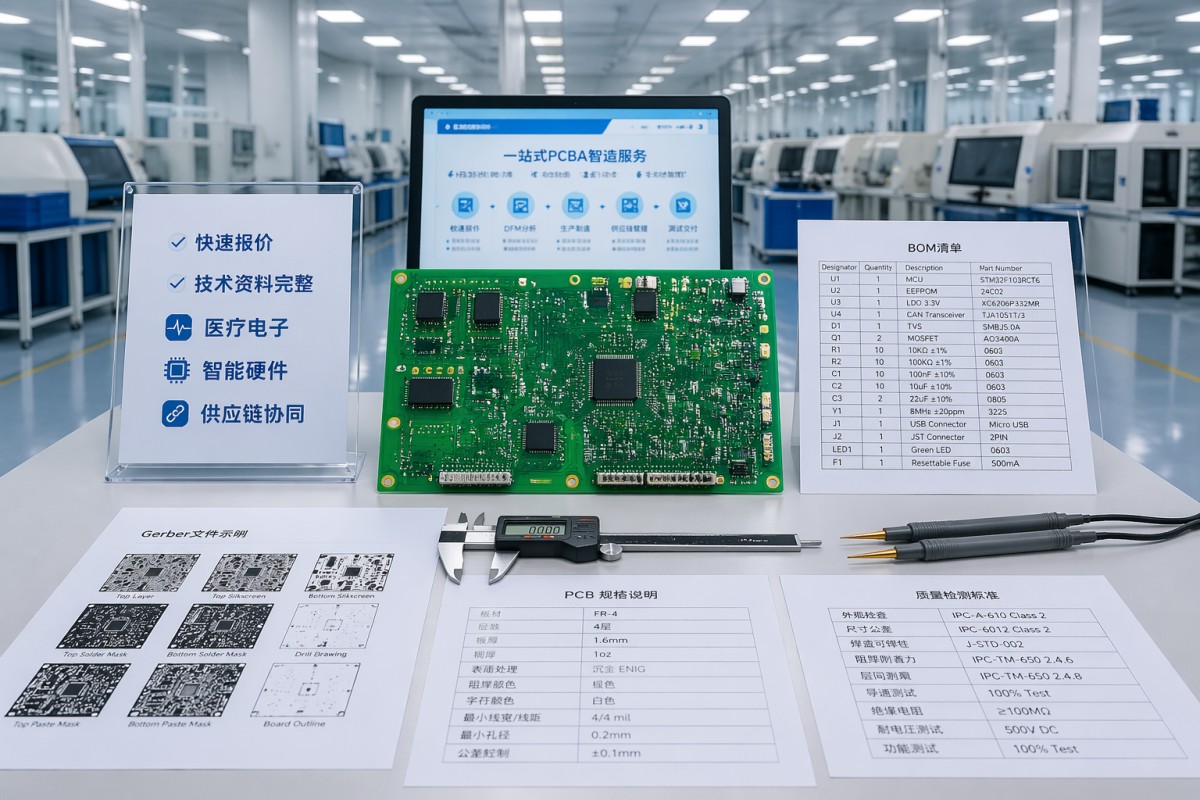
The biggest bottleneck in custom PCB quoting is incomplete or inconsistent input data. A supplier may respond slowly not because they are inefficient, but because they cannot responsibly price what has not been clearly defined.
The most common delay factors include:
- Missing or outdated Gerber, ODB++, or drill files
- No clear bill of materials for PCBA projects
- Unspecified board dimensions, thickness, copper weight, or layer count
- Unclear surface finish requirements such as ENIG, HASL, or immersion silver
- No tolerance expectations for impedance, hole size, warpage, or assembly fit
- Unconfirmed annual volume, prototype quantity, or batch size
- Unclear testing needs such as flying probe, ICT, AOI, X-ray, or functional test
- Open questions around material substitutions or component availability
- Lack of target delivery date, Incoterms, or shipping destination
For high-mix or technically complex programs, even one of these gaps can trigger multiple clarification rounds. That slows supplier response, reduces quote comparability, and increases the risk of hidden assumptions inside the final price.
What buyers and project teams should prepare before requesting a quote
If speed matters, the most effective move is to standardize your RFQ package. A strong RFQ gives the supplier enough information to assess manufacturability, material cost, process complexity, and delivery feasibility in one pass.
For bare custom PCB boards, include:
- Gerber or ODB++ files
- Drill files
- Board dimensions
- Layer count
- Material type, such as FR-4, high-Tg, Rogers, aluminum, or flex substrate
- Board thickness and copper thickness
- Surface finish
- Solder mask and silkscreen requirements
- Impedance control needs
- Special requirements such as blind vias, buried vias, via-in-pad, heavy copper, or edge plating
- Required certifications or compliance standards
- Prototype and production quantities
- Target lead time
For PCB assembly quotes, also include:
- Bill of materials with manufacturer part numbers
- Pick-and-place file
- Assembly drawings
- Test requirements
- Programming, conformal coating, box build, or final integration needs
- Approved alternates for at-risk components
If your application is in healthcare technology or smart electronics, mention any environment-specific constraints early. For example, wearable medical devices may require compact layouts, low power stability, high reliability solder joints, and strict traceability. Remote monitoring systems may need specific wireless module handling, battery management considerations, and long lifecycle component planning.
How to structure an RFQ so suppliers can respond faster and more accurately
A fast quote often comes from a well-structured request, not just a detailed one. Organize your RFQ in a way that reduces interpretation effort.
A practical RFQ structure looks like this:
- Project overview: Briefly state the product type, application, and current stage—EVT, DVT, pilot, or mass production.
- Technical files: Attach fabrication and assembly data in current revision-controlled versions.
- Key specifications: Highlight critical-to-quality parameters such as impedance, tolerances, material grade, and inspection standards.
- Commercial scope: Specify quote basis, including quantities, shipping terms, lead time target, and whether tooling or NRE should be separated.
- Sourcing assumptions: Clarify whether components are consigned, turnkey, or partially sourced by the supplier.
- Approval expectations: Ask suppliers to state assumptions, exceptions, and risks explicitly.
This approach helps procurement, engineering, quality, and finance review the same quote on the same basis. It also prevents a common problem: a low price that later changes because the original request was too vague.
What information matters most for quote speed in complex or regulated applications
In advanced electronics and healthcare-adjacent products, suppliers usually need more than standard fabrication data. They need to understand where precision, traceability, and process control matter most.
For example, in projects involving diagnostic devices, wearable sensors, or telemedicine systems, the following items often influence quote speed and accuracy:
- Required lot traceability for materials and components
- Documentation needs such as COC, inspection reports, and process records
- Cleanliness or contamination control expectations
- ESD-sensitive handling requirements
- Reliability validation plans
- Long-term supply continuity requirements
- Specific acceptance criteria for cosmetic and functional quality
Suppliers that understand these requirements early can quote more confidently. Suppliers that do not may either delay, overprice to cover uncertainty, or underestimate the true scope.
How procurement teams can compare PCB quotes without making the wrong decision
The fastest quote is not always the best quote. A useful comparison should look beyond unit price and include manufacturability, sourcing assumptions, quality controls, and delivery realism.
When reviewing multiple custom PCB board quotes, compare:
- Scope completeness: Does the quote include tooling, stencil, test, programming, packaging, and freight assumptions?
- Material assumptions: Are laminate grade, copper weight, and finish clearly defined?
- Component sourcing risk: Are lead-time constraints or substitute approvals disclosed?
- Yield assumptions: Has the supplier considered process complexity honestly?
- Lead time credibility: Is the timeline feasible based on technology and sourcing conditions?
- Quality and compliance: Are inspection, traceability, and certification requirements acknowledged?
- Change control: How are engineering changes or BOM updates handled?
This is especially relevant for enterprise buyers and financial approvers. A quote that looks cheaper upfront can become more expensive if it creates delays, quality escapes, resourcing events, or repeated engineering adjustments.
Practical ways to shorten the quote cycle internally
Many delays happen before the RFQ ever reaches the supplier. Internal alignment is often the hidden factor behind quote speed.
To reduce cycle time inside your organization:
- Create a standard PCB and PCBA RFQ checklist
- Assign file ownership across engineering, sourcing, and quality
- Lock revision control before releasing requests to suppliers
- Pre-approve acceptable component alternates where possible
- Define target cost, required lead time, and must-have quality criteria in advance
- Use a single question log to avoid fragmented supplier communication
- Separate prototype urgency from production commercial negotiation if needed
For project managers, this improves planning accuracy. For procurement teams, it increases supplier responsiveness. For decision-makers, it creates cleaner cost visibility and fewer downstream surprises.
When it makes sense to ask for a preliminary quote versus a production-ready quote
Not every project needs the same quoting depth. In early product development, a budgetary quote may be enough to support planning. Later, a production-ready quote becomes necessary for supplier selection and approval.
A preliminary quote is useful when:
- The design is still evolving
- You need fast cost guidance for business evaluation
- Volume assumptions are still rough
- Component strategy is not yet finalized
A production-ready quote is necessary when:
- Design files are released
- Compliance and quality requirements are confirmed
- Procurement needs firm supplier comparison
- Finance or management needs realistic approval numbers
Being explicit about which type of quote you need helps suppliers respond appropriately and helps your team avoid false precision too early in the process.
How to get faster custom PCB board quotes without sacrificing control
The fastest way to quote custom PCB boards is not to pressure suppliers for speed alone. It is to remove uncertainty. When technical files are complete, manufacturing expectations are clear, and commercial assumptions are aligned, suppliers can quote faster and with fewer revisions.
For buyers in smart electronics, healthcare technology, and related B2B sourcing environments, the best quoting process balances three things: speed, comparability, and production realism. If you only optimize for speed, you may get unusable numbers. If you optimize for detail without structure, the process slows down. The right approach is a disciplined RFQ package supported by internal alignment and supplier-ready documentation.
In short, faster custom PCB quoting comes from better preparation. Teams that define the real scope early usually get quicker responses, better supplier engagement, and more dependable purchasing decisions.
Get weekly intelligence in your inbox.
No noise. No sponsored content. Pure intelligence.
 Apr 28, 2026Suez Canal Fee Hike & China-Europe Rail Premium: Q2 2026 ImpactSuez Canal Fee Hike & China-Europe Rail Premium: Q2 2026 Impact
 Apr 28, 2026TÜV Rheinland Launches Fast-Track Certification for Chinese Warehouse RobotsTÜV Rheinland Launches Fast-Track Certification for Chinese Warehouse Robots
 Apr 28, 2026EU Enforces Battery Passport Rule for Chinese ESS Exports from 2027EU Enforces Battery Passport Rule for Chinese ESS Exports from 2027
 Apr 28, 2026ADB Raises Vietnam GDP Forecast to 7.2%: SMT & Precision Fixture Demand RisesADB Raises Vietnam GDP Forecast to 7.2%: SMT & Precision Fixture Demand Rises
 Apr 28, 2026US ITC Launches Section 337 Investigation into Chinese Wi-Fi 7 RF FEMsUS ITC Launches Section 337 Investigation into Chinese Wi-Fi 7 RF FEMs
 Apr 28, 2026Côte d'Ivoire Opens $500M Power Tender: Chinese BESS Get Fast-Track AccessCôte d'Ivoire Opens $500M Power Tender: Chinese BESS Get Fast-Track Access
 Apr 28, 2026BP’s Algeria East Basin Permit Spurs Valve Demand, Lead Times Extend to 18 WeeksBP’s Algeria East Basin Permit Spurs Valve Demand, Lead Times Extend to 18 Weeks
") Apr 28, 2026Vietnam Mandates V-Trust for Smart Appliances Export (July 2026)Vietnam Mandates V-Trust for Smart Appliances Export (July 2026)
Apr 28, 2026Vietnam Mandates V-Trust for Smart Appliances Export (July 2026)Vietnam Mandates V-Trust for Smart Appliances Export (July 2026) Apr 28, 2026Morocco Enforces PV Mounting Structure Certification from Q3 2026Morocco Enforces PV Mounting Structure Certification from Q3 2026
 Apr 28, 2026UAE Establishes AI Hub Status, Opens CE-ADAS+ Pathway for Chinese Smart Industrial EquipmentUAE Establishes AI Hub Status, Opens CE-ADAS+ Pathway for Chinese Smart Industrial Equipment
 Apr 27, 2026Algeria’s Oil & Steel FDI Push Opens Valve, Corrosion-Resistant Material OrdersAlgeria’s Oil & Steel FDI Push Opens Valve, Corrosion-Resistant Material Orders
 Apr 27, 2026Azerbaijan’s New PV Mounting Standard Opens Path for Chinese SuppliersAzerbaijan’s New PV Mounting Standard Opens Path for Chinese Suppliers
 Apr 27, 2026Fitch Cuts East Africa Growth Forecasts, Raises Cross-Border Trade RisksFitch Cuts East Africa Growth Forecasts, Raises Cross-Border Trade Risks
 Apr 27, 2026ADB Raises Vietnam GDP Forecast to 7.2% on Electronics Export GrowthADB Raises Vietnam GDP Forecast to 7.2% on Electronics Export Growth
 Apr 27, 2026Maine Halts Large Data Centers: AI Server Export ImpactMaine Halts Large Data Centers: AI Server Export Impact
 Apr 27, 2026OFID $500M for Côte d'Ivoire: Boost to Factory Automation & Warehouse RoboticsOFID $500M for Côte d'Ivoire: Boost to Factory Automation & Warehouse Robotics
 Apr 27, 2026Morocco Ranks 4th in EU Energy Aid to AfricaMorocco Ranks 4th in EU Energy Aid to Africa
 Apr 27, 2026UAE Emerges as Global AI Hub, Opening Fast-Track for Chinese Smart DevicesUAE Emerges as Global AI Hub, Opening Fast-Track for Chinese Smart Devices
") Apr 26, 2026China Releases Green Design Guidelines for Industrial Products (2026)China Releases Green Design Guidelines for Industrial Products (2026)
Apr 26, 2026China Releases Green Design Guidelines for Industrial Products (2026)China Releases Green Design Guidelines for Industrial Products (2026) Apr 26, 2026ANATEL Mandates Portuguese Offline Voice Assistant for Smart Home Devices in BrazilANATEL Mandates Portuguese Offline Voice Assistant for Smart Home Devices in Brazil
 Apr 26, 2026Vietnam Enforces Bilingual Safety Labels for Electronic Components from Apr 22, 2026Vietnam Enforces Bilingual Safety Labels for Electronic Components from Apr 22, 2026
 Apr 26, 2026Japan Updates JIS for Rehab Devices: IEC 62366-1:2024 RequiredJapan Updates JIS for Rehab Devices: IEC 62366-1:2024 Required
 Apr 26, 2026THE Alliance Cuts Ningbo–Rotterdam Transit to 18 Days, Spot Rates Up 35%THE Alliance Cuts Ningbo–Rotterdam Transit to 18 Days, Spot Rates Up 35%
 Apr 26, 2026India BIS Mandates PLC & HMI Certification under IS 13252:2025 by Oct 2026India BIS Mandates PLC & HMI Certification under IS 13252:2025 by Oct 2026
") Apr 26, 2026SASO Enforces New EV Charger Rules in Saudi Arabia (2026)SASO Enforces New EV Charger Rules in Saudi Arabia (2026)
Apr 26, 2026SASO Enforces New EV Charger Rules in Saudi Arabia (2026)SASO Enforces New EV Charger Rules in Saudi Arabia (2026) Apr 26, 2026TÜV Rheinland Updates IoT EMC Guidelines: AI Edge Modules Now Mandatory for Immunity TestingTÜV Rheinland Updates IoT EMC Guidelines: AI Edge Modules Now Mandatory for Immunity Testing
 Apr 26, 2026USTR Launches First Annual Review of China Solar PV AD/CVD OrdersUSTR Launches First Annual Review of China Solar PV AD/CVD Orders