How to Compare Fast Charging Power Banks for Field Work
For field teams working in remote, mobile, or high-demand environments, choosing the right fast charging power banks can directly affect uptime, safety, and productivity. This guide explains how to compare charging speed, battery capacity, durability, port compatibility, and real-world performance, while also helping buyers evaluate related mobile power and device accessories across broader categories such as wireless charging pads, jump starters, and dash cameras 4k.
For procurement teams, project leads, and technical evaluators, the decision is rarely about headline capacity alone. In field work, a power bank must charge critical devices fast enough to support shift continuity, withstand rough handling, and match the actual power draw of smartphones, tablets, radios, scanners, cameras, or compact laptops. A unit that looks strong on paper may still underperform if voltage profiles, thermal behavior, cable quality, or enclosure durability are not aligned with the application.
This article takes a B2B decision-making approach. It breaks down the specifications that matter most, shows how to compare products across different work scenarios, and highlights what buyers should verify before approving a purchase order. It also connects fast charging power banks to a broader mobile power ecosystem, which is useful for distributors, enterprise buyers, and sourcing teams building complete field kits.
Understand the Power Requirements Before Comparing Products
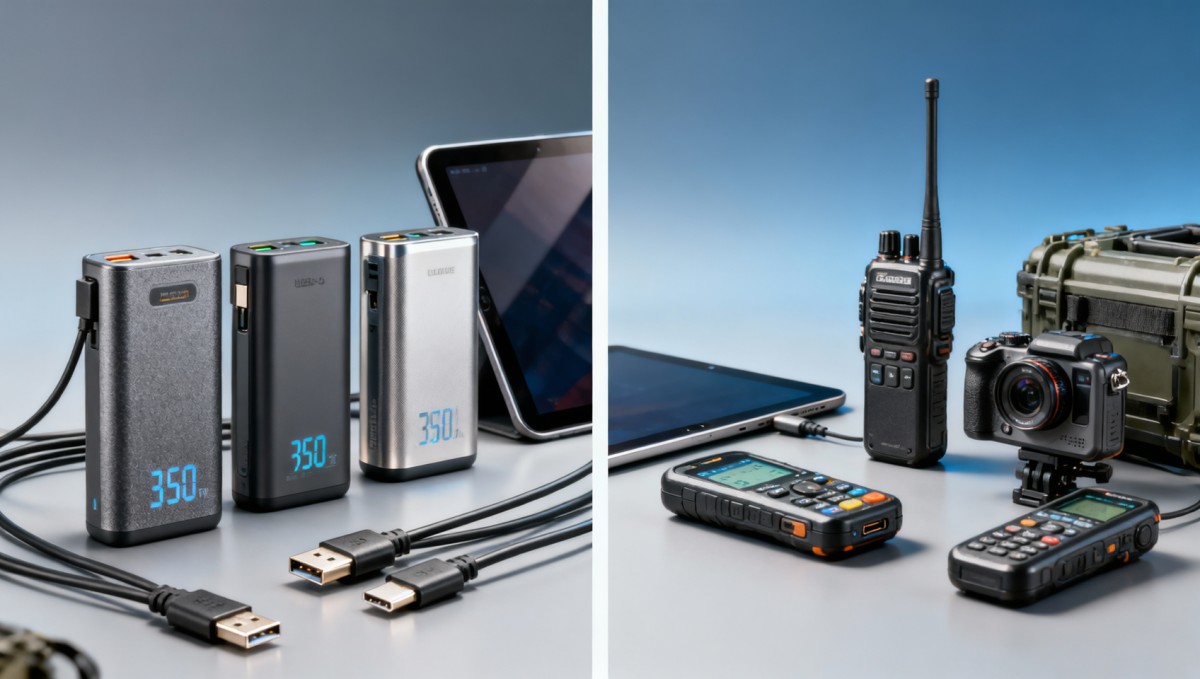
The first step is to define the device mix and the expected duty cycle. A field technician using one phone and one barcode scanner for 8 to 10 hours has very different needs from an inspection team running tablets, action cameras, and a 30W to 65W USB-C laptop throughout a 12-hour shift. Without this baseline, power bank comparisons become misleading.
Battery capacity is commonly shown in mAh, but buyers should translate that figure into watt-hours where possible. A 20,000mAh unit at 3.7V typically provides around 74Wh before conversion losses. In real use, usable output can be 10% to 25% lower depending on cable resistance, conversion efficiency, and temperature. That means the practical recharge count for a 5,000mAh smartphone may be closer to 2.5 to 3 times, not 4 times.
Charging speed is just as important as capacity. Many field teams get only short windows to recharge between jobs, vehicle transfers, or shift changes. A power bank with 18W output may be acceptable for basic smartphones, but a 30W, 45W, or 65W model is often better for tablets and USB-C notebooks. For a buyer comparing options, the real question is not “How big is the battery?” but “How much usable energy can it deliver in 30, 60, and 120 minutes?”
Input speed also matters because field teams cannot wait overnight to refill battery packs. A 20,000mAh power bank with 18W input may need roughly 6 to 7 hours to recharge fully, while a similar-capacity model with 45W or higher input may finish in about 2.5 to 4 hours. For organizations rotating gear across crews, this difference affects asset utilization and backup inventory levels.
Key Electrical Metrics to Verify
Before comparing brands or price points, build a shortlist based on five core metrics: rated capacity, usable output, maximum single-port power, total combined output, and recharge input wattage. These values should be checked against the intended devices, not just the packaging claims.
- Rated capacity: commonly 10,000mAh, 20,000mAh, 24,000mAh, or 27,000mAh for field-ready models.
- Single-port output: typical tiers include 18W, 30W, 45W, 65W, and 100W.
- Total output: important when charging 2 to 4 devices at once.
- Input charging speed: 18W to 65W is common; faster input improves fleet turnaround.
- Protocol support: USB Power Delivery, Quick Charge, PPS, and legacy 5V modes should all be reviewed.
The table below helps translate specifications into common field work outcomes, especially for mixed-device operations where charging flexibility matters more than one headline number.
For most enterprise field deployments, the standard field tier is the practical starting point. It balances portability with enough power to support mixed devices and faster charging windows. Higher-capacity models make sense when crews are off-grid for more than 10 hours or when laptops are part of the kit.
Compare Fast Charging Standards, Ports, and Real-World Charging Behavior
Not all “fast charging” labels mean the same thing. A power bank can advertise 65W output, yet fail to charge a target device at full speed if the correct protocol is missing. For business buyers, compatibility should be tested at three levels: port type, charging protocol, and shared-output behavior when multiple devices are connected.
USB-C Power Delivery is now the baseline for most modern tablets, premium phones, and notebooks. PPS support is increasingly important for newer smartphones that adjust voltage more dynamically. Quick Charge remains relevant for older Android device fleets. If your operations include legacy handhelds, dash cameras 4k, battery-powered diagnostic tools, or small wireless charging pads, mixed-port support still has value.
Another common oversight is shared power allocation. A power bank may provide 65W from one USB-C port, but only 15W plus 15W plus 18W when three devices are connected. This matters for supervisors charging a phone, body camera, and tablet at once. Procurement teams should ask for single-port and multi-port output tables, not just the maximum number printed on the housing.
Real-world charging behavior also depends on cable rating. A 100W-capable power bank paired with a low-grade cable may fall back to 18W or 30W. In field deployments, cable losses, connector wear, and dust ingress can reduce charging reliability within 3 to 6 months if accessories are not standardized. That is why the power bank should be evaluated as part of a complete charging system, not as a standalone item.
Questions Technical Evaluators Should Ask
- Does each USB-C port support input and output, or only one direction?
- What is the sustained output after 15 to 20 minutes, not just the peak output?
- Will the unit maintain fast charging when 2 or 3 devices are connected?
- Does the vendor specify support for PD, PPS, QC, and low-current accessory charging?
- Are cables included, and if so, what wattage and durability rating do they support?
Port Mix by Use Case
A field service team may prefer dual USB-C plus one USB-A, while a distribution fleet may still need more USB-A support for older handheld devices. The right port mix reduces adapter dependence, lowers cable loss, and shortens charge management time across the fleet.
The table below compares common port configurations and where they fit best in enterprise mobility programs.
In many B2B environments, 2 x USB-C plus 1 x USB-A offers the best transition path. It supports current devices while protecting compatibility with existing assets. That reduces replacement pressure and helps distributors build broader accessory bundles around one power platform.
Assess Durability, Safety, and Environmental Suitability for Field Work
Field-ready power banks operate under more stress than office accessories. Drops from 1 to 1.5 meters, repeated cable insertion, vibration in vehicles, dust exposure, and charging in ambient temperatures above 35°C can all affect performance. Buyers should look beyond sleek consumer styling and focus on enclosure integrity, port reinforcement, and thermal stability.
Battery chemistry and internal protection design also deserve review. Over-current, over-voltage, short-circuit, and over-temperature protection are basic requirements, but implementation quality varies. For quality and safety managers, the practical question is whether the unit can sustain repeated fast charging cycles without excessive heat buildup or unstable output under load.
Ingress resistance may matter depending on the site. While not every field team needs a ruggedized battery pack, dust-prone warehouses, outdoor inspection work, utilities, and mobile maintenance teams often benefit from better casing seals and reinforced connectors. If devices are frequently used in rain, mud, or roadside service work, a protective carry case or integrated cover is often a low-cost risk control measure.
Weight is another trade-off. A 10,000mAh unit may weigh around 180 to 250 grams, while a 20,000mAh to 27,000mAh model can reach 350 to 650 grams. For walk-heavy teams, that difference affects carry comfort and compliance. For vehicle-based teams, the extra weight may be acceptable if it avoids downtime and unnecessary repeat visits.
Field Risk Checklist
- Repeated use at high ambient temperatures can reduce effective output and battery life.
- Loose or recessed ports may fail earlier in operations with daily cable changes.
- Glossy consumer-grade housings often show damage quickly and reduce perceived fleet quality.
- Unrated cables can become the weak point even when the power bank itself is reliable.
- Poor thermal control may trigger throttling during simultaneous charging of 2 or more devices.
Minimum Practical Review Standard
For enterprise buying, establish a minimum review protocol over 2 to 4 weeks. Test at least three use cases: single high-speed charging, dual-device charging, and repeated recharge cycles. Include charging inside vehicles, during travel, and under routine rough handling. A short controlled pilot often reveals more than a long specification sheet.
If the battery pack is part of a safety-sensitive workflow, such as field diagnostics or emergency roadside support, quality teams should also define acceptance criteria for heat, casing stability, and charging consistency after repeated use. This is especially important when the same sourcing channel also supplies jump starters or other high-discharge mobile power devices.
Build a Procurement Framework That Balances Cost, Performance, and Fleet Standardization
The lowest unit price rarely delivers the lowest total operating cost. If a cheaper power bank adds 30 to 45 minutes of downtime per worker each week, or fails after a short service period, the indirect cost can exceed the savings quickly. Procurement should score options across performance, compatibility, durability, replenishment speed, and support terms.
A structured buying matrix helps align technical teams, finance approvers, and operations managers. It also reduces subjective decisions based on marketing claims. In most enterprise programs, 5 to 7 weighted criteria are enough to compare vendors consistently across regions or business units.
Standardization matters when an organization manages dozens or hundreds of mobile workers. One power platform with common cables, labels, storage pouches, and charging procedures can reduce confusion, simplify replacement, and improve compliance. The same sourcing logic can extend to related accessories such as wireless charging pads for desks and vehicles, compact jump starters for fleet support, and dash cameras 4k for incident capture.
For distributors and resellers, this is also a margin opportunity. Bundled field kits often perform better than single-item quotes because buyers value compatibility and deployment readiness. Instead of selling only a battery pack, suppliers can propose a use-case bundle with cables, protective storage, power adapters, and selected mobile electronics matched to the customer’s fleet profile.
Sample B2B Evaluation Matrix
The following framework can be adapted for tenders, distributor line reviews, or internal fleet upgrades. Weighting can vary by project, but most teams should give the highest scores to usable output, charging compatibility, and operational durability.
This kind of matrix often reveals that a mid-priced unit creates the best value over a 12- to 24-month fleet cycle. It may not be the cheapest upfront, but it can reduce replacements, simplify training, and support a wider mix of field devices without workarounds.
Common Mistakes, Deployment Tips, and Related Accessory Strategy
One of the most common mistakes is buying based on one use case while the field team actually operates across several. A battery pack selected for phones only may fail when teams later add tablets, thermal printers, dash cameras 4k, or USB-C laptops. That usually leads to mixed inventory, charging confusion, and avoidable emergency purchases.
Another mistake is ignoring recharge logistics. If crews return to base with depleted power banks and there are not enough high-wattage chargers or charging stations, the organization creates a bottleneck. In practice, deployment plans should cover not just the number of power banks, but also the ratio of chargers, spare cables, storage labels, and replacement units. A sensible starting point is a 1.1 to 1.3 backup ratio for critical teams.
Accessory strategy should also be considered early. Wireless charging pads may support in-vehicle or desk transitions, but they are usually less efficient than wired charging for field-critical replenishment. Jump starters belong in fleet or roadside kits, not general personal issue kits. Dash cameras 4k add value for logistics, service fleets, and mobile compliance programs, but they should be assessed separately for power draw, storage requirements, and mounting conditions.
For implementation, pilot the selected fast charging power banks with a small group first, ideally 5 to 20 users across different roles. Measure three practical outcomes: recharge time, number of completed shifts without power interruption, and user-reported convenience. This creates a clearer business case for finance and gives procurement a stronger basis for contract negotiation.
FAQ for Buyers and Technical Teams
How much capacity is enough for field work?
For basic smartphone-led work, 10,000mAh to 15,000mAh may be enough for a single shift. For mixed devices or longer routes, 20,000mAh is a stronger baseline. If the user carries a USB-C laptop or power-hungry tablet, 24,000mAh to 27,000mAh with 65W output is usually more practical.
Is higher wattage always better?
Not always. Higher wattage helps when devices can accept it, but compatibility and thermal control matter just as much. A stable 45W unit that matches your devices may deliver better field performance than a nominal 100W unit with poor shared-output behavior or weak cables.
What should quality or safety teams verify first?
Start with thermal behavior during fast charging, casing durability, connector retention, and protective circuit stability. Then review user conditions: vehicle charging, outdoor use, daily drop risk, and storage temperature. A 2- to 4-week operational pilot is often the most efficient validation step.
How should distributors position these products?
Focus on solution bundles rather than isolated specifications. Buyers respond well to clear application mapping: field service kit, delivery driver kit, inspection kit, or mobile sales kit. Pair fast charging power banks with rated cables, adapters, storage accessories, and where relevant, wireless charging pads or fleet-use electronics.
Choosing fast charging power banks for field work is ultimately about fit, not just maximum numbers. The best option matches the device mix, supports the required charging standards, withstands daily operating conditions, and integrates cleanly into procurement, maintenance, and replenishment workflows. Buyers who compare usable energy, output behavior, port compatibility, and deployment logistics will make more resilient decisions than those relying on capacity claims alone.
If your team is evaluating mobile power solutions, accessory bundles, or broader field electronics sourcing opportunities, now is the right time to build a category-based comparison framework. Contact TradeNexus Pro to explore tailored sourcing insights, compare product strategies across suppliers, and get a more practical view of what works in real field operations.
Get weekly intelligence in your inbox.
No noise. No sponsored content. Pure intelligence.
 Apr 28, 2026Suez Canal Fee Hike & China-Europe Rail Premium: Q2 2026 ImpactSuez Canal Fee Hike & China-Europe Rail Premium: Q2 2026 Impact
 Apr 28, 2026TÜV Rheinland Launches Fast-Track Certification for Chinese Warehouse RobotsTÜV Rheinland Launches Fast-Track Certification for Chinese Warehouse Robots
 Apr 28, 2026EU Enforces Battery Passport Rule for Chinese ESS Exports from 2027EU Enforces Battery Passport Rule for Chinese ESS Exports from 2027
 Apr 28, 2026ADB Raises Vietnam GDP Forecast to 7.2%: SMT & Precision Fixture Demand RisesADB Raises Vietnam GDP Forecast to 7.2%: SMT & Precision Fixture Demand Rises
 Apr 28, 2026US ITC Launches Section 337 Investigation into Chinese Wi-Fi 7 RF FEMsUS ITC Launches Section 337 Investigation into Chinese Wi-Fi 7 RF FEMs
 Apr 28, 2026Côte d'Ivoire Opens $500M Power Tender: Chinese BESS Get Fast-Track AccessCôte d'Ivoire Opens $500M Power Tender: Chinese BESS Get Fast-Track Access
 Apr 28, 2026BP’s Algeria East Basin Permit Spurs Valve Demand, Lead Times Extend to 18 WeeksBP’s Algeria East Basin Permit Spurs Valve Demand, Lead Times Extend to 18 Weeks
") Apr 28, 2026Vietnam Mandates V-Trust for Smart Appliances Export (July 2026)Vietnam Mandates V-Trust for Smart Appliances Export (July 2026)
Apr 28, 2026Vietnam Mandates V-Trust for Smart Appliances Export (July 2026)Vietnam Mandates V-Trust for Smart Appliances Export (July 2026) Apr 28, 2026Morocco Enforces PV Mounting Structure Certification from Q3 2026Morocco Enforces PV Mounting Structure Certification from Q3 2026
 Apr 28, 2026UAE Establishes AI Hub Status, Opens CE-ADAS+ Pathway for Chinese Smart Industrial EquipmentUAE Establishes AI Hub Status, Opens CE-ADAS+ Pathway for Chinese Smart Industrial Equipment
 Apr 27, 2026Algeria’s Oil & Steel FDI Push Opens Valve, Corrosion-Resistant Material OrdersAlgeria’s Oil & Steel FDI Push Opens Valve, Corrosion-Resistant Material Orders
 Apr 27, 2026Azerbaijan’s New PV Mounting Standard Opens Path for Chinese SuppliersAzerbaijan’s New PV Mounting Standard Opens Path for Chinese Suppliers
 Apr 27, 2026Fitch Cuts East Africa Growth Forecasts, Raises Cross-Border Trade RisksFitch Cuts East Africa Growth Forecasts, Raises Cross-Border Trade Risks
 Apr 27, 2026ADB Raises Vietnam GDP Forecast to 7.2% on Electronics Export GrowthADB Raises Vietnam GDP Forecast to 7.2% on Electronics Export Growth
 Apr 27, 2026Maine Halts Large Data Centers: AI Server Export ImpactMaine Halts Large Data Centers: AI Server Export Impact
 Apr 27, 2026OFID $500M for Côte d'Ivoire: Boost to Factory Automation & Warehouse RoboticsOFID $500M for Côte d'Ivoire: Boost to Factory Automation & Warehouse Robotics
 Apr 27, 2026Morocco Ranks 4th in EU Energy Aid to AfricaMorocco Ranks 4th in EU Energy Aid to Africa
 Apr 27, 2026UAE Emerges as Global AI Hub, Opening Fast-Track for Chinese Smart DevicesUAE Emerges as Global AI Hub, Opening Fast-Track for Chinese Smart Devices
") Apr 26, 2026China Releases Green Design Guidelines for Industrial Products (2026)China Releases Green Design Guidelines for Industrial Products (2026)
Apr 26, 2026China Releases Green Design Guidelines for Industrial Products (2026)China Releases Green Design Guidelines for Industrial Products (2026) Apr 26, 2026ANATEL Mandates Portuguese Offline Voice Assistant for Smart Home Devices in BrazilANATEL Mandates Portuguese Offline Voice Assistant for Smart Home Devices in Brazil
 Apr 26, 2026Vietnam Enforces Bilingual Safety Labels for Electronic Components from Apr 22, 2026Vietnam Enforces Bilingual Safety Labels for Electronic Components from Apr 22, 2026
 Apr 26, 2026Japan Updates JIS for Rehab Devices: IEC 62366-1:2024 RequiredJapan Updates JIS for Rehab Devices: IEC 62366-1:2024 Required
 Apr 26, 2026THE Alliance Cuts Ningbo–Rotterdam Transit to 18 Days, Spot Rates Up 35%THE Alliance Cuts Ningbo–Rotterdam Transit to 18 Days, Spot Rates Up 35%
 Apr 26, 2026India BIS Mandates PLC & HMI Certification under IS 13252:2025 by Oct 2026India BIS Mandates PLC & HMI Certification under IS 13252:2025 by Oct 2026
") Apr 26, 2026SASO Enforces New EV Charger Rules in Saudi Arabia (2026)SASO Enforces New EV Charger Rules in Saudi Arabia (2026)
Apr 26, 2026SASO Enforces New EV Charger Rules in Saudi Arabia (2026)SASO Enforces New EV Charger Rules in Saudi Arabia (2026) Apr 26, 2026TÜV Rheinland Updates IoT EMC Guidelines: AI Edge Modules Now Mandatory for Immunity TestingTÜV Rheinland Updates IoT EMC Guidelines: AI Edge Modules Now Mandatory for Immunity Testing
 Apr 26, 2026USTR Launches First Annual Review of China Solar PV AD/CVD OrdersUSTR Launches First Annual Review of China Solar PV AD/CVD Orders