What affects the lifespan of hospital furniture most?
The lifespan of hospital furniture depends on more than daily use. For after-sales maintenance teams, factors such as material quality, cleaning methods, load stress, repair response time, and compliance with healthcare standards all play a critical role. Understanding what shortens or extends the service life of hospital furniture helps reduce replacement costs, improve safety, and support more reliable facility operations.
Why lifespan varies so much across hospital environments
For maintenance professionals, the most important truth about hospital furniture is that service life is not determined by age alone. A bedside cabinet in a low-turnover recovery ward may stay functional for years, while a treatment trolley in an emergency department can degrade quickly even when it is relatively new. The difference comes from application context: traffic intensity, disinfection frequency, exposure to fluids, user behavior, movement between rooms, and the speed of preventive maintenance.
This is why after-sales support cannot rely on generic replacement schedules. Hospital furniture must be evaluated by use case. A chair, overbed table, stretcher-side cabinet, nurse station workstation, or medication cart may all belong to the same product family, but the real lifespan driver is the environment in which the unit operates. For maintenance teams, a scenario-based approach helps prioritize inspections, spare parts planning, and repair response more effectively.
In practical terms, what affects the lifespan of hospital furniture most is usually the interaction between product design and operational conditions. Strong materials can still fail under poor cleaning chemistry. Heavy-duty frames can still bend when loads are applied unevenly. High-end casters can still wear out if debris is not removed. The best maintenance decisions therefore come from linking each furniture type to the real stresses it experiences.
The main factors that affect hospital furniture lifespan
Across most healthcare settings, five factors repeatedly determine how long hospital furniture will last. First is material quality. Stainless steel, powder-coated steel, solid polymer surfaces, antimicrobial laminates, and medical-grade plastics all perform differently under heat, impact, and disinfectant exposure. Second is cleaning protocol. Frequent use of aggressive chemicals can discolor surfaces, weaken coatings, dry out seals, and corrode fasteners if products are not compatible.
Third is load stress. Furniture often fails not because of rated capacity, but because of misuse: staff sitting on overbed tables, equipment being stacked on carts, or drawers being overloaded beyond design intent. Fourth is repair response time. Small issues such as loose hinges, damaged caster bearings, cracked edge banding, or unstable legs become major failures when not corrected early. Fifth is compliance and design fit. Hospital furniture that is not aligned with infection control, ergonomics, or patient safety standards often experiences indirect lifespan loss because staff work around the design, creating abnormal wear points.
For after-sales teams, these five factors are useful because they are measurable. They can be translated into maintenance checklists, service intervals, training notes, and procurement feedback. Instead of asking only whether furniture is damaged, the better question is which stress source is consuming its lifespan the fastest.
Scenario comparison: where hospital furniture wears out fastest
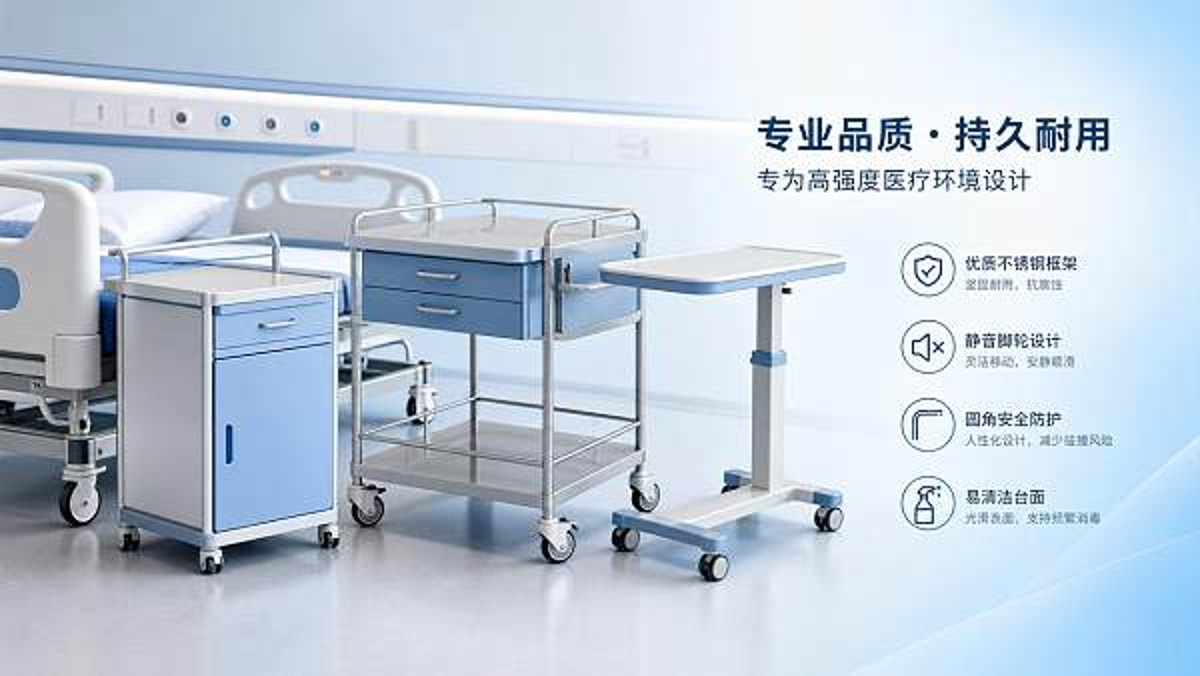
Not all departments create the same maintenance burden. The table below helps after-sales maintenance personnel compare how different use scenarios influence hospital furniture durability and what should be inspected first.
Application scenario 1: emergency and high-turnover care areas
In emergency rooms, urgent care units, and fast-paced intake zones, the biggest threat to hospital furniture lifespan is kinetic stress. Furniture is moved quickly, repositioned often, and used by multiple staff members under time pressure. In these settings, the parts that fail first are rarely the primary frame. Instead, accessories and movement components break down sooner: caster housings crack, brake pedals loosen, drawer tracks deform, and side handles become unstable.
For after-sales maintenance teams, these areas need short inspection cycles. Mobility-related furniture should be checked for wheel resistance, axle wear, swivel lock function, and fastener tightness. Rounded corners, reinforced bumper protection, and impact-resistant polymer trims generally extend service life here more than cosmetic finishes do. If replacement planning is needed, maintenance staff should favor hospital furniture built for transport-heavy environments rather than standard inpatient models.
Another common problem in these high-turnover settings is overload misuse. Equipment, documents, supplies, and even staff body weight are often placed on furniture not designed for those loads. That means lifespan is strongly influenced by user training and signage. Clear load labels and quick staff reminders can prevent structural fatigue more effectively than repeated reactive repairs.
Application scenario 2: ICU and infection-sensitive environments
In intensive care units and isolation-support areas, what affects the lifespan of hospital furniture most is usually chemical exposure combined with strict sanitation routines. These spaces demand repeated cleaning with disinfectants, sometimes several times per day. If the furniture materials are not designed for that chemical profile, the service life drops quickly. Coatings may blister, metal surfaces may pit, and seams may open, creating both maintenance and hygiene concerns.
For this scenario, maintenance teams should focus less on visible dirt and more on material compatibility records. A polished-looking surface may still be degrading microscopically. Signs such as fading, whitening, sticky finishes, rust spots around welds, swelling edges, or micro-cracks near handles indicate that cleaning chemistry is attacking the substrate. In many hospitals, switching to approved dilution ratios and microfiber methods adds more lifespan than replacing the furniture itself.
The best fit for these areas is hospital furniture with sealed edges, smooth transitions, corrosion-resistant joints, and low-crevice designs. For after-sales personnel, documenting which products withstand the local disinfection regime can also support future procurement decisions and reduce lifecycle cost across departments.
Application scenario 3: general wards and patient rooms
General wards create a different wear pattern. Here, hospital furniture usually experiences moderate but continuous use from patients, visitors, nurses, and cleaning teams. The lifespan challenge is less about acute impact and more about cumulative minor damage. Bedside lockers may suffer from spilled liquids, overbed tables may be used for eating and support, and visitor chairs may be dragged repeatedly across flooring.
For this environment, maintenance teams should pay attention to edge sealing, door alignment, tabletop warping, and joint looseness. These are the issues that slowly reduce safe usability. General wards also expose an important truth: hospital furniture lifespan depends heavily on early intervention. A loose hinge that is ignored can tear out the panel. A damaged caster can tilt a table, causing stress on the entire frame. A cracked laminate edge can absorb moisture and expand.
Preventive rounds are especially effective in this scenario because damage develops predictably. Monthly checks, simple torque verification, fast replacement of consumable parts, and quick cleaning protocol reviews can keep furniture in service far longer without major capital replacement.
Application scenario 4: outpatient, waiting, and public-facing spaces
Outpatient clinics, waiting areas, registration counters, and consultation rooms place more emphasis on public contact and repeated seating cycles. In these scenarios, what affects the lifespan of hospital furniture most is user diversity. Children, elderly patients, bariatric users, and visitors with bags or mobility aids all interact with furniture differently. The result is uneven load distribution, abrasion, upholstery strain, and loosened arm supports.
Maintenance teams should not evaluate these areas only by visual cleanliness. A chair can look acceptable while becoming structurally unsafe. Welds, fasteners, anti-slip feet, seat pans, and arm joints deserve regular attention. Materials also matter greatly. Easy-clean vinyl may support infection control, but if it cracks under repeated flexing, actual lifespan may be shorter than expected. In high-traffic reception areas, robust frame design often matters more than soft-finish aesthetics.
This is also where procurement feedback becomes important. If one chair model repeatedly fails in registration zones but performs well in low-use consultation rooms, the issue is not necessarily poor manufacturing. It may be a scenario mismatch. Correct furniture deployment by use intensity can increase lifespan without increasing total inventory cost.
How maintenance teams should judge scenario fit before failure happens
A practical after-sales framework is to assess hospital furniture through three filters: environment, behavior, and response. Environment includes moisture, chemicals, impact risk, and floor conditions. Behavior includes dragging, overloading, misuse, and user turnover. Response includes how quickly faults are reported, whether spare parts are available, and whether preventive service is documented. Furniture lasts longer when all three are controlled.
If maintenance teams want a simple decision method, they should ask: Is this furniture exposed to aggressive cleaning? Does it move often? Does it support variable body loads? Does staff behavior match design intent? Are minor failures repaired within days rather than weeks? Each “yes” changes the expected lifespan and should influence maintenance frequency.
Common misjudgments that shorten hospital furniture life
One common mistake is assuming all visible damage is caused by poor product quality. In many cases, the real cause is mismatch between product specification and application scenario. Another misjudgment is treating cleaning as always beneficial. Proper cleaning extends lifespan, but incompatible chemicals can destroy finishes and seals over time. A third error is delaying minor repairs because furniture still appears usable. In healthcare settings, “still usable” can quickly become unsafe or noncompliant.
Maintenance teams also sometimes focus too heavily on large items while ignoring small replaceable components. Yet drawer runners, caster stems, handles, bumpers, and hinges often determine the functional lifespan of hospital furniture. Replacing these low-cost parts early can protect the entire unit and delay replacement budgets significantly.
FAQ for after-sales maintenance teams
Does heavier hospital furniture always last longer?
Not necessarily. Heavier units may have stronger frames, but if surfaces, casters, or hardware are not matched to the care setting, lifespan can still be short. Application fit matters more than weight alone.
What is the first sign that hospital furniture lifespan is being reduced?
Usually it is a functional sign before a structural one: sticking drawers, wobble, uneven rolling, loose arms, swelling edges, or finish breakdown near touchpoints. These should trigger early service.
Which matters more: cleaning frequency or repair speed?
Both are critical, but in many hospitals, delayed repair creates the fastest hidden deterioration. A small unresolved fault often multiplies stress on surrounding parts and shortens total service life.
Final takeaway: match the maintenance strategy to the real care scenario
What affects the lifespan of hospital furniture most is rarely one isolated factor. It is the combination of material choice, cleaning chemistry, movement intensity, load behavior, and maintenance response within a specific healthcare scenario. For after-sales maintenance personnel, the smartest approach is not to treat all hospital furniture the same. Instead, group assets by department conditions, identify the dominant wear pattern in each area, and build service routines around actual risk.
For organizations that want longer-lasting hospital furniture, fewer emergency repairs, and better lifecycle value, the next step is clear: review furniture performance by scenario, document recurring failure points, and align future replacement or sourcing decisions with real usage patterns. This scenario-based method supports safer care spaces and more efficient facility operations—exactly the outcome that modern healthcare environments need.
Get weekly intelligence in your inbox.
No noise. No sponsored content. Pure intelligence.
 May 05, 2026Inventory management systems that fix stock errors at the sourceInventory management systems that fix stock errors at the source
 May 05, 2026Medical disposables sourcing gets risky when prices drop too fastMedical disposables sourcing gets risky when prices drop too fast
 May 05, 2026Supply Chain Management gaps that create hidden inventory costsSupply Chain Management gaps that create hidden inventory costs
 May 05, 2026Why ERP software rollouts fail even with strong vendor supportWhy ERP software rollouts fail even with strong vendor support
 May 05, 2026Patient monitors: which features actually improve bedside responsePatient monitors: which features actually improve bedside response
 May 05, 2026Medical PPE shortages are easing, but quality gaps remainMedical PPE shortages are easing, but quality gaps remain
 May 05, 2026Portable oxygen concentrators: what matters beyond battery lifePortable oxygen concentrators: what matters beyond battery life
 May 05, 2026Medical diagnostic equipment buying mistakes that cost more laterMedical diagnostic equipment buying mistakes that cost more later
 May 05, 2026Cold chain logistics failures often start before transitCold chain logistics failures often start before transit
 May 05, 2026Hydrogen energy projects face one cost issue few plan forHydrogen energy projects face one cost issue few plan for
 May 05, 2026Digital Footprint risks that grow when suppliers scale fastDigital Footprint risks that grow when suppliers scale fast
 May 05, 2026Cross border ecommerce fulfillment problems that hurt repeat salesCross border ecommerce fulfillment problems that hurt repeat sales
 May 05, 2026N95 respirators: why fit matters more than many expectN95 respirators: why fit matters more than many expect
 May 05, 2026Ultrasound machines: when image quality and workflow clashUltrasound machines: when image quality and workflow clash
 May 05, 2026LED displays for retail spaces: brightness is not the only issueLED displays for retail spaces: brightness is not the only issue
 May 05, 2026What to check before placing wheelchairs wholesale ordersWhat to check before placing wheelchairs wholesale orders
 May 05, 2026Freight forwarding services that help avoid customs delaysFreight forwarding services that help avoid customs delays
 May 05, 2026Aesthetic lasers: the difference between power and precisionAesthetic lasers: the difference between power and precision
 May 05, 2026How rehabilitation equipment choices affect recovery routinesHow rehabilitation equipment choices affect recovery routines
 May 05, 2026Robot vacuum cleaners with mapping: what changes in daily useRobot vacuum cleaners with mapping: what changes in daily use
 May 05, 2026Where logistics drones make sense and where they still do notWhere logistics drones make sense and where they still do not
 May 05, 2026B2B SaaS solutions that reduce manual trade workflowsB2B SaaS solutions that reduce manual trade workflows
 May 05, 2026What makes 3PL logistics performance hard to measure fairlyWhat makes 3PL logistics performance hard to measure fairly
 May 05, 2026Shipping rates are shifting again: what costs are easy to missShipping rates are shifting again: what costs are easy to miss
 May 05, 2026Trade Leaders in 2026: what will separate winners from the restTrade Leaders in 2026: what will separate winners from the rest
 May 05, 2026Why smart warehousing projects stall after the pilot stageWhy smart warehousing projects stall after the pilot stage
 May 05, 2026AGV robots or forklifts: which fits busy warehouses better?AGV robots or forklifts: which fits busy warehouses better?