Intel Mass-Produces World’s Thinnest GaN Chip (19μm)
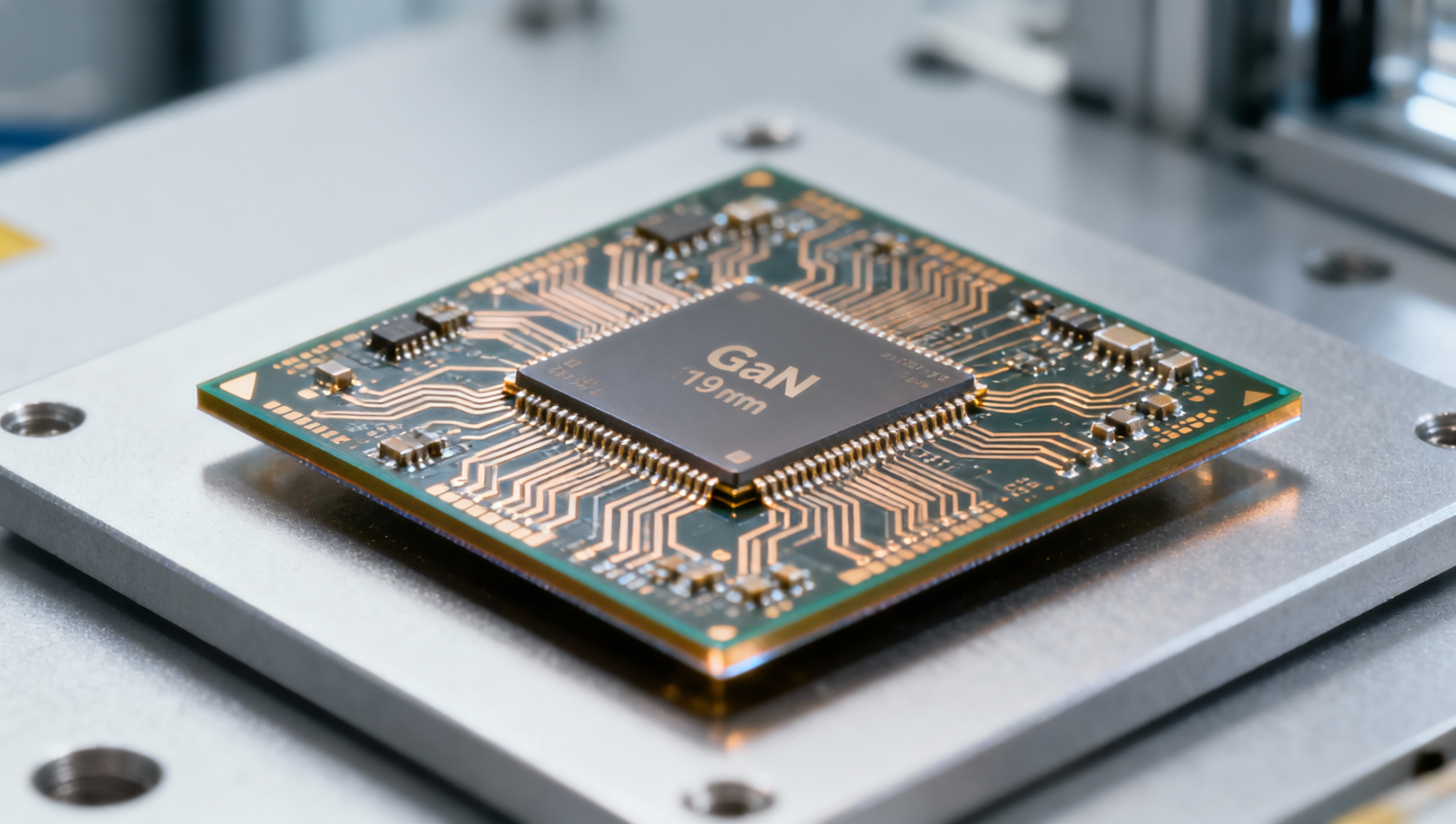
On April 14, 2026, Intel announced mass production of a 19μm-thin gallium nitride (GaN) chip fabricated on 300mm wafers — the thinnest GaN chip globally to enter volume manufacturing. The integration of GaN power transistors with silicon-based digital logic on a single die marks a milestone for high-power IC applications. This development is particularly relevant for power management ICs, fast-charging modules, and onboard chargers (OBCs) in electric vehicles — sectors where efficiency, thermal density, and form factor are critical.
Event Overview
On April 14, 2026, Intel confirmed the commencement of volume production of its ultra-thin GaN chip, achieving a thickness of 19μm using 300mm GaN-on-silicon wafers. The chip features monolithic integration of GaN power transistors and silicon-based digital control logic. Chinese IDMs including Suzhou Novosense and Shenzhen Injoinic have initiated certification of GaN-compatible packaging lines, with small-batch trial production for overseas customers expected to begin in June 2026.
Impact on Specific Industry Segments
Power IC Design Firms
These firms may face accelerated design cycle pressure as monolithic GaN–Si integration enables new system-level architectures. Impact manifests in revised thermal modeling requirements, updated gate-driver co-design protocols, and tighter timing constraints between analog power stages and digital control blocks.
Power Module & Charger Manufacturers
Manufacturers of fast-charging adapters and EV onboard chargers will encounter shifting component qualification timelines. The 19μm chip’s thinness improves thermal interface performance but demands revalidation of mechanical mounting, underfill dispensing, and board-level stress simulation — especially for automotive-grade OBCs operating under wide temperature ranges.
GaN Packaging & Assembly Service Providers
Chinese IDM foundries such as Novosense and Injoinic are actively certifying GaN-compatible packaging processes. Impact centers on process adjustments: thinner die handling requires upgraded pick-and-place accuracy, modified backgrinding parameters, and enhanced warpage control during molding. Certification progress directly affects lead times for pilot builds starting in June.
Supply Chain & Logistics Operators
Logistics providers supporting high-value GaN IC shipments must adapt to new handling specifications — notably stricter humidity sensitivity level (HSL) classification and vibration tolerance thresholds due to extreme die thinness. Current air freight and warehousing SOPs may require revision ahead of June trial runs.
What Relevant Companies or Practitioners Should Monitor and Act On
Track formal packaging certification status from named IDMs
Novosense and Injoinic have not published public timelines for full qualification completion. Companies planning June trial orders should confirm internal certification milestones — e.g., reliability test reports (HTOL, TC, UHAST), mold compound compatibility data, and wafer-level probe yield — rather than relying solely on announcement dates.
Validate thermal and mechanical interface specs before design freeze
The 19μm thickness enables better heat spreading but increases susceptibility to die cracking during board assembly. Practitioners should request Intel’s latest mechanical stress guidelines and conduct early-stage board-level drop and thermal cycling tests — especially if targeting automotive or industrial applications.
Distinguish between pilot availability and scalable capacity
June 2026 marks the start of small-batch trial production, not volume ramp. Firms should avoid assuming immediate capacity allocation; instead, prioritize securing slot reservations and clarifying first-shipment logistics terms (e.g., shipping conditions, traceability requirements) during initial engagement.
Align procurement planning with known wafer cycle times
300mm GaN-on-Si processes involve longer fab cycles than traditional Si power devices. Procurement teams should map Intel’s stated wafer start-to-finish timeline and buffer inventory plans accordingly — especially for designs requiring dual-sourcing or cross-platform validation.
Editorial Perspective / Industry Observation
From an industry perspective, this announcement is best understood as a capability signal rather than an immediate supply shift. Intel’s achievement confirms technical feasibility of monolithic GaN–Si integration at 19μm thickness on 300mm platforms — a prerequisite for future cost scaling. However, observed adoption remains limited to select pilot programs through mid-2026. Widespread substitution of discrete GaN FETs + controller ICs will depend less on device specs alone and more on ecosystem readiness: packaging yield, test infrastructure maturity, and design tool support. Current activity among Chinese IDMs suggests growing regional capacity intent — but certification outcomes remain pending verification.
Analysis来看, the timing aligns with upcoming EU and US energy-efficiency mandates for AC-DC power supplies (e.g., DoE Level VI, CoC Tier 2), where GaN-based solutions offer measurable compliance advantages. Yet actual regulatory impact hinges on certified product availability — not just chip fabrication capability.
Current more appropriate interpretation is that this represents a foundational enabler, not a near-term replacement wave. Industry attention should focus on qualification progress — not just announcement headlines.
Conclusion
This milestone reflects advancement in GaN integration technology and signals growing readiness across the high-power IC supply chain — particularly in packaging and system-level validation. However, it does not indicate immediate broad-market availability or architectural displacement. For now, it is most accurately viewed as a targeted capability expansion, with practical impact contingent on verified packaging readiness and customer-specific qualification outcomes.
Information Sources
Main source: Intel official announcement dated April 14, 2026. Additional details sourced from public statements by Suzhou Novosense and Shenzhen Injoinic regarding GaN packaging line certification timelines. Ongoing verification of certification completion status and June 2026 trial production scope remains pending.
Get weekly intelligence in your inbox.
No noise. No sponsored content. Pure intelligence.
 Apr 16, 2026Guangzhou Yangsen Pharma’s Sensitive-Skin Patents Shift ODM LandscapeGuangzhou Yangsen Pharma’s Sensitive-Skin Patents Shift ODM Landscape
 Apr 16, 2026Xinjiang Huayu Textile Full Production of Medical-Grade NonwovensXinjiang Huayu Textile Full Production of Medical-Grade Nonwovens
 Apr 16, 2026Linklog AI Audit Case in China Supply Chain Finance YearbookLinklog AI Audit Case in China Supply Chain Finance Yearbook
 Apr 16, 2026Wuhan China-Europe Express Launches PV-Dedicated Train to EUWuhan China-Europe Express Launches PV-Dedicated Train to EU
 Apr 16, 2026Gaode Unveils First Quadruped Robot, Boosting China's Warehouse Robotics ExportsGaode Unveils First Quadruped Robot, Boosting China's Warehouse Robotics Exports
 Apr 16, 2026Polysilicon Price Falls Below $4,000/ton: PV Module Export Window ReopensPolysilicon Price Falls Below $4,000/ton: PV Module Export Window Reopens
 Apr 16, 2026Zanglong Island Semiconductor Park Land Acquisition Starts in WuhanZanglong Island Semiconductor Park Land Acquisition Starts in Wuhan
") Apr 16, 2026Intel Mass-Produces World’s Thinnest GaN Chip (19μm)Intel Mass-Produces World’s Thinnest GaN Chip (19μm)
Apr 16, 2026Intel Mass-Produces World’s Thinnest GaN Chip (19μm)Intel Mass-Produces World’s Thinnest GaN Chip (19μm) Apr 16, 2026Lithium Carbonate Prices Rebound, Export Cost Pressure ReturnsLithium Carbonate Prices Rebound, Export Cost Pressure Returns
 Apr 16, 2026EU CBAM Enters Enforcement Phase on April 1, 2026EU CBAM Enters Enforcement Phase on April 1, 2026
 Apr 16, 2026Smart Rings Are Getting Better, but Where Do They Still Fall Short?Smart Rings Are Getting Better, but Where Do They Still Fall Short?
 Apr 16, 2026Rapid Prototyping or CNC Machining: Which Fits Low-Volume Parts?Rapid Prototyping or CNC Machining: Which Fits Low-Volume Parts?
 Apr 16, 2026Solar Panel Efficiency Drops: Dirt, Heat, or Installation Error?Solar Panel Efficiency Drops: Dirt, Heat, or Installation Error?
 Apr 16, 2026Why Some EV Charging Stations Cost More to Operate Than ExpectedWhy Some EV Charging Stations Cost More to Operate Than Expected
 Apr 16, 2026What Makes a Bluetooth Speaker Sound Good Outdoors?What Makes a Bluetooth Speaker Sound Good Outdoors?
 Apr 16, 2026Metal stamping parts look simple until tooling wear starts to showMetal stamping parts look simple until tooling wear starts to show
 Apr 16, 2026Precision casting vs machining for complex parts with tight specsPrecision casting vs machining for complex parts with tight specs
 Apr 16, 2026Plastic extrusion problems that usually appear after shipmentPlastic extrusion problems that usually appear after shipment
 Apr 16, 2026Urethane casting is ideal for prototypes, until tolerance becomes criticalUrethane casting is ideal for prototypes, until tolerance becomes critical
 Apr 16, 2026Rapid tooling works fast, but what gets sacrificed first?Rapid tooling works fast, but what gets sacrificed first?
 Apr 16, 2026Low volume manufacturing sounds flexible, but where do delays start?Low volume manufacturing sounds flexible, but where do delays start?
 Apr 16, 2026Why surface finishing services change part quality more than expectedWhy surface finishing services change part quality more than expected
 Apr 16, 2026Anodizing services or paint? Where the cost gap really showsAnodizing services or paint? Where the cost gap really shows
 Apr 16, 2026Powder coating defects that often trace back to pretreatmentPowder coating defects that often trace back to pretreatment
 Apr 16, 2026When digital twin manufacturing pays off on the factory floorWhen digital twin manufacturing pays off on the factory floor
 Apr 16, 2026Wire EDM services make sense when tight corners really matterWire EDM services make sense when tight corners really matter
 Apr 16, 2026Gear manufacturing tolerances that affect noise and service lifeGear manufacturing tolerances that affect noise and service life